What are the advantages of pulmonary delivery?
- Avoid first pass metabolism
- Rapid onset of action (inhalation faster than injection)
- Reduced dose and side-effects
- Convenience
- Metered dose – improved patient compliance
- Closed delivery system: stability & security
- Potential to target and control delivery
What are the disadvantages/problems with pulmonary delivery?
- Expensive
- Disposal
- Propellant toxicity
- Irritation
- Poor technique
- Lung disease
What are the features of lungs?
- Large surface area ≈100 m2
- Extensive blood supply
- Ciliated mucous covered cells
Alveoli have large surface area and thin epithelia: attractive as primary absorption site for systemic administration. With that in mind, what are some physiological barriers to drug delivery?
- Absorption - requires dissolution in lung fluid and penetration of thin layers of mucus and surfactant on epithelium
- Pulmonary metabolism – enzymes present but lung metabolic capacity much lower than liver
- Mucociliary clearance and cough – ciliated cells and mucus in upper respiratory tract remove foreign particles. Cough facilitates expulsion of particles. > 6 µm with poor solubility
- Phagocytosis: alveolar macrophages (immune cells) phagocytose particles deposited in the alveoli. 1.5 – 3 µm with poor solubility
What are examples of drugs used in the pulmonary route of administration for the following;
A) Anaesthesia
B) Asthma and COPD
C) Cystic fibrosis
D) Pulmonary infections
A)
- Isoflurane, sevoflurane, desflurane
B)
- B2-adrenergic agonists, corticosteroids, mast cell stabilisers
C)
- Acetylcysteine
- Recombinant human deoxyribonuclease 1: Dornase alfa
- Both mucolytic agents
D)
- Zanamivir for influenza
- Potential for delivery of macromolecules: vaccines and proteins*
What are some of the factors that influence drug deposition into the lung?
- Physicochemical aerosol characteristics – particle size/diameter (Daer), size/diameter variability (polydispersity), charge, surface properties, extent of aggregation
- Ventilatory parameters – inter-subject variability, disease-induced changes
- Respiratory tract anatomy/physiology
Aerodynamic diameter (Daer): diameter equivalent to one of a sphere of unit density that has the same terminal settling velocity as the particle (droplet) of interest
Define what the following forces affecting lung deposition are:
A) Inertial impaction
B) Sedimentation
C) Brownian diffusion
D) Interception
A)
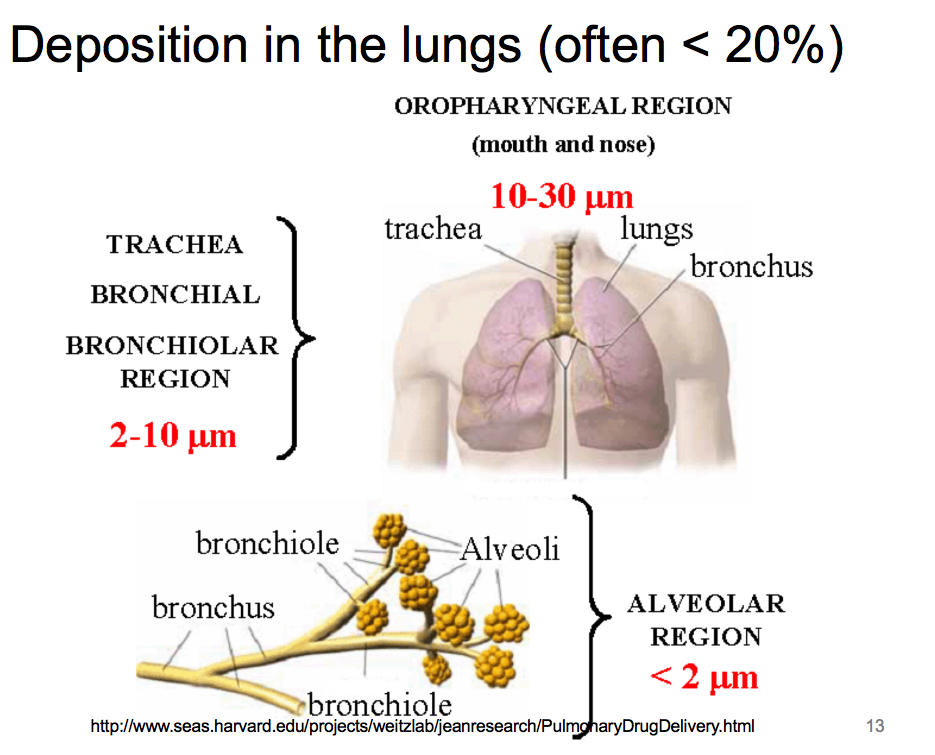
- particles (droplets) with Daer >5 μm; deposited in extra-thoracic regions due to tendency to move in a straight direction instead of following the air stream
B)
- Particles (droplets) with Daer 0.5 to 5 μm; by gravity.
- When Daer 1 to 3 μm, maximum alveolar deposition is achieved.
C)
- Ultrafine particles (droplets) <0.5 μm can impact the alveoli membrane by diffusion.
- However, most will be exhaled. Diffusion deposition increases as particle size decreases and is independent of density
D)
- relevant when the anatomical dimensions are close to Daer;
- the center of gravity of particle (droplet) is in the air stream but a distal end touches the surface
Where do larger particles and smaller particles deposit?
- Larger particles deposit in the airways or mouth and throat
- Smaller particles deposit in the alveolar region
Particles <1 μm can be exhaled, thereby reducing deep-lung deposition
What are THREE examples of formulations and devices for pulmonary drug delivery?
- Nebulisers
- Dry powder inhalers (DPI)
- Pressurised metered-dose inhalers (pMDI)
What are nebulizers? Desribe the tree types below
A) Jet (or pneumatic)
B) Ultrasonic. Not suitable for?
C) Static and vibrating mesh
Device aerosolizes a liquid formulation for administration via a mouthpiece or mask
A)
- Based on the Venturi principle: compressed gas supplied through an orifice to a zone of negative pressure
- Liquid formulation drawn into the gas stream and over baffle to reduce droplet size
B)
- Electric transducer produces high frequency ultrasonic waves that pass through the liquid formulation to create an aerosol
- Liquid is heated to 30ºC and 40ºC within 5 and 30 min respectively
- Not suitable for proteins or thermolabile drugs – potential denaturation
C)
- Liquid formulation pressurized and passed through orifices of a static or vibrating mesh: produces fine aerosol droplets and minimizes residual loss
Why do jet nebulizers suffer from low deposition efficiency?
> larger droplets are recycled into medication reservoir by baffles
- A significant amount of medication is wasted since these devices have a residual “dead” volume of 0.5 to 1.5 mL
- Operate continuously also during exhalation phases
only 5–15% of the initial charge actually deposits in the lung
Are ultrasonic nebulizers better than jet nebulizers? Why/why not?
> fine mist is delivered to the mouthpiece while the larger droplets are recycled into the medication reservoir by baffles
- US nebulizers are more portable and operate quietly
- Treatment times are reduced since output rates are usually higher with ultrasonic nebulizers
BUT
- pulmonary deposition efficiency remains comparable to jet nebulizers
- A substantial amount of material is lost as residual “dead” volume –> same as jet nebulizers
How are dry powder inhalers activated?
> portable, single use or multi-dose, and “smart” inhalers
Activated by patient inspiration, overcoming requirement for coordination between aerosol generation and inspiration
What particulate system does DPI’s have? How must the particles be dispersed?
> Size, morphology (shape and surface), relative humidity also have a role to play
microparticles as amorphous materials, crystalline salts, cocrystals, complexes, nanoclusters, polymeric and lipidic composites
- Particles must be easily dispersed at relatively low aerodynamic dispersion forces
What excipients do DPIs have? What is their particle size and why is their particle size this?
lactose, mannitol, trehalose, sucrose, sorbitol, glucose
- significantly larger particle size (40-200 µm) than inhalable microparticles
- to improve rheological and aerodynamic properties (powder flow) of formulation
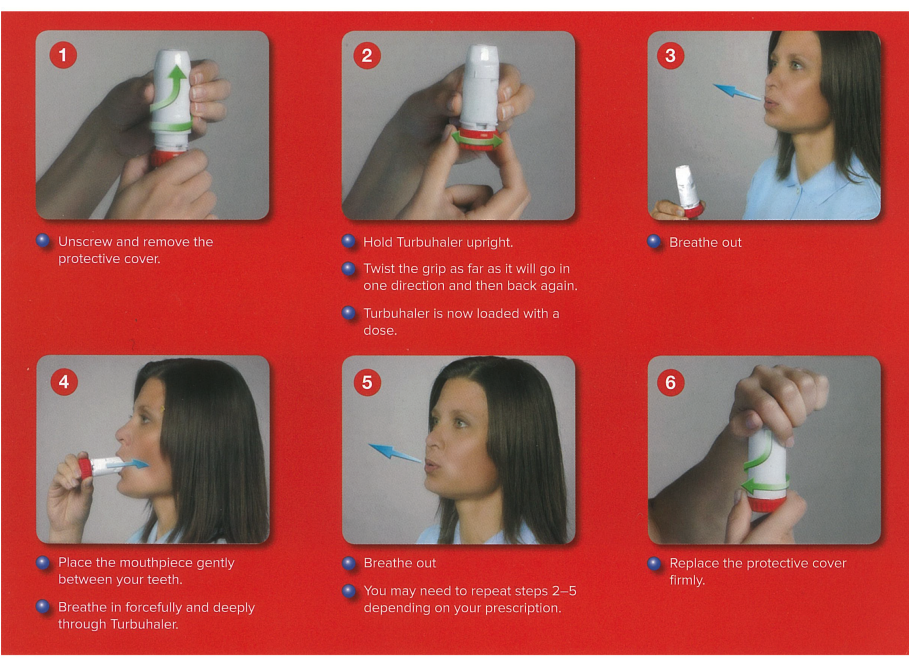
What are the steps in using a DPI?
> before using a new DPI, prime it. To prime: remove the cover and twist the grip as far it will go in one direction and then back again as far as it will go, then repeat this process one more time.
> rinse mouth out after inhaling Symbicort Turbuhaler
For pressurised metered-dose inhalers (pMDI);
A) Why is it the most widely used?
B) Drug in reservoir with?
C) What 2 phases does it exist in?
D) What are the excipients? Why are they used?
D) What to do when in suspension?
A)
- small, multidose, convenient
B)
- Drug in reservoir with liquified propellant (typically HFA 134a and HFA 227ea) and other excipients
C)
- Propellant exist in 2 phases: liquified phase in equilibrium with gas phase
C)
- cosolvents (e.g. ethanol); surfactants and polymers (mainly in dispersed systems) to provide stability to the formulation
D)
- Drug particles must be reduced in size. Potential for Ostwald ripening if partial solubility exists
What are some properties of liquefied gas propellants?
- Gas at RT and AP; liquid at ↑ pressure
- Liquid → gas on discharge
- Spray vary from ≈ 5 μm for inhalation to 100 μm for surface spray
- Vapour pressure constant in container
- Spray same regardless of ½ or full
> VP: the pressure that exists when there is an equilibrium between molecules which exist in the vapour and liquid states. Dependent on temp, independent of quantity
For a pMDI;
A) What is the reservoir canister made from? Why?
B) What is the volume loaded from the reservoir into the valve and subsequently atomized?
C) What determines droplet size, plume properties, and device clogging
D) The smaller the orifice, the greater the?
E) What is the usual drug dose?
A)
Plastic or aluminum - internal walls usually covered to prevent drug adherence or degradation.
B)
20 to 100 μL loaded from reservoir into the valve and subsequently atomized.
C)
Actuator orifice
D)
The greater the pulmonary deposition
- Orifice diameter varies between 0.2 and 0.5 mm
E)
usually 20 μg to 5 mg.
> pressurized formulation released quickly on the valve stem by pressing down the actuator
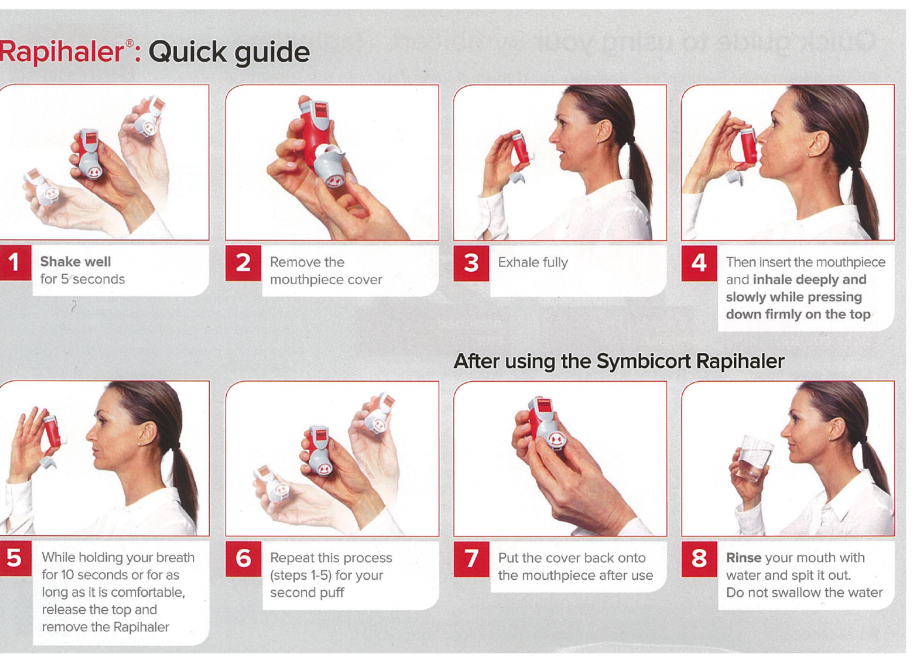
How to use pMDI? (rapihaler)
What are the disadvantages/limitations of pMDIs? How to improve this?
- The need to coordinate actuation with inhalation
- High proportion of drug remaining at the oropharynx: related to plume velocity and droplet size.
- Many patients do not properly use pMDI devices due to lack of training and synchronizing.
Improve by:
- Spacers and breath-activated devices can improve administration and performance.
- Spacers increase the distance between the inhaler mouthpiece and the patient, thereby decreasing the plume velocity and the oropharyngeal impact.
- Breath-activated pMDI sense the patient’s inspiration and are subsequently activated.
What are some strategies for controlled drug delivery to the lungs?
- Dissolution rate controlled
- Sustained release systems
- Drug complexes
- Drug-receptor binding
- Drug-conjugates
- Drug-polymer matrix particles
- Large porous particles
- Nanotechnology-based systems
Summary
After inhalation
A) Non porous particles with larger diameters (usually >5um) are prone to deposit in the oropharynx
B) Non porous particles with suitable diameters (usually 1-5um) can achieve deep pulmonary deposition but engulfed by alveolar macrophages
C) Large porous particles can deposit in the deep lung owing to their low density and escape phagocytosis because of their larger diamter
D) Porous nanoparticle-aggregate particles can reach the deep lung and disassociate into nanoparticles

-
Sterilisation by membrane filtration23
-
Sterility Testing19
-
Colligative Properties 1+255
-
Formulation of eye drops27
-
Cold sterilisation26
-
Parametric Release24
-
CDR and TPN36
-
DDS: Pulmonary23
-
DDS: Implant18
-
DDS: Nasal24
-
DDS: Intraocular26
-
Protein and Insulin38
-
DDS: Transdermal37
-
Drug targeting and nanotechnology 129
-
Drug targeting and nanotechnology 2 + 336
-
Recombinant Pharmaceuticals 1 and 238



