Why do we need to dispense complex bifocals?
- For px with anisometropia = an unequal refractive power between the 2 eyes (+/-1.50D or more) as it results in asthenopia and diplopia due to differential prism and aniseikonia
- For differential prismatic effect.
What is differential prismatic effect?
Result of different amounts of prism experienced by each eye when looking away from OC - generally there is a tolerance of only 2 prism dioptres vertically, but much more horizontally.
What is anisokonia?
How much anisokonia can we tolerate?
What is the relationship between anisometropia and anisokonia?
- A difference in retinal image size between the eyes resulting from a difference in Rx
- We can only tolerate 1%
- Difference in image size is 1% of every dioptre of anisometropia - i.e. a 1 dioptre difference in prescription between the two eyes = 1% difference in retinal image size
How do you correct anisokonia?
Via ISEIKONIC/ SIZE LENSES -These do not alter the focal power of a lens, they just (typically) increase magnification thus retinal images are the same size.
-Typically You would give the size lens (i.e. the magnifying lens) to the eye with the least positive power
[You could equally reduce magnification in the eye with the most positive Rx]
Which of the following lens options reduce spectacle magnification:
A-High index material
B- Aspheric lens
C- Flatten base curve
D- All of the above
D - all of the above:
- Flattening the base curve
- Using a High index material
- An aspheric lens
What are the bifocal solutions to unwanted prismatic effect/differential prism or if prism is needed to be worked into the lens?
- slab off prism/ bi prism lenses
- franklin split
- prism controlled bifocals
- different sized round segs
- fresnel prism
What is a slab off/ bi prism?
What is the minimum amount of prism that can be slabbed off?
- A process that removes unwanted base-down prism from the bottom of the back of the lens
- It results in a line across the lens (so an E or D seg with the seg top coinciding with the line looks best ) - can slab off a varifocal but not good cosmetically as it puts a line across the lens (and realistically px go for a varifocal due to cosmesis).
- A minimum of 2 prism dioptres base DN is required to slab off (because that’s the smallest amount you can slab off).
What are franklin split bifocal lenses and how can they be prescribed to get rid of differential prism/unwanted prism or even induce it?
How are these lenses from a cosmesis point of view?
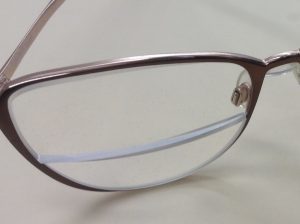
- 2 separate lenses literally stuck together one underneath the other
- DV and NV are completely separate lenses - the OCs can be placed where required and prism can be surfaced into either portion to eliminate any unwanted prismatic effect
- not cosmetically good
What are prism controlled bifocals?
What material are they available in?
What is the standard seg size?
How much prism can be worked into these lenses?
Can prismatic effect be worked into both distance and near vision?
How are prism controlled bifocals manufactured?
How can we know the base direction of the prism controlled bifocal lens?
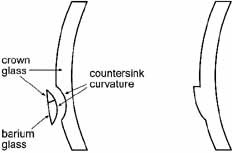
A lens with a visible round bifocal segment.
Only truly available in glass.
The standard segment size is a round 30mm seg.
Up to 6 prism diopters of extra prism can be worked in any direction in the seg ONLY.
We can only induce prismatic effect in near vision.
A depression curve is worked into the lens and a small prism dropped in (basically what this means is that the lens is actually cut out and a prism is put in that space).
The thinnest edge indicates the prism base.
How can different sized round segs in bifocals be handy in removing unwanted prismatic effect as a result of anisometropia?
What is a benefit to the Px of managing prismatic effect via changing segment size?
- A large seg can be dispensed to the most positive eye (induces more base down prism in the seg for reading (which is good) and to eliminate the base up of the distance portion)
It is usually done at no extra cost. Fairly good cosmeisis (compared to D and E seg- the bigger the difference between the seg sizes though the worse the cosmesis). (If px has worn round segment in the past then there will be no adaptation issues).
What seg sizes are available for the different segments?
r - 22,24,25,28,30,38,40,45
d - 25,28,35,40,45
c - 25,28,35
Describe fresnel prisms. [It is pronounced freh-nal]
- They are normally used as a temporary measure.
- Its basically like a sticker that you stick onto a lens- it can be peeled off too. (You can layer these ‘stickers’). The way you stick the ‘sticker’ on would depend on the base direction the px needs.
- It will reduce px VA by approx 2 lines - so you don’t want to give to both eyes (not good for drivers who have vision around 6/9) - may be used for prism in any direction and available from 1 prism dioptre to 30.
- Don’t split fresnel because it will reduce VA in both eyes
- Difficult to keep clean as dirt goes in grooves - when dirt gets into the groves cosmesis is awful.
What options are available for anisometropia in single vision?
- contact lenses - you can control decentration by altering their head position so you always look through OC
What’s a disadvantage of iseikonic/size lenses via INCREASING magnification of one of the lenses?
By increasing the magnification in one of the lenses essentially you have made it thicker - now both lenses are thick.
What is our typical near vision point?
8-10mm down and 2mm in.
What is slabbing on?
When you add onto the top of the back of the elns to remove unwanted base up prism. The minimum amount of prism that can be removed is 2 dioptres base up.
Generally which lens do we tend to slab off in order to remove unwanted base-down prism?
Our most negative lens.
What is the formula for the segment size (comparisons) in the bifocal we need to control prismatic effect?
Difference in segment sizes = (20 x differential prism)/ add.
Note this formula doesn’t give you the size of segment needed it gives you the difference in segment size needed to combat or induce that prism.




