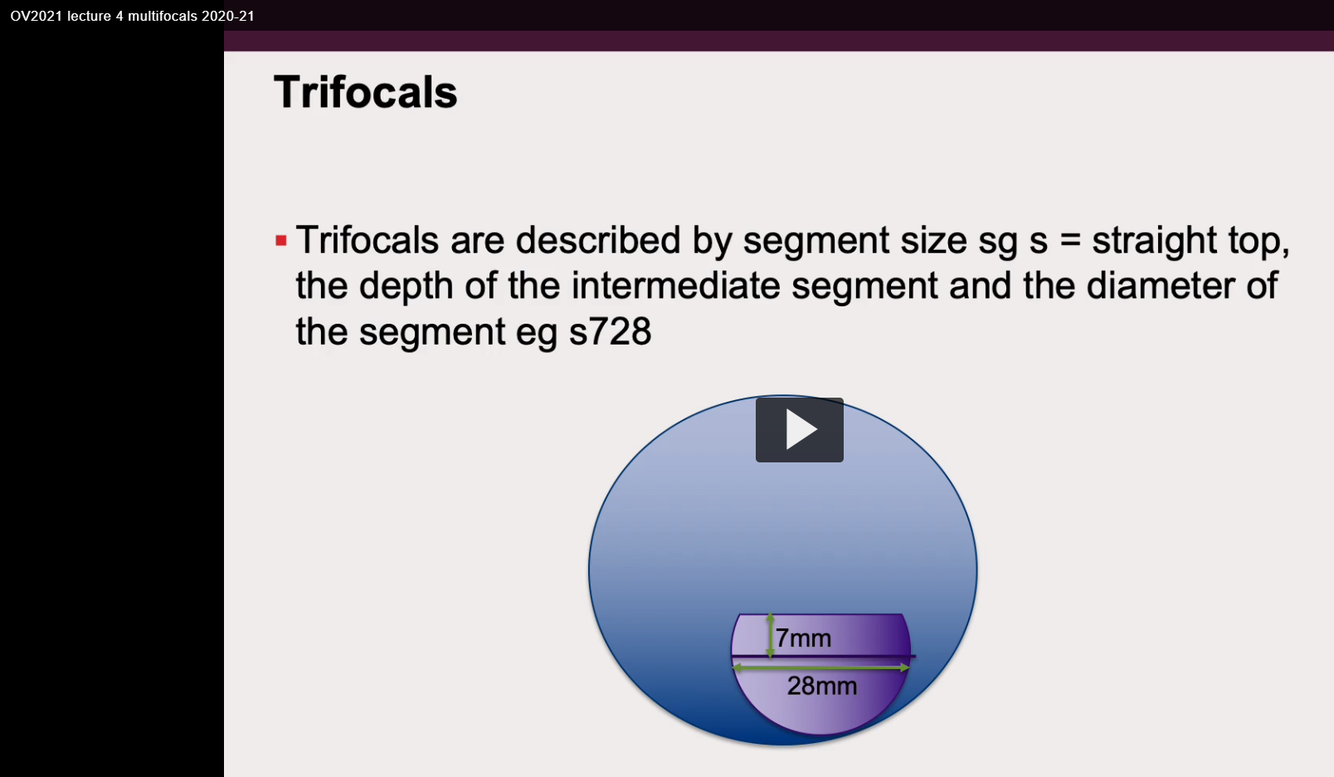
How to describe Trifocals?
Described by seg height and shape (i.e s = straight top) AND the depth of the int seg and the diameter of the seg eg s72Attach Images8
What is the IP/RP ratio?
IP/RP ratio = (IP add/RP add) x 100
[Smaller % means more diatnce vision is available]
Advantages of trifocals?
- Contain an intermediate section
- No distortion
- Full distance portion which isn’t available in progressive lenses
- Wide intermediate and near portions
Disadvantages of trifocals?
- The seg top is set usually higher than we would set a bifocal seg (seg top 3mm above limbus) - which may interrupt distance vision (but this could be set lower)
- reading portion 2mm lower than bifocals (thus smaller near section)
- 2 areas of jump
If a px has Occupational Bifocals and requires them for limited extra near or intermediate use what can we do?
We can set the seg 2mm higher - this makes the seg easier to access and gives Px larger area to look through.
[Note - this is not suitable for walking around - so only good for occupations where you are sat at a desk]
What are the different types of Trifocals and who are our recommended Pxs for them?
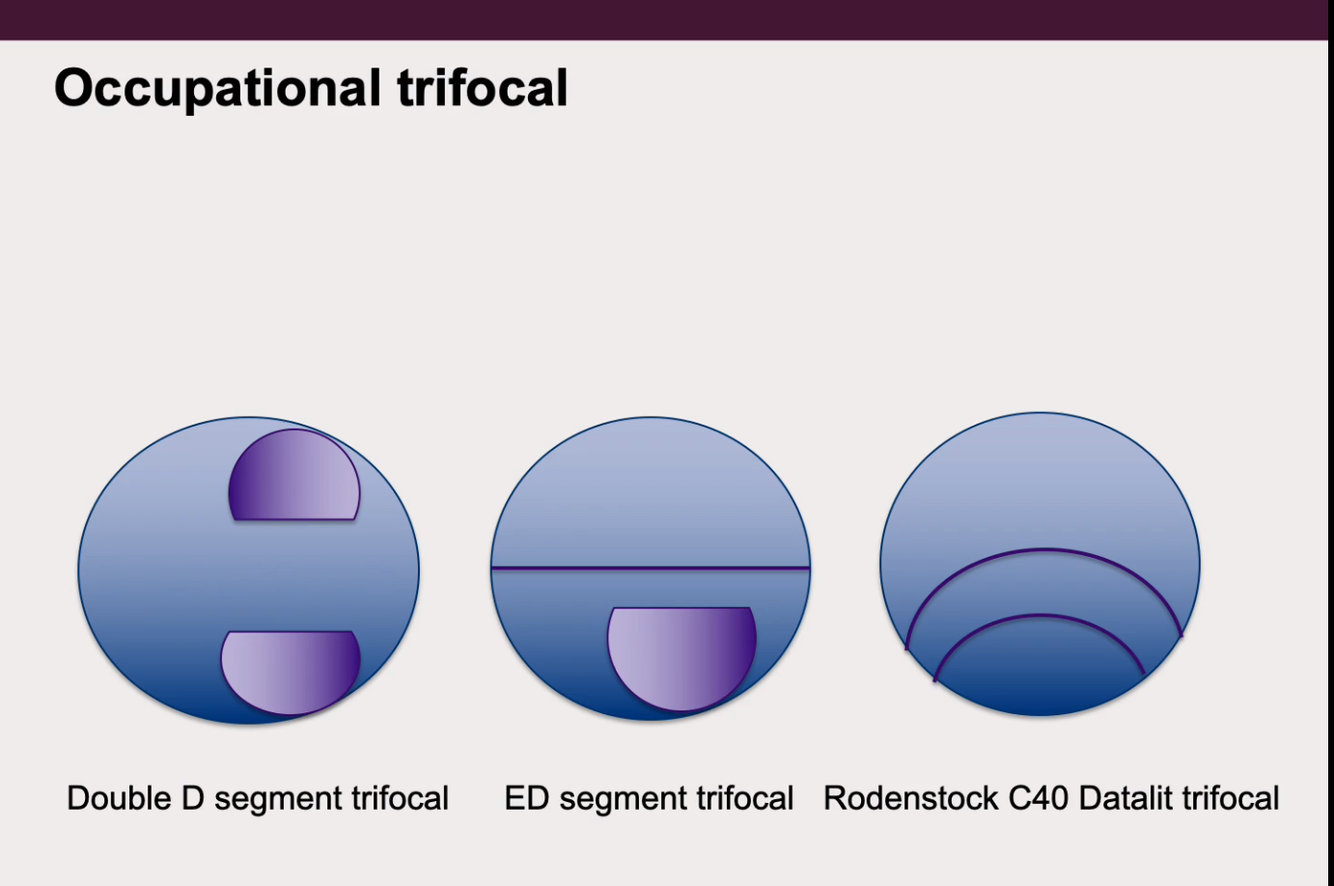
- DOUBLE D - we can prescribe a sep rx above and below, px for this tend to be professions like pilots, plumbers, mechanics. (For job looking at small print above and below eye print).
- ED seg - Large IV and NV (for px who don’t get on with varifocals but don’t like straight top look of seg)
- Rodenstock C40
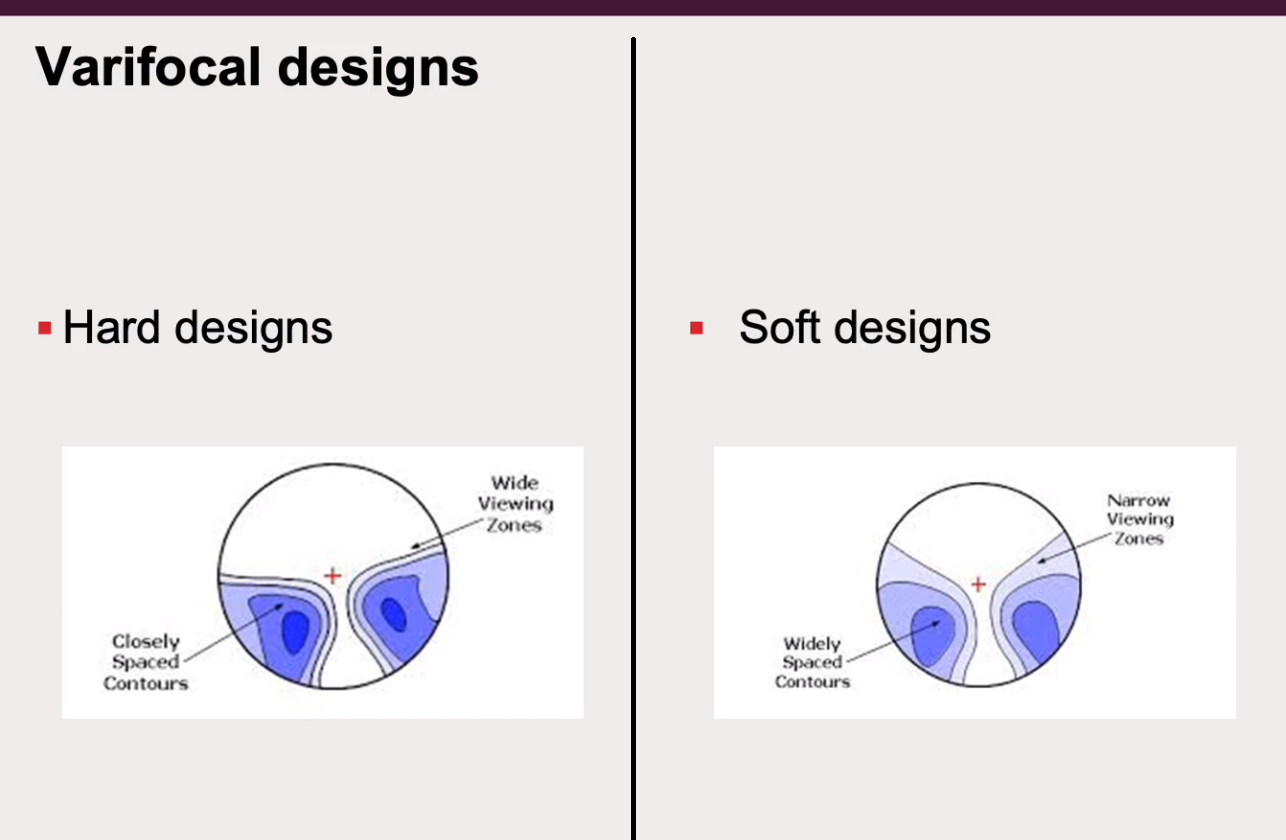
What are hard varifocals?
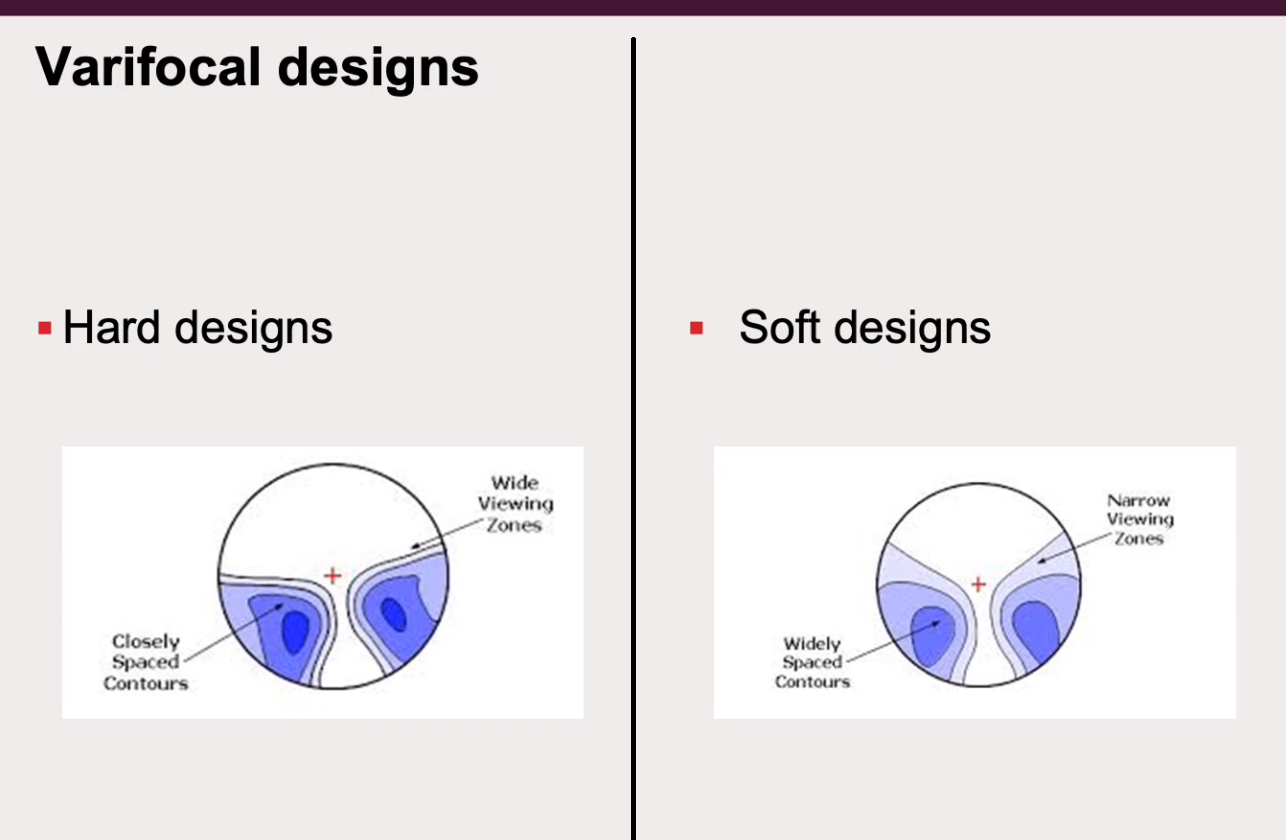
- 1st generation of design.
- surface astigmatism is concentrated in lower and nasal areas of the lens - very narrow progression corridor
- wide reading area and full width distance portion
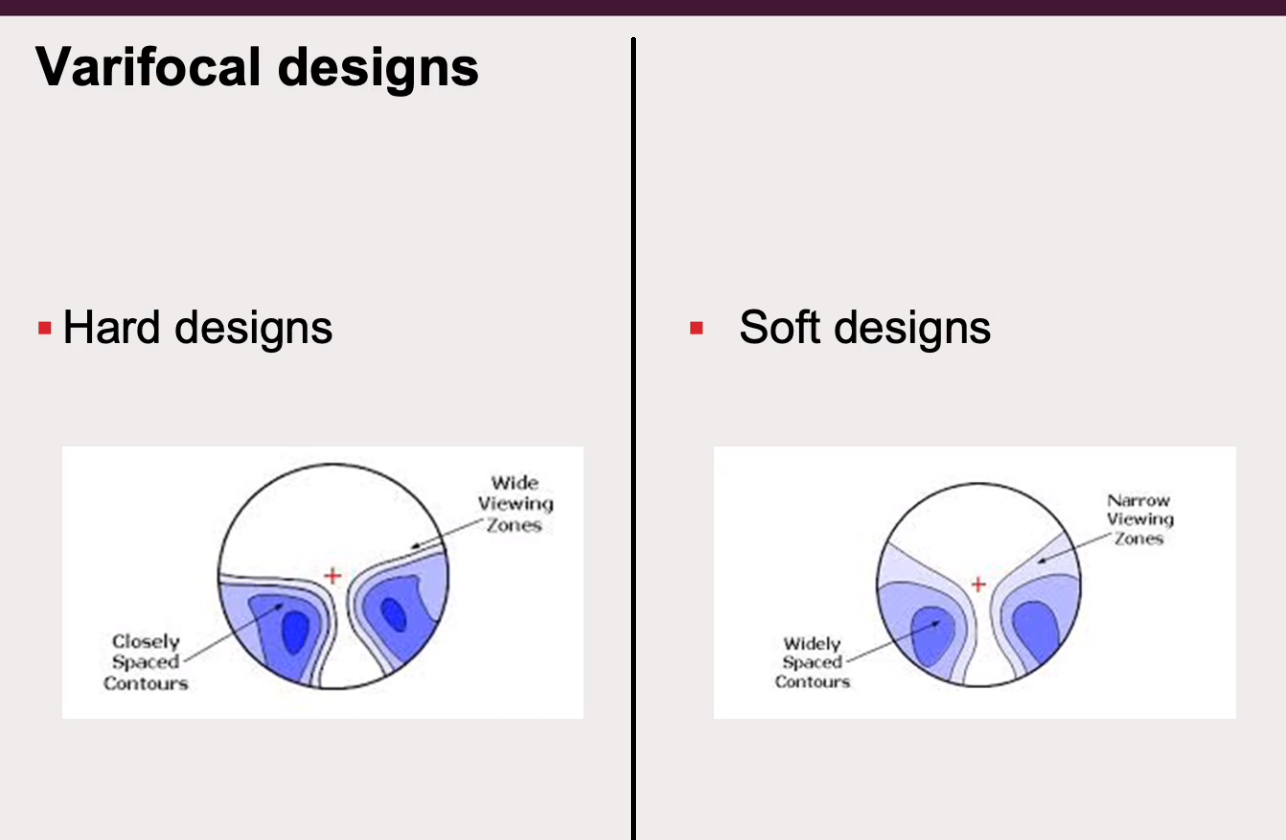
- closely spaced isocylinder lines (this refers to the image) = rapid change of astigmatism ( it means there are steep curve changes whihc mean you have more oblique astigmatism which is interpretated by the Px as distortion)
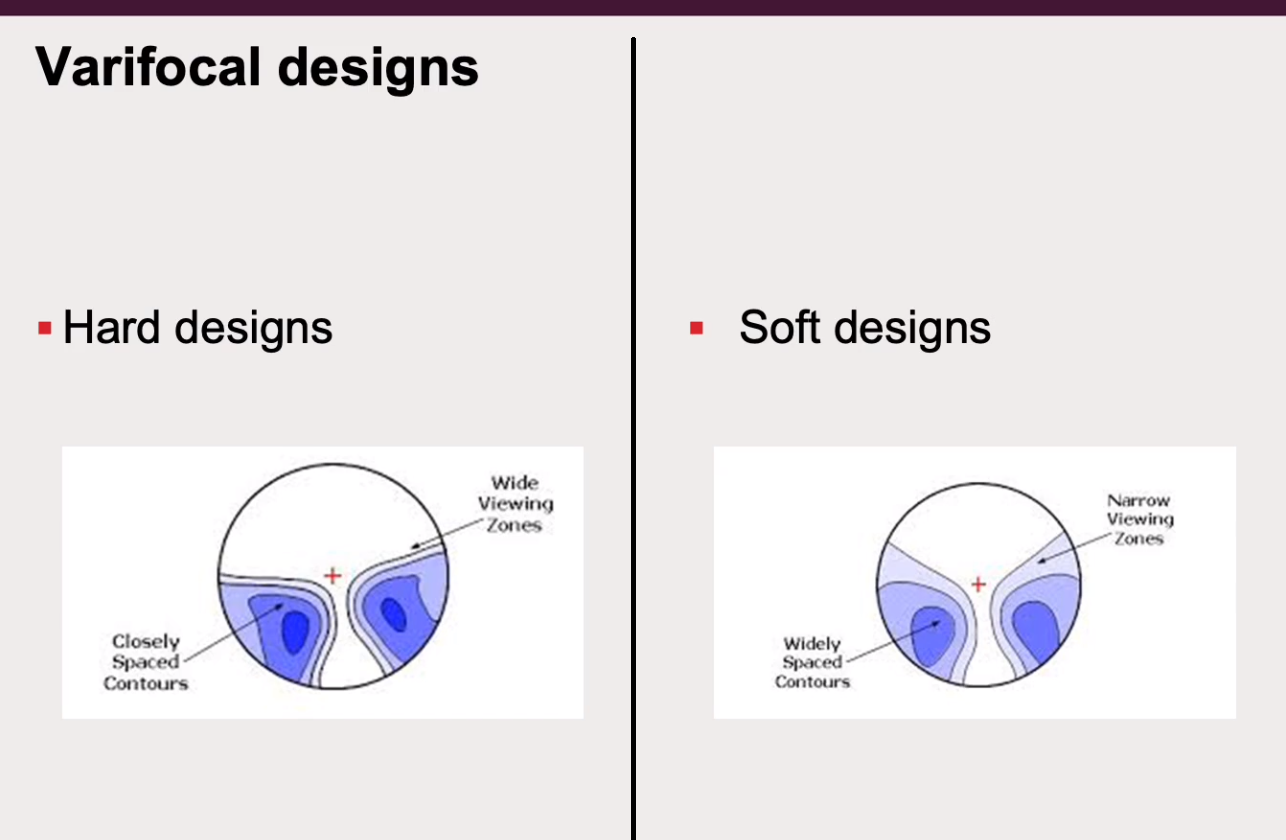
What are soft varifocals?
- 2nd generation of design
- surface astigmatism extends into marginal parts of distance portion
- allows a reduction in amount of surface astigmatism
- narrow reading area and wide progression corridor
- wider intermediate portion than hard design but blur introduced into distance portion
- Easier adaptation
What are freeform varifocals?
What are some examples of freeform varifocals?
- Basically customisable varifocal lenses that use Computer aided design to make them specific (and accurate) to the patient.
- eg varilux s or zeiss individual 2
- created by computer driven equipment and made to suit each individual specification
- freeform can have progressive surfave on front, back or both (traditional lenses had progressive surface on the front only)
- they allow for multidesign - back surface designs which allow modification of lens parameters eg variable inset, corridor length, etc.
- They are unique to the point where they even consider physiological factors - e.g. consider head and eye movement
In freeform lenses the design changes with:
- right and left eye
- level of hyperopia or myopia
- how much add is present
- body posture
- behaviour -whether your a head mover or an eye mover e.g. do you turn your head to glance at mirror or look from the edge of your glasses)
- frame chosen
Effect of increasing the add in varifocals:
- length of the progression corridor increases and the width of the reading area narrows as the add increases
- increased surface astigmatism leading to isocylinder lines being closer together - px would notice reduction in the width of the intermediate and reading areas
What are compensated areas? Why are freeform lenses difficult to focimeter?
- focimeter position isn’t a natural wearing position
- (This means measurement is off -effects add mostly, but can also affect DV rx )
- This is because freeform varifocals have ‘compensated powers’ which take into account Back Vertex Distance, pantoscopic tilt, face form angle, px position - can result in diff readings for sph, cyl and axis - thus they typically come in packets that dictate all parts of the Rx.
What are the different types of Occupational progressive lenses and what are their main features- give examples of each :
1) Driving lenses
- eg varilux computer 3v
- widest possible DV and IV with limited NV
2) office lenses
- e.g. zeiss gradal RD
- gives good visual comfort
- Designed for IV and NV but sacrifices DV thus cannot be worn for driving.
- corrects up to 5m
3) Intermediate/ near only or Enhanced Readers
- interview lens
- Larger IV and NV than office lens
- low levels of surface astigmatism
- wide and stable FOV -e.g. good for receptionists
- wouldn’t use these to look at a distance of a whole room away.
What are Occupational considerations to take note of when prescribing any type of multifocal?
1) Visual task analysis - task size - contrast - stereopsis - lighting - working distance - still/moving task - affects peripheral distortion - position of task and px (vertical and horizontal) - area of vision
2) amount of distance vision required
3) amount of int vision required
4) amount of near vision required
Which type of varifocal design is best in what cases?
- When mainly distance vision is needed to be considered i.e. for occupations like driving and landscaping, hard/ freeform are best
- When mainly intermediate vision is needed to be considered e.g. in offices and retail, soft, firm or occupationals are best
- When mainly near vision is needed to be considered, e.g. for an office worker and product inspection, freeform or enhanced readers are best
What qs to ask about px occupation before prescribing any type of multifocal?
- what is your occupation
- how many hours a day are you on a computer screen
- how many hours a day are you driving
- what are the main tasks involved in your occupation - also consider their hobbies
Other occupational considerations that are not related to the distance at which vision occurs, which need to be asked to the Px?
1) safety - lens material
2) glare from artifical lighting - multi AR coating
3) glare from sunlight - tints with UV400 coating or transitions
4) sun glare from surfaces - polarised
For most people what is a suitable IP/RP ratio?
Around 50-60%
If a px has suffered with jump in bifocals is a trifocal a good option?
No because there’s now two areas of jump as a pose to one in bifocals.
What distances can occupational bifocals be set at?
DV and IV or IV and NV
What type of Px are hard design varifocals best for?
Traditionally don’t have distortion in the distance thus good for Px who do distance work e.g. drivers or golfers.
How is distortion experienced in a hard design contact lens?
Distortion at periphery is abrupt and obvious this can be seen from lines being close together indicating surface change is steeper.
How is distortion experienced in a soft design contact lens?
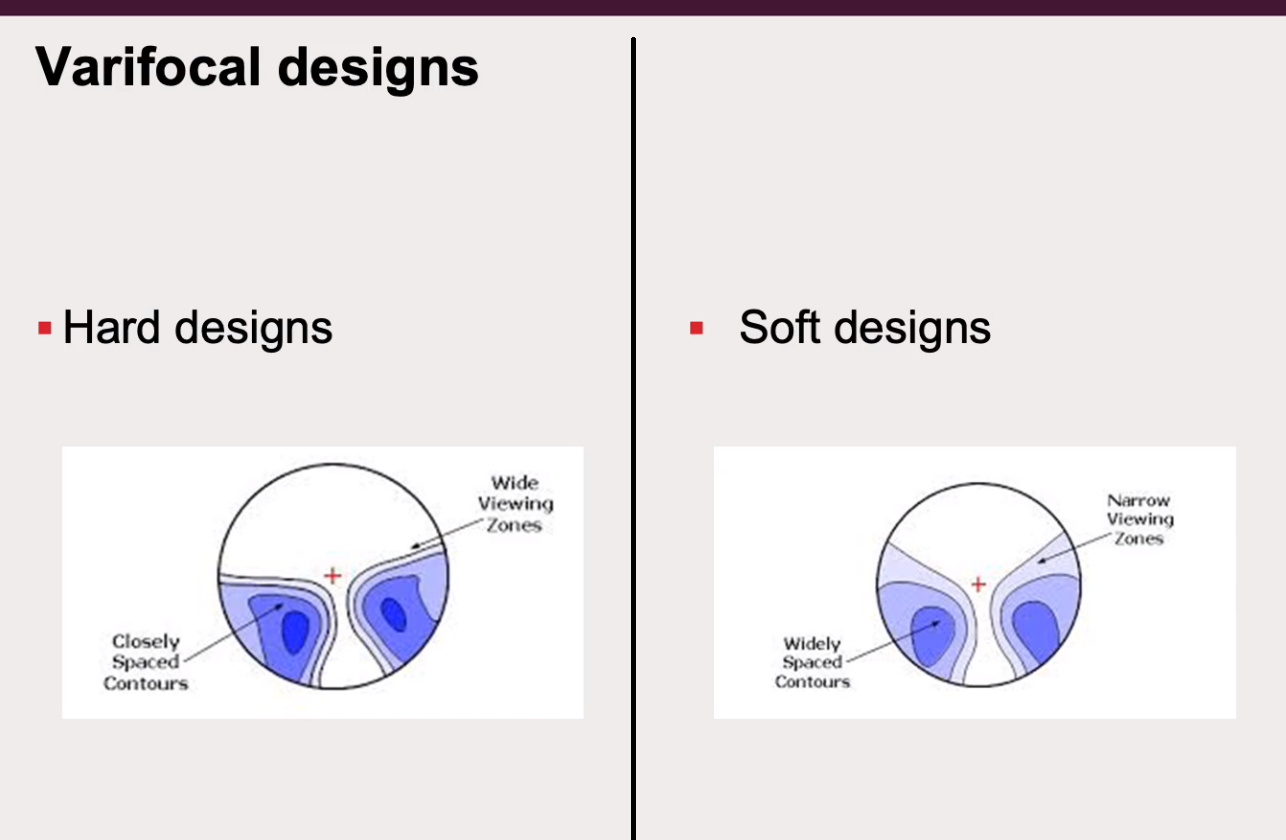
It is softer/more gradual than that of a hard design varifocal thus is less obvious.