What are
- *two other names** for the
- *complex plane**?
z-plane
Argand plane
(a + bi ) (a − bi ) = _____
a2 + b2
&
|a + bi |2
For complex number
z = a + bi,
|z| = _____
√(a2 + b2)
In other words:
√( Re(z)2 + Im(z)2)
Absolute value means
distance from zero, whether the number is real or imaginary.
The absolute value of a complex number can be obtained by applying the Pythagorean theorem.
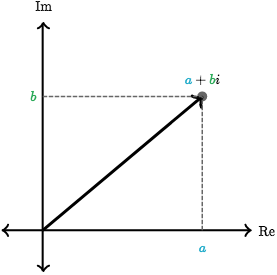
If you
don’t know the
real part and imaginary part of a
complex number,
what
other information
may allow you to
uniquely describe that number?
Absolute value
&
Angle
(or argument)
(or modulus)
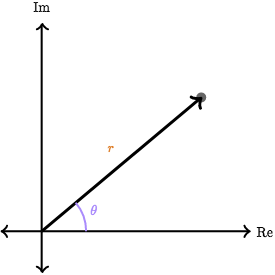
If you
don’t know the
absolute value and angle of a
complex number,
what
other information
may allow you to
uniquely describe that number?
Real part
&
Imaginary part
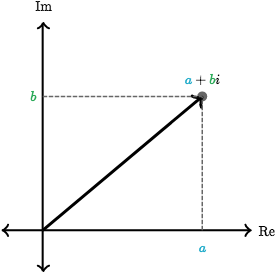
In complex numbers,
what does
absolute value
refer to?
The
- *absolute value**, or
- *modulus**, gives the
- *distance** of the number from the
- *origin** in the complex plane.
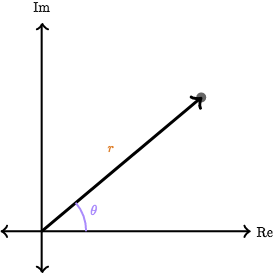
In complex numbers,
what does
angle
refer to?
The
- *angle**, or
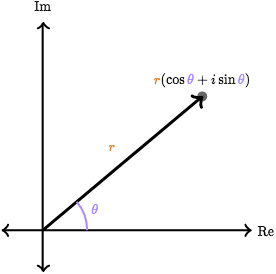
- *argument**, is the angle the number forms with the
- *positive real axis**.
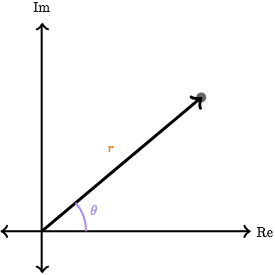
How do you find the
- *angle** of complex number
- a + bi ***?
Θ = _____?
Θ = tan−1 (b/a_)_
- The slope of the line that intersects the number and the origin.*
- Just as with real numbers on a Cartesian plane.*
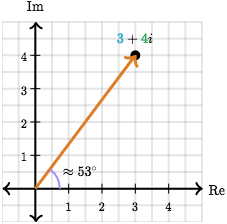
What are
- *three forms** of a
- *complex number**?
Rectangular form:
a + bi
Polar form:
r (cosΘ + i sinΘ))
Exponential form:
r•e<em>i</em> Θ
What
form is the complex number
2√(3) + 2i
written in?
Rectangular form
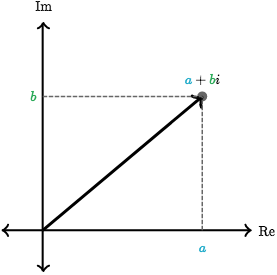
What is the
rectangular form of a
complex number
useful for?
Adding and subtracting
complex numbers.
It’s the sum of two terms: the real part and the imaginary part.
Plotting
in the complex plane.
It gives you the two coordinates.
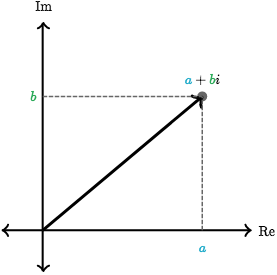
What is the
polar form of a
complex number
useful for?
Multiplying and dividing
complex numbers.
The product of two numbers with absolute values
r1 and r2 and angles Θ1 and Θ2 will have an absolute value r1 • r2 and angle Θ1 + Θ2.
Example:
- z1 has absolute value r1 and angle Θ1.
- z2 has absolute value r2 and angle Θ2.
- z1 • z2 = (r1 • r2) (cos(Θ1 + Θ2) + i sin(Θ1 + Θ2)).
How does the
exponential form of a complex number
relate to the
polar form?
It
uses the same attributes
as polar form (absolute value and angle), but
displays them in a
more compact way.
Example:
- z1 has absolute value r1 and angle Θ1.
- z2 has absolute value r2 and angle Θ2.
- z1 • z2 = (r1 • e<em>i</em> Θ1) • (r2 • e<em>i</em> Θ2) = (r1 • r2) • e<em>i</em> (Θ1+Θ2)
What
form is the complex number
4 (cos (π/6) +i sin (π/6))
written in?
Polar form
What
form is the complex number
4e(π/6)<em>i</em>
written in?
Exponential form
How do you state
- *complex number** z in
- *rectangular form**?
z = _____
z = a + bi
a: real part
b: imaginary part
* i:* imaginary unit
How do you state
- *complex number** z in
- *polar form**?
z = _____
z = r (cosΘ + i sinΘ)
r: absolute value or modulus
Θ: angle or argument
i: imaginary unit
How do you state
- *complex number** z in
- *exponential form**?
z = _____
z = r•e<em>i</em> Θ
r: absolute value or modulus
Θ: angle or argument
i: imaginary unit
In what quadrant of the complex plane does
3 + 4i
lie?
Quadrant I
In what quadrant of the complex plane does
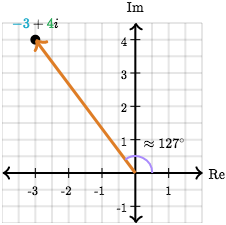
−3 + 4i
lie?
Quadrant II
In what quadrant of the complex plane does
−3 − 4i
lie?
Quadrant III
In what quadrant of the complex plane does
3 − 4i
lie?
Quadrant IV
Why is the
quadrant of a
complex number
important?
Because the calculator may give the
opposite angle,
so you may need to
add 180° or π to the result.
Example:
- −3 + 4i
(located in Quadrant II) - tan−1 (4/−3) ≈ −53°
(located in Quadrant IV) - Must add 180° to result from calculator to obtain the opposite angle:
−53° + 180° = 127°
How do you restate
z = 4 (cos(π/6) + i sin(π/6))
in
rectangular form?
Expand
the parentheses in the
polar representation.







