Murmur of a patient with a VSD
Murmur: precordial – pansystolic / hyperactive
Anatomy of a PFO
septum primum lies to the left of the PFO (ostium secundum) - fails to fuse with the sides.
surgical correction of PDA in preterm infants
phrenic nerve injury
More common than full-term infants (4%)
opposite side injury common
(not surgical damage)
Perimembranous
Frequency: ?
Perimembranous
Frequency: most common (80%)
Repair of coarctiaion of the aorta - current mortality for isolated lesions
2-10%
Neonatal Presentation of aortic coarc ?
Heart failure after a variable time of being well
Once PDA closure –> Heart failure; this is related to the amount of collaterals which have developed
Symptoms:
- tachypnea
- feeding difficulties
- acidosis
- bp miss match with decreased or absent femoral pulses
HLHS - frequency of concominant coarctation ?
80%
Outcomes (In hospital mortality) for type B interrupted aortic arch ?
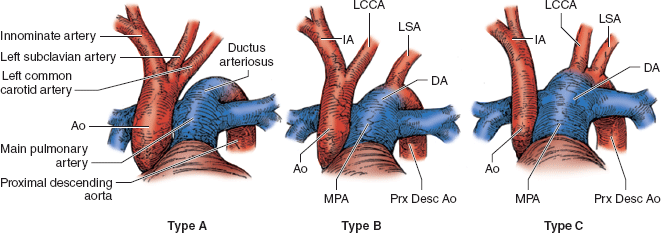
Outcomes (In hospital mortality) for type B interrupted aortic arch
Type B: 11%
The timing of the repair of an aortic coarctation?
- Neonate with severe failure: operation at the time of diagnosis
- If NO cardiac failure or FTT: 3-6 months
Issues with timing of operation:
a) Increased re-stenosis if operated before 3 months
b) Persistent HTN if operated on after infancy
PDA in preterm infants
indications for surgical intervention
Indications for surgical correction of a PDA in a preterm infant
- Respiratory Distress
- Large PDA
- Failure of two courses of inomethacin
- NEC (cant give NSAID)
- Intracrainial hemorrhage
Interrupted aortic arch is ?% of all CHD
1%
Hybrid approach for HLHS
the hybrid procedure for hypoplastic left heart physiology was first developed in 1993 in response to poor outcomes following the Norwood procedure.
The hybrid procedure (avoids CPB) :
- surgical placement of bilateral branch pulmonary artery bands
- placement of a stent in the ductus arteriosus
- catheter-based atrial septostomy,
Conal septal VSD
- AKA?
- Morphology?
- Conduction system?
Conal septal VSD
- AKA: conalseptal, supracristal, infundibular, subpulmonary, doubly committed
- Morphology: conjoined leaflets of the aortic and pulmonary valves form a rim
- may have AI in up to 50% of the cases
- Conduction system: remote to the defect
Factors which promote the closure of a VSD
those VSD that are muscular or juxtatricuspid are most likely to close spontaneously
Adherence to the tricuspid leaflet and chordal tissue is an important mechanism for perimembranous VSD
- Can also result in a LV-RA shunting – Gerbode Defect
.
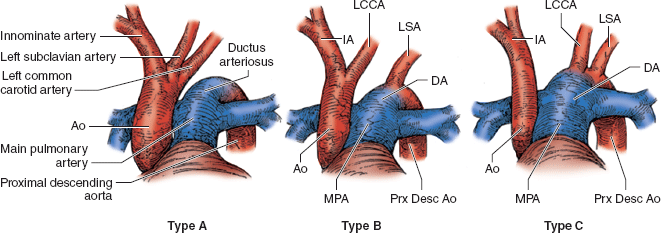
Outcomes (In hospital mortality) for Type C interrupted aortic arch
Outcomes (In hospital mortality) for type C interrupted aortic arch
Type C: highly lethal
Unrestricted VSD
No resistance to flow across the VSD
the LV and RV pressures become equal
the Qp/Qs become Equal
Type B interrupted aortic arch - % of cases and anatomic description?
A. Classification:
- Type A: (40%) – distal to the left subclavian
- Type B: (55%) – between L common carotid and L subclavian
- Type C: (5%) – between the innominate and L common carotid
In what type of patient is the common atrium usually found
Heterotaxy
Cardiac Anomalies associated with AVSD ?
Associated Cardiac Anomalies
- PDA: 10%
- TET : 10%
- 1% of TET have AVSD
- DORV: 2%
- TGA – Rare
- Unroofed coronary siunus – 3%
- Downs Syndrome
- 45% of Down’s patients have CHD
- 45% of the Down’s CHD cases are AVSD
- 75% complete AVSD
- Partial VSD is rare
Anatomic definition of the PDA
Connection between the upper descending aorta and the left PA
Partial AV septal defect
- Formerly known as an Ostium primum defect
- Usually associated with a cleft in the anterior leaflet of the mitral valve
PDA in preterm infants
What is the frequency of PDA in babies < 1000g?
83%
PDA in preterm infants
What is the frequency of a PDA in infants born at < 30 weeks?
75%
HLHS - most common
Most common is combined aortic and mitral atresia (2/3)






