Flight control
an aircraft is controlled if its movement can be matched to its demanded input
Stability
an aircraft can be described as stable if it exhibits a tendency to resume its original attitude after an upset that causes displacements or rotations, without the intervention of the pilot
Primary flight control
Control surfaces and devices that allow the pilot and/or the FMS to change the aircraft altitude
Secondary flight controls
Control surfaces and devices that allow the pilot and/or the FMS to control lift and drag
Name primary controls
Rudder Elevator Aileron
Name secondary flight controls
Flaps Slats Spoilers
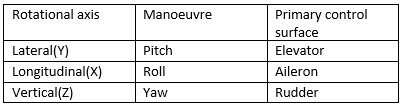
Match primary control surfaces to the manoeuvre and rotational axis
Factors affecting lift
- relative airflow velocity
- planform area of lifting surface
- air density
Ailerons
- located on the trailing edge of the wing
- used to turn the aircraft left/right
Why are the ailerons located on the trailing edge of the wing?
there is a greater moment at the trailing edge
therefore, more effective and greater control
Elevators
- located below the rudder at the back of the aircraft
- used to control the pitch of the aircraft
Rudder
- located on the tail of the aircraft
- used to keep the nose and tail pointing in the same direction
Canard/foreplane
small wings at the front of an aircraft
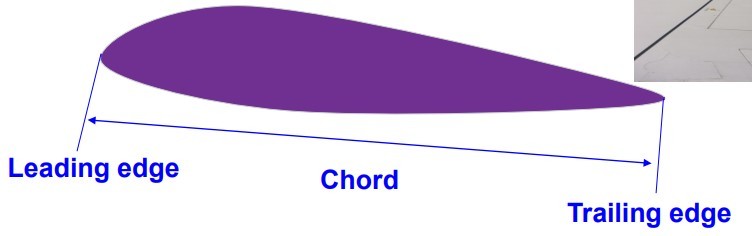
chord
length from the leading edge to the trailing edge
Name other control surfaces and the manoeuvre they control
Control surfaces
Manoeuvre
Tailerons
Roll and pitch
Canards(foreplanes)
Pitch or pitch and roll
Elerons
Roll and pitch(delta wing)
Spoilers
Assist in roll control
Flaperon
Pitch, roll and flap functionality
Identify ways to reduce lift and forward speed
- flaps, nose flaps, slats
- variable camber wing(NASA complex system to alter wing curvature)
- Boundary layer control(bleed air from the engine to re-energise the boundary layer)
Types of flaps
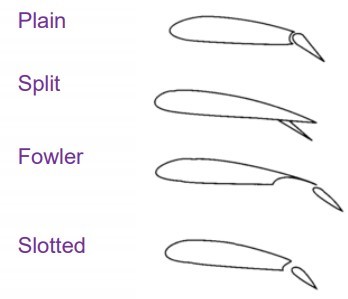
Which variables are affected by flaps?
wing area
coefficient of lift
Lift equation

Aspect ratio
It is a measure of wing planform ‘slenderness’
ratio of span to chord

Span
distance from one wingtip to the other wingtip
Factors affecting the coefficient of lift
- aerofoil shape
- angle of attack
- air viscosity
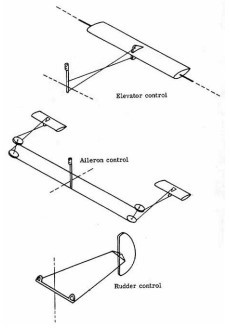
Manual flight control system
double run cable system
combination of rods, levers and cables
Advantages and disadvantages of manual flight control
Advantages
- natural feedback
- cheap
- fewer failure modes than hydraulic powered
- lightweight
- easy to maintain
- simple to set up
Disadvantages
- motion fixed at the design stage
- difficult to fly unstable aircraft
- limited to pilot strength
- more potential for mechanical failure


-
Flight mechanics29
-
Finite wings9
-
High speed flows15
-
Straight and level flight7
-
Aircraft stability9
-
Control systems32
-
Structures and materials21
-
Systems and electrical power17
-
Fuel system18
-
Jet propulsion14
-
Turbofan13
-
Engine control9
-
Hydraulic systems(power and user)28
-
Landing gears16
-
Braking systems11
-
Icing20
-
Environmental control10
-
Electric aircraft8
-
Maintenance16



