1
Q
Diagnosis
A
- Providers should obtain gestational history at initial evaluation of boys with suspected cryptorchidism.
- Primary care providers should palpate testes for quality and position at each recommended well-child visit.
- Providers should refer infants with a history of cryptorchidism (detected at birth) who do not have spontaneous testicular descent by six months (corrected for gestational age) to an appropriate surgical specialist for timely evaluation.
- Providers should refer boys with the possibility of newly diagnosed (acquired) cryptorchidism after six months (corrected for gestational age) to an appropriate surgical specialist.
- Providers must immediately consult an appropriate specialist for all phenotypic male newborns with bilateral, non-palpable testes for evaluation of a possible disorder of sex development (DSD).
- Providers should not perform ultrasound (US) or other imaging modalities in the evaluation of boys with cryptorchidism prior to referral as these studies rarely assist in decision making.
- Providers should assess the possibility of a disorder of sex development (DSD) when there is increasing severity of hypospadias with cryptorchidism.
- In boys with bilateral, non-palpable testes who do not have congenital adrenal hyperplasia (CAH), providers should measure Müllerian Inhibiting Substance (MIS or Anti- Müllerian Hormone [AMH]) and consider additional hormone testing to evaluate for anorchia.
- In boys with retractile testes, providers should assess the position of the testes at least annually to assess for secondary ascent.
2
Q
Treatment
A
- Providers should obtain gestational history at initial evaluation of boys with suspected cryptorchidism.
- Primary care providers should palpate testes for quality and position at each recommended well-child visit.
- Providers should refer infants with a history of cryptorchidism (detected at birth) who do not have spontaneous testicular descent by six months (corrected for gestational age) to an appropriate surgical specialist for timely evaluation.
- Providers should refer boys with the possibility of newly diagnosed (acquired) cryptorchidism after six months (corrected for gestational age) to an appropriate surgical specialist.
- Providers must immediately consult an appropriate specialist for all phenotypic male newborns with bilateral, non-palpable testes for evaluation of a possible disorder of sex development (DSD).
- Providers should not perform ultrasound (US) or other imaging modalities in the evaluation of boys with cryptorchidism prior to referral as these studies rarely assist in decision making.
- Providers should assess the possibility of a disorder of sex development (DSD) when there is increasing severity of hypospadias with cryptorchidism.
- In boys with bilateral, non-palpable testes who do not have congenital adrenal hyperplasia (CAH), providers should measure Müllerian Inhibiting Substance (MIS or Anti- Müllerian Hormone [AMH]) and consider additional hormone testing to evaluate for anorchia.
- In boys with retractile testes, providers should assess the position of the testes at least annually to assess for secondary ascent.
3
Q
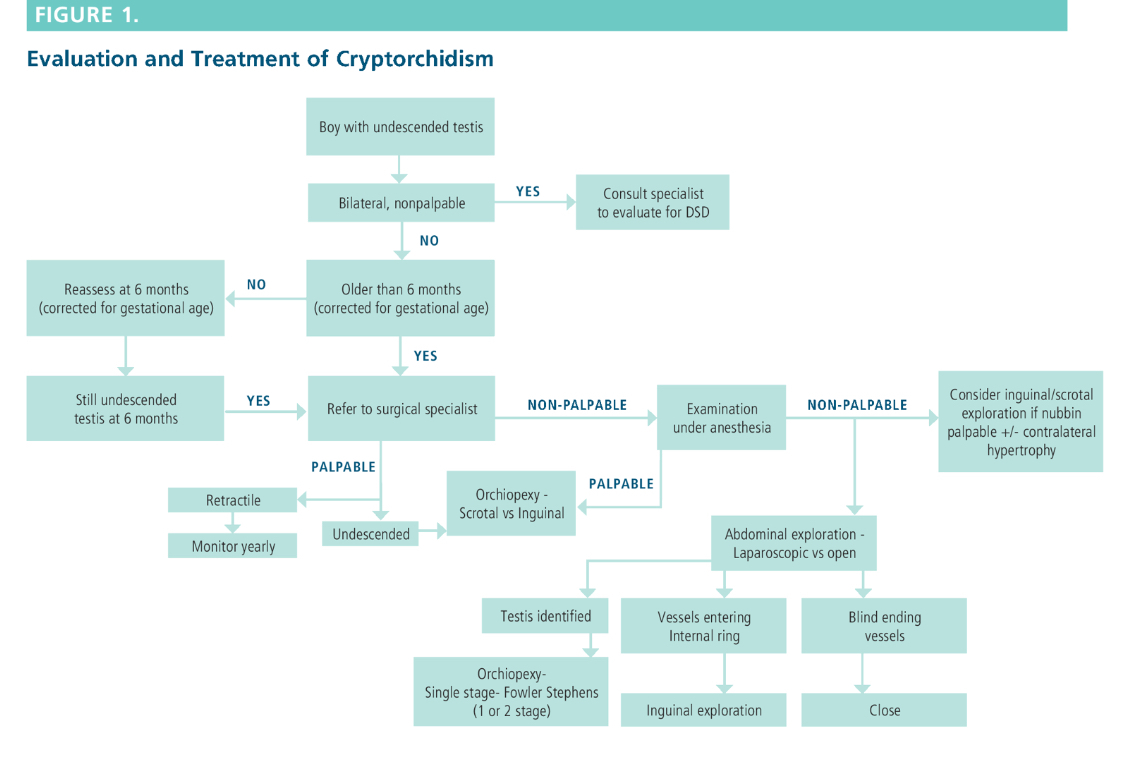
Treatment algorithm
A

AUA guidelines
flashcards
Decks in class (18)
# Cards
-
VUR8
-
Antimicrobial prophylaxis10
-
Asymptomatic microhematuria4
-
BPH17
-
Bladder Cancer - Muscle Invasive14
-
Bladder Cancer - non muscle invasive14
-
Cryptorchidism3
-
Erectile Dysfunction5
-
Interstitial cystitis/bladder pain9
-
Male Infertility13
-
OAB7
-
Peyrones disease3
-
premature ejaculation5
-
Priapism7
-
Prostate cancer - Clinically localized15
-
Prostate Cancer - Screening4
-
Prostate cancer - CRPC8
-
Renal mass and localized renal cancer10



