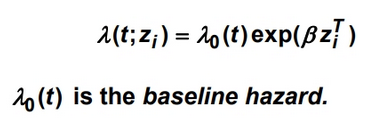
General formula for Cox proportional hazard (PH) model
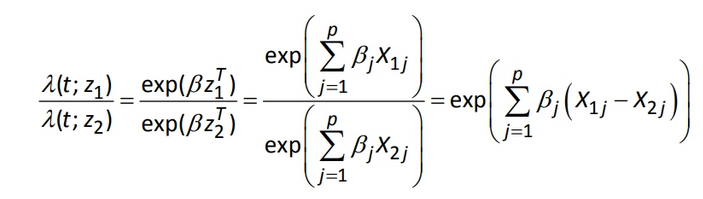
Ratio of hazards of lives with covariate vectors z1 and z2 (Cox PH model)
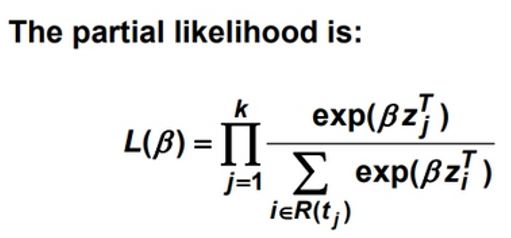
Proportional hazards model: Likelihood estimator for beta vector
Aims of graduation
- Produce smooth set of rates that are suitable for a particular purpose
- Remove random sampling errors
- Use the information available from adjacent ages
Desirable features of graduation
- Smoothness
- Adherence to data
- Suitability to purpose to hand
Degrees of freedom for Xi-Squared test
- Start with the number of groups
- If the groups form a set of mutually exclusive and exhaustive categories (probabilities add up to 1), subtract 1
- Subract further 1 for each parameter that has been estimated
Distributions of D_x and mu~x
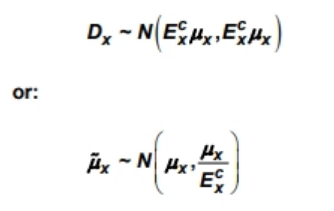
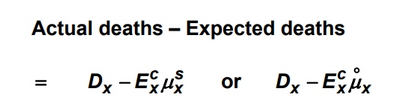
Mortality experience: Deviation
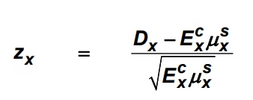
Mortality experience: Standardised deviation
Degrees of freedom when comparing an experience with a standard table
Degrees of freedom = number of age groups
Xi-squared failures: Standardised deviations test
To detect a few large deviations that the Xi-square test did not detect
Check if standardised deviations of mortality are following the standard normal distribution with Xi-Squared test
Xi-squared failures: Signs test
To detect imbalance between negative and positive deviations
Binomial distribution
N number of negative deviations:
Check that 2*P(N <= x) > 5%
P number of positive deviations:
Check that 2*P(P >= x) > 5%
Xi-squared failures: Cumulative deviations
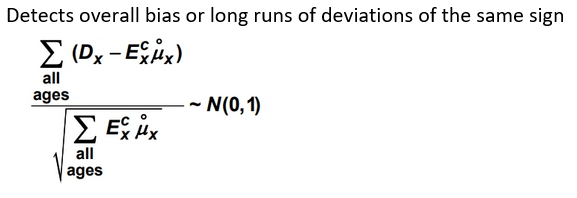
Xi-squared failures: Grouping of signs test
Detects ‘clumping’ of devations with the same sign.
Check ‘Grouping of signs test’ in tables.
If number of groups of positive (or negative) runs is lower or equal than the test statistic, we can reject the null hypothesis.
Testing smoothness of graduation
Third difference (change in curvature) of the graduated quantities should
- Be small in magnitude compared with the quantities themeselves
- Progess regularly
Methods of graduation
- Graduation by parametric formula
- a1 + a2 exp(a3x + a4x^2+…)
- well-suited to the production of standard tables from large amounts of data
- Graduation by reference to standard table
- (a+bx) mu_x^s
- Can be used to fit relatively small data sets where a suitable standard table exists
- Gradution using spline functions
- Method is suitable for quite small experiences as well as very large experiences.
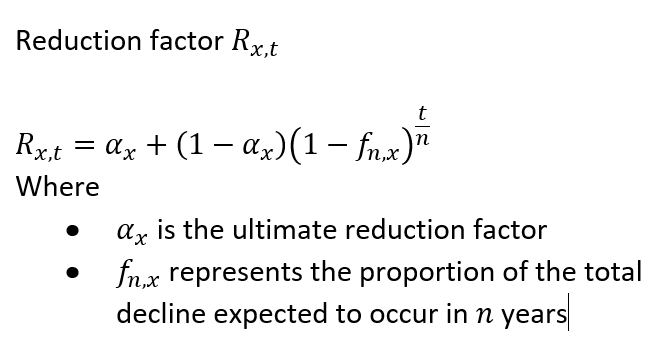
Morality projection - Method based on expectation
Autocovariance function

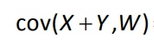
Simplify:

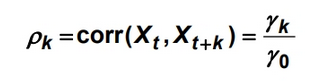
Autocorrelation function
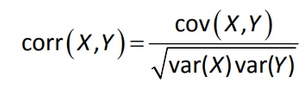
Correlation formula
Autoregressive process of order p
AR(p)

Moving average process of order q
MA(q)

Autoregressive moving average
ARMA(p,q)







