State the characteristics of model systems that can be used for experimental evolution
- Organisms that have a small generation time and can have their ancestors frozen/viewed in some way are good model systems
- These include viruses, bacteria, chlamydomonas, drosophila, yeast
Describe how the relative fitness of E. coli can be measured
- Split a culture of bacteria into two
- One we label with a neutral gene that turns the cells red which we call the evolved culture, and the other one is left blank
- Subject the evolved culture to a condition (ex., low pH for 2000 generations)
- Allow them to replicate
- Then we mix them and allow them to grow for a short time at low pH
- Calculate w = relative fitness = the growth rat of the evolved strain / the growth rate of the ancestral strain
Assess what it means for W to be <,> or = to 1
- If w > 1, suggests adaptation has taken place
- If w = 1, then there is no adaptation taking place
- If w < 1, this suggests maladaptation
Describe the design of Lenski’s long term evolutionary experiment (LEE) with E. coli
- Lenski grows 12 large, identical populations of E. coli and seeks to observe spontaneous mutations that occur from asexual recombination
- Every we day we take an aliquot of each population and put it into fresh medium
- The medium contains reduced glucose as well as Fe-citrate (to main aqueous state of iron)
- Every 75 days we take an aliquot of each population and freeze them to allow us to go “back in time” and look at the ancestral populations later
Where does citrate enter metabolism?
- Present in the citric acid cycle
- Acetyl-CoA can combine with oxaloacetate to produce citrate, or citrate can be directly taken up
Describe the role of glucose limitation in the experiment and the effects on the role of citrate
- Glucose resources run out after about 8 hours of growth, stopping growth
- Citrate can only be taken up in E. coli under anaerobic conditions, which are non-existent in the lab
- Gives rise to an ecological opportunity! If a cell line could access the citrate under aerobic conditions, it would enable growth only until it runs out of citrate!
What is the Cit+ phenotype…that is what did the researchers detect that was different in the Ara-3 line?
- Cit+ phenotype enables cells to grow on citrate under aerobic conditions, giving them a growth advantage once glucose resources run out
Describe the actualisation mutation that occured
- In a normal Cit- population, the citrate gene exists under an operon whose promoter is repressed in the presence of oxygen
- In the Cit+ population, actualisation occurred: part of the citrate operon was duplicated and inserted further down the gene, in front of a constitutive promoter!
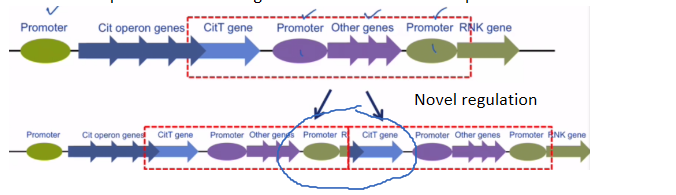
Describe the refinement process of the Cit+ phenotype
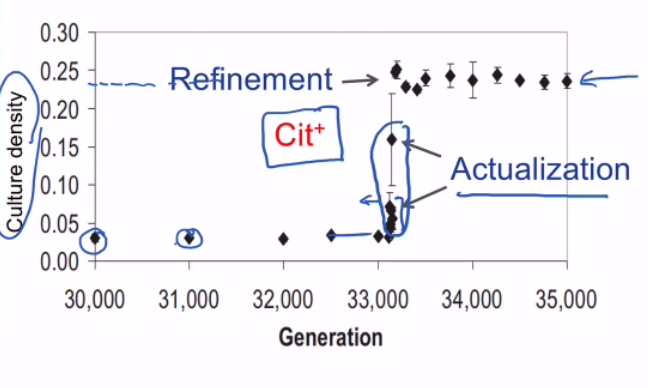
What is meant by the term potentiation and what is the evidence that a potentiation event occurred after 20,000 generations?
- Contingency believes that each step in evolution is dependent on all the steps before it
- This mutation 1 is called a potentiation mutation: a silent mutation that has no effect on the phenotype but enables mutation 2 (actualisation) to occur
- It was observed that a potentiation event occurred at the 20,000 mark
- Species removed from freezing at the 10,000 mark never developed Cit+, but species thawed after the 20,000 mark did!
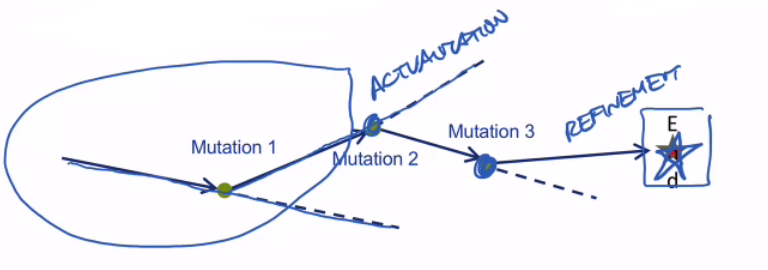
Is the Ara-3 line a new species?
By definition, E. coli can’t grow on citrate aerobically, so some argue that this is a new species
Explain why Cit+ lines do not drive Cit- lines to extinction
Cit+ lines do not drive Cit- lines to extinction because Cit- lines are more effective at using glucose while supplies last, so it is not completely unfavoured
What is trichromatic vision?
- Three different types of rhodopsin
- SW, MW, LW
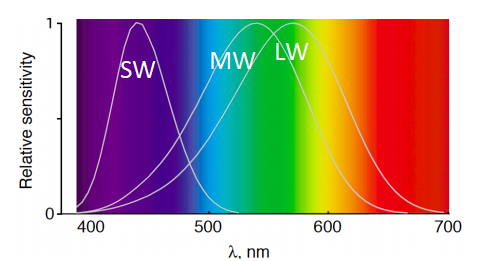
What accounts for the differences in absorption characteristics of the different rhodopsins?
- The pigment retinal remains the same in each cone cell, but the protein (opsin) varies slightly
- Each type of opsin is folded slightly differently, and so absorbs slightly different wavelengths by straining the structure of the retinal
Describe the major similarities and differences as revealed in protein alignment of SW, MW and LW opsins
- MW and LW opsins are found on the X chromosome (likely originated by duplication) while SW is on chromosome 7 (likely originated via translocation)
- Have the same counterion glutamic acid and same retinal binding sequence lysine
Describe the importance of lysine at position 296 and glutamic acid at position 113 of opsins
- Highly conserved amino acids in the different types of opsins
- Lysine at position 296 binds to retinal
- Glutamic acid at position 113 stabilises the interaction between lysine and retinal (it is a counterion)
Describe the association between trichromacy, dichromacy, old world monkeys and new world monkeys
- Old world monkeys are found in Africa and Asia and are trichromats
- Originally started as dichromats, evolved to be trichromats
- New world monkeys are dichromats found in South America
- Separation arose from the splitting of Pangea 50 mya
State the general distribution of di vs. tri vs. tetrachromacy among vertebrates
- Dichromats: dogs, goats, new world
- Trichromats: humans, old world
- Tetrachromats: reptiles, birds, dinosaurs, common ancestor of vertebrates
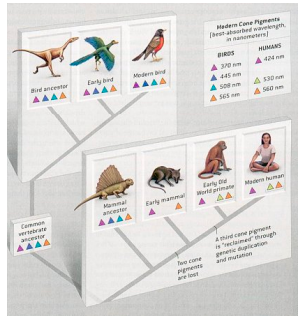
Mechanisms to explain how and why, over evolutionary time, lineages may lose and regain opsin
- Dichromacy is advantageous if you need to break camouflage or if you have a nocturnal lifestyle where colour vision isn’t necessary
- Ex., early mammals, where 2 opsins are lost
- Trichromacy is advantageous if you need to determine ripeness of food
- in genes
- Ex., old world monkeys, where 1 opsin is gained back
- Thus, complexity is not always better
State the mechanism to explain why some new world monkey females have better colour discrimination than any males
Females have 2X chromosomes, so 2 alleles making slightly different opsins that strain retinal in different ways to absorb different wavelengths, therefore better colour discrimination

-
Cycle 1 - Light as Energy and Info21
-
Cycle 2 - Molecular Evolution12
-
Cycle 3 - Thermodynamics and Membranes19
-
Cycle 4 - Metabolism19
-
Cycle 5 - Integrated Metabolism13
-
Cycle 6 - Evolution of the Eukaryotic Cell21
-
Cycle 7 - Bacterial Gene Structures and Regulation7
-
Cycle 8 - Eukaryotic Gene Regulation9
-
Cycle 8 (Reg Control)16
-
Cycle 9 - Development and Cancer29
-
Cycle 10 - DNA Technologies21
-
Cycle 11 - Genomics25
-
Cycle 12: Molecular Evolution20
-
Notes Final27
-
Skills8



