Compare the GlsA gene in volvox vs. chlamy
- GslA in chlamy is very similar to the volvox gslA gene
- When the gslA is knocked out in chlamy, nothing happens, but in volvox, the cell dies –> it is essential for asymmetric cell division
- When the chlamy gene is extracted and put in volvox, it work well
- Bioinformatics (blast) is used to confirm the idea that the gene originated from a common ancestor
Differences between global versus local sequences
Two types of algorithms are used by the computer
- Global: matches all sequences to form global alignment (attempts to align end to end)
- Computationally more demanding, therefore slower
- Local: the computer uses small, local regions of matching (builds alignment out from local matches)
- Still end up with a complete alignment
Distinguish between the BLAST score and the E-value
- BLAST gives you the probability that the two proteins are similar purely by chance.
- E value is how likely they are to be homologous
- E < 0.00001 = homologous
- E value for volvox and chlamy GslA gene = 0; they are related
Define synonymous vs nonsynonymous mutations
- Synonymous mutations are point mutations that, like a synonym in grammar, still have the same meaning as the original codon and therefore does not change the amino acid
- Non-synonymous mutations affect the amino acids that are coded for and change the resulting protein that is expressed
Describe neutral theory and selection theory
- Selection theory: all mutations affect fitness, and most mutations cause bad things
- Neutral theory: many changes to the gene sequence have no affect (gene evolution without any natural selection)
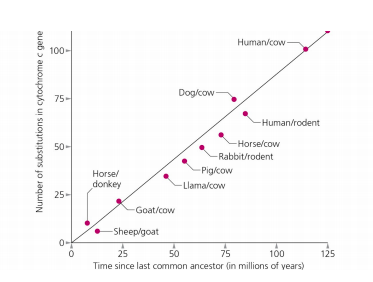
State the relationship between frequency of amino acid substitutions in given proteins vs. time since common ancestor (molecular clock)
- If the neutral theory is correct, then the number of mutations acquired should be clocklike; i.e., they just enter the population at a constant rate.
- So, the number of mutations (differences from common ancestor) would be proportional to the number of time since the species last diverged
Relative rates of accumulation of synonymous vs. non-synonymous mutations: why the difference?
Synonymous mutations have a higher rate because they are neutral, so they are always passed on and eventually become fixed in the population
Non-synonymous mutations have a lower rate because they are on average harmful, and so are less likely to be passed on due to lowering fitness
Exception: any type mutation in introns and pseudogenes has a high rate of accumulation because it can never affect the phenotype regardless
State the variables that affect the rate of evolution for a particular protein
- Rates of evolution differ for proteins due to selection pressures
- Ex., cytochrome C is very important, we don’t want a lot of mutations in this area
- Thus, cytochrome C is more constrained in tis structure because mutations in this area are likely to be severely negative due to its critical function for respiration
Define contigency and convergence evolution
- Contingency (Gould) states that each step in evolution is dependent on the step before it
- Convergence (Morris) states that the evolutionary routes are many, but the destinations are limited.
Describe the two types of opsin
Type 1: ex., channelrhodopsin, homologous to bacterial opsin
Type 2: rhodopsin, functions in sight and smell as well (called GPCR G-protein coupled receptors)
State the characteristics of ruminant organisms that enable them to extract energy from cellulose
- Ruminant organisms: mammals that are able to acquire energy from cellulose
- They have lysozyme enzyme which functions to digest grass/cellulose
- They have a rumen: section of the stomach where fermentation occurs
- The rumen consist of microbes which release the cellulase
Distinguish between digestive lysozyme and non-digestive lysozyme.
- Digestive lysozyme is more pH resistant than non-digestive forms, due to having amino acids at specific residues that are capable of protecting against degradation.
- It can exist in the stomach
- Non-digestive forms unfold at low urea/extreme pH

-
Cycle 1 - Light as Energy and Info21
-
Cycle 2 - Molecular Evolution12
-
Cycle 3 - Thermodynamics and Membranes19
-
Cycle 4 - Metabolism19
-
Cycle 5 - Integrated Metabolism13
-
Cycle 6 - Evolution of the Eukaryotic Cell21
-
Cycle 7 - Bacterial Gene Structures and Regulation7
-
Cycle 8 - Eukaryotic Gene Regulation9
-
Cycle 8 (Reg Control)16
-
Cycle 9 - Development and Cancer29
-
Cycle 10 - DNA Technologies21
-
Cycle 11 - Genomics25
-
Cycle 12: Molecular Evolution20
-
Notes Final27
-
Skills8



