What structures, other than the cortex, are capable of generating and controlling movement?
- basal ganglia & cerebellum
- reticular formation
- tectum & red nucleus
- vestibular system
- these structures are able to send descending pathways to stimulate muscles at the level of the body
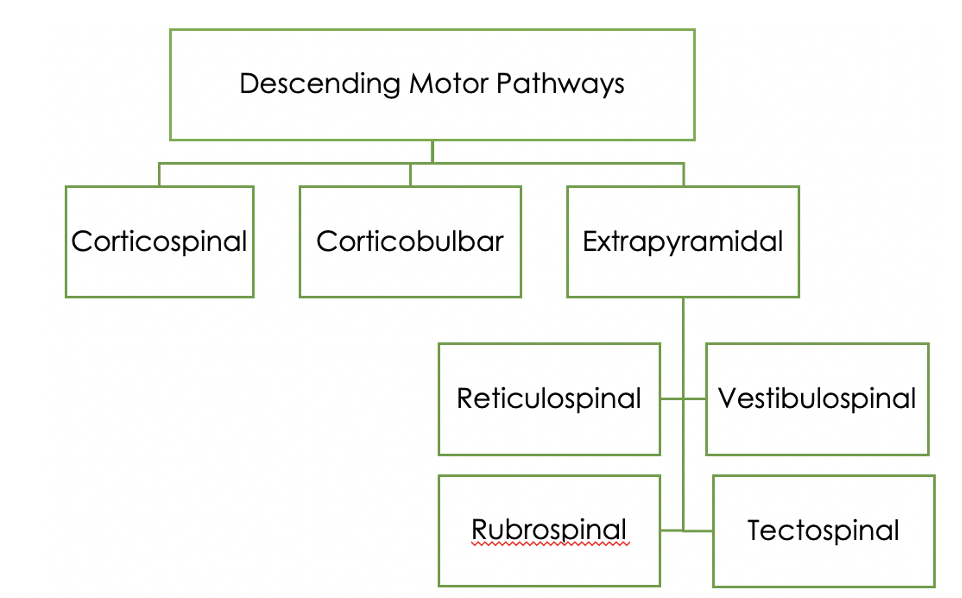
What are the 3 descending motor pathways?
- corticospinal
- corticobulbar
- extrapyramidal
Where does the corticospinal tract travel to and from?
What movement is it associated with?
- it travels from the cortex to the spinal cord
- also called the “pyramidal tract” as part of this tract crosses the midline at the level of the pyramids in the medulla
- associated with fine movement and flexor function
Where do the corticobulbar tracts start and end?
What are their roles?
- this refers to any pathway that starts in the cortex and runs to the brainstem
- this includes the corticonuclear tracts that innervate cranial nerve nuclei
- they are associated with control over cranial nerves** and **modulation of descending pathways
What is meant by an extrapyramidal tract?
What are the 4 main extrapyramidal tracts and what are they involved with?
- an extrapyramidal tract does NOT start in the cortex and does NOT pass through the pyramids
pathways arising in the midbrain:
- tectospinal - involved with head movements
- rubrospinal - involved with fine movement & flexor function
pathways arising in pons / medulla:
- vestibulospinal
- reticulospinal
- both involved with maintaining tone - antigravity, balance and posture
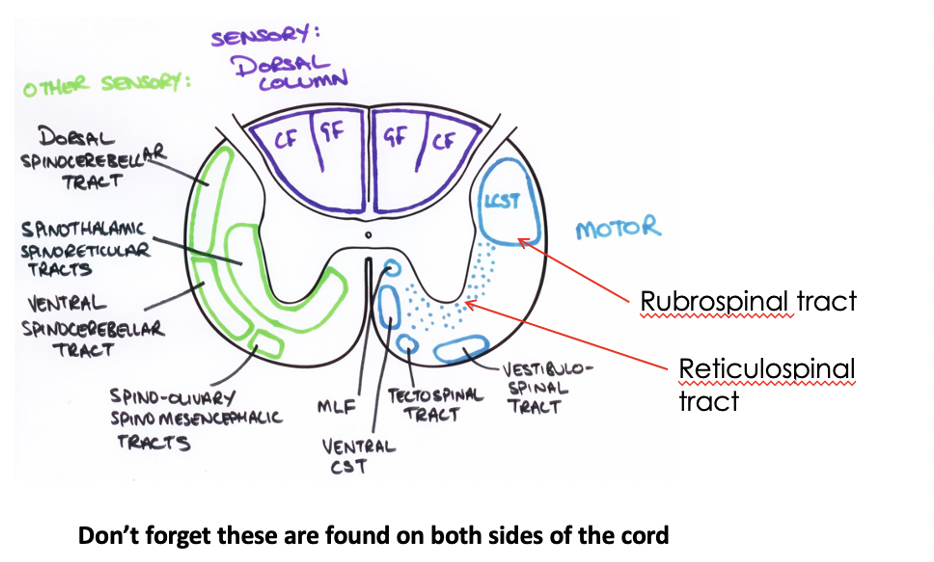
Which funiculi are the descending motor tracts found in?
Lateral funiculus:
- lateral corticospinal tract
- rubrospinal tract (runs parallel)
Ventral funiculus:
- tectospinal tract
- vestibulospinal tract
- some of the reticulospinal tract
- MLF
- ventral corticospinal tract
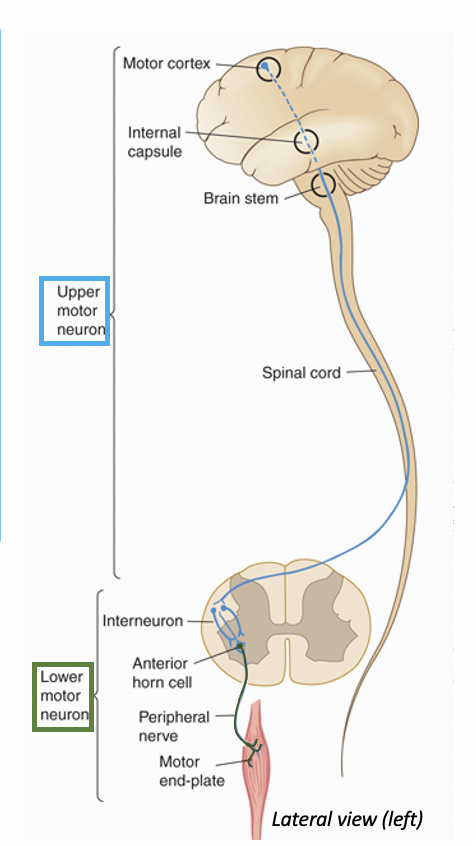
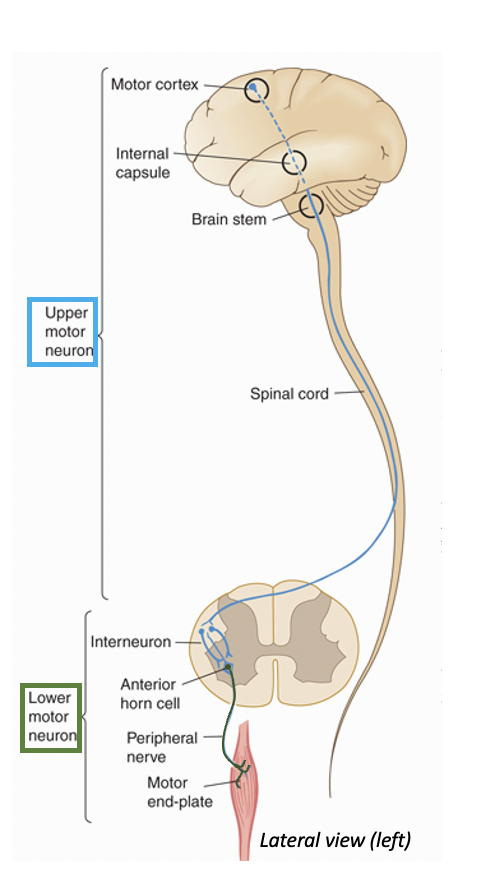
What are the 2 neurones involved in a typical motor pathway?
Upper motor neurone (UMN):
- originates in cerebrum and subcortical structures
- descends to either the brainstem or the spinal cord to stimulate a LMN
Lower motor neurone (LMN):
- originates from the brainstem (cranial nerve nuclei) and spinal cord (ventral grey horm)
- gives rise to peripheral nerves (cranial or spinal nerves) that travel to motor end plates / neuromuscular junctions
What are the typical symptoms and causes of UMN and LMN lesions?
UMN lesion:
- leads to hyperreflexia** and **hypertonia
- pathological reflexes may be present - e.g. positive Babinski sign
- typical causes include:
- stroke at the level of the cortex / internal capsule
- tumours compressing the pyramids or pons
LMN lesion:
- leads to muscle weakness, hyporeflexia and hypotonia
- typical causes include:
- trauma to the peripheral nerve
- tumours of the ventral grey horn
- demyelination
- lack of blood supply
Describe the main pathway of the corticospinal tract
- precentral gyrus sends an UMN which descends via the posterior limb of the internal capsule
- UMN descends through the cerebral peduncles, ventral pons and into the medulla
- within the medulla, the UMNs collect together to form the pyramids
- at the cervicomedullary junction, 90% of fibres cross the midline as the decussation of the pyramids
- these fibres will enter the CONTRALATERAL lateral corticospinal tract
- the lateral corticospinal tract descends to reach a specific level of the spinal cord and then sends its axons to the ventral grey horn
- LMN travels from the ventral grey horn to innervate a specific muscle of the body
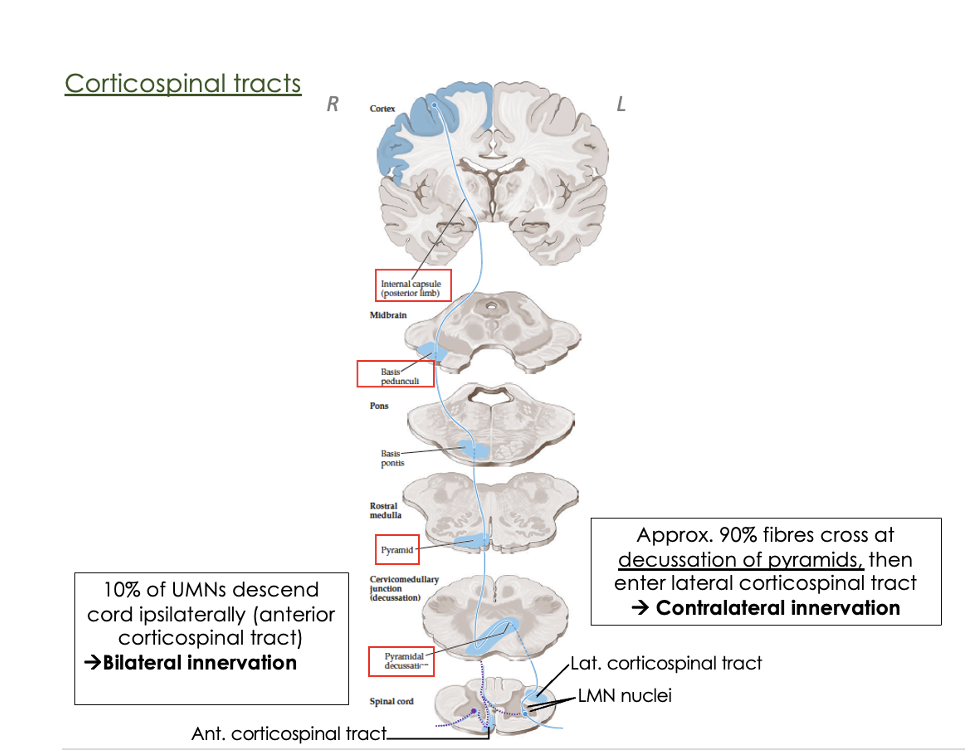
What happens to the fibres that do not cross the midline at the decussation of the pyramids?
- 10% of descending fibres do not cross the midline at the decussation of the pyramids in the caudal medulla
- these fibres enter the IPSILATERAL anterior corticospinal tract
- some fibres will travel to the contralateral ventral grey horn and some will travel to the ipsilateral ventral grey horn
- this provides bilateral innervation
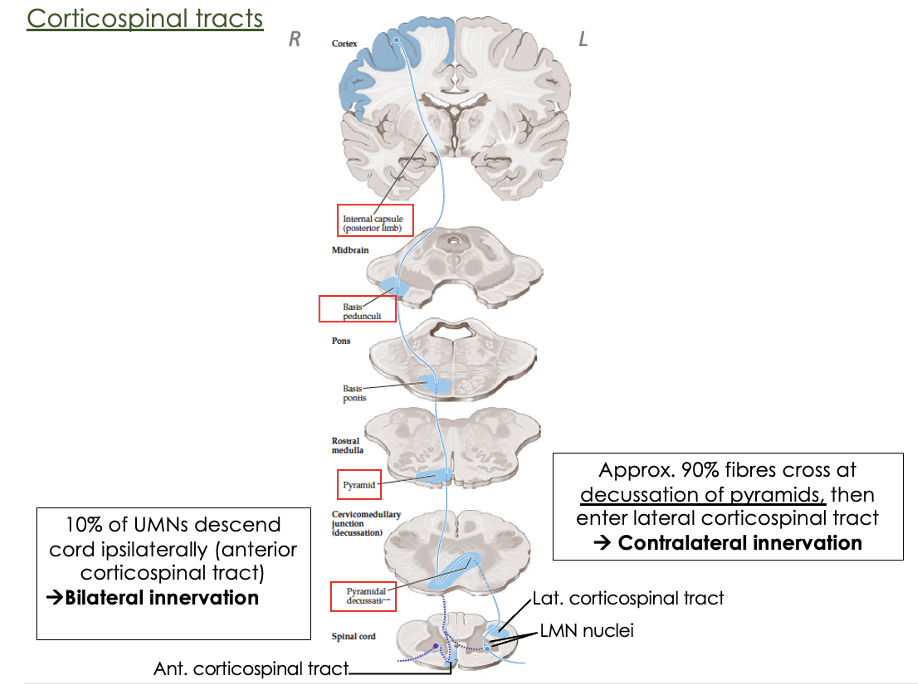
What is significant about the corticospinal tracts being able to provide contralateral and bilateral innervation?
Contralateral innervation:
- provided by the lateral corticospinal tract
- mainly for the upper and lower limbs
- CST is particularly important for the flexor functions of the upper limb
Bilateral innervation:
- provided by the anterior corticospinal tract
- mainly for axial and proximal girdle muscles
Where can the corticospinal / corticobulbar tracts arise from?
Where do they pass after this?
- they mainly arise from the precentral gyrus
- they can also arise from the sensorimotor strip of the postcentral gyrus (BA 3) and the premotor & supplementary motor areas (BA 6)
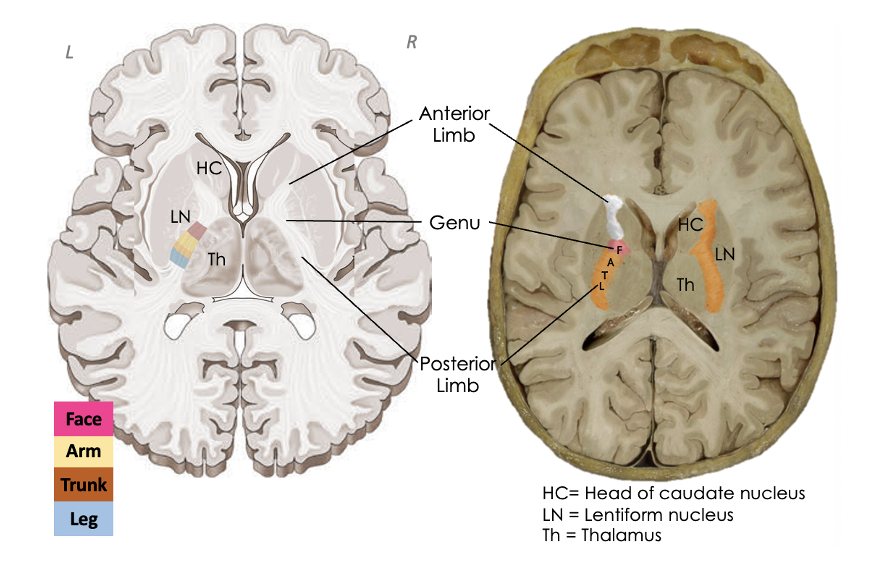
- fibres pass from the cortex via the corona radiata and enter the posterior limb of the internal capsule
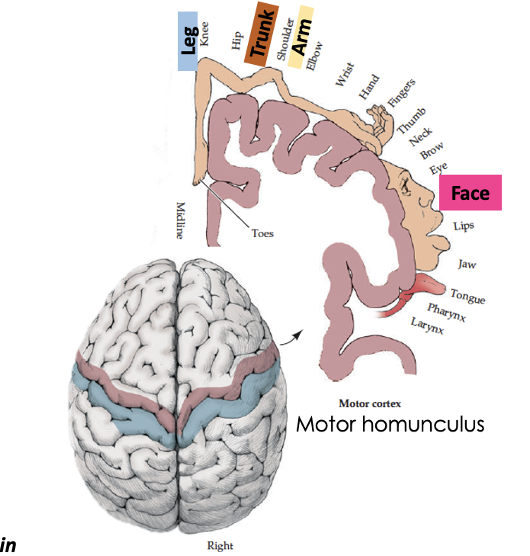
How is somatotopic organisation maintained at the level of the internal capsule?
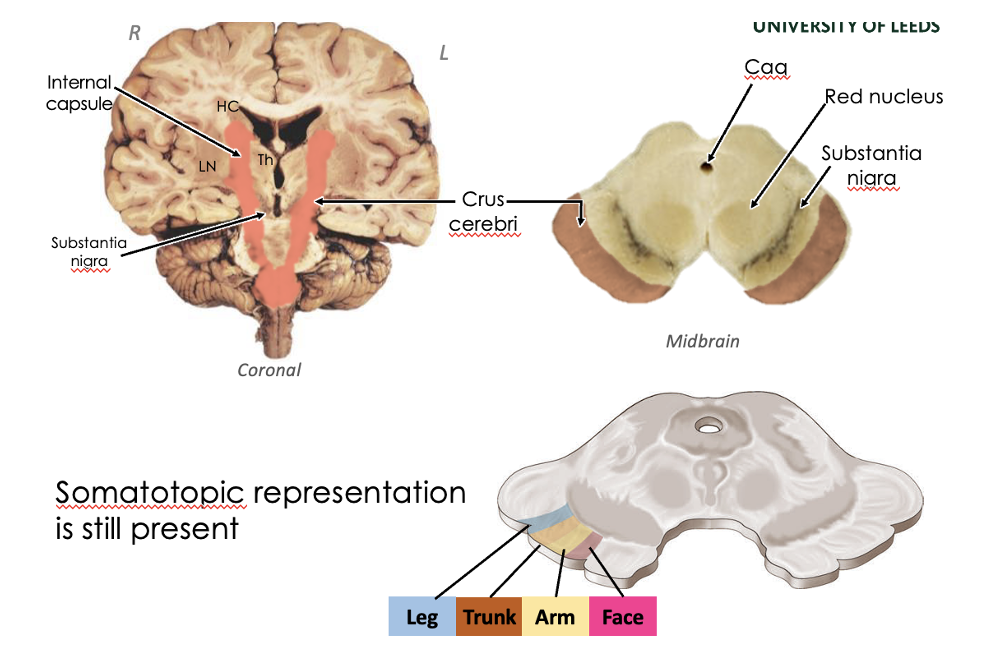
- descending corticospinal / corticobulbar fibres retain somatotopic representation as they pass through the internal capsule
- motor neurones passing to the face are located more anterior and travel through the genu and anterior part of the posterior limb
- motor neurones passing to the legs are located most posterior in the posterior limb of the IC
How is somatotopic organisation maintained as fibres pass from the internal capsule to the next structure?
- the internal capsule connects to the crus cerebri (cerebral peduncles)
- neurones travelling to the face are located more medially
- neurones travelling to the legs are located more laterally
How do corticospinal fibres appear as they travel through the pons?
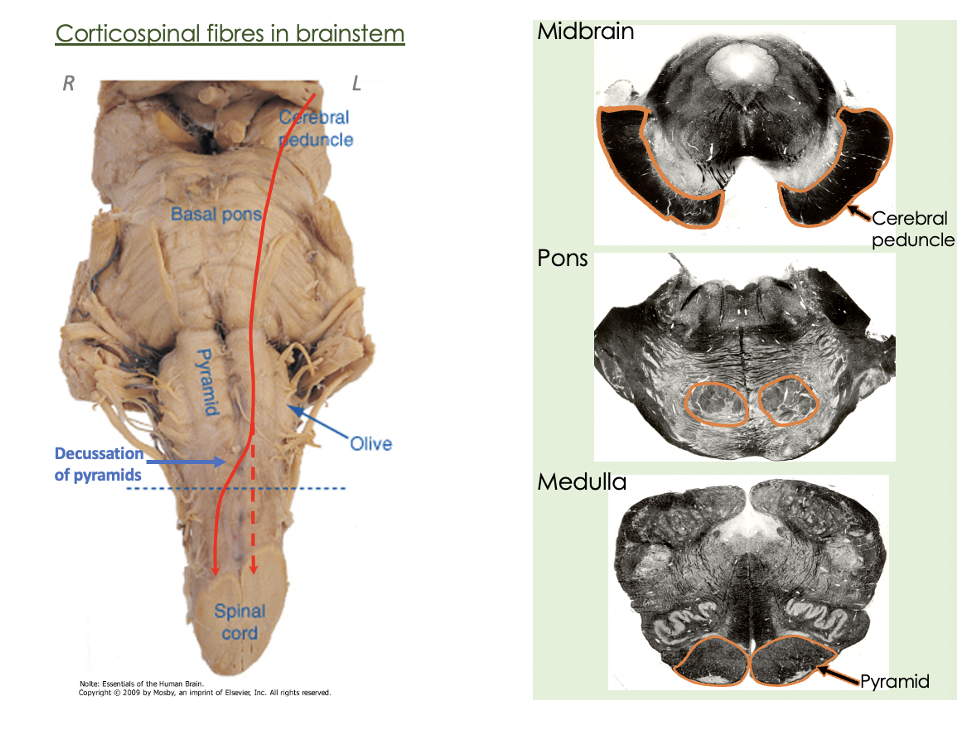
- as they pass through the ventral pons, the corticospinal tracts appear as scattered fascicles
- this is due to the presence of transverse pontine fibres travelling between the pons and cerebellum
- the fibres recollect as the pyramids at the level of the medulla
What fibres are found within the lateral corticospinal tract?
Where do they meet the LMN and what does this innervate?
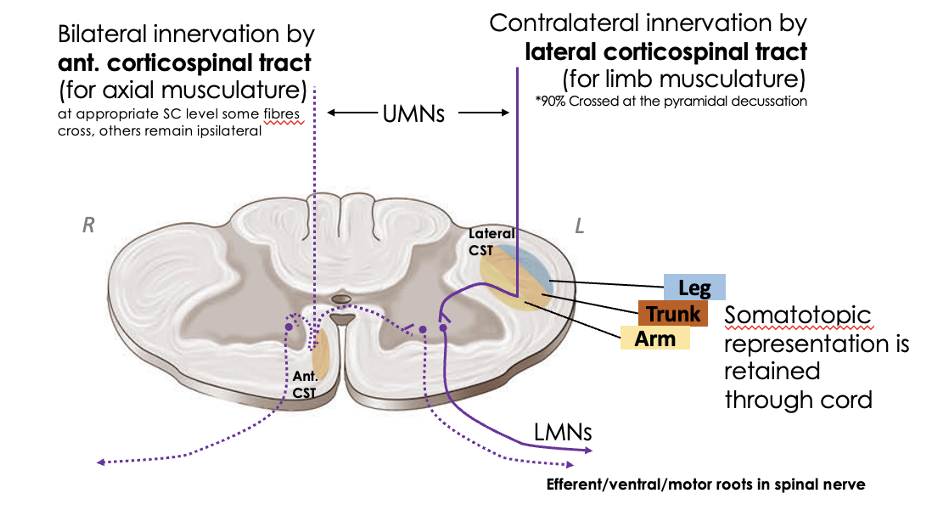
- the lateral CST contains the 90% of fibres that crossed the midline at the pyramidal decussation of the medulla
- they synapse with the LMN within the CONTRALATERAL ventral grey horn
- they provide contralateral innervation to the limb musculature
What fibres are found within the anterior corticospinal tract?
Where do these meet the LMN and what does this innervate?
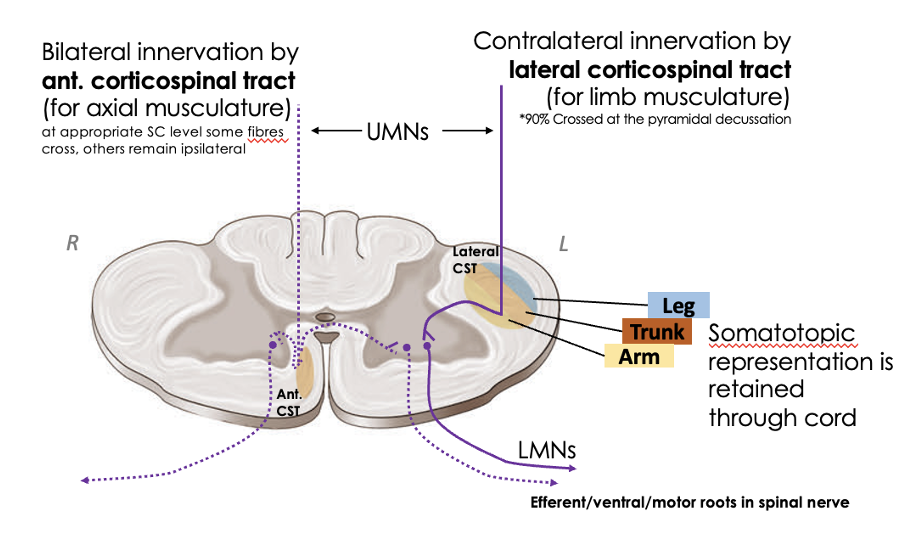
- the anterior CST contains the 10% of fibres that did NOT cross the midline at the pyramidal decussation
- at the appropriate spinal cord level, some fibres will cross the midline via the ventral white commissure and some will remain ipsilateral
- the UMN synapses with the LMN in either the ipsilateral or contralateral ventral grey horn
- this provides bilateral innervation to the axial musculature
What are the 4 main corticobulbar tracts?
- corticobulbar tracts pass from the cortex to the brainstem
- corticonuclear (travel to cranial nerve nuclei)
- corticorubral (to red nucleus)
- corticoreticular (to reticular formation)
- corticocollicular (to superior colliculus)
What is the purpose of the corticoreticular pathway?
- it passes to the reticular formation of the pons and medulla
- the pons gives rise to the medial reticulospinal tract and the medulla to the lateral reticulospinal tract
- the corticoreticular pathway provides a route for cortical control over the reticulospinal descending pathways via inhibitory interneurones
What is the corticorubral pathway and how is it organised?
- this runs from the cortex to the red nucleus
- it allows for cortical control over the rubrospinal pathways
- these are diminished in humans with most fibres only going to cervical regions
- it is somatotopically organised such that upper limb fibres travel in the dorsal part and lower limb fibres travel in the ventral part
What is the purpose of the corticocollicular pathway?
- this allows for cortical input to the superior colliculus and horizontal gaze centres
- this allows for cortical coordination of voluntary and involuntary eye movements


-
Development of the Nervous System85
-
Spinal Cord14
-
Blood Supply to the Brain56
-
Cranial Nerves - V & VII49
-
Cranial Nerves - IX, X, XI & XII27
-
Cranial Nerves - Blood Supply & Reflexes41
-
Cranial Nerves - III, IV & VI41
-
Cortical Localisation & Subcortical White Matter72
-
Diencephalon53
-
Visual Pathway34
-
Auditory Pathway34
-
General Sensation43
-
Descending Pathways34
-
Cerebellum42
-
Basal Ganglia51
-
Limbic System41



