What’s dependence?
dependence - an adaptive state associated with withdrawal symptoms if exposure to the substance/stimulus is stopped
What effects do opioids produce?
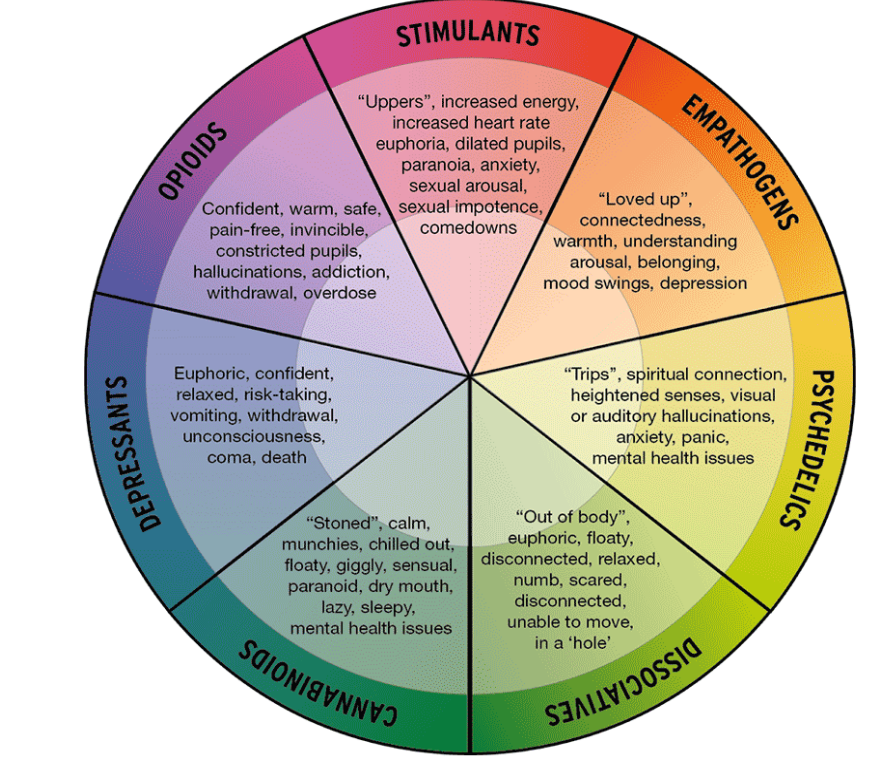
Opioids
- confident, warm, safe, pain-free, invincible /pl niepokonany/
- constricted pupils, hallucinations, addiction, withdrawal, overdose
What effects do stimulants produce?
Stimulants
- increased energy
- increased HR, dilated pupils
- paranoia, anxiety
- sexual arousal but impotence
What effects do empathogens produce?
Empathogens
- loved, connected, warmth, understanding, arousal, belonging
- depression, mood swing
What effects do psychedelics produce?
Psychedelics
- ‘trips’, spiritual connection
- heightened senses, visual/auditory hallucinations
- anxiety, panic, mental health issues
What effects do dissociatives produce?
Dissociatives
- ‘out of the body’, floating
- euphoric, disconnected, relaxed
- scared, unable to move, ‘in a hole’
What effects do cannabinoids produce?
Cannabinoids
- calm, chilled out, giggly, sensual
- paranoid, dry mouth, lazy, sleepy, mental health issues
What effects do depressants produce?
Depressants
- euphoric, confident, relaxed
- risk-taking, vomiting, withdrawal
- unconsciousness, coma, death
Drugs belonging to class A
- examples
- prison length
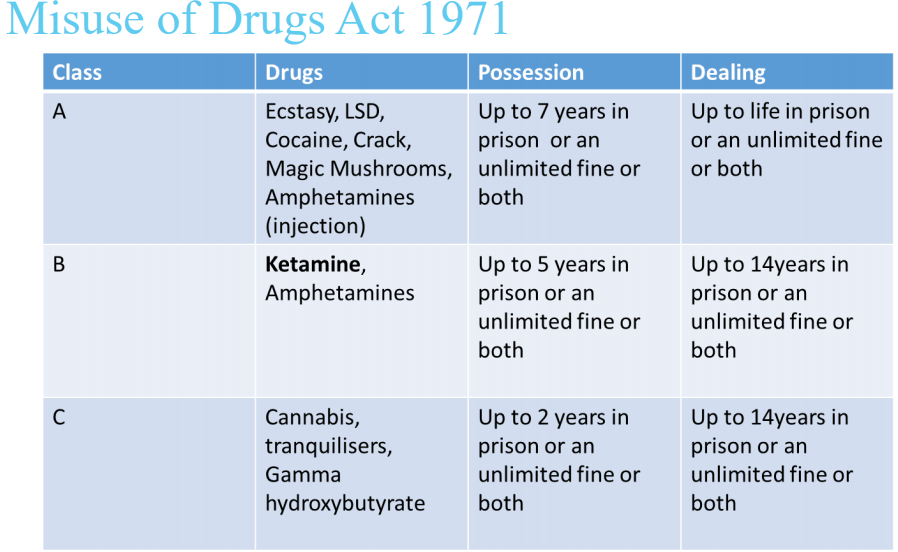
Class A
Examples: ecstasy, LSD, crack, cocaine, magic mushrooms, amphetamines (injections)
Prison:
- possession - up to 7 years
- dealing - up to life in prison
Drugs belonging to class B
- examples
- prison length
Class B drugs
Examples: Ketamine, Amphetamines (non-injection)
Prison:
- possession - up to 5 years
- dealing - up to 14 years
Drugs belonging to class C
- examples
- prison length
Class C drugs
Examples: cannabis, tranquilizers, gamma hydroxybutyrate
Prison:
- possession - up tp 2 years in prison
- dealing - up to 14 years in prison
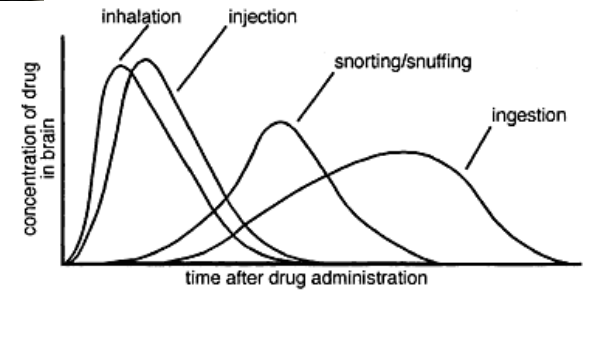
What is the fastest method of drug delivery that affects drug concentration in the brain?
Inhalation, then injection
What are the effects of cocaine similar to?
Halfway between amphetamine and ecstasy
(euphoria, love, agitation, isomnia)
How do amphetamine, cocaine and Ecstasy (MDMA) work on a physiological level?
Amphetamine, cocaine and ecstasy:
- all increase levels of monoamines (dopamine, serotonin, noradrenaline)
*different balance of monoamines - different behaviors:
A. amphetamine - mostly dopamine
B. Ecstasy - mostly serotonin
Physiological effects of cocaine
Cocaine
- Na+ channel blocker (anaesthetic)
- stimulant; appetite supressant
- Triple re-uptake inhibitor (noradrenaline, dopamine, serotonin)
What is more dangerous: cocaine or amphetamine?
- Cocaine is more dangerous
- due to Na+ channel blockage (coronary and myocardial disease - sudden death)
What’s ‘crack’?
- components
- effects
‘Crack;
Mixture of: cocaine + sodium bicarbonate (baking soda) + water
Effects: immediate ‘high’ when inhaled
What’s ‘speedball’?
- components
- why it is dangerous?
‘Speedball’
Mixture of: heroin + cocaine (injection)
*it is particularly dangerous because it masks symptoms of OD
What are the physiological effects of Ecstasy (MDMA)?
- block serotonin & dopamine re-uptake -> more in the synaptic cleft
Ecstasy
What are the fatal adverse effects?
Ecstasy
- hyperthermia
- dehydration
- overhydration* - as ADH is suppressed
*due to fatal hyponatraemia - occurs in those who consume excess water without replacing electrolytes (ADH suppression)
Ketamine
- class
Ketamine
- complex, multiple sites action
Class: NMDA receptor antagonist - glutamate receptor antagonist
Effects of Ketamine
Ketamine effects
Overall: NMDA receptor antagonist (glutamate receptor antagonist)
Effects: disconnection of thalamocortical and limbic systems -> dissociation of CNS from outside stimuli (e.g. pain, sound, sight)
‘sensory isolation’ is produced
- anaesthesia -> slurred speech, immobilisation
- euphoria
- amnesia
What happens to SNS with intake of Ketamine?
Ketamine
SNS stimulant -> ventilatory system is maintained
*used in paediatric sedation and in psychiatry
LSD
*physiological effects
* what is the adverse effect?
LSD
Physiological effect: serotonin agonist
- very potent - even if people leak small amount - will have a powerful effect lasting even a week
Adverse effect: causes flashbacks - chronic psychiatric problems (10-20 years later)


-
Infections in Pregnancy31
-
Vomiting and diarrhoea in children25
-
Gastro-duodenal disease29
-
Haematology in GI disorders (anaemia)29
-
Liver and pancreas pathophysiology39
-
Causes of Abdo pain31
-
Abdominal pain in pregnancy40
-
Antibiotics48
-
Paediatric prescribing21
-
Pharmacological Mx of epilepsy42
-
Drug Overdose57
-
Alcohol and health25
-
Female pelvic pain33
-
SIM session_useful info11
-
Lower GI bleeding35
-
Upper GI bleed48
-
Drug dependency46
-
GI genetics56



