ARDS Diagnosis
What is important in the dx of ARDS from other respiratory problems?
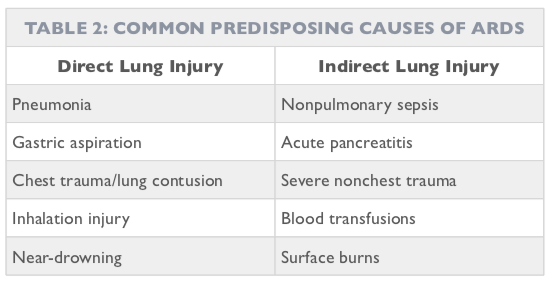
Identification of an underlying cause or inciting event is important in differentiating ARDS from other lung diseases or syndromes that may be misidentified as ARDS
What are the most common causes of ARDS?
Pulmonary and non Pulmonary sepsis
What are the presenting ARDS sx? Progress to what?
- dyspnea, cough, SOB
- altered mentaiton, hypercapnia, tachypnea
*leukocytosis is nonspecific, but can suggest underlining cause is an infection
What do we see on CXR in ARDS?
- b/l, diffuse airspace infiltrates
- patchy infiltrates become more confluent as the syndrome evolves

Which cells are injured in ARDS? When?
- Type I pneumoncyte injury - accounts for early disease due to disruption of barrier integrity; accounts for movement of fluid out of capillary compartment (=pulmonary edema)
- Type II pneumoncyte injury - leads to impaired surfactant function that contributes to the atelectasis and worsening pulmonary compliance
Increases in pulmonary artery pressures secondary to ______, decreases in pulmonary circulation _____, and direct damage to the vascular endothelium lead to _______. Together, each of these contributes to increased ______.
Increases in pulmonary artery pressures secondary to hypoxemic pulmonary vasoconstriction, decreases in pulmonary circulation due to microthrombi, and direct damage to the vascular endothelium lead to worsening dead space ventilation. Together, each of these contributes to increased work of breathing
What are the stages of ARDS?
- Exudative
- Proliferative
- Fibrotic OR Resolution
What happens in the proliferative stage?
- Type II pneumocytes begin to regenerate in order to reconstitute the surfactant layer
- Type I cells rebuild the damaged alveolar epithelium
- can lead to healing very quickly
As vascular changes in the exudative phase become more irreversible, the risk of what increases?
Pulmonary HTN
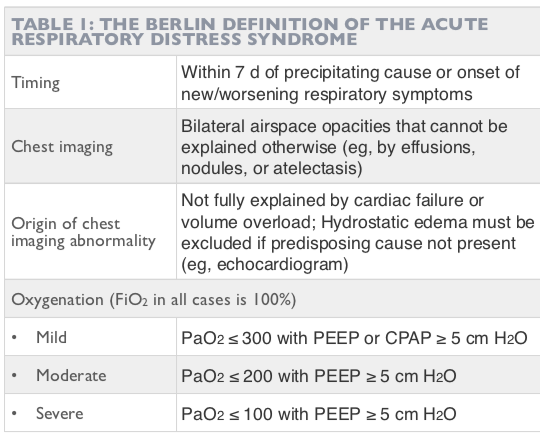
What do you need to dx ARDS?
- b/l infiltrates
- Hypoxemia (PaO2/FiO2 =200
- abrupt onset of sx
- noncardiac in nature
*helfpul to have DADs, but not required for clinical dx
What is ventilator induced injury?
The abnormalities in surfactant physiology characterizing ARDS lead to excessive closure of some alveoli during expiration. Repeated closure and over distention leads to additional alveolar damage
How does mechanical ventilation improve ARDS?
- allows decreased work of breathing by off-loading respiratory muscles and improving effective minute ventilation
- as the work of breathing decreases, CO2 production is decreased and overall acid-base status is improved.
What is a danger to using mechanical ventilation? What is a possible solution?
- Atelectatic segments, especially those in an area of transition near normal lung, are especially susceptible to overstretching during the inspiratory phase of respiration. The abnormalities in surfactant physiology characterizing ARDS lead to excessive closure of some alveoli during expiration.
- Lower tidal volumes
What is HFOV?
- High frequency oscillatory ventilation
- provides low tidal volumes with increases RR
- decreases risk of over distention
Conservative fluid management reduces what?
the number of days spent on a ventilator and in the ICU in ARDS pts without causing nonpulmonary organ dysfunction
Benefits of Extracorporeal membrane oxygenation (ECMO)
Extracorporeal membrane oxygenation (ECMO) has the advantage of supporting hypoxemia without the potentially injurious ventilator settings sometimes needed in severe ARDS. Extracorporeal membrane oxygenation (ECMO) has the advantage of supporting hypoxemia without the potentially injurious ventilator settings sometimes needed in severe ARDS. Some of the positive results may reflect that centers comfortable with ECMO may also be expert in general ARDS management.Extracorporeal membrane oxygenation (ECMO) has the advantage of supporting hypoxemia without the potentially injurious ventilator settings sometimes needed in severe ARDS. Some of the positive results may reflect that centers comfortable with ECMO may also be expert in general ARDS management.Extracorporeal membrane oxygenation (ECMO) has the advantage of supporting hypoxemia without the potentially injurious ventilator settings sometimes needed in severe ARDS. Some of the positive results may reflect that centers comfortable with ECMO may also be expert in general ARDS management.
What must always be addressed in ARDS patients?
underlying cause
Prophylaxis must be taken to avoid what comorbidities in ARDS pts
- DVTs
- bleeding
- stress ulcers
- raise bed to 30 degrees to avoid ventilator associated pneumonia
*perform daily screenings to see if they are able to be removed from the ventilator along with daily interruption of all sedative and analgesic infusions
What is the #1 predictor of outcome in ARDS?
- Hypoxemia
- others include: age, no decreased O2 by day 7, length of stay, net positive volume stasus, sepsis
A review of 1-year ARDS survivors found that none of the patients were requiring oxygen supplementation and their lung function testing, with the exception of ________ had returned to normal. Most frequently patients experienced functional limitation caused primarily by ________. ________ administration and prolonged duration of _______ are associated with more functional sequelae in these ARDS survivors
A review of 1-year ARDS survivors found that none of the patients were requiring oxygen supplementation and their lung function testing, with the exception of low diffusion capacity, had returned to normal. Most frequently patients experienced functional limitation caused primarily by muscle weakness and fatigue. Corticosteroid administration and prolonged duration of respiratory failure are associated with more functional sequelae in these ARDS survivors

-
Pharmacodynamics DSA20
-
Cholinergic DSA17
-
Cholinergic Drugs61
-
Stars on Dr. Martin's slides9
-
BPH/ED Pharm18
-
Pharm orientation and scope15
-
Adrenergic Drugs42
-
Biotrans/PD/CT21
-
Anit fungal/influenza/TB108
-
Radiographs29
-
Micro Review19
-
Quick Review46
-
Sketchy meds10
-
Pulmonary HTN Pharm11
-
HTN Pharm15
-
DSA ARDS22
-
DSA Approach to Cough22
-
DSA Approach to Dyspnea12
-
DSA Pulmonary HTN11
-
DSA Fever50
-
DSA Lightheadedness, Dizziness, Syncope8
-
Things I always forget74



