Hypoglycemic Event
- Critically low serum glucose
- Can lead to seizures
Hypoglycemia Treatment
- Mild hypoglycemia is 10 to 15g of either PO or IV
- Complex carbohydrates by mouth
- PO: 4oz of orange juice (unless patient has renal failure with lower potassium, lower water options are better).
- IV glucose: 12.5g - 25g (amp)
- D5W has 5g of dextrose per 100ml (20 calories)
- D50W has 50g of dextrose per 100ml (12.5g of carbohydrate and 50 calories)
- Glucagon: given only if IV glucose is not possible
- ↓ GI motility, monitor for nausea/vomiting
SIADH Clinical Indications
- Lethargy
- Headache
- Nausea/Vomiting
Syndrome of Inappropriate Antidiuretic Hormone (SIADH)
- Increase in antidiuretic hormone (ADH) and water intoxication.
- Causes the retention of water, dilution of sodium, and serum hypo-osmolality.
- Hyponatremia
- Watch for cerebral edema and seizures
- Frequently occurs in oat cell carcinoma of the lung and other malignancies
- Too much ADH > Water retention > ↓ serum Na, ↓ urine output, ↓ osmolality
Hypoglycemia Early Signs
- Early signs mediated by the sympathetic nervous system which acts to mobilize glucose stores.
- Tachycardia
- Tachypnea
- Diaphoresis
- Palpitations
- Irritability
- Restlessness
- Late signs related to low glucose levels in the brain (neuroglycopenia)
- Confusion
- Lethargy
- Slurred speech
- Seizure
- Coma
Diabetic Ketoacidosis (DKA)
- Absolute insulin deficiency
- glycogenolysis
- gluconeogenesis
- Causes the incomplete breakdown of free fatty acids
- Results in ketones in the blood and urine
- **Positive ketones
Hyperosmolar Hyperglycemic State (HHS)
- Relative insulin deficiency
- glycogenolysis
- **Negative ketones
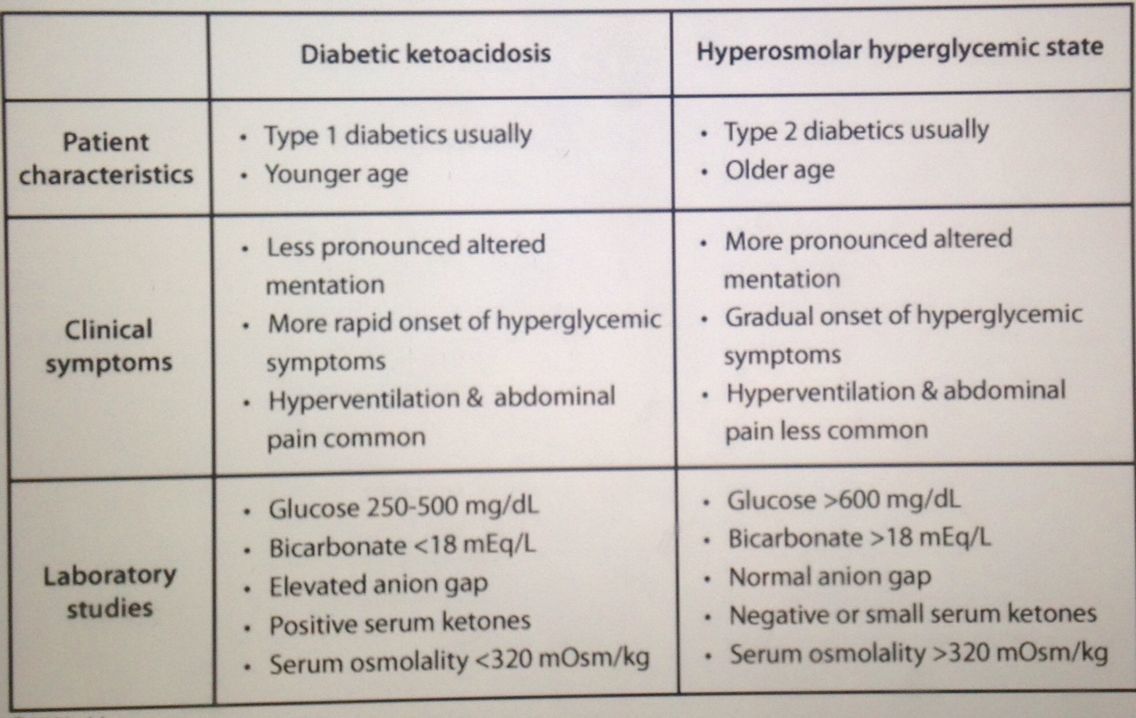
DKA vs. HHS
DKA
- Lower serum glucose
- Higher insulin
- Absolute insulin deficit
- Lower fluid deficit
- Lower potassium deficit
HHS
- Higher serum glucose (more osmotic diuresis)
- Greater potassium deficit
- Less insulin
- Relative insulin deficit
- Higher fluid deficit
Hyperglycemia
- Caused by insulin deficiency and therefore the inability of insulin to move into the cell
- Leads to:
- Hypertonic diuresis
- Dehydration
- Elevated serum osmolality
- Glyconeogenesis -> acidosis, hyperkalemia
Glyconeogenesis
- Causes the breakdown of fats and proteins for energy
- Results in an increase in ketone bodies and acidosis
- Causes potassium to move out of the cell and into the serum (hyperkalemia)
Diabetes Insipidus
- Decreased amount or effect of antidiuretic hormone
- Massive diuresis / Polyuria
- Urine is low in sodium and specific gravity
- Sodium concentrates in the blood,
- –>Hypernatremia
- –>Hyperosmolality
- Dilute urine (specific gravity 1.001 - 1.005)
- Not enough ADH > water loss > ↑serum Na, urine output low urine S.G., ↑ serum osmolality
Antidiuretic Hormone
Causes the retention of water, not the retention of sodium
Does not affect serum glucose levels
Patients with low calcium or magnesium levels should be monitored for what?
Tetany
Somogyi Phenomenon
Due to the release of counterregulatory hormones (epinephrine, glucagon, glucocorticoids, and growth hormone). after hypoglycemia.
Suspected when the morning serum glucose is unexpectedly elevated.
Counterregulatory Hormones
- Epinephrine
- Glucagon
- Glucocorticoids
- Growth Hormone
Why monitor serum glucose in patient receiving enteral feedings?
High-glucose enteral feedings increase risk of developing glucose intolerance and hyperglycemic hyperosmolar state (HHS)
-Requires monitoring of serum glucose and sliding scale insulin to prevent development of HHS and life-threatening dehydration.
Glucagon
Hormone that causes the body to mobilize glucose
-indirect way to increase the serum glucose and will take longer than giving glucose directly
Patient education with the medication acarbose
Acarbose is an a-glucosidase inhibitor. -
Delays digestion of ingested carbohydrates
- Results in smaller rise in serum glucose after meals
- Simple sugar must be given for hypoglycemia
- Instruct patients to carry glucose tablets for signs of hypoglycemia
Demeclocycline
Given for SIADH
- Blocks the action of ADH or ADH-like substance on the renal tubes
- Allows diuresis to occur
What hormone regulates sodium levels
Aldosterone
Diabetic Ketoacidosis Treatment
Rapid infusion of normal saline
- Regular insulin intravenous injection followed by infusion
- Potassium replacement
- Dextrose should be added to the NS or 1/2 NS (depending on serum osmolality) when the blood glucose decreases to less than 250 mg/dl but only in a concentration of D5W.
Metformin side effects
Lactic acidoses and Rhabdomyolysis
- weakness
- fatigue
- muscle pain
- abdominal discomfort
Rate for serum glucose reduction
50 to 100 mg/dl/hr Rapid reduction in serum glucose reduces the intravascular osmolality so that fluid moves into the more hypertonic brain cells causing cerebral edema
Which medication would prevent the early symptoms of hypoglycemia?
Sympathetic blocking agents like Metoprolol.
-Early signs of hypoglycemia are mediated by the sympathetic nervous system (tachycardia, nervousness, diaphoresis)

-
Professional Caring & Ethical Practice 20%25
-
Behavioral/Psychosocial 4%39
-
Integumentary and Musculoskeletal Systems 2%29
-
Hematologic and Immunologic Systems 4%35
-
Endocrine System 4%41
-
Gastrointestinal System 5%64
-
Renal System 5%56
-
Multisystem 14%14
-
Neurologic 7%98
-
Hemodynamic Concepts16
-
Nursing Illustrations24
-
Cardiology34



