what is epigenetics?
changes in organisms caused by modification of gene expression rather than alteration of the genetic code
(not modifying DNA, but modifying which genes are switched on / off)
what is genome and what is epigenome?
genome: complete set of genes / genetic material present in a cell or organism. 3 billion bp in human. static.
epigenome: bits of the genome that are switched on / off. flexible - can change with age and environment ( the epigenome describes modifications to the genome that do not affect the DNA sequence but determine whether genes are switched on or off where and when they are needed.)
what are epigenetic influences?
- environment (e.g. state of mind, diet, social contact, state of gut, exercise, chemicals - drugs, smoking, season / circadian rhythm)
when is epigenetic life?
why is it difficult to predict what the final outcome of epigenome is going to be?
- changes in epigenome through: pre-conception -> embryo -> infancy -> childhood -> adolescence -> early adult -> adult -> maturity
- cumulative effects makes epigenome difficult to predict what the final outcome will be. also is flexible - so changes
what is epigenetic drift?
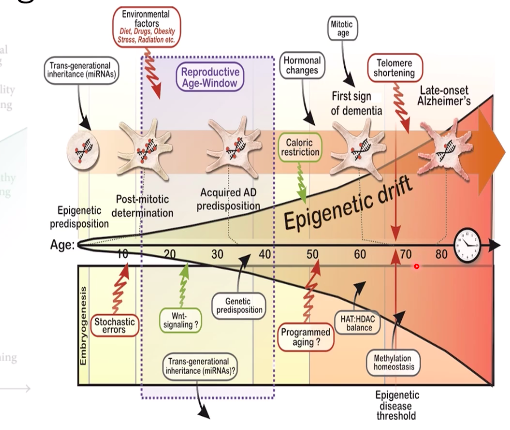
- environmental exposure to different epigenetical determines epigenetic drift. epigenetic drift gets bigger as we get older
- as move through life, environment plays bigger role on epigenome.
- means we have a biological age and chronological age
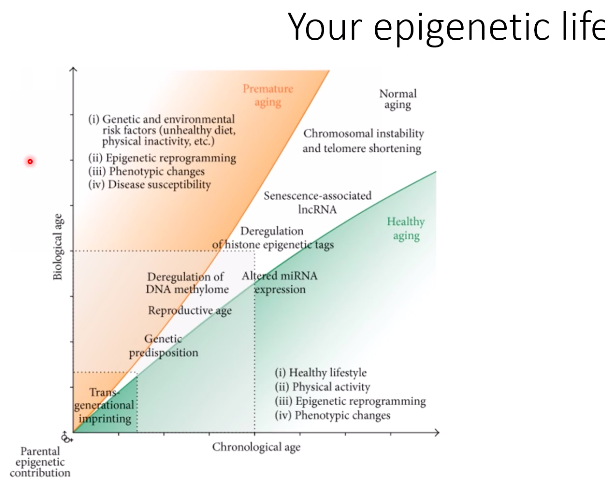
explain how modifying epigenetic environment can increase / decrease liklihood to getting disease?
- everyone has an individual epigenetic predispostion to disease. but acquired epigenetic mutations can make someone meet the threshold for onset of symptoms earlier / later than expected
describe how identical twins from same genome and within same amniotic membrane have different outcomes from leukomia cells
- pre-leukaemic cells present in both twins
- only progressed to leukaemia in one twin.
- environment sub. birth = different.
acute lymphoblastic leukaemia often developens spotaneously from fusion of two genes
which part of epigenome is inherited?
- DNA methylation is inheritable
why is there a difference in epigenome heritabilty between males and females?
females: germ cells are produced in developing fetus -> affects F1 and F2 directly, F3 indirectly (grandmother can effect grandchildren epigeneticlly).
e.g. granny smokes when pregnent - effects mother. But within mother, she produces oocytes that produces grandchild. oocytes were already formed when she was in-utero in granny- affects granchild
males:
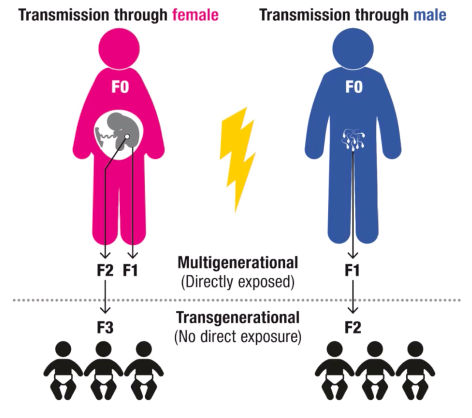
describe which progeny are mutltigenerationally and transgenerationally epigenetically affected from changes to male / female?
multigenerational (directly exposed) - female: = F1 and F2. male: F1
transgenerational (no direct exposure) - female: F3. male: F2
what is the Barker hypothesis?
thrifty phenotype - if a baby in-utero is subject to poor nutrients (because of bad maternal diet), the epigenome is programmed to expect this environment post-natally. means there are developmental changes in cellular energy metabolism, such as: glucose handling, lipid metabolism and mt biogenesis. if exposed to nutrient poor environment postnally: means pre-disposed to have a survival offspring.
BUT
if born and given a nutrient rich environment -> get increased risk of susceptibility to metabolic disease, such as type 2 diabetes, obesity and CHD
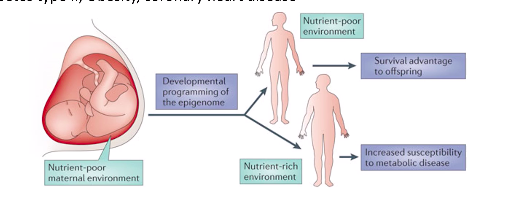
what are the risk factors that are increased bc of Barker Hypothesis? what diseases do they lead to?
- increased adipose tissue, increased lipid accumulation in muscles: type 2 diabetes
- impaired glucose sensing: hyperinsulinemia (means the amount of insulin in your blood is higher than what’s considered normal. )
- leptin resistance in brain (think always hungry): obesity
- lipid accumulation in CV system: CVD
what are the epigenetic mechanisms / regulators of epigenome
- DNA methylation-cytosines
2. micro and small RNAs
3. Histone modification - histones
4. chromatin architecture
what are histones?
how do they influence DNA structure?
Histones are a family of basic proteins that associate with DNA in the nucleus and help condense it into chromatin.
- 8 histones (octamer of core histones) make one nucleosome. histone H1 keeps the keeps the DNA attached to the histones
histone strings are wrapped into helical fibre -> further coils -> compact af!
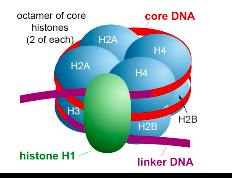
how does DNA packing prevent gene expression?
When the DNA is bound more tightly to the histones, however, it is more difficult for transcription factors and RNA polymerase to bind to the DNA, making it more likely that those genes will be turned off.
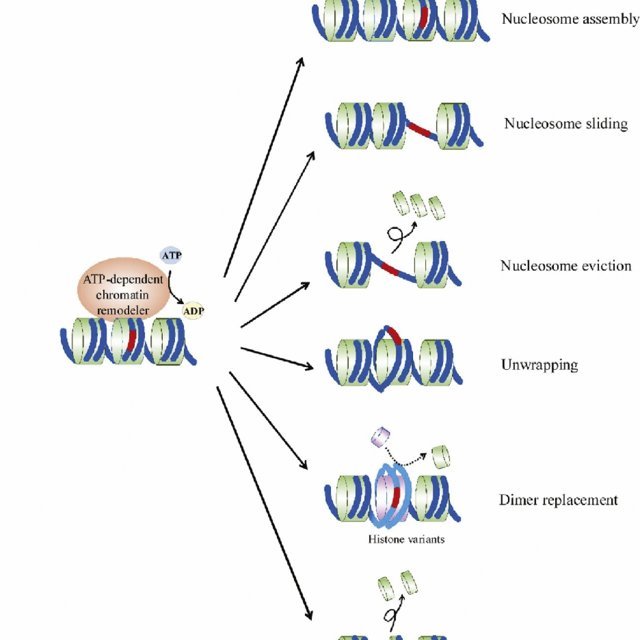
describe how chromatin architecture is changed (a factor than influences epigenome mechanism)
chromatin architecture modifcations
- changes shape of histone / DNA complex
- ATP-depending remodelling:
- complex of proteins sits on the histone nucleosomes. uses ATP. alters:
1. the contact between DNA and histones,
2. the path of DNA wound around histones,
3. the structure of nucleosomes.
normally an immediate effect
explain how histone modifications occurs (a factor than influences epigenome)
where do most modifications occur?
which enzymes used?
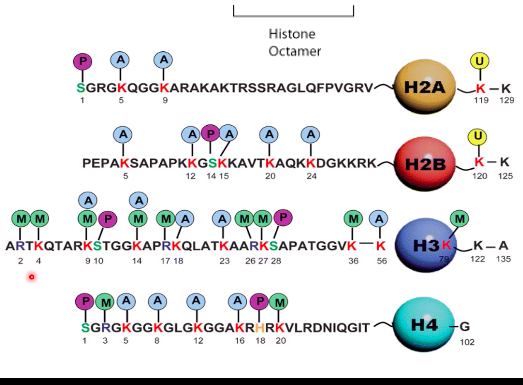
histone modifications
- post-translational modification of histone proteins: acetylation (acetyl functional group added), methylation M (addition of methyl group) , phosphorylation P, ubiquitylation (U)
- most of modifications are on lysine (K) and serine a.a. -> can make active genes by doing this. e.g. H3K4me3 (this is 3 methyl groups on K) OR make genes repressed (e.g. H3K27me3- adding 3 methyl groups to K)
can change histone modifcations using enzymes:
a) histone acetylase (HAT): opens DNA to make it accessible
b) Histone deactylase (HDAC) associated with closing DNA to make it inaccessible
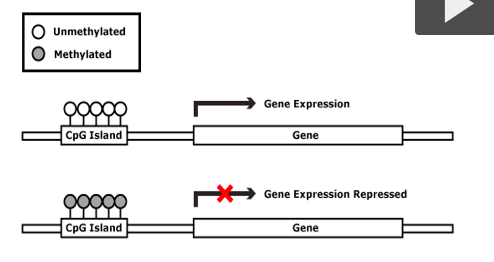
what does DNA methylation usually cause to happen?
represses gene transcription -> gene silencing
how are HDAC inhibitors used in therapy?
*double check this*
HDAC inhibitors increase gene transcription because they keep chromatin relaxed -> opens up the DNA.
explain DNA methylation (a factor than influences epigenome / regulates epigenome)
- where does it often occur?
- what enzyme used?
- which base is methyl added to / what does it make?
- methyl groups can be added / removed from cytosine (the nucleotide base)
- methylation interferes with binding of transcriptional activators -> causes gene inactivation
- occurs when you get areas of DNA where cytosine and guanine are adjacent and repeated (CGCG / CpG islands). found in promoter regions.
- DNA methyltransferase (DNMT) is the enzyme
- methyl is added to cytosine to make 5-methylcytosine.
which a factor that influences epigenome / regulates epigenome is inheritable?
DNA methylation
what happens to DNA methlyation with age?
changes with age:
- DNA methylation decreases in the zygote
- after implantation and development and have embryo, degree of methlyation increases, as more genes are swithed off
how does hypomethylation and hypomethylation change with ageing and how does this influence chance of cancer?
- normal genome is usally hypermethylated and stable (dont need them all genes activated)
- BUT with increased ageing, get genome wide hypomethylation, leads to tumorigenesis
- at tumour suppressor genes, CpG-islands become hypermethylised: locks into an inactive state

-
DNA Structure and Replication29
-
The Human Genome and Chromosomes31
-
Causes of genetic mutations27
-
Genetic Inheritance of Disease22
-
Genetic Variation and Genetic Disease19
-
Epigenetics30
-
RNA translation & protein targeting33
-
RNA Transcription and Processing25
-
Pedigree Practice Examples16
-
Pedigree and Inherited Disease Examples12



