Intrinsic value
How it occurs
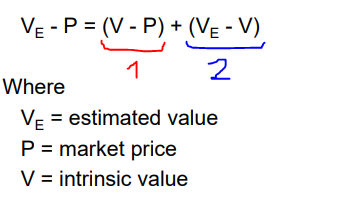
Possible sources of mispricing (Formula)
- Value of the asset given a hypothetically complete understanding of the asset’s investment characteristics
- A mispricing occurs where the market price differs from the intrinsic value
- Active investment managers aim to generate a positive excess risk-adjusted return i.e. a positive Alpha
- Two possible sources of mispricing:
- Genuine mispricing
- Our estimate compared to I. Value = error in analysts estimate
Going-concern value / Liquidation value
- Going-concern: Valuation under the assumption that the company will continue its business activities in the foreseeable future
- Liquidation: Value if the company was dissolved and its assets sold individually
The difference between going concern value and liquidation value consists of intangible assets and goodwill
Fair market value / Investment value
- Fair market value: The price at which an asset would change hands between a willing buyer and a willing seller
- Investment value: The value to a specific buyer taking into account potential synergies and based on investor’s requirements and expectations (That has a potetnial much bigger value to me)
Applications of equity valuation
- Stock selection
- Inferring market expectations
- Corporate event analysis such as mergers, divestitures etc.
- Fairness opinions
- Business strategy analysis
- Shareholder communication
- Private equity valuation
- Share based payment
The valuation process steps
- Understand the business
- Industry analysis (5 forces etc.)
- Competitive position (5 forces etc.)
- Information from regulatory filings, press releases etc.
- Analysis of financial reports (Ratios etc)
- Forecast performance
- Economic forecast (top-down vs. bottom-up)
- Forecast sales, earnings, cash flow (quantitative)
- Financial statement analysis (including footnotes and adjustments)
- Qualitative factors (management, quality of earnings, disclosures)
- Select valuation model
- Estimate intrinsic value
- Make investment recommendation
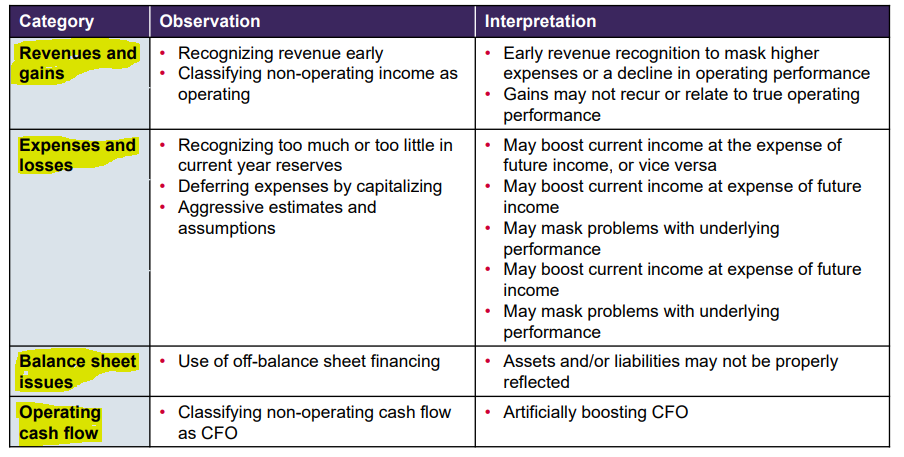
Quality of earnings analysis
Covered in FRA
Valuation models
- Absolute valuation models: Specifies intrinsic value
- Present value models:
- Dividend discount model
- Discounted cash flow models
- Residual income models
- Asset-based models
- Relative valuation models: Method of comparables
- Multiples: assume that comparison asset is fairly valued
- Price-to-earnings
- Price-to-sales
- Price-to-book value
- Price-to-cash flow
Valuation / Model selection criteria
- Consistent with economics of the business
- Availability and quality of data
- Purpose of the valuation
Other issues:
- Control premiums: Ability to influence management and operations adds value to majority ownership
- Marketability discounts: Non-publicly traded companies are more difficult to value and ultimately sell
- Liquidity discounts: Thinly traded securities are more difficult to value and may be more risky than issues with greater liquidity
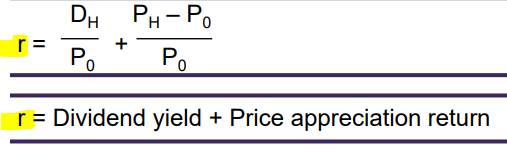
Realized vs. Expected Holding period return
- The selling price PH and the dividend DH are only known at the end of the holding period i.e. a realized holding period return
- If the future sale price and dividend are estimated, this would give an expected holding period return
The investor’s expected rate of return has two components
- The required return
- A return from the price converging to its intrinsic value
Required / Expected return
Definition
3 apporaches
The minimum level of expected return that an investor requires given the asset’s riskiness
The required / expected return on equity = Three popular approaches:
- CAPM
- Multifactor models (Fama-French)
- Build-up method
Expected (ex ante) / Realized Alpha

Internal rate of return
The discount rate that equates the present value of the asset’s expected future cash flows to the asset’s price
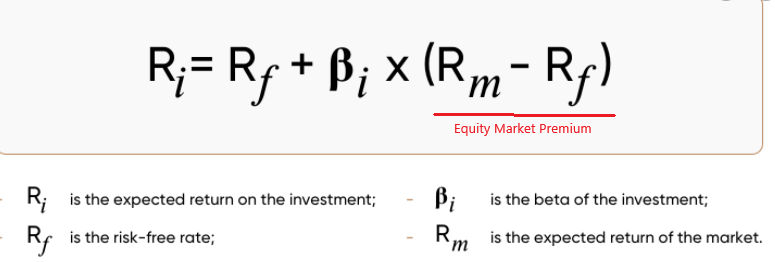
The equity risk premium (ERP)
RM - Rf
The equity risk premium is the incremental return that investors require for holding equities rather than a risk-free asset
Two broad approaches:
- Historical estimates
- Forward looking estimates
ERP: Historical estimates
Historical average of difference between returns from a broad-based equity index and the risk-free (Government Bond) return. Two issues:
- Arithmetic or Geometric mean:
- Arithmetic mean for single period models e.g. CAPM
- Geometric mean is preferred as typically looking at multi-period context
- Risk-free rate: Long-term Government Bond yield preferred to short term T-Bill yield as looking at a multi-period context
Adjusted Historical estimate: Poorly performing companies tend to get removed from major indices, thus overestimating the equity premium
ERP: Forward looking estimates (ex-ante estimates)
Three common ways:
- Gordon Growth Model Equity Risk Premium
= forecasted dividend yield
+ consensus long-term earnings growth rate
– current long-term government bond yield
= > GG: [r = D1 / P0 + g] - current long-term government bond yield
- Macroeconomic models: Multiple regression approach, e.g. Ibbotson and Chen model uses 4 variables to develop the equity risk premium estimate:
- Expected inflation
- Expected growth rate in real earnings per share (GDP growth)
- Expected growth rate in the P/E ratio
- Expected income component (e.g. div yield of S&P500)
=> Compound 1,2,3 (x* x* x) and add 4. => RM - Rf = ERP
- Survey estimates
CAPM
Calculates required return for an investment
Estimating a Beta for a public company
- Regression analysis is regressing stock return against the market
- Issues to consider:
- Choice of index
- Length of data period and frequency of observations
- Adjusting a historic (raw) Beta to make it forward looking
- Commonly adjusted using the Blume method which is an autoregressive model = > Blume method assumes Betas mean revert to one
- Issues to consider:
Adjusted Beta: Blume method
Adjusting a historic (raw) Beta to make it forward looking
Commonly adjusted using the Blume method which is an autoregressive model
Blume method assumes Betas mean revert to one (1* 1/3 = 1/3)

Estimating the Beta for non-public company or thinly traded company
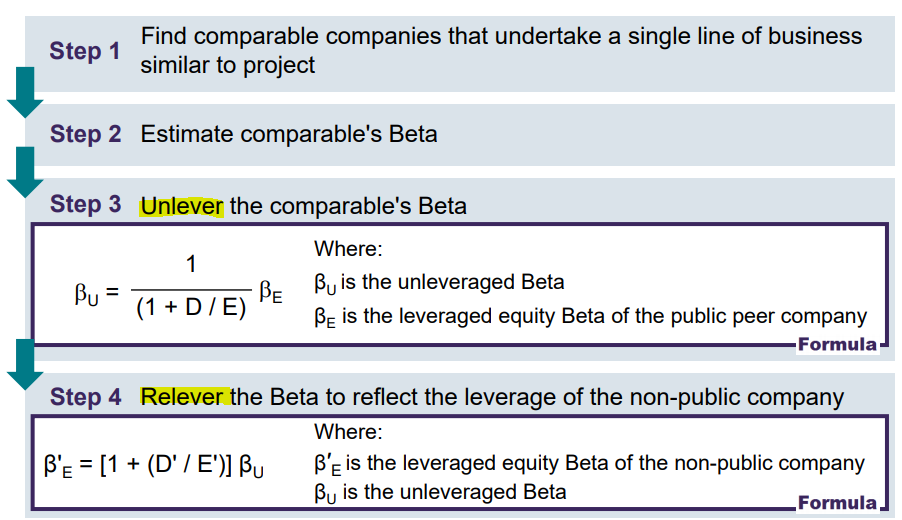
Unlever Beta

Relever Beta
“with debt of 20% in the capital structure”
=> Debt: 20 ; Equity 80 ; Total 100 => D/E = 20/80 = 0.25

Fama-French: Multifactor models
Fundamental Multifactor: Calculating the required return on equity
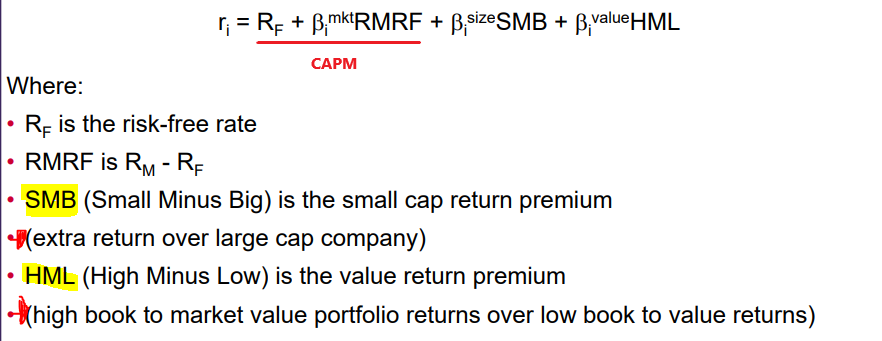
Pastor-Stambaugh model
Extensions to Fama-French:
LIQ is the excess return from investing proceeds from shorting high liquidity stocks into a low liquidity stock portfolio, i.e. earning a liquidity premium
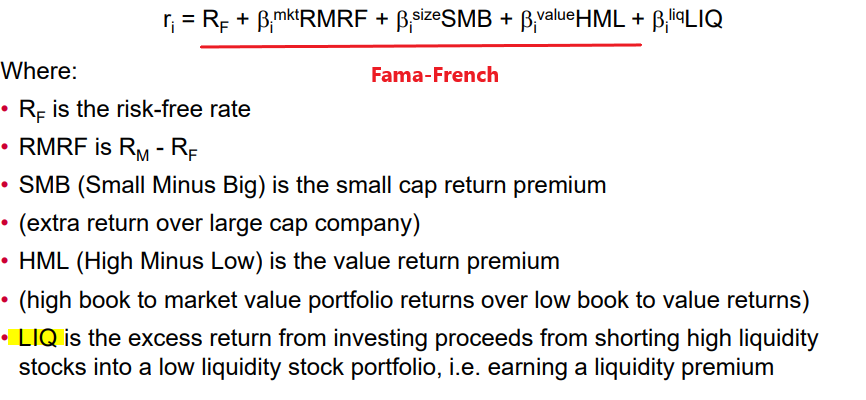
Macroeconomic / Statistical factor models
The required return on equity:
- Macroeconomic factor models
- Factors are economic variables that affect the expected future cash flows and/or the discount rate e.g. five-factor BIRR Model uses the following factors:
- Confidence risk
- Time horizon risk
- Inflation risk
- Business cycle risk
- Market timing risk
- Factors are economic variables that affect the expected future cash flows and/or the discount rate e.g. five-factor BIRR Model uses the following factors:
- Statistical factor models
- Applied to historical returns to determine stock portfolios (acting as factors) that explain returns



