////////////////////////////////////////////////////////////////////////
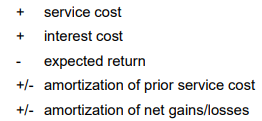
Pension Expense - US GAAP
The amortization of net gains/losses is subject to a “corridor test”. Only if the resultant net figure is greater than 10% of the higher of PBO or asset value, should we amortize. Also, watch out for actual v expected returns. US GAAP uses expected returns.
Pension Expense - IFRS
Net interest cost = Opening funded status x discount rate
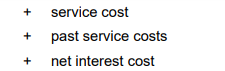
Actuarial gains and losses are known as remeasurements and are taken directly to equity/OCI and not amortized through the income statement. Remeasurement gains/losses include impact caused by changes to actuarial assumptions (e.g. increase life expectancy) and also include the cumulative difference between actual returns on plan assets and the return recognized within the net interest cost (plan assets x discount rate). Past/prior service costs would be recognized immediately in the income statement, unlike US GAAP where such costs are amortized.
Closing PBO, Closing Plan Assets
Ending PBO = Opening PBO + Service cost + Interest cost - Benefits paid +/- Actuarial adjustments +/- Prior service costs + Employee contribution
Closing Plan Assets = Opening Plan Assets + Actual return on investments + Employer contributions + Employee contributions - Benefits paid
Funded Status, TPPC
Funded Status = FV of Plan Assets - PBO
TPPC = Employer Contributions - Change in Funded Status (End - Bgn)
Current Rate Method
For a selfcontained, independent Sub. - prices, financing in foreign currency
Use Current if IFRS and Hyperinflation (cum. Infl. >100%)
Gains / Losses through BS - Currency Translation Adjustment
Assets / Liabilities at Current
Common Stock at Historical
Income Statement at Average
Dividends at Historical
Exposure limited to Net Asset position
Temporal Method
Highly integrated into parent, functional currency not foreign currency
Use Temporal if US GAAP and Hyperinflation (cum. Infl. >100%)
Gains / Losses through IS -> earnings volatility
Monetary Assets / Liabilities at Current
Non-monetary Assets / Liabilities at Historical
Revenues, SGA at Average
COGS, Depreciation, Dividends at Historical
Exposure limited to Net Monetary Asset position
Equity Method
20-50%, significant influence, Joint Ventures
Calculate BS and IS effect
BS:
Original investment at cost (FMV)
+ Prop. Share of EAT
- Prop. Share of Dividends
- Prop. Share of Extra Depreciation (remaining life)
- Prop. Share of de-recognized profits (Upstream / Downstream)
= Year-end carrying value
IS:
Prop. Share of EAT
- Prop. Share of Extra Depreciation (remaining life)
- Prop. Share of de-recognized profits (Upstream / Downstream)
Upstream / Downstream Sale
Upstream: straightforward -> de-recognise profit from BS and IS
Downstream:
- Calculate total profit
- Amount to de-recognise first year: Total profit * How much is remaining * Our ownership
- If sold the next year: Reinstate the stripped out amount calculate in Y1 (PLUS X)
Acquisition Method
>50%, Control
NcI, Goodwill Impairment
- Consolidated Assets / Liab at FV
- Retained acquisition pre -acquisition not recognized
Consolidation = BVA + FMVB
Minority / Non-controlling Interests:
- IFRS: FV of acquiree net assets * (1-ownership)
- US GAAP: FV of acquiree * (1-ownership)
After t1 -> balancing plug
Goodwill Impairment:
- IFRS: Check: Carry Value > Recov. Amount -> Impairment Loss to IS
- US GAAP: if test above: yes -> Goodwill old - Goodwill new (Recov. Amount - FVNA)
Effect of accounting method
Net income
Equity
- Net income is not affected by acct. method used for investments
- Equity is higher under Acquisition Method now including Nci
- Control > Acquisition M. > Full consolidation > Revenue higher AND Net Income higher
- Sign. Influence > Equity M. > Prop. Share of EAT on IS > Net Income higher
- <20% equity stake > FVPL / FVOCI > recognize e.g. 19% of dividends on IS > NI higher
=> Net profit margin would be highest under sign. influence as NI goes up by a lot but revenue stays the same
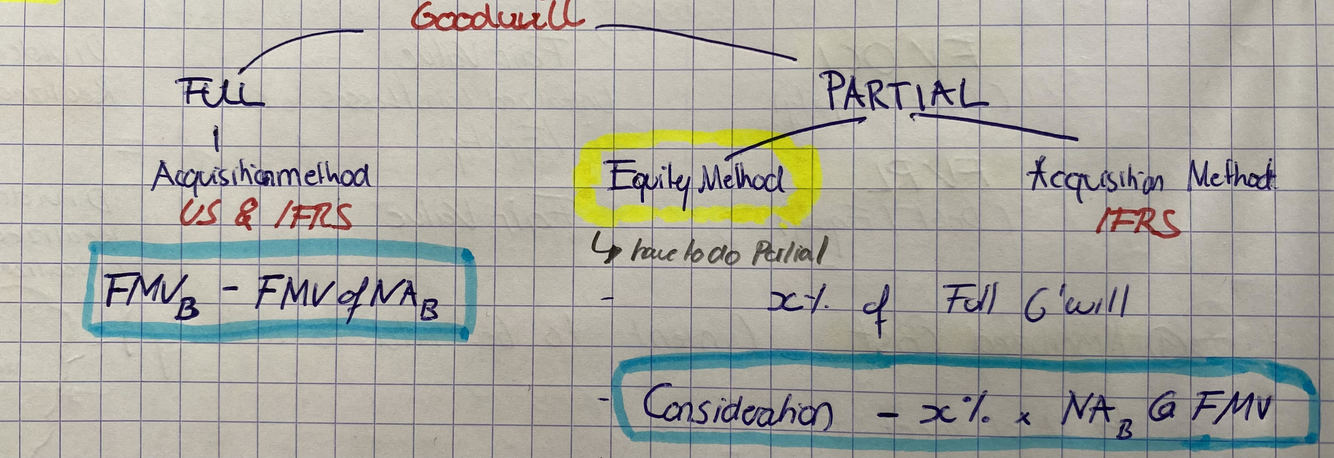
Goodwill
US GAAP = FULL Goodwill Method
Equity Method = Partial Goodwill
Full Goodwill -> higher intangibles -> higher Assets -> higher Equity -> Debt to Equity Ratio lower => DE ratio higher under partial goodwill
Minority / Non-controlling Interests (Nci)
Share of equity ownership in a subsidiary’s equity that is not owned or controlled by the parent corporation
US GAAP: (1-Ownership) * FV of Acquiree
IFRS: (1-Ownership) * FV of Acquiree Net Assets
Difference between two, same difference like Full goodwill and Partial goodwill
Goodwill impairment
- IFRS: Carry BV > Recoverable amount = Impairment loss -> IS
- US GAAP: Carry BV > Recoverable = true -> Goodwill old - Goodwill new -> Differnce to IS
Accruals
- *Earnings =** Cashflows + Accruals
- > Closer Earnings to CFO = higher the earnings quality (accruals component less persistent)
Using balance sheet information:
Aggregate accruals = NOAt - NOAt-1
Using Cash Flow information:
Aggregate accruals = NI – (CFO + CFI)
The accruals ratio = aggregate accruals / average NOA
NOA = (Total assets - Cash and short-term investments) - (Total liabilities - Total debt)
High Ratio = high % of accruals which implies less persistent and lower quality earnings
Stock Options / Grants
Stock options = Fari value of options on Grant date and amortized on SL basis over Service Period (period between Grant date and Vesting period)
=> Total compensation expense: [# options x option price (on grant date)] / Service period
Stock grants = Like stock options.
For any compensation expense recognized, the offset is an expense in paid-in capital, which is a stockholders’ equity account. No change to debt-equity-ratio= RE goes down but Paid-in-capital goes up
PC Insurance Ratios
Combined Ratio = Total Insurance Expenses / Net premiums earned
>100% = Underwriting Loss
High Ratio = Soft market = High competition, premiums low
Low Ratio = Hard market = Less competition, premiums higher, better profitability
////////////////////////////////////////////////////////////////////////
Forward Rate Model
[1 + f (j,k)] k = [1 + S(j+k)](j+k) / (1 + Sj)j
Term Structure Models
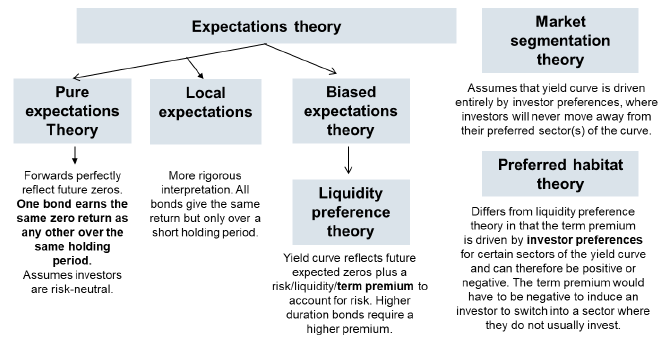
Valuing Bonds with embedded Options
Callable Bond
Putable Bond
Effect of Vola
Value of a callable bond = Value of a straight bond - Value of call option
Value of a putable bond = Value of a straight bond + Value of put option
Call Price = Max “Ceiling” Price
Put Price = Min “Floor” Price
As interest rate volatility rises:
- Call option values rise, so the value of callable bonds fall
- Put option values risk, so the value of putable bonds rises
OAS vs. Z-spread
For call options:
- ZCall = Credit + Liq. Risk + Option Risk
- OASCall = Credit + Liq. Risk + N/A
=> ZCall > OASCall
For put options:
- ZPut = Credit + Liq. Risk - Option Risk
- OASPut = Credit + Liq. Risk + N/A
=> ZPut < OASPut
If interest rate volatility rises the OAS must decrease for a given callable bond
(and given price); the OAS must increase for a given putable bond. (Vola up, Option Value up, Value of Callable Bond up, smaller OAS to get to market price)
If we hold the price constant, yield constant and then the Z spread will be constant. If volatility changes then the only aspect directly effected is the option value which in turn effects the OAS part (must compensate for option value going up / down): Credit + Liq. Risk.
OAS: Interest rate volatility
OAS = PV so equals Market price
Volatility down:
- Callable bond = Option value down, Value of CB up => so that market price = value of CB still holds we must bring down value with a higher OAS
- Putable Bond = Option value down, Value of PB down => so that market price = value of PB still holds we must discount value with a smaller OAS
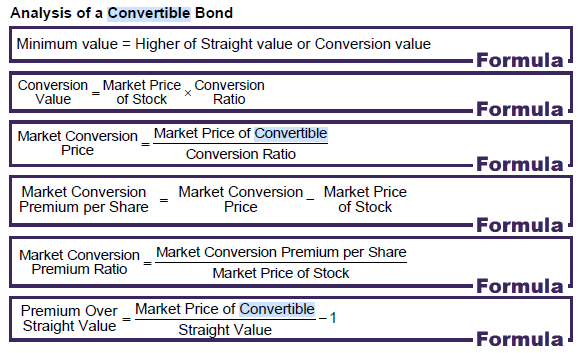
Formulas / Ratios : Convertible Bond
- CBs rise in value when issuers common stock price goes up
- CBs generally have lower coupon rates then similar option-free bonds
- (When Cash dvididend > Treshold dividend, typical reduction in conversion price
- Forced conversion: When stock price > conversion price, bondholders mus either convert and accept shares or accept fixed call price (to preven bondholders to continue receiving coupons at expense of shareholders )
- CBs can be valued with interest Tree (just like callable)
- Conversion period = limits time when bondholder can convert
- Busted convertible = underlying stock trades far below its conversion price (low probability that will reach conv. price, acts like a bond)
- Stock split (1 for 2 reverse): Stock price, Conversion price double, Conv. Ratio halves
- When Underlying stock price rises, the convertible bond will underperform because of the conversion premium. However, buying convertible bonds in lieu of stocks limits downside risk. The price floor set by the straight bond value causes this downside protection.