- Amino acids are linked to the next amino acid in the sequence of a protein by which of the following bonds?
- Hydrogen
- Ester
- Glycosidic
- Peptide
4.
The process of meiosis in the germline starts:
- During fetal life in males
- At puberty in females
- At puberty in males
- During the first trimester of gestation in females
3,4.
Ethylene oxide is commonly used to:
- Sterilize plastic syringes
- Sterilize incubators
- Disinfect benches
- Disinfect hands
2.
pH levels in bicarbonate buffered culture media are:
- Influenced by the oxygen tension of the air to maintain equilibrium
- Corrected by other molecules in the culture medium such as amino acids
- Corrected by partial pressure of CO2
- Not only dependent on bicarbonate ions but on other molecules in the culture medium such as amino acids
3.
Trophectoderm cells will go on to make parts of the:
- Fetus
- Chorionic villi
- Amniotic sac
- Uterus
2.
Which of following is a valid principle of ice formation?
- Embryos must be stored at temperatures low enough to allow ice crystals to form
- Increasing permeability of the cell membrane will prevent ice crystal formation
- Removing most of the water from the embryo will prevent ice formation
- Removing too little water will result in increased solute concentration and cell damage
3.
One widely used cryoprotectant is:
- 1.2M 1, 5-Propanediol
- 1.0M 1, 5-Propanediol
- 0.5M 1, 2-Propanediol
- 1.5M 1, 2-Propanediol
3.
Advantages of vitrification:
- Rapid cooling/warming rates
- Requires no programmable freezer
- Shortened exposure to cryoprotectants compared to slow cooling
- All of the above
4.
Most Down’s syndrome are due to:
- Non-disjunction in the oocyte first meiotic division
- Non-disjunction in the spermatocyte first meiotic division
- Non-disjunction in the oocyte second meiotic division
- Non-disjunction in the spermatocyte second meiotic division
1.
In PGD for X-linked recessive disease, where the female is a heterozygous carrier, and the male is normal, what proportion of the female embryos will be affected?
- None
- 75%
- 50%
- 25%
1.
The European Tissues and Cells Directives (EUTCD) applied:
- Only to units that store gametes
- To units that store gametes and embryos
- Only to units that store ovarian and testicular tissue
- To units that handle fresh and frozen gametes, embryos and gonadal tissue
4.
What aspect of laboratory operations monitors equipment and processes to ensure that the laboratory is functioning properly on a day to day basis?
- Documentation
- Quality improvement
- Quality control
- Quality assurance
3.
Quality control
aspect of laboratory operations monitors
equipment and processes
that ► ensure that the laboratory is functioning properly
⇒ on a day to day basis
This Day-5 blastocyst is scored according to the Istanbul consensus workshop criteria as:
- Stage=3 (Expanded), ICM=3 (Poor), TE=2 (Fair)
- Stage=2 (Blastocyst), ICM=3 (Poor), TE=3 (Poor)
- Stage=3 (Expanded), ICM=2 (Fair), TE=3 (Poor)
- Stage =2 (Blastocyst), ICM=2 (Fair), TE=2 (Fair)
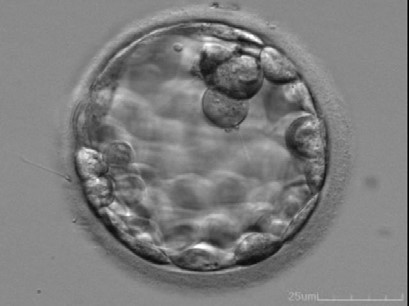
1.
blastocyst —-EXPANDED (3)
ICM few cells no compaction-poor (3)
TE fair (2)
= 3CB
According to WHO Laboratory Manual for the Examination and Processing of Human Semen (2010), the assessment of sperm morphology must be made in duplicate, evaluating _______ spermatozoa in each replicate.
- 50
- 100
- 200
- 300
3.
Ovarian primordial follicles begin their development:
- Via a mechanism that is currently incompletely characterised
- At the end of the preceding ovarian cycle
- Only after the beginning of sexual maturity
- In response to gonadotropins
4.
Gonadotropin hormones are synthesized in the:
- Hypothalamus
- Posterior pituitary
- Anterior pituitary
- Gonads
3.
Immotile sperm and immotile cilia are a feature of:
- Kartagener’s syndrome
- Beckwith-Wiedemann syndrome
- Kallman’s syndrome
- Disorders involving mitochondrial DNA deletions
1.
Kallmans syndrome
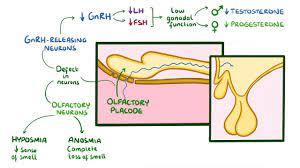
Kallmann syndrome
is a condition characterized by
body does not make enough of (GnRH)
delayed or absent puberty (hypogonadism low FSH and LH)
and an impaired sense of smell.
olfactory disorders
A peroxidase stain of semen smears is used to:
- Differentially stain nuclear and acrosomal regions of sperm head
- Identify granulocytes
- Identify sperm cells with fragmented DNA
- Identify the presence of reactive oxygen species in the semen
2.
In humans, implantation involves invasion finally reaching the:
- Uterine epithelium
- Endometrial ECM (Extra Cellular Matrix)
- Basement membrane of endometrial blood vessels
- Lumen of endometrial blood vessels
3.
This is a cross-section of a seminiferous tubule. Which cells do the arrows point to?
- Spermatogonia
- Elongated spermatids
- Primary spermatocytes
- Sertoli cells
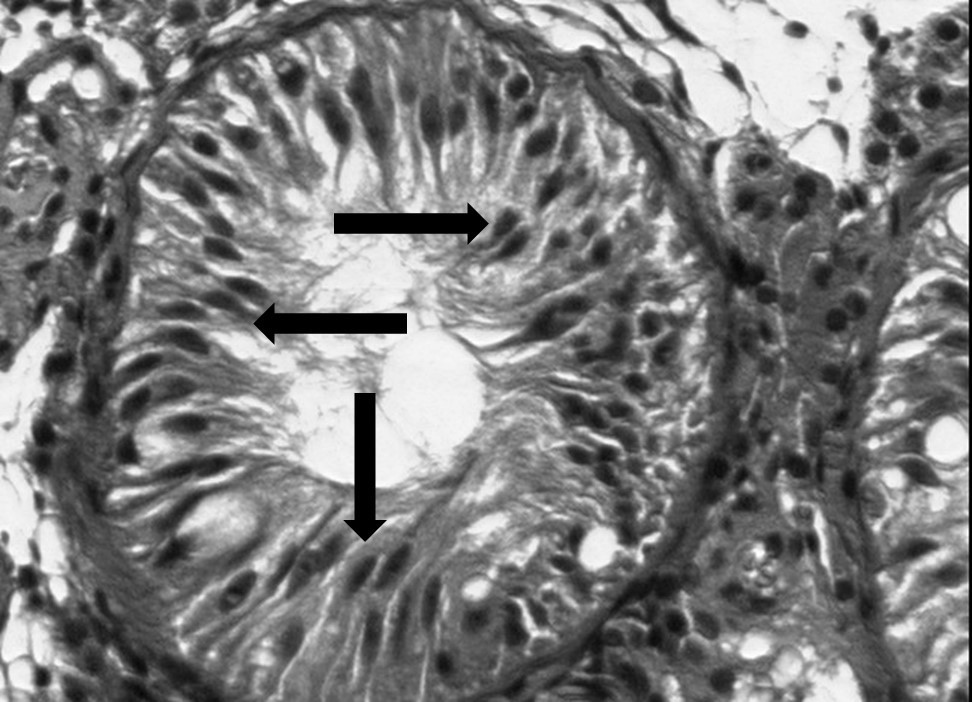
2.
- Embryonic stem cells:
- Are derived from trophectoderm
- Cannot differentiate spontaneously to beating cardiac muscle cells
- Can differentiate spontaneously to neural cells
- Can be identified as pluripotent by the marker TGF alpha
3.
According to the European Directive 2012/39/EU and as far as partner donation of reproductive cells is concerned, the permitted time interval until repeat blood testing is:
- Up to 24 months
- Every 6 months
- Every time the samples are produced
- Up to 12 months
1.
- Which of the following statements is TRUE?
- All enzymes are proteins
- All proteins are enzymes
- Some RNAs are enzymes
- Some DNAs are enzymes
1.
all Enzymes are proteins
Prosthetic groups or coenzymes are non-protein


-
M1-Embryology74
-
Basic cell biology30
-
CRYO-LAB & LN210
-
IVF Culture Media42
-
ART-Laboratory procedures68
-
QC & QA88
-
MEIOSIS & MITOSIS31
-
CELL MEMBRANE- STRUCTURE & TRANSPORT35
-
CELL CYCLE & Signal Transmitters30
-
Regulation and guidlines11
-
Gonadogenesis55
-
Andrology 2 & Semen A.94
-
Testicular and Semen Parameters- WHO 2010127
-
ART & INFERTILITY165
-
COH & Endocrinology65
-
ESHRE-Exam Samples95
-
Exam Questions 202274
-
Essential of GENETICS137
-
EHSHRE Exam sample 284
-
DNA & RNA structures8
-
from 2022 ESHRE46
-
PGD10



