Examine this patient’s temporal lobe
Mnemonic = VOLMA 1. Introduce 2. Inspect for scars or features of any neurocutaneous conditions e.g. NF / tuberous sclerosis / Sturge-Weber 3. Visual field assessment to confrontation using a red hat pin 4. Object recognition / Facial recognition (BNT / Famous faces test). “Name these 3 objects…” 5. Language - receptive “fold this piece of paper in half, then half again and then place it under your chair” / conductive “repeat after me…” / expressive “how did you arrive here today?” / nominal “name as many animals as you can in one minute” (normal is 12) 6. Memory - short-term = recall of 3 items and long-term = dates of WW2 (1939-1945) 7. Auditory assessment with noise presented to the contralateral ear i.e. auditory extinction
Examine this patient’s parietal lobe
Mnemonic = VNS ALFA ADC Introduce and inspect for scars. Both: Visual fields to confrontation Neglect - line bisection test “draw a line bisecting these three lines half way along them”. Sensation - UL and LL, sensory extinction and agraphaesthesia. Dominant: Astereoagnosis - “Can you identify these objects that I am placing in your hands?” Left/right disorientation - “place you left hand on the table” Finger agnosia - “show me your ring finger” Alexia without agraphia - “Can you write a sentence for me?” “Can you read the sentence for me?” Acalculia - “Subtract 7 from 100 and keep going…” Non-dominant: Dressing apraxia “Can you show me how you put your jacket on?” Constructional apraxia “Can you draw a clock face for me?” “Can you draw these two intersecting hexagons?” “Can you show me how you use a key to open a lock?”
Examine this patient’s frontal lobe
Mnemonic = MPSRORACLEs Motor - power in the limbs Premotor -Luria’s hand test (fist, chop and palm), “Can you show me how you use a key to open a lock?” Smell - “Can you identify these smells please?” University of Pennsylvania Smell inventory Test (UPSIT - a booklet of 40 scratch and sniffs) Reflexes - Frontal release signs - palmar-mental, palmar-grasp and glabella tap. Orientation - Time person and place Recall - “Remember these 3 things…” Attention - “What are the months backwards” Concentration - “Spell WORLD backwards” Language - “Name as many animals as you can in one minute.” “How many words beginning with F can you name?” Eye movements - Frontal eye fields
How does macular sparing with a homonymous hemianopia help with identifying the lesion site?
Macular sparing is found with an occipital lobe lesion. No macular sparing suggests an optic radiation lesion.
Examine this patient’s head shape.
- Introduction 2. Inspection for shunts / scars / tracheostomy etc 3. Inspect head shape from the front, side and on top. 4. Comment on head shape, occipital flattening, frontal bossing, eyes - exophthalmos, midface hypoplasia, malocclusion of the teeth, ear position 5. Feel sutures 6. Feel fontanelle 7. Head circumference 8. To complete my examination I would inspect the growth chart, undertake a developmental milestone assessment and request fundoscopy.
Examine this patient’s autonomic function.
- Introduction 2. Inspect for scars (DBS) 3. Eyes - Horner’s syndrome / Pupillary response 4. Sweating 5. Lying and standing BP 6. Pulse - effect of Valsalva (should cause slight hypertension and bradycardia) 7. Bladder control
Examine this patient’s extrapyramidal system.
- Introduce - ask to walk 2. Inspect for Tremor, PD features - facial expression / dyskinesias, Scars for DBS - ask if it is switched on? 3. Eye movements 4. Head position 5. Torticolilis / titubation 6. Arm / leg movements - resting tremor, action tremor, intention tremor, finger-nose-finger test 7. Tone 8. Fast alternating movements (dysdiadochokinesia UL and foot tapping LL) 9. Writing / Archimedes spiral (frequency, amplitude and direction) / Vertical and horizontal line drawing
Examine this patient’s eyes
- Introduce 2. Inspect for scars, ptosis, resting position of the eyes (squint), square wave jerks 3. Ask if they wear glasses and if they can see out of both eyes 4. Visual acuity using a Snellen chart and colour vision with Ishihara 5. Pupillary response to light and accommodation 6. RAPD 7. Visual fields 8. Eye movements in H-shape asking for double vision. Side by side or diagonal. 9. Cover test if has a squint to distinguish a phoria (only with other eye covered) from a tropia (squint).
Examine these patients speech
- Introduce - ask name, age and occupation
- Inspect for scars (head and neck), tracheostomy, PEG
- Ask about hand dominance
- Dysphasia - Expressive, Receptive, Conductive and Nominal
- Dyshonia - ‘eee’ and ‘aaa’, hoarse voice and bovine cough suggest recurrent laryngeal nerve palsy
- Dysarthria - “Baby hippopotamus”, “Yellow lorry red lorry” and “British constitution”.
Examine the lower cranial nerves
- Introduce
- Expose and inspect - ACDF / retrosigmoid / suboccipital scars, tracheostomy, PEG
**Look for Horner’s syndrome, facial asymmetry
- Trigeminal nerve - sensation in the 3 divisions and onion bulb distribution
**Check the corneal reflex!
Motor - muscles of mastication: clench teeth = temporalis / masseter; open mouth = lateral pterygoids and mouth sided to side = medial pterygoids
- Facial nerve - asymmetry, smile, close eyes, show teeth, blow out cheeks and ask about taste (ant 2/3 of tongue)
- Vestibulocochlear nerve - nystagmus, vestibulo-ocular reflex and hearing (rub fingers over one ear and whisper in the other). Weber’s and Rinne’s 512Hz tuning fork test.
- IX and X - speech - say ‘eee’ and ‘aaa’ - uvula central? *moves away from the side of the lesion. Hoarse voice? Test gag reflex and cough (bovine?)
- XI - shrug shoulders and turn head to the left and right against resistance
- XII - tongue fasiculations, symmetry, power and atrophy.
To complete my examination I would request a PTA, FNE for vocal cord assessment, a videofluoroscopy for swallowing. I would also complete the rest of the cranial nerve as well as upper and lower limb examination.
I would like to see an MRI scan of the brain.
Examine this patients upper limbs
- Introduce - ask if any pain
- Expose and inspect the neck, the clavicle, the axilla, the arm and the hands for scars, any wasting, fasciculations or abnormal position such as clawing.
- Tone
- Maneouvres = Make a fist (Benediction sign), straighten out the fingers, OK sign, interossi movement and Froment’s test
- Power: Shoulder abd (C5), Elbow flex and wrist ext (C6), Elbow ext and wrist flex (C7), Finger flex (C8), APB and interossei (Median), Finger abd (T1)
- Reflexes - Biceps / Supinator (look for the inverted supinator reflex) / Triceps and Hoffman’s. Higher reflexes are Deltoid C5 > Medial pectoral C4 > Trapezius C2/3 > Jaw jerk (Trigeminal spinal nucleus)
- Sensation
- Proprioception
- Coordination - dysdiadochokinesia / dysmetria / intention tremor
Examine the lower limbs
- Introduction and ask if any pain
- Inspect for scars / wasting / trophic changes (venous / arterial skin changes). Look at the spine for scars! ?MMC repair
- Assess gait - Trendelenburg, ataxic, apraxic, antalgic, circumducting and high stepping
- Tone - Roll, lift knee, clonus
- Power - Hip flex L1/2 (Lumbar plexus to iliopsoas), Hip add L2/3 (Obturator n), Knee ext L3/4 (femoral n), Ankle dorsiflexion L5 both inversion (tibial n) and eversion (supfl. peroneal n), EHL L5 (deep peroneal n), hip abduction (L5 superior gluteal n) and planar flexion S1 (tibial n). Knee flexion (S1 sciatic n) Hip ext (S1 inferior gluteal n)
- Reflexes - Knee L4) and ankle jerk (S1) **Adductor reflex = L3 and Hamstring reflex = L5 but these are less reliable. Babinski
- Proprioception
- Sensation
- Coordination - run heal down the shin
To complete my examination I would assess perineal sensation and anal tone. I would also assess the upper limbs and obtain an MRI scan and NCS/EMG
Examine the gait
- Introduce
- Expose and inspect the head. spine and legs looking for scars, atrophy and fasciculations. Any cutaneous stigmata?
- Ask to walk across the room. Comment on Facial expression, arm swing, shuffling, tremor and Pace (mnemonic = FASTPACE) posture, step size, slapping, stability, turning and balance. Swing and stance phases.
- Walk heel toe
- Walk on heels
- Walk on tiptoes
- Rhomberg’s sign
- To complete my examination I would examine the upper and lower limbs, cerebellum and cranial nerves. Depending on my findings, I would request an MRI of the brain and spine.
Examine the cerebellum
- Introduce
- Expose and Inspect for scars over the head and spine
- Dysdiadochokinesia
- Ataxia - assess the gait. Truncal only = vermis/ Extremities = hemispheric
- Nystagmus
- Intention tremor
- Slurred speech
- Hypotonia
Examine the median nerve
- Introduce
- Expose and inspect - scars ?CTD ?spinal surgery
- Make a fist (benediction sign), ‘OK’ sign (AIN) and lumbricals.
- Power - APB, Wrist flexion (radial side vs ulnar side), pronation (pronator teres), finger flexion. **Wrist extension should be strong because this is radial nerve via the C6 root
- Sensation over the thumb and palm
- Tinel’s and Phalen’s signs
Examine the ulnar nerve
- Introduce
- Expose and Inspect - scars, wasting of the hypothenar eminence and first dorsal interosseous, fasciculations, clawing of the hand. Comment on the carrying angle and
- Make a fist and straighten fingers. Ulnar side lumbricals. Froment’s sign
- Tone
- Power - Wrist flexion (ulnar side vs radial side = median n), finger flexion (weakness in hypothenar eminence only). interossei (PAD and DAB), ulnar side lumbricals, thumb adduction.
- Sensation - little and 1/2 ring finger, ulnar aspect of the palm, forearm and arm.
- Tinels over Cubital tuneel and Guyon’s canal
Examine the radial nerve
- Introduce
- Inspect - scars, wasting, fasciculations
- Make a fist, straighten the fingers (PIN) and cock your wrist backwards (radial). Extend the elbow and abduct the shoulders (axillary involvement suggests posterior cord)
- Power in radial nerve muscles direct (triceps, brachioradialis, ext. carpi radialis and supinator), power PIN (finger extension and thumb abduction = abductor pollicis longus as well as thumb extension). Power in deltoids. If deltoids weak then check lat dorsi (both are posterior cord).
- Sensation over the dorsum of the 1st web space and check the regimental patch.
- Elbow reflex C7 and inverted supinator jerk C6 myeloradiculopathy
Examine the spine
- Introduce
- Expose and inspect - scars front of the neck, back of the neck, thoracotomy, spine, abdomen and wasting in the UL or LL. Look specifically for a Horner’s syndrome.
- Cervical spine - flexion, extension, lateral flexion and rotation - Spurling’s sign
- Thoracic spine - rotation
- Lumbar spine - flexion, extension, lateral flexion and rotation
- Do any deformities correct with bending?
- SLR
- Examination of the UL and LL.
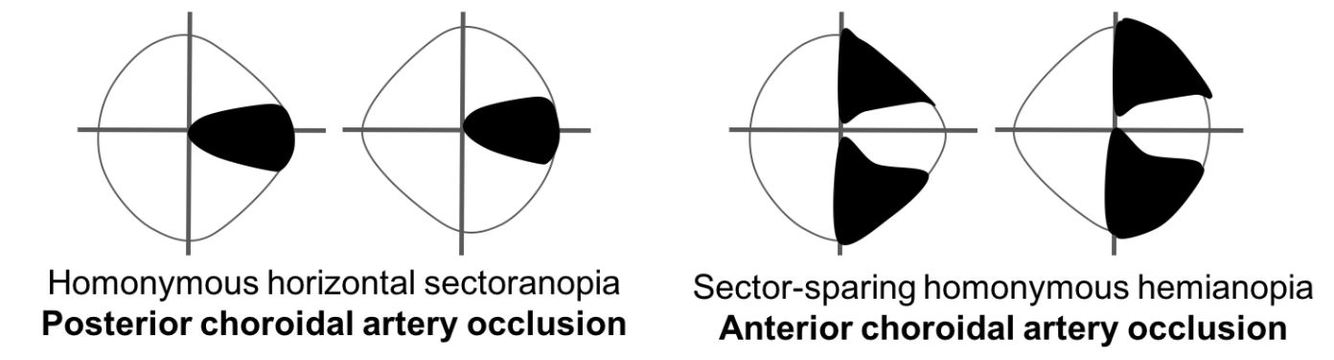
What causes a homonymous horizontal sectoranopia?
LGN lesions. IF the horizontal meridian is spared then it is an anterior choroidal artery infarct. If the horizontal meridian is affected then it is a posterior choroidal artery infarct.
What is nystagmus, torticollis and head nodding called?
Spasms nutans. Seen in children with OPGs.
How would you examine a patient with facial pain / Examine this patient’s face.
- Introduce. Ask name, age and occupation.
- Inspect for asymmetry of the face, scars, rashes, excess lacrimation and abnormal movement. Ask where the pain is.
- Test sensation in V1/2/3 and from outside in (onion bulb) including corneal reflex
- Test masseter strength
- Test eye movements (Cavernous sinus involvement)
- Test facial power
- Test hearing
- Dentition
- I would complete my examination with fundoscopy looking for optic atrophy suggesting MS as well as an upper and lower limb examination.
What is the differential diagnosis of hemifacial spasm?
Blepharospasm
Facial dyskinesia
Facial myokymia
Tics associated with Tourettes
What is the differential diagnosis of Trigeminal neuralgia?
Trigeminal neuropathic pain
Post-herpetic neuralgia
Atypical facial pain
Trigeminal cephalalgias (SUNCT / SUNA)
Which nuclei contribute to the CN7?
The facial nucleus motor nucleus, superior salivatory nucleus (lacrimation) and nucleus tractus solitarius (taste to anterior 2/3 of tongue).



-
Examinations76
-
Scenarios276
-
Operative viva101
-
Investigation Viva70
-
Non-operative viva215
-
Trauma112
-
Syndromes involving tumours117
-
Neuro-oncology198
-
Paediatric tumours299
-
Spine430
-
Skull base303
-
Congenital anomalies161
-
Peripheral Nerve175
-
Vascular299
-
Hydrocephalus147
-
Embryology135
-
Paediatrics Examination169



