Trauma Flashcards

(112 cards)

1
Q

What are the guidelines to CT scan a child following a head injury?

A

CT scan for neurological or cognitive dysfunction or suspicion of a depressed / basilar skull fracture

2
Q

What imaging would you perform for a child <1 year old who is not having a CT head?

A

Skull xrays

3
Q

Define minor head injury.

A

GCS > 13 without neurological deficit

4
Q

What proportion of children with >5min LOC have a brain injury?

A

22% compared to 8% if LOC <5 mins

5
Q

What imaging modality should be considered instead of CT head?

A

MRI

6
Q

What is a ping-pong fracture?

A

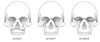
A green stick fracture of the skull with caving of the skull in a region. Mainly in newborns due to skull plasticity.

7
Q

How would you manage a temporo-parietal ping-pong fracture?

A

Conservative if no underlying brain injury - usually corrects itself as the skull grows

8
Q

When would you operate on a ping-pong fracture?

A

Raised ICP CSF leak through to the subgaleal space Neurological deficit Cosmesis if on the forehead

9
Q

What proportion of <10 year olds with a head injury are NAI?

A

10%

10
Q

What age group is NAI highest?

A

<3 years old

11
Q

Which assocated injuries are suggestive of NAI?

A

Retinal haemorrhage Bilateral CSDH <2 years Multiple skull fractures Where neurological injury does not fit external trauma

12
Q

What is the pathological mechanism in shaken-baby syndrome?

A

Angular acceleration / deceleration of the head (due to larger proportion to body and weaker neck muscles). Death is due to uncontrollable ICP **look for CCJ injury**

13
Q

What is Purtscher’s retinopathy?

A

Loss of vision following major trauma / pancreatitis / child birth etc due to posterior pole ischaemia. No known treatment

14
Q

Where do NAI skull fractures occur?

A

90% are parietal

15
Q

How can NAI fractures be differentiated from non-NAI trauma fractures?

A

Multiple / bilateral fractures or those that cross sutures

16
Q

What is a traumatic leptomeningeal cyst?

A

Growing skull fracture in which a CSF leak causing the fracture edges to widen with time

17
Q

What age do growing skull fractures occur?

A

<3 years

18
Q

What are the radiological features of a growing skull fracture?

A

Widening sutures with scalloping of the edges

19
Q

What is the management of a growing skull fracture?

A

Closure of the dural defect. The dural defect is usually larger than the bony defect so perform a craniotomy around the fracture, repair the dura and then replace the bone

20
Q

How do you manage depressed skull fractures in children?

A

Conservatively unless: 1) Dural penetration 2) Persistent cosmetic defect 3) Focal neurological deficit attributable to the fracture

21
Q

What are the suitability criteria for brainstem testing?

A

A catestrophic irreversible brain injury

Absence of depressant drugs

Absence of hypothermia

Absence of reversible causes (metabolic derangements)

22
Q

How is brainstem death confirmed?

A

No response to pain (supraorbital pressure)

Pupils fixed and dilated

Absent corneal reflexes

Absent occulo-vestibular reflexes

Absent of gag reflex

Apnoea with pCO2>6 KPa

23
Q

Which open fractures do you operate on?

A

Depression > thickness of the skull Dural penetration ICH needing evacuation Depression >1 cm Frontal sinus involvement Infection or gross contamination Gross cosmetic deformity

24
Q

What surgery is recommended for depressed skull fractures?

A

Elevation of bone fragmentes and debridement of skin edges. Repair of dural lacerations.
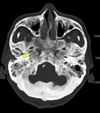
25
Is there any evidence that elevating a skull fracture affects post-traumatic seizures?
No
26
What structures may be disrupted with longitudinal temporal bone fractures?
Along the EAC and potentially leads to disruption of the ossicular chain
28
What structures may be disrupted with transverse temporal bone fractures?
Perpendicular to EAC through the cochlea and may stretch the geniculate ganglion causing CN7 and 8 deficits
29
What should be given to all patients with CSF leak following skull base fracture?
Pneumovax
30
What is the difference between proptosis vs exopthalmos?
Proptosis means the eye ball is pushed forward Exopthalmos means the eye ball is in the right place but the surrounding structures are not
31
Why check sensation of the forehead with frontal sinus fractures?
Supratrochlear / supraorbital nerve injury
32
When is the frontal sinus radiographically visible?
8 years
33
How is the frontal sinus approached surgically following trauma?
Bicoronal incision Forehead skin crease / eyebrow incision
34
What are Le Fort fractures?
Maxillary fractures: \>1 - Above the upper teeth \>2 - Across the maxilla to the top of nasion \>3 - Across the top of the orbits separating the face from the skull
35
What does cranialisation of the frontal sinus mean?
Removal of the posterior wall and stripping of mucosa down to the frontonasal duct. Any residual mucosa may form a mucocele. The sinus can be packed with fat / muscle / gel foam etc and covered with periosteum.
37
What are the HU of air?
-1000 (remember Fat is -40, CSF is 0; Blood is 60-80 and bone is \>500)
38
Which skull fractures should you give antibiotics for?
Open skull fractures
39
What radiological sign suggests pneumocephalus?
Mt Fuji sign
40
How do you classify skull fractures?
Closed (simple fracture) vs open (compound fracture)
41
What proportion of skull fractures are simple, linear calvarial fractures in children?
90%
42
How do you calculate cerebral perfusion pressure?
CPP = MAP - ICP
43
What metric does autoregulation maintain?
CBF to meet CMRO2 (cerebral metabolic rate for oxygen)
44
What is normal CPP?
\>50mmHg (Note: autoregulation occurs between a CPP of 50-150 mmHg)
45
What is the approximate intracranial blood volume? CSF volume?
150ml for both
46
What is the normal ICP in a young child?
3-7mmHg
47
What is the normal ICP in a term infant?
1.5-6mmHg
48
What are the different types of ICP monitors?
1. EVD - (most accurate) 2. Intraparenchymal (different models, some prone to drift) 3. Subdural/subarchnoid/epidural 4. Fontanometry in infants with open AF
49
How do you convert mmHg into cmH2O?
1mmHg = 1.36cmH2O 1cmH2O = 0.735cmH2O
50
What is your target CPP for a head injury patient?
60-70mmHg
51
What is your target blood glucose in trauma?
7-10mmol/l
52
What is targeted temperature management (TTM)?
Aiming for normothermia or mild hypothermia (35.5-37)
53
What did CRASH 3 show?
Safe to give TXA within 8 hours of TBI with intracranial haemorrhage or GCS\<12 Improved mortality rates in mild and moderate head injuries. No improvement in severe head injuries
54
What is your target for ICP in head injury patients?
Brain trauma foundation guidelines suggest intervention to keep ICP \<22mmHg
55
What are the indications for ICP monitoring in head injury?
BTF guidelines (2016)- All salvageable patients with severe head injury and abnormal CT head Or - all salvageable patients with severe head injury, normal scan and 2 or more of the following - age\>40 motor posturing SBP \<90 Consensus statement in 2014 suggests that in light of a normal CTH patient should not have ICPM
56
What is the volume of the brain?
1400 ml
57
What is Cushing's triad?
Hypertension Bradycardia Respiratory irregularity
58
What are Lundberg A waves?
Plateau waves with ICP elevations \>50 mmHg for 5-20 minutes
59
What are Lundberg B waves?
Pressure pulses with amplitudes 10-20 mmHg lasting 30 sec - 2 minutes
60
What are Lundberg C waves?
Low amplitude elevations in ICP every 10 seconds.
61
What level of pBt02 should be maintained following head injury?
\>25 mmHg improves outcome
62
What are the calorific requirements following head injury?
100% if paralysed 140% if not paralysed Mortality is reduced if this is achieved by day 7 and started within 72 hours. \>15% should of calories should be protein. Enteral route is prefered
63
How is the calorific requirement calculated?
As the basal energy expenditure (BEE) using the Harris-Benedict equation.
64
Why does urea increase following trauma?
Catabolic state breaks down proteins and Nitrogen is excreted as urea. To replace this \>15% of the BEE should be protein.
65
How do you differentiate post-traumatic hydrocephalus from ex vacuo hydrocephalus?
High pressure on \>1 LP Papilloedema Headaches Transependymal oedema Neurological decline or altered rehabilitation
66
Which basal cisterns are viewed following trauma?
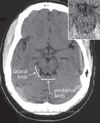
The quadrigeminal and 2x ambient cisterns. Correlated with mortality.
67
What is the biparietal diameter?
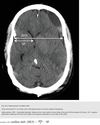
A measure of midline shift. Measure the inner skull vault distance at the level of the foramen of Monroe, dividing by 2 and subtracting the distance of the septum pellucidum from the inner table of the vault.
70
What is a genetic risk factor for severe head injury?
Apolipoprotein E4 (also risk factor for Alzheimer's!)
71
What are the delayed complications of head injury?
Seizures (10% severe, 5% moderate and 0% mild) Encephalopathy Pituitary deficiencies
72
What are the histological findings in chronic traumatic encephalopathy?
Beta-Amyloid plaques and cererbral amyloid angiopathy - similar to Alzheimer's disease. Present with clinical features of Parkinsonism.
73
What underlies the risk of second impact syndrome?
Dysfunction of cerebral autoregulation causing diffuse cerebellar swelling
74
What are Duret haemorrhages?
Small haemorrhages within the brainstem as a result of damage to perforators following herniation.
75
What is implied by dorsal pontine haemorrhages?
Severe diffuse axonal injury
76
Why do you get a PCA infarct with raised ICP?
Due to the PCA being compressed against the tentorium
77
What are the histological features of DAI?
Gliding/shearing forces cause disruption of axoplasmic transport resulting in retraction balls (axonal swellings), haemorrhages and accumulation of APP (amyloid precursor protein)
78
What is the grading of DAI?
Petechial haemorrhages in the: 1. Cortex 2. Corpus callosum 3. Brainstem
79
What is chronic traumatic enchephalopathy?
Repeat head injuries resulting in a neurodegenerative tau pathology (tauopathy) affecting the deep sulci
80
What is the incidence of TBI?
250 per 100,000 population, based on TBI hospital admissions
81
Define TBI
Alteration in brain function or evidence of brain pathology caused by an external force
82
What is the weight of the brain?
1.4Kg
83
What is elastance?
Elastance = dPressure / dVolume
84
What is compliance?
Compliance = dVolume / dPressure
85
What are the indications for ICP monitoring?
Abnormal CT head in a patient that cannot be assessed neurologically i.e. intubated and ventilated
86
What is the conversion between cmH20 and mmHg?
10cmH20 = 7mmHg
87
What are Lundberg waves?
A waves = ICP\>50 for \>5 mins B waves = ICP up to 25 for 2-3 mins C waves = physiological fluctuations in ICP every 10 seconds
88
What is Pouseille's equation?
The flow through a tube is proportional to the radius^4
89
Where does autoregulation occur? CO2 reactivity?
Pial arteries Pial small vessels
90
What is the Marshall classification?
1 = normal CT 2 = Diffuse injury; MLS\<5 mm visible basal cisterns 3 = Diffuse injury; MLS \<5mm compression of the basal cisterns 4 = Diffuse injury; MLS\>5 mm with no mass lesion \>25 cm^3 5 = Evacuated mass lesion 6 = Non evacuated mass lesion (\>25 cm^3)
91
Decision tree of Marshall classification?
Abn yes / no Mass yes / no (mass requiring evacution yes / no) cisterns yes / no midline shift yes / no
92
How do you classify the mechanisms of TBI?
Closed, penetrating, crush and blast. There is overlap
93
What are the tiers of treatment for raised ICP?
Tier 1 - HOB, sedation / analgesia, intermittent ventricular drainage, repeat CT Tier 2 - Hyperosmolar therapy, PCo2, paralysis Tier 3 - DHC, barbiturates (hypotherapy in rescueICP has worse outcome)
94
When should orthopaedic patients be performed in TBI?
Delay for 48 hours until ICP is stable
95
When should clexane be given in TBI?
Within 72 hours (prophylactic IVC filter can be placed if big contusions etc) Note - 20% of TBI will have a VTE
96
How should you treat an elderly patient on anticoagulation with ASDH?
Consider it to be similar to EDH as the elderly patient will have minimal brain injury if surgery is performed earlier
97
Which penetrating injuries carry a very low prognosis?
Transventricular and multilobar path / injury
98
How extensive do you debride a penetrating head injury?
Minimal debridement
99
What are the principles of management for penetrating head injury?
Antibiotics Full exposure Control of vascular components Minimal debridement Water tight dural closure (depending on ICP)
100
What are the complications of penetrating head injury?
Infection Sinus - mucocoele Pseudo-aneurysm ..
101
How do you manage a pseudo-aneurysm?
Vessel sacrifice
102
What is the relationship between ICP and volume?
Exponential
103
How is CBF affected by CO2?
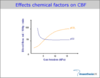
Rising CO2 affects ICP with a sigmoidal relationship
106
What are the reversible factors of raised ICP?
Pyrexia Seizure Raised MAP Low Na Low protein Pain Sedation / paralysed
107
Which study showed no difference with using ICP monitoring?
BEST:TRIP (Chestnut et al 2012)
108
What are the outcomes of DECRA?
Decompressive craniectomy worsens outcome even though ICP was lower Early decompression at ICP 20mmHg More people had blown pupils in the surgery group
109
What are the outcomes of RescueICP?
Overall survival is increased with decompressive hemicraniectomy but they are made vegetative High proporion of bifrontal craniectomies Cranioplasty side-effects were not counted
110
What BP do you aim for in TBI?
Look up
111
What does cerebral microdialysis measure?
Mitochondrial dysfunction: Lactate to pyruvate ration
112
What is brain tissue oxygenation monitoring? How does it work?
look up
113
Explain the rational of jugular venous saturation
Look up
114
What does Xe-CT show?
CBF measurement
115
How does near infrared spectroscopy work?
Look up Different wavelengths correspond to HbO2 etc so able to monitor the response to treatment
116
Does gender affect TBI outcome?
No
117
When would you place a brain tissue monitor?
...Variable, most would place with any depressed GCS
118
What threshold would you treat at brain tissue oxygenation?
Brain trauma foundation recommend \>15 but more recent evidence suggests 20.