Fatty acids structure & 4 fxns
- Structure*: Long hydrophobic hydrocarbon tail + terminal carboxylic acid at one end
- Function*:
- Major long-term storage of energy in our body as triacylglycerides
- Endogenous fuel source during fasting (so the brain can keep using glucose)
- FA oxidation yields acetyl CoA that can be converted into ketone bodies, which after glucose is the main E for the brain
- Structural component of membrane phospholipids
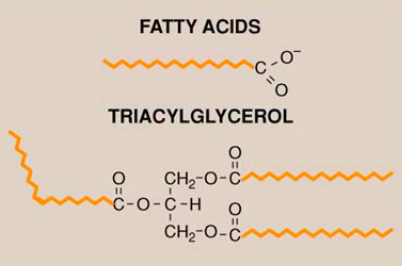
General properties of lipids
- Heterogeneous
- Amphipathic (hydrophilic and lipophilic properties)
- Relatively insoluble in aqueous environments
- Compartmentalized in membranes, TG lipid droplets, lipoproteins, or associated with albumin
Why do unsaturated FAs make the membrane more fluid?
double bonds induce kinks in the membrane so FAs don’t pack as closely together
Nomenclature of FAs
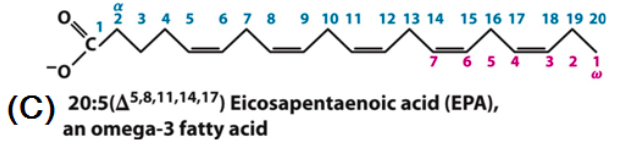
The carboxylic acid carbon is #1; carbon#2 is alpha; carbon#3 is beta; the last one is omega.
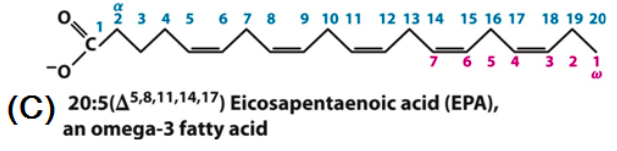
of carbons:# of double bonds (delta#of carbon where double bound starts)
Animal sources generally contain ___ and ___ FAs.
Vegetable oils, seafoods, and fish oisl contain mainly ___ and ___ FAs.
Animal - saturated & monounsaturated FAs
Vegetable oils, seafood, fish oils - linoleate & polysunsaturated FAs
“-enoic acid” vs “-anoic acid”
“-enoic” = unsaturated FA
“-anoic” = saturated
How are omega-FAs named?
Numbered and named from their omega-carbon end.
Ex) “Omega-3” indicates the carbon that begins a double bond numbered this time from the w- end.
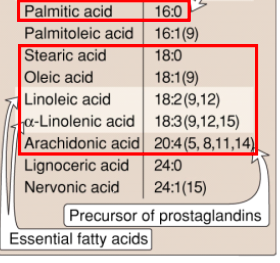
The most common saturated FAs are __ and ___.
What is the clinical importance of saturated fats?
Palmitic acid & Stearic acid
Saturated fats increase the risk of atherosclerosis, coronary heart disease, andstroke; negatively affectscholesterol
LImit it to <7% of daily caloric intake!
Palmitoleic acid & oleic acid are
common monounsaturated FAs in our diet
a-linolenic acid
eicosapentaenoic acid
docosahexaenoic acid
linoleic acid
arachnidonic acid
polyunsaturated FAs in our diet
Hydrogenation
Reducing cis-double bonds to saturated single bonds, increasing melting temp and shelf-life
Also increase trans-double bonds, which are implicated in cardiovascular risks
DHA & EPA are important w-3 FAs that can be generated from ALA (another w-3 FA)
What is their importance?
DHA is an essential nutrient in the brain and retina at all developmental stages
Both are important to prevent CVD (and other chornic diseases like HTN, stroke, cacner, inflammatory disease, etc)
ALA
EPA
DHA
Linoleic acid
ARA
a-Linolenic acid (ALA, 18:3, w-3): must be supplied in diet
Eicosapentaenoic acid (EPA, 20:5, w-3)
Docosahexaenoic acid (DHA, 22:6, w-3)
Linoleic acid: must be supplied in diet
Arachidonic acid (ARA, 20:4, w-6)- a prostaglandin/leukotriene precursor
What are the essential FAs (can’t be synthesized de novo, must get from diet)? What’s their importance?
a-Linolenic acid [18:3, delta9,12,15]: precursor for other w-3 FAs, including DHA and EPA
Linoleic acid [18:2, delta9,12]: precursor for the w-6 FA, ARA (substrate for prostaglandin synthesisis)
DHA & ARA are added in milk for growing children
Scaly dermatitis (ichthyosis) and visual or neurological impairments indicate
essential FA deficiency.
If linoleic acid is deficient in the diet
arachidonic acid becomes essential
Palmitic acid, Oleic acid, Linoleic acid, a-linolenic acid, arachidonic acid.
Saturated or unsaturated (mono or poly)? w-3 or w-6?
(Don’t need to know where the double bond is)
“SOLA” = 18’s with increasing #s of double bonds
Structure of triacylglycerol/triglycerides (form of free FA storage)
Glycerol backbone with 3 FA’s esterified to it (carboxylic acid group of each FA forms an ester bond to one of the OH groups on the glycerol)
The middle FA is usually unsaturated
Functions of TGs
- Storage form for most of our energy needs
- Physical cushion in adipocytes for organs
- Thermal insulation (brown fat)
- Carrier for the absorption and transport of fat-soluble vitamins (ADEK)
In the well-fed state, FAs are assembled into..
In the fasting state, FAs are…
Well-fed: FA assembled into TGs and stored into fat droplets in adipocytes.
Fasting state: FA are hydrolyzed from TGs and mobilized to other tissues for B-oxidation
TGs vs glycogen
FAs vs glucose
TGs are less hydrated (anhydrous) than glycogen, so they weigh less and take up less space.
FAs are more reduced than glucose, so they produce more energy upon oxidation.
Fat digestion begins with salivary and gastric lipases.
In response to lipids, the intestinal mucosa releases
- releases cholecystokinin (CCK)
- –> stimulate gallbladder to secrete bile
- –> stimulate pancreas to secrete lipases
Fat digestion in the intestine
- Bile salts emulsify fats into mixed micelles, increasing their accessibility to lipases
- TGs are degraded by the lipases to form free FAs and 2-monoacylglycerol
- Lipid-soluble components diffuse from the micelle into the intestinal mucosa while free FAs are converted back to TGs
- Mucosal cells package TGs, cholesterol, cholesteryl esters, phospholipids, and specific apolipoproteins (ApoB-48) into chylomicrons
Chylomicrons
apolipoprotein complex that transports dietary TGs to the peripheral cells
Composed of phospholipids, cholesterol, and apolipoproteins on the outside; TGs and cholesteryl esters on the inside
TG makes up the bulk of it



-
Human Chromosome24
-
DNA Analysis and Technology18
-
DNA Replication, Damage, and Repair19
-
Gene Regulation15
-
Transcription and RNA Processing25
-
Translation and Protein Processing56
-
GPCR Signaling22
-
Single Pass Transmembrane Receptor Signaling29
-
End of CSB- Genetic recombination23
-
Actin/Cytoplasmic Filaments and Cell Motility35
-
Collagen35
-
Extracellular matrix38
-
Enzymes51
-
Microtubules41
-
Glycolysis54
-
Gluconeogenesis39
-
Glycogen Metabolism39
-
PDH & CAC57
-
ETC & Ox Phos34
-
Fatty Acids64
-
Lipoprotein complexes and cholesterol transport32
-
Hemoglobin and myoglobin23
-
Sickle Cell Anemia & Thalassemia24
-
Pentose Phosphate Pathway26
-
Immunoglobulins25
-
erythrocytosis9
-
ER-GOLGI TRAFFICKING AND ENDOCYTOSIS56
-
GLYCOBIOLOGY80



