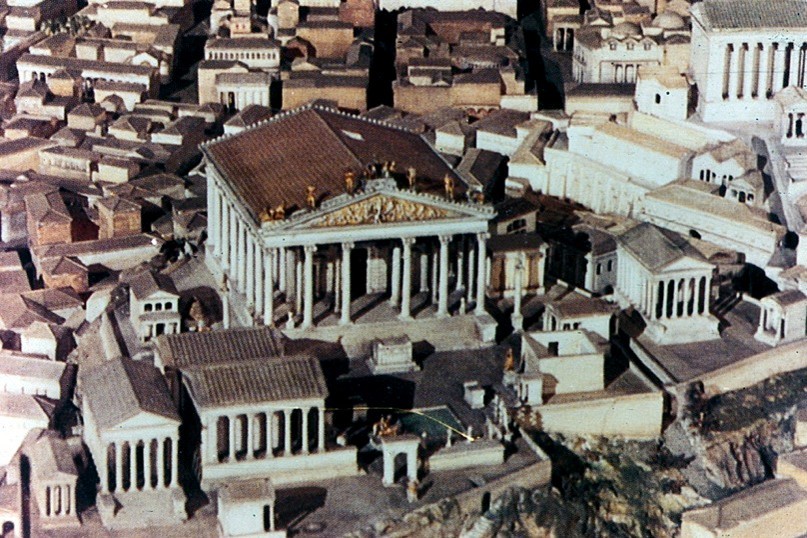
Temple of Jupiter Optimus Maximus
Capitoline Hill
ca. 550 BC
- Temple is built around the time that other great temples were going up around the world - Temple of Zeus at Athens - Temple of Artemis at Ephesus, Temple of Hera at Samos
- Overlooked the Roman Forum and the Via Sacra
- Important processional location - all of the imperial triumphs ended at this location.
- Became a significant place to reengage with the Roman Topography - rebuilt under several emperors
- 3 Cella side by side - Jupiter, Minerva, Juno
- Burnt to the ground several times - in 83 BC, rebuilt near the end of the Republic, restored by Augustus, burnt down & restored in 60s, burnt down and restored under Domitian, etc.
- center of the religious system of the state during the republic and empire
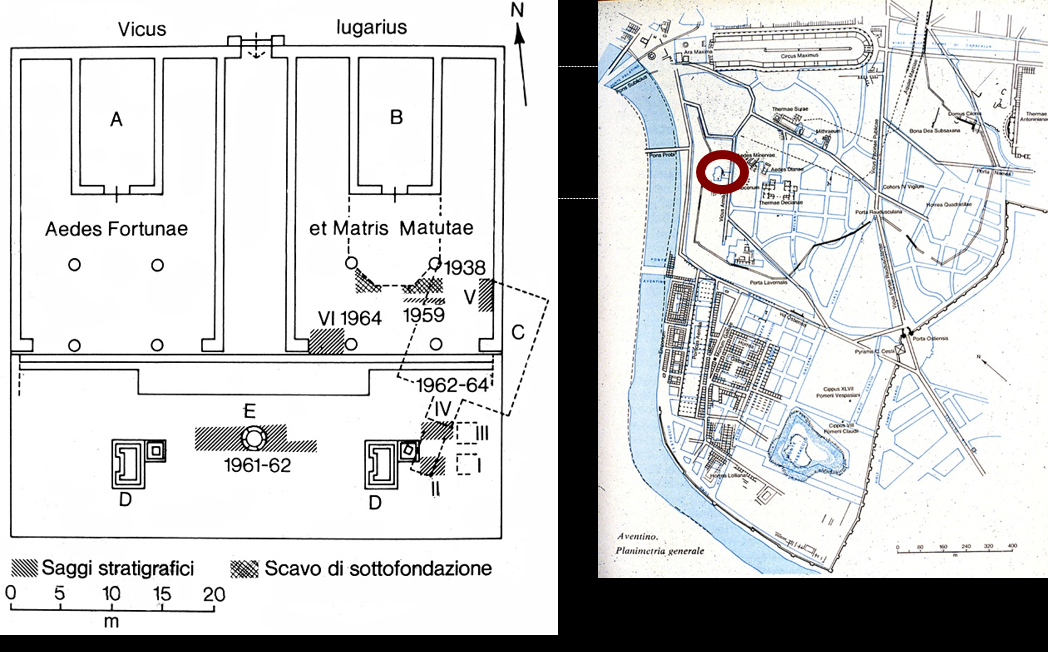
Temple Complex to Fortuna and Mater Matuta
San Omobono (Aventine Hill)
6th c. BCE, then 396 BCE
- Temples as triumphal monuments - begins in 396 with construction of Manubial temples
- Complex at San Omobono - temple of Fortuna, mater Matuta
- Veiian weapons sent to Delphia - following the model established by the Syracusians
- Done by Marcus Furius Camillus
- Marks them as a major player
- Really establishes two major trends within Roman Temple construction
- First - clustering of temples in this location picked up in other locations - grouping of 4 manubial temples in the Largo Argentina, temple of cybele and apollo,
- This complex is also indicative of the trend to develop manubial temples within roman culture -
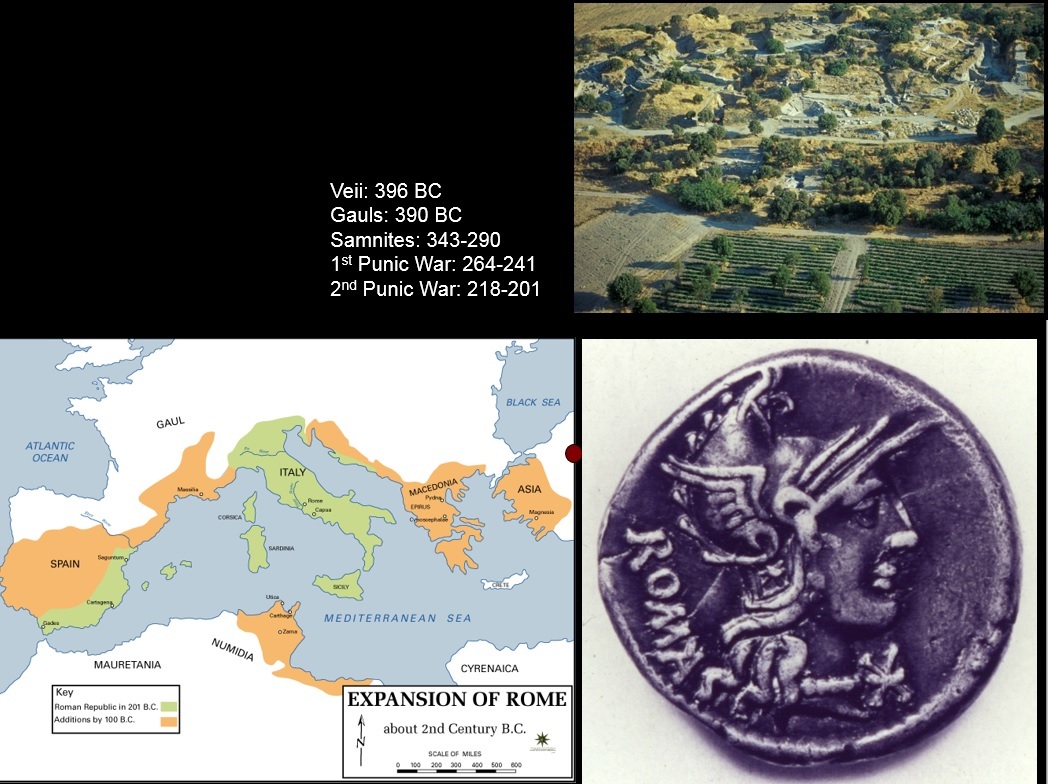
Roman expansion 4th-2nd c. BCE
B/c they are a major player, need a major ancestry - Trojan ancestry established by the late 4th c. BCE
Similar claims by the Goths, Venetians, Turks, Hapsburgs
Roma begins wearing the Phrygian cap
Hero’on at Lavinium -
Cult of Cybele imported at the end of the second Punic Wars
As we move through the 4th & 3rd c. - wars in increasing scope
Veii - 396 BC
Gauls 390 BC
Samnites 343-290 BC
1st Punic War - 264-241 BC
2nd Punic War: 218-201 BC
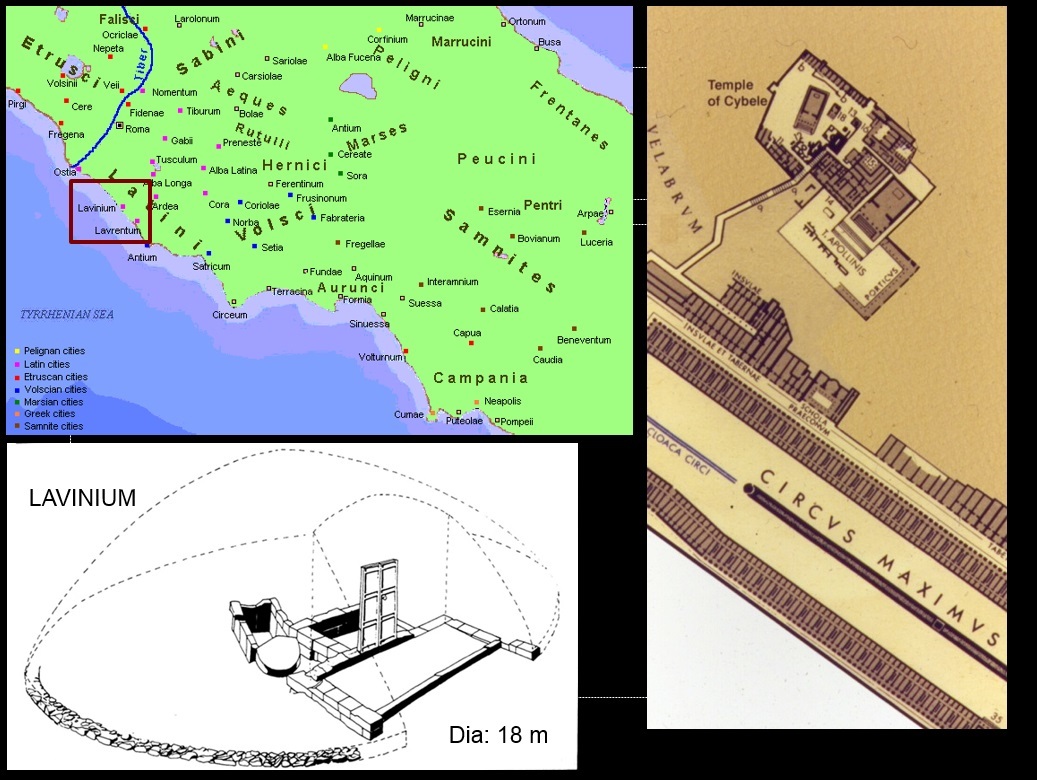
Temple to Cybele and Temple to Apollo
(Roman Expansion)
B/c they are a major player, need a major ancestry - Trojan ancestry established by the late 4th c. BCE
Similar claims by the Goths, Venetians, Turks, Hapsburgs
Roma begins wearing the Phrygian cap
Hero’on at Lavinium -
Cult of Cybele imported at the end of the second Punic Wars
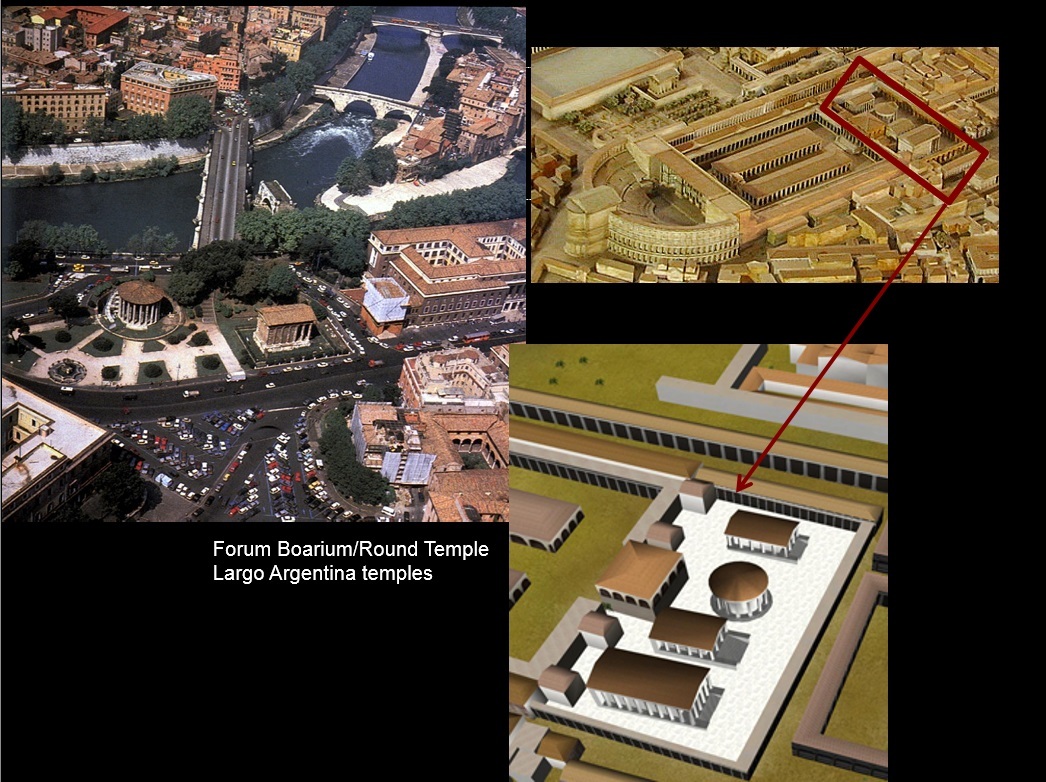
Forum Boarium/ Round Temple -
Round Temple - 130-120 BCE
- Indicative of the military successes of Rome - triumphal temple groups adding to prestige of individual temples
- Military successes brought increased wealth into the city - Increasing grandeur around the Forum Boarium/Round Temple and Largo argentina temples -
- Imported marble - Cararra Marble - Extravagence of Rome and display of wealth
- Round Temple -
Temple dedicated to Hercules Victor
Likely built by L. Mummius who defeated Greek city of Corinth
First Corinthian temple in Rome, similar to temples in Greece of the 4th and 3rd c. cf. Sanctuary of the Great Gods
Near the mouth of Truth
Features Drafted Margin Masonry
Made almost entirely of Pentelic Marble and situated on a low Krepis, built as a Greek Tholos - round style is not seen in Rome until 3rd quarter of 2nd c. BC
- Largo Argentina complex -
Temple A: Iuturna, T. Lutatius, 1st Ounic War, ca. 241
Temple B: Fortuna Huiusce Diei, Lutatius Catullus, 101
BCE
Temple C: Feronia, 300 BCE over Sabines
Temple D: Lares Permerini
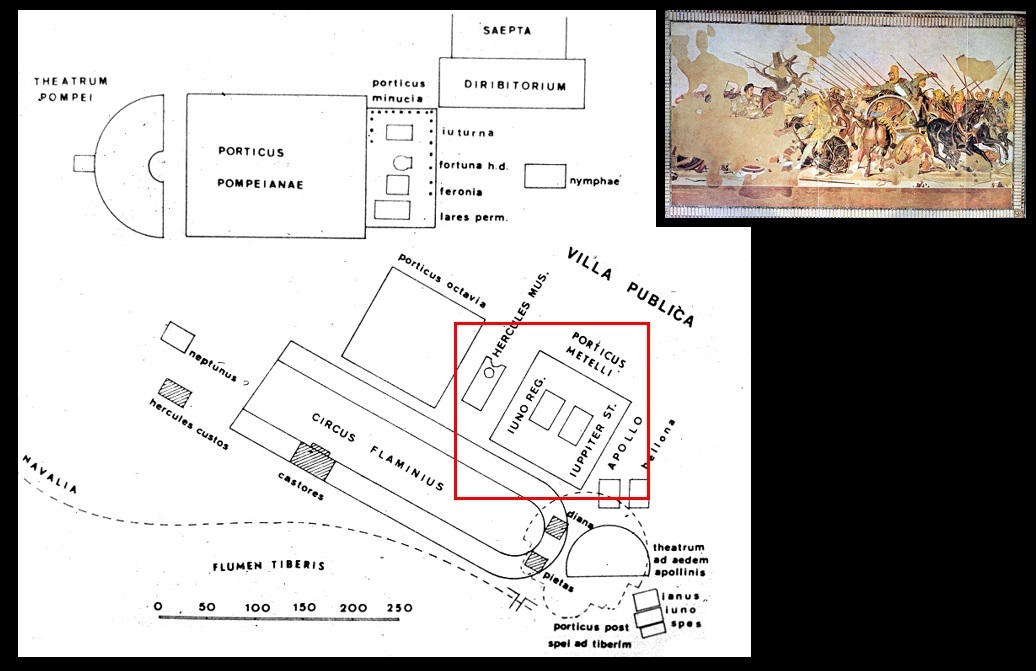
Temple of Juno Regina and Temple of Jupiter Staator
Temple to Juno Regina - early 4th c. BCE
Temple of Jupiter - 146 BCE
- Grouped Temples
- First Marble Temple - Jupiter Staator in 146 BC
- Imported architect - Hermodorus of Salamis
- Granicus group displayed as victory monuments at the porticus Metelli - around the temples
- Participates in a larger trend for the display of booty -
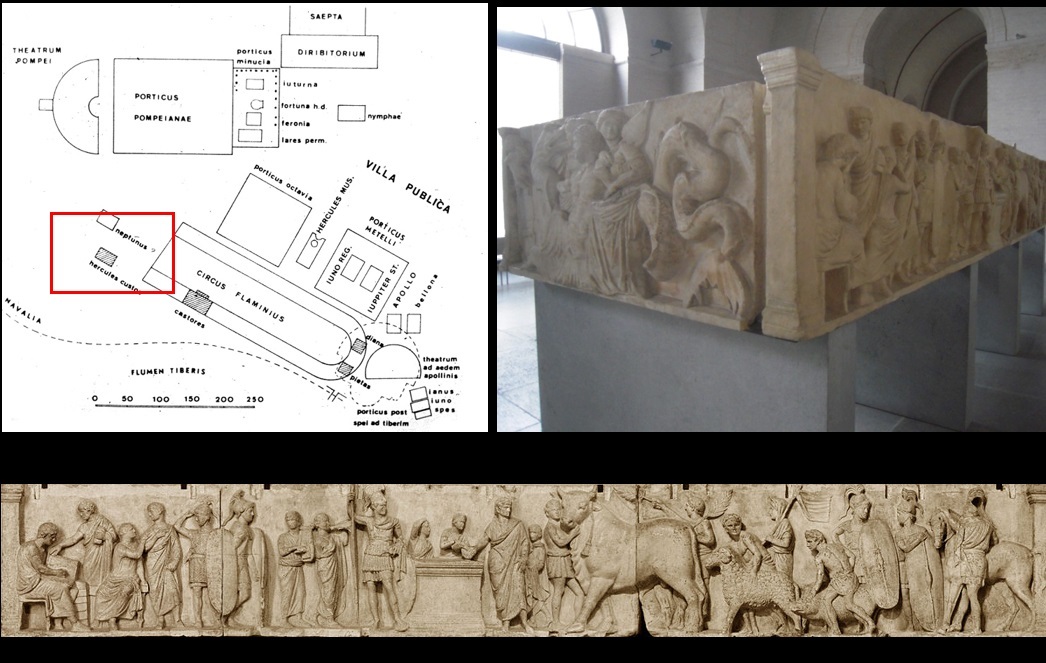
Altar to Domitius Ahenobarbus
ca. 100 BCE
Campus Martius
- Area becoming increasingly important for the larger display of wealth and of booty from conquest
- Census, Suovetaurlia, Maritime gods on the sides, Possibly celebrating victory over pirates
- Possibly a human and god image - but next example is not for another 180 years - probably human and human
- Triumphal procession began near the Circus Flaminius - ended near the Temple of Jupiter
Reference the nearby display of the Granicus group - also would become an area for display of Augustus’ obelisk/horologium/Ara Pacis
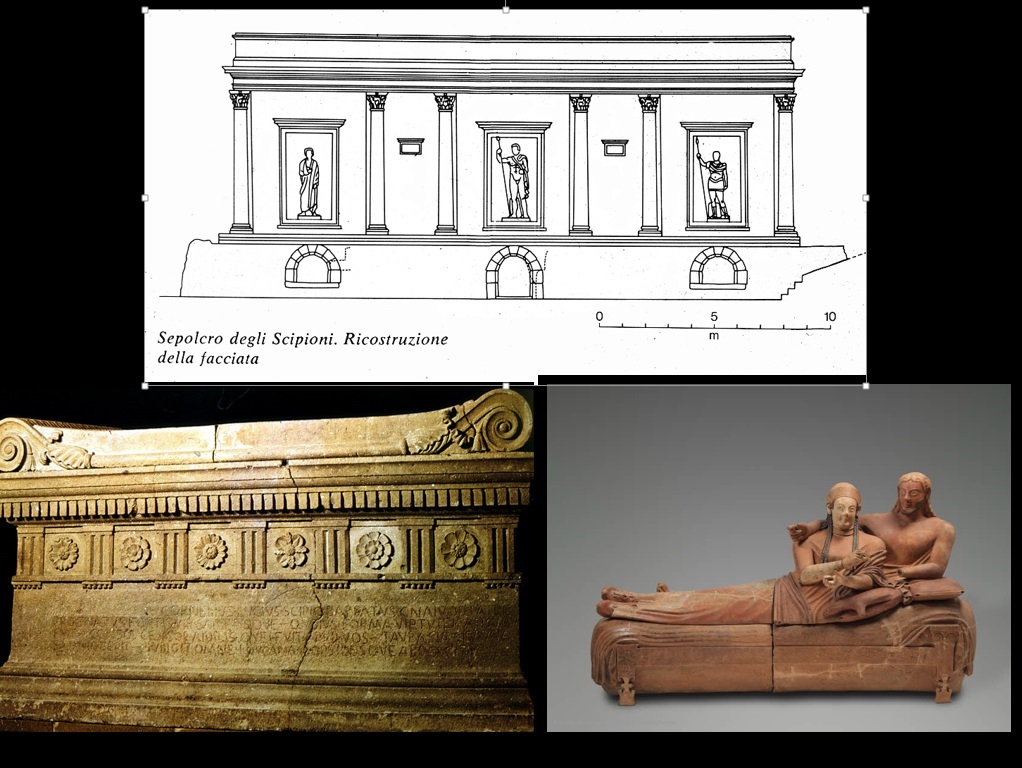
Tomb of the Scipios - 2nd c. BCE
Sarcophagus of Scipio Barbatus - 298 BCE
Caere Sarcophagus - ca. 550 BCE
Trio Tomb Suite - set up by one of the major families responsible for Roman Military Successes -
- Scipio Africanus the Elder
- L. Scipio Asiagenus
- Ennius -Poet
Sarcophagus of Scipio Barbatus - Res Gestae on the sarcophagus
- Features a Res Gestae of sorts - informs us that he was a Consul in 298 BC -
- Different form than the Etruscan sarcophagi - still not a dominant form of burial
- Inhumation becoming more popular at this point
- Sarcophagus of Scipio Barbartus
298 BC
Features inscription with family lineage, lists of political offices, and military conquests
Consul in 298, censor in 290 - sarcophagus ca. 280 BCE
Tomb of the Scipios
Part of a long line of burials - shown with the Caere Sarcophagus (c. 550 BC)
Part of the Tomb of the Scipios - 2nd c. BCE (tomb for Scipio Africanus the Elder)
Inscription similar to the Elogia read out during the aristocratic funeral
Caere Sarcophagus
- ca. 550 BCE
- One of two burial practices active in Rome (the other being cremation)
- Draws on line of Etruscan burial practices, imported from Greece during time of increased interaction and cultural movement
- Alters the typical symposium scene seen in Greece by the introduction of women
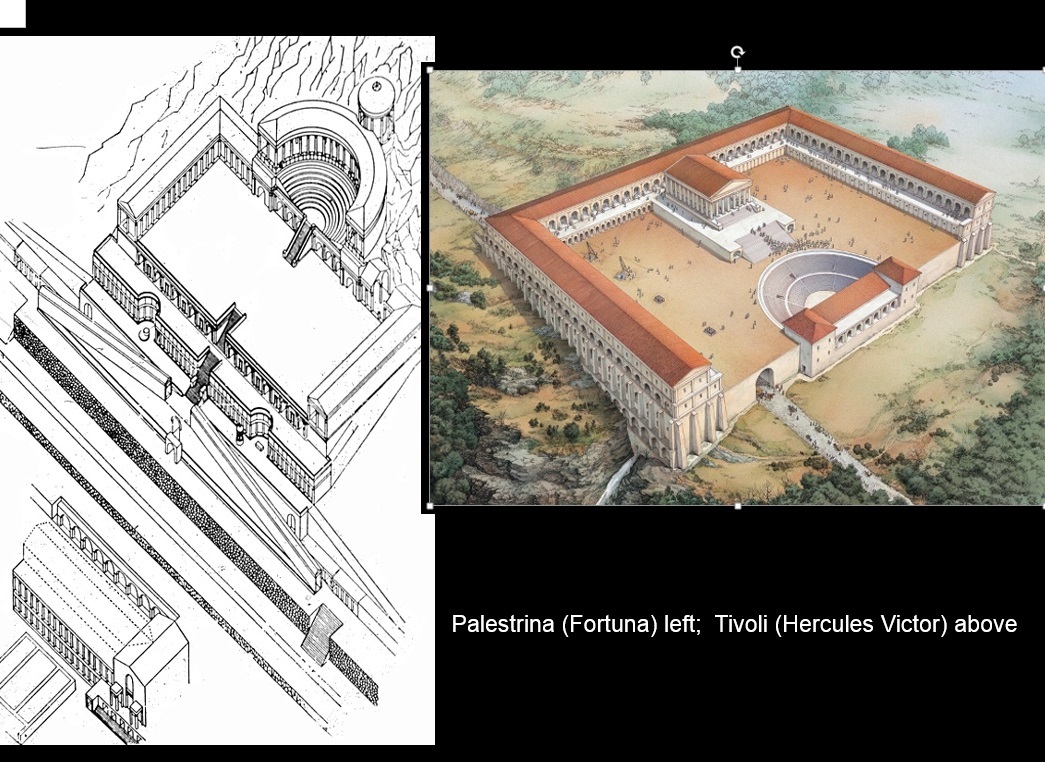
Temple at Palestrina and at Tivoli (Hercules Victor)
2nd century BCE -
Monumental sacred complexes
Palestrina’s temple of Fortuna
Dominant axial symmetry
Tivoli, hercules Victor
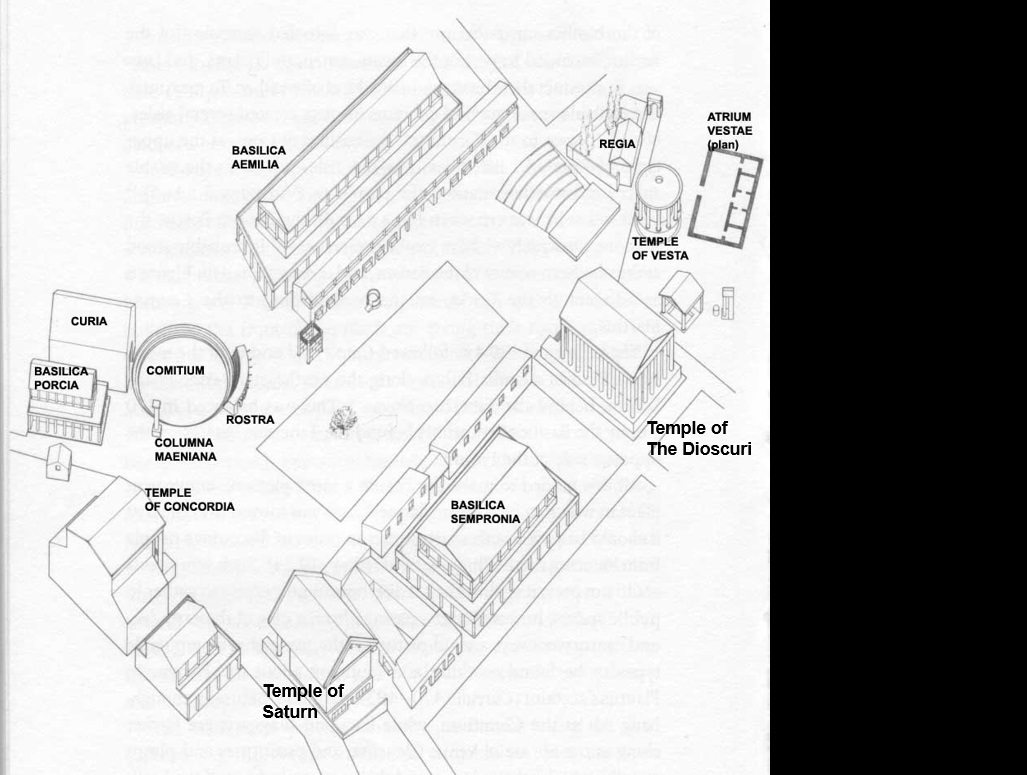
Roman Forum
2nd c. BCE
Forum coming together -
- Basilicas start appearing in this period -
- First is the Basilica Porcia - 180s BC
- Also Basilica Aemilia and Basilica Sempronia
- Nearby - the Regia and Temple of Vesta -
- Also Curia/Comitium/Rostra complex
- Rostral Column of Maenius - in the 4th c. CE
- Temple of the Dioscuri and Temple of Saturn here
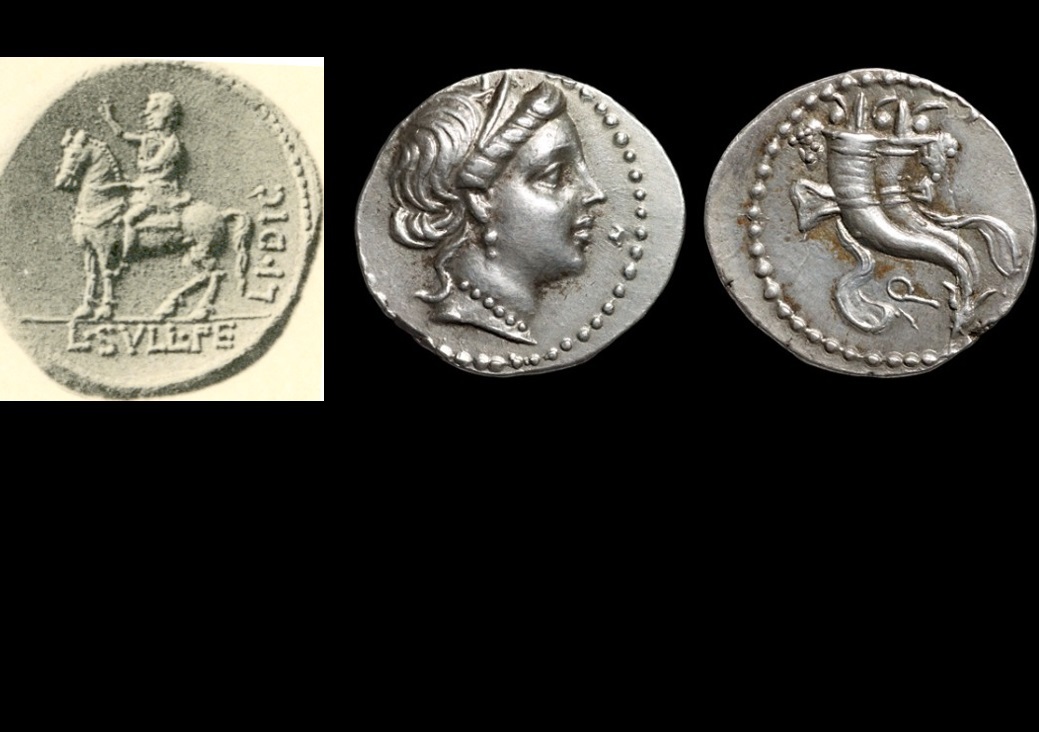
Political Propoganda of Sulla - Early 1st Century CE
Moving into the 1st c. BCE - Military men seizing control of the Roman State
- Sulla - first to utilize Aphrodite/Venus in his propaganda
- “Epaphroditos” - Associated with Aphrodite (on his coins)
- Felix -
- Iusus Troiae - establishes Trojan games for the upper class youth of Rome
- Would occur in the Circus Maximus just below the Temple of Cybele (also Trojan/Eastern)
- Battle of the Colline gate 82 BC - war is endemic of this period - foreign
- Also wars in Germany
- Italian Allies - Social wars (wars against allies)
- Fires sweep through Rome in this period - massive period of building
- Importation of temple components -
- Zeus Olympios - brought in from sack of Athens
Sulla as Victor in the battle of the Colline Gate - secures control of Rome following the Civil Wars
- as ‘Favorite of Venus’ - Epaphrodites
- Starts the Iusus Troiae
- Cornucopia promising abundance -
- Monuments to Sulla -
- Establishes precedents that would later be picked up by Caesar/Pompey
- cf. Monument to Sulla
ca. 104 BCE
Capitoline Hill
Erected to honor Sulla by the king of Bocchos
In honor of victories in the Jugurtha campaign
Engages a relatively recent phenomenon in Rome established by Marius in his defeat of the Gauls (121 BC)
Similar to Numidian victory monuments, features trophies, shield on the front with image of Sulla
Victories and Eagle in the Center
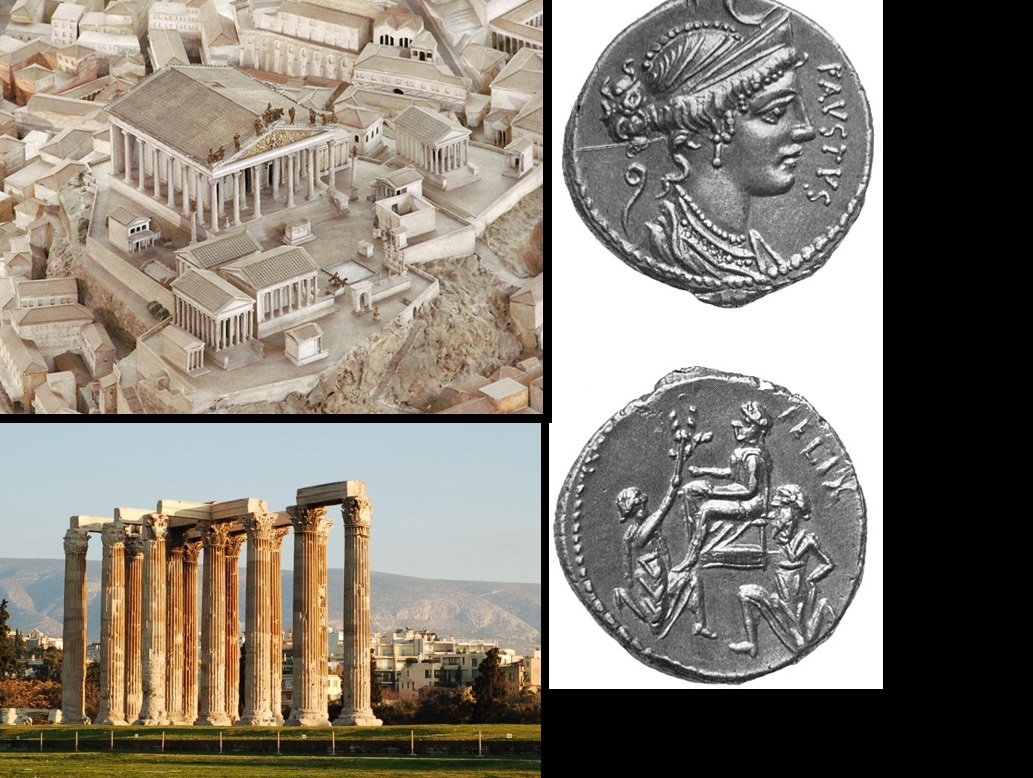
Political Propoganda of Sulla - Early 1st Century CE
Moving into the 1st c. BCE - Military men seizing control of the Roman State
- Sulla - first to utilize Aphrodite/Venus in his propaganda
- “Epaphroditos” - Associated with Aphrodite (on his coins)
- Felix -
- Iusus Troiae - establishes Trojan games for the upper class youth of Rome
- Would occur in the Circus Maximus just below the Temple of Cybele (also Trojan/Eastern)
- Battle of the Colline gate 82 BC - war is endemic of this period - foreign
- Also wars in Germany
- Italian Allies - Social wars (wars against allies)
- Fires sweep through Rome in this period - massive period of building
- Importation of temple components -
- Zeus Olympios - brought in from sack of Athens
- Establishes precedents that would later be picked up by Caesar/Pompey
cf. Monument to Sulla
- ca. 104 BCE
- Capitoline Hill
- Erected to honor Sulla by the king of Bocchos
- In honor of victories in the Jugurtha campaign
- Engages a relatively recent phenomenon in Rome established by Marius in his defeat of the Gauls (121 BC)
- Similar to Numidian victory monuments, features trophies, shield on the front with image of Sulla
- Victories and Eagle in the Center
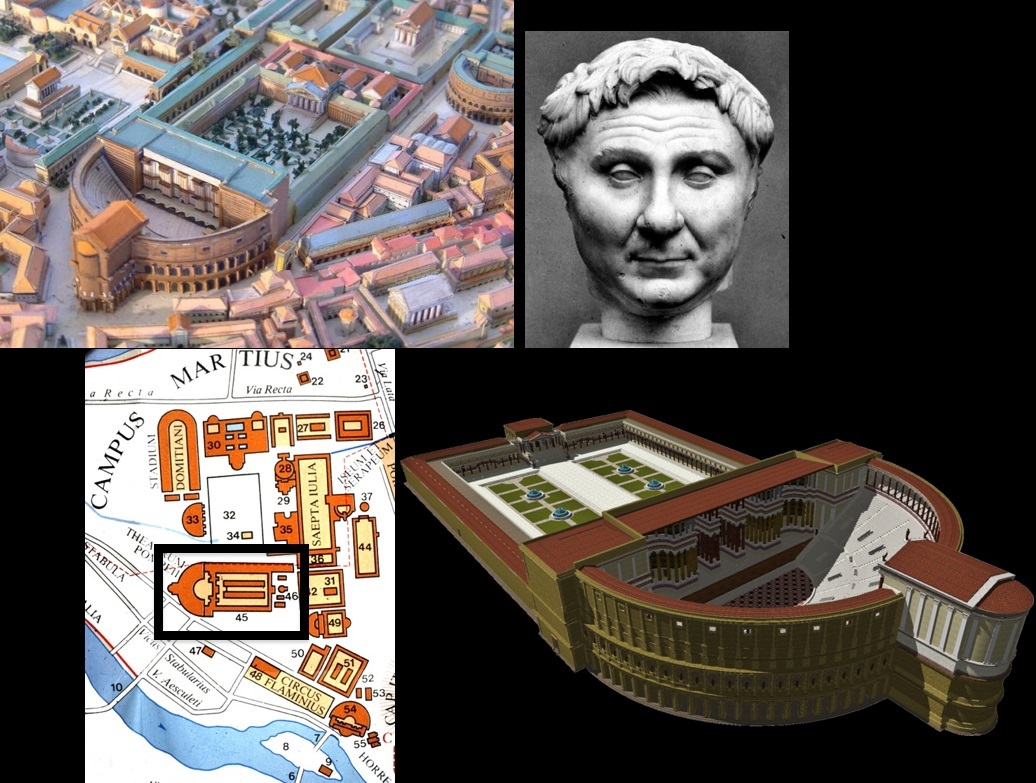
Theater of Pompey
55 BC
Campus Martius - Southern Side
- Built by Pompey following his successful campaigns in Asia Minor and Syria
- Theater is a public works donation, part of the larger construction competitions funded by wealth generated from conquest (cf. Caesar and his constuctions)
- Theater complex is legitimized by the small Temple to Venus Victrix at the top of the complex’
- Included on the Forma Urbis Romae
- Building on the model of Sulla - Appropriation of Venus as part of legitimation campaign
- Fruits of the triumphs displayed in the courtyard
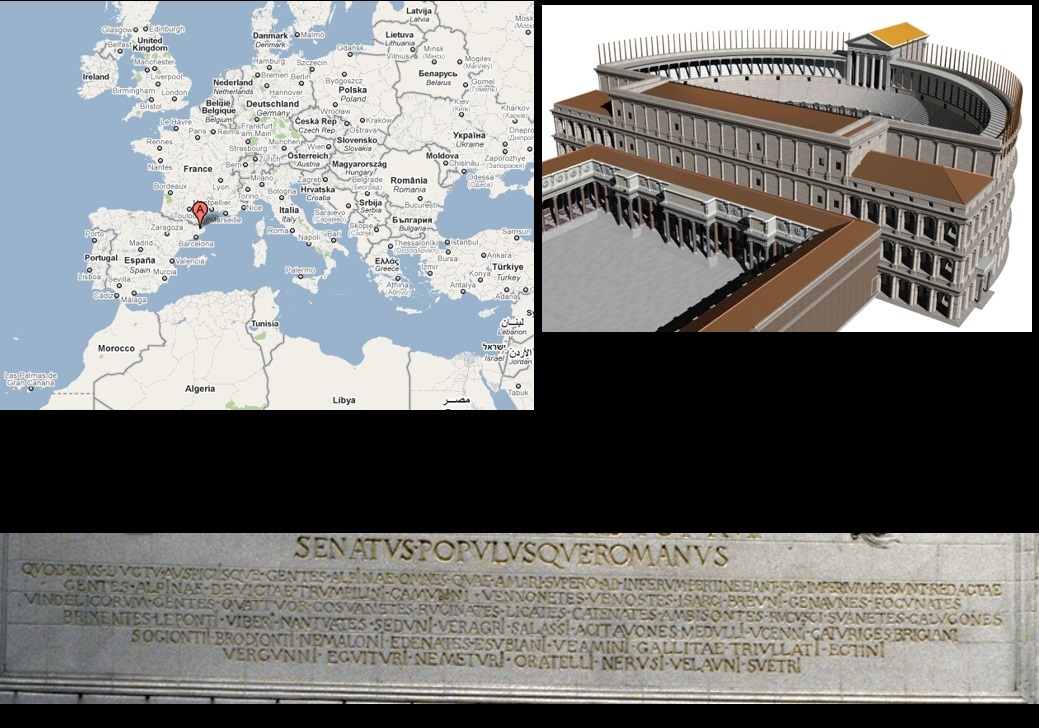
- Res Gestae inside of the Temple of Venus (in the Theater of Pompey) - precursor to Augustus
- Triumphal Monument of Pompey - La turbie
- See also Adamkilissi (Trajanic in Romania)
Gaius Julius Caesar - 100-44 BC
- Use of Aenias on coins -
- 46 BC - Quadruple triumph
- First Imperial Fora - built right next to the Roman Forum - ca. 42 BCE
- Temple of Venus Genetrix - Venus as Matriarch of the family
- Rebuilding of much of the Roman Forum in Marble
- Basilica Julia 46 BC - (Basilica Sempronia - know almost nothing, built in 170s BC as law courts)
- Curia Julia
- Forum of Julius Caesar - First Imperial Forum
- First person elevated to Divus status - under Augustus
Theater of Pompey
55 BC
Campus Martius - Southern Side
Built by Pompey following his successful campaigns in Asia Minor and Syria
Theater is a public works donation, part of the larger construction competitions funded by wealth generated from conquest (cf. Caesar and his constuctions)
Theater complex is legitimized by the small Temple to Venus Victrix at the top of the complex’
Included on the Forma Urbis Romae
Building on the model of Sulla - Appropriation of Venus as part of legitimation campaign
Fruits of the triumphs displayed in the courtyard
Res Gestae inside of the Temple of Venus (in the Theater of Pompey) - precursor to Augustus
Triumphal Monument of Pompey - La turbie
See also Adamkilissi (Trajanic in Romania)
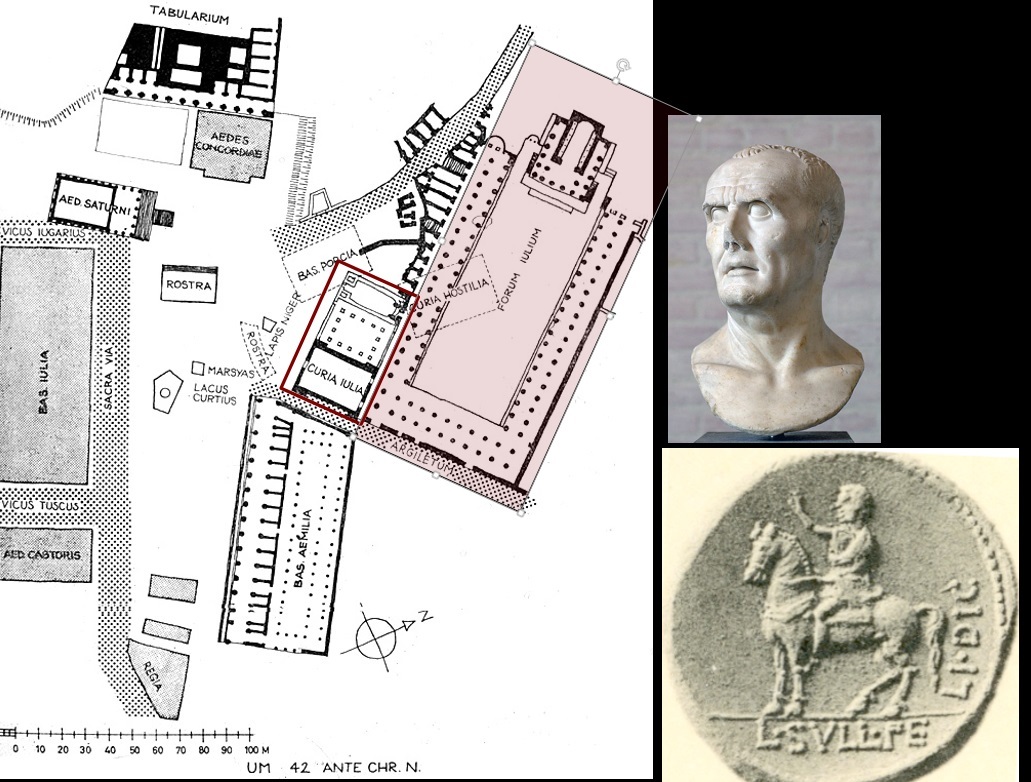
Gaius Julius Caesar - 100-44 BC
- Use of Aenias on coins -
- 46 BC - Quadruple triumph
- First Imperial Fora - built right next to the Roman Forum - ca. 42 BCE
- Temple of Venus Genetrix - Venus as Matriarch of the family
- Rebuilding of much of the Roman Forum in Marble
- Basilica Julia 46 BC - (Basilica Sempronia - know almost nothing, built in 170s BC as law courts)
- Curia Julia
- Forum of Julius Caesar - First Imperial Forum
- First person elevated to Divus status - under Augustus
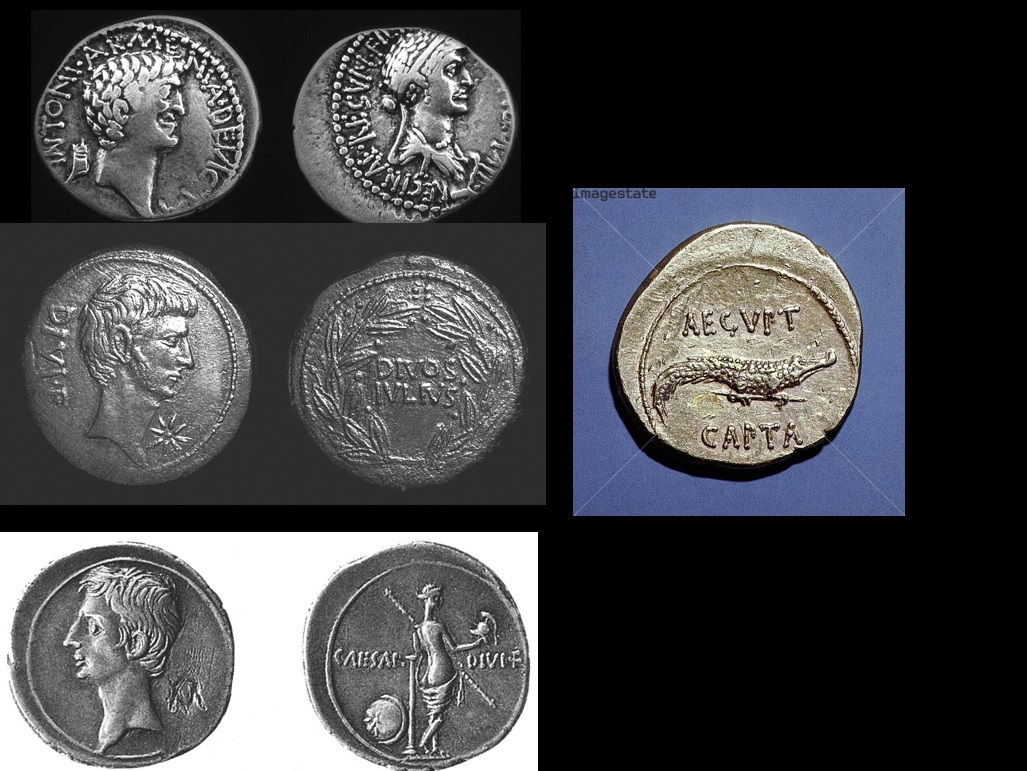
Second Triumvirate: 43-33 BC
Octavian, Antony, Lepidus
Deification of Caesar (divus): 42 BC -
- First time that a ruler is lifted up to the semi-divine status in Roman society - above a man, below a god -
- Deification of leaders had been common since Alexander the Great - if not from earlier
- Octavian could now claim to be Divi Filius - Son of a God, coin shows a comet - Comet of Caesar - appeared for 7 days and seen as Caesar’s becoming divine
- Statues often had a hole - for umbrella (to prevent perching) or for a star if divinized
- Octavian introduces new type of coinage language - iconographic themes
- Especially ones involving the Zodiac - the Capricorn - Zodiac sign of his conception
- Capricorn holding the globe of the world, cornucopia on its back, Augustus on the bottom of the coin
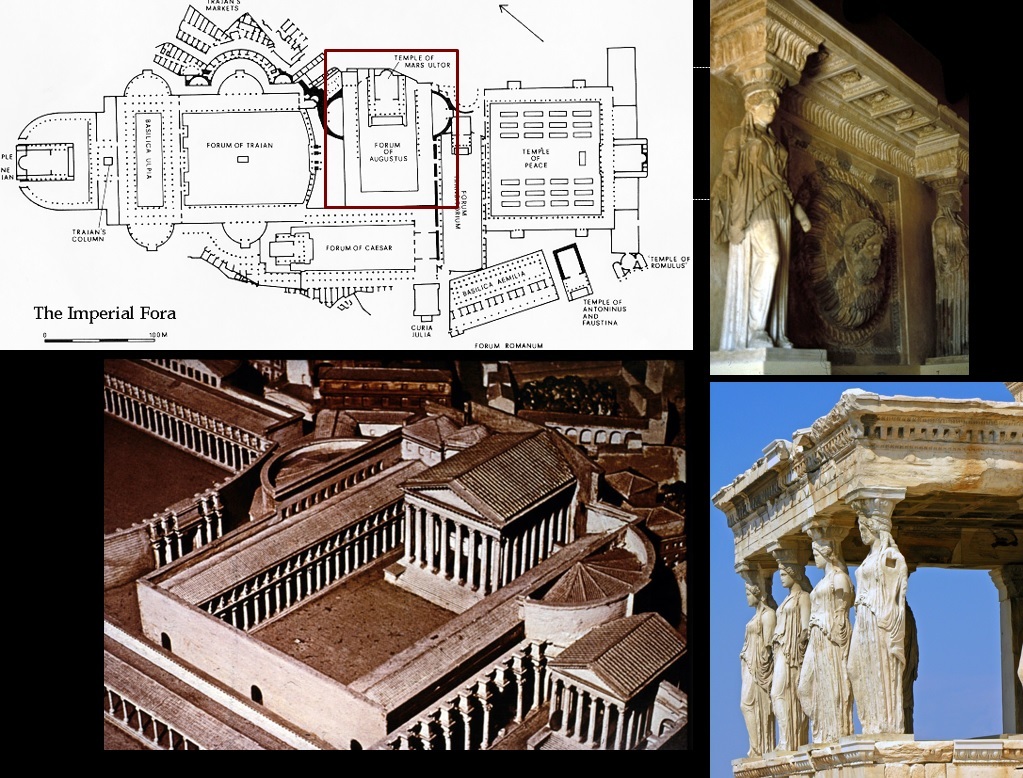
Forum of Augustus
- began in 42 BC and dedicated in 2 BC
- All of these themes come together - Roman ordering of the world into time and eternity
- Temple of Mars Ultor - (Mars the Avenger) - where he goes after those who murdered Caesar
- Battle of Philippi, 42 BC
- Monument dedicated - 2 BC
- Near Mussolini’s Street of the Empire - just by the Forum of Julius Caesar
- Subura of Rome sits behind the Forum of Augusuts
- Fires would break out in this areas all the time - wooden tenements
- Lit by lamps - fires would sweep the area quite frequently
- Large firewall behind the Augustus - Pepperino - fireproof stone
- Keeps the fires from the Sabura
- Layout of the Forum
- Quadriga in the center of the Forum
- Statues of Roman leaders placed around the complex
- Exedra -
- Julian family in the Western Exedra - Family tree of the Julian Gens - Julians, Aeneas, Kings of Alba Longa
- Eastern Exedra - Romulus
- Central Temple - Many of the gods - Romulus, Venus, Mars, Fortuna, Roma, Divus Julius
- Combined expression - pinnacle of the military, religious, civic legacy of Rome
- His genealogical chart is on display in the form
- Statues of Aeneas and Romulus - across from each other in the juxtaposed Exedra
- Copied in Pompeii, Also in Spain at Augusta Emerita
- Aeneas and Romulus both dressed as a Roman General
- Ascaneus - still bears the Parthian Phrygian Cap
- Many of the eulogia statues from around Rome - Great People - survive
- Great figures of the Republic - all men
- Summi Viri - Great Men in Latin
- Changes under Trajan - first to include women
- In this space - have the Augustan Caryatids, Parthians, then the Dacian Caryatids on Trajan’s forum
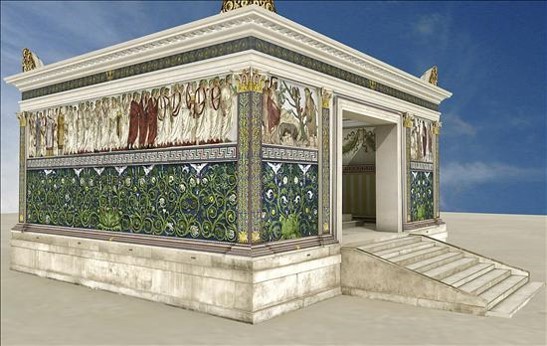
Ara Pacis - 13-9 BCE
- Horologium of Augustus / Ara Pacis
- Timepiece, victory monument, calendar
- Parthian Arch of Augustus - ca. 20 C
- First triple bayed triumphal arch in Rome
- In religion/politics/war - all culminate in the figure of Augustus
- In images on the Forum of Augustus, also in res gestae
- Mausoleum of Augustus
- Unusual form for this monument - no established Roman type in use at this point
- Cf. the Pyramid tomb,
- Res Gestae here - continuing on Pompey’s tradition (also Scipios)
- Size is closer to the tombs of the Hellenistic Kings
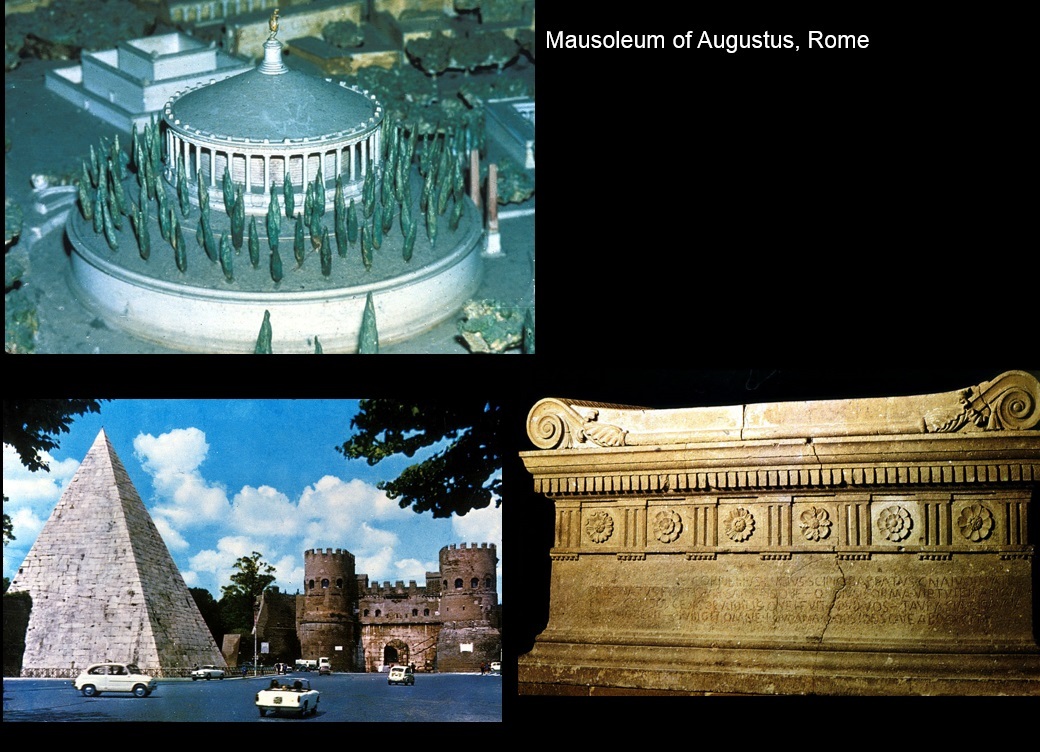
Mausoleum of Augustus
28-23 BC
Campus Martius
- Artificial Hill, covered by evergreen trees
- Entrance flanked by 2 large obelisks - part of the booty from Egypt
- Exterior contains a plan for the construction of the Pantheon, found by Haselberger - was out of the way so it served as a staging area for materials
- Large outer ring and grove, inner columned circular chamber - circumambulation possibly related to veneration of military trophies
Mausoleum of Augustus
- Unusual form for this monument - no established Roman type in use at this point
- Cf. the Pyramid tomb,
- Res Gestae here - continuing on Pompey’s tradition (also Scipios)
- Size is closer to the tombs of the Hellenistic Kings
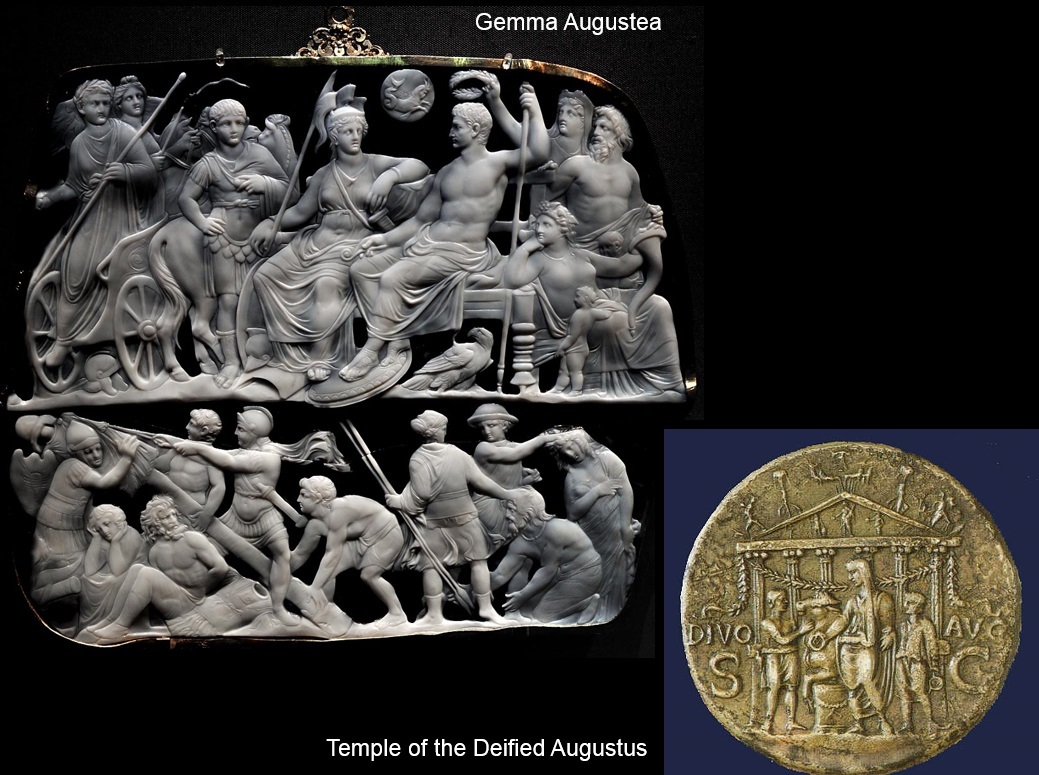
Images of the Deified Augustus -
Gemma Augustea - Late Augustan Period (Early 1st CE)
Gemma Augustea -
- On the throne with Roma, with the Lituus, Laurel Wreath
- Augustus’ zodiac sign in front of him -
- Trophy below, victorious sons getting out of the triumphal chariot
- Imperial family as Hellenistic kings in private art - different than the public image
- Depicted as a God in public life only after death -
Temple of the Deified Augustus
- Difference between Private/Public display
- Trojan Imagery -
- Only preserved on coins, would have been in the Forum near the temple of the Divine Julius Caesar
Domus Aurea
Palatine and Esquiline Hills
60s CE
- Spans Palatine and Esquiline hills
- Built over domus transitorium that burned down in great fire of 64
- Finished in 3 years by the time Nero dies
- 300 acres (1/3 of central park)
- Designed by Severus and Celer
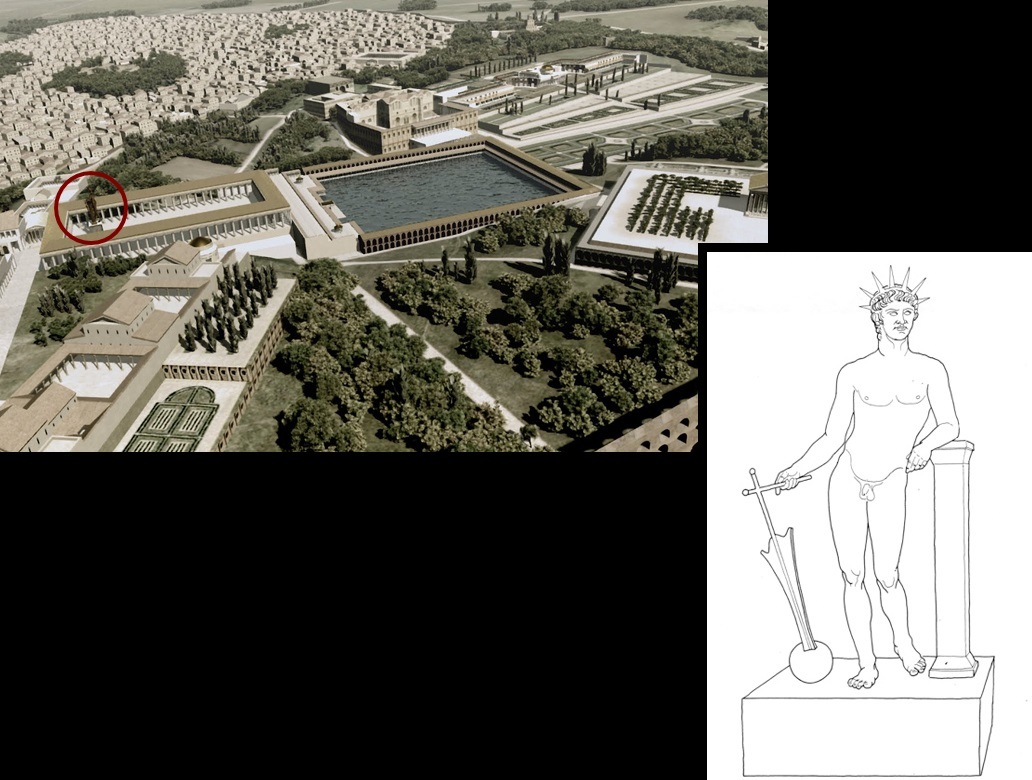
- Gardens around artificial lake
- Colossal statue of Helios with Nero’s head
- Represented on coins later on
- Nude nero with a rudder sticking into an orb
- Extensively vaulted
- Dining room
- Seems to be tracks around oculus
- Planetarium so you can see the sky moving as you dine beneath it
- Octagonal merging into a dome
- Flowers fall on you and mists of perfume
- Decoration
- 3rd style wall painting with scenes
- Mostly from Trojan War
- Laocoon probably housed here
- Grotesque because the figures hang out in the grottos
Templum Pacis
Late 1st c. CE (69-79)
Imperial Forum
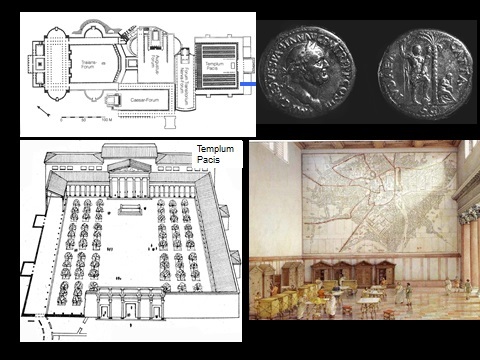
- In fact monument to war
- Show case triumph over Judaea
- Gilded bronze manorah, ark of covenant?
- Columns of Egyptian Granite
- Coins struck with him holding a spear and his foot on the globe of the
- world, before palm tree with personification of Judaea forlornly sitting
- below
- Rectangular temple with long side opening to forum
- Dedicated to personification of peace
- Represented on Severan Plan
- Joined rectangular space interpreted as landscaping
- Marble plan is found affixed to Templum
- Likely had a Flavian predecessor
- Greek and Latin libraries on either side
- Fragmentary
- Red granite fountain
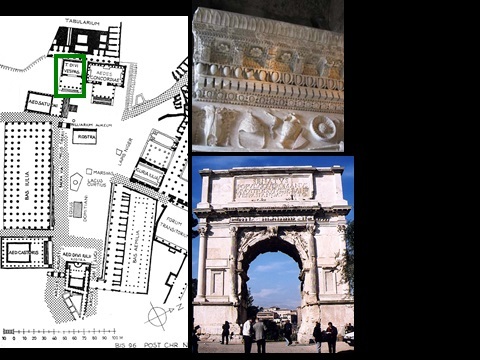
Temple of Vespasian - Late 1st c. CE
Arch of Titus - 81 CE
Arch of Titus
- celebrates the victory over Judea -
- Emblematic of the militaristic depiction of the emperor - celebrating the victory
- Looting and spoils taken away - reminiscent of the display of wealth following conquest that had long been part of Roman display practices






