What different tests are done when a patient comes into the hospital with a fever of unknown origin? In other words, what is a septic panel of tests?
CBC, Chem 25, Urinalysis, CMP, Lumbar Puncture, CT (so a shotgun workup..)
Blood culture on two different arms
UTI, Pneumonia, Meningitis (Common sources)
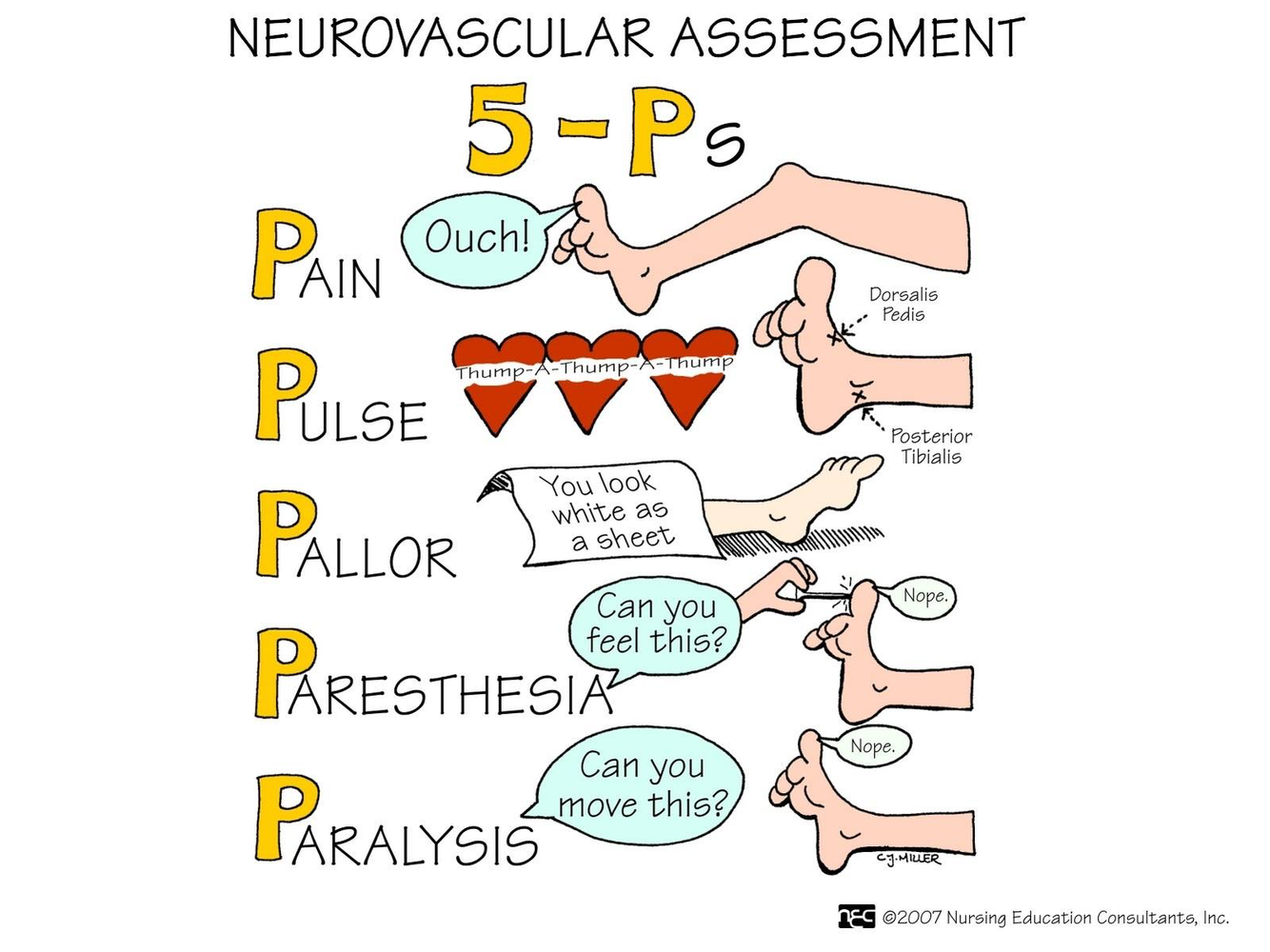
Recognize the signs and symptoms of compartment syndrome and what to do about it.
Compartment Syndrome (Muscles expand, pushes against nerves and arteries) EMERGENCY → fasciotomy
- CUT THAT LEG OPEN, its pretty brutal
- pain is unrelieved by anything
OSTEOPOROSIS
Osteoporosis: Its in the name lol, Porous bones, brittle bones
Med management
- Nutrition and Exercise
- Calcium + Vitamin D
- Boniva + Fosamax (Don’t eat or drink for 30 mins after med) Stand up during this time.
Nurse management:
- Education, keep patient safe, fall precaution.
OSTEOARTHRITIS
Slowly progressive non-inflammatory degeneration of articular cartilage, usually affecting the weight bearing joints- spine, knees, hips.
Med Management:
- Tylenol
- NSAIDs
- Corticosteroid injections
- Joint replacement
Nurse Management:
- Nutrition plus lose weight
- ADL’s
- ROM
- Home safety and point protection
- Non-Pharm stuff like ice packs
ISCHEMIC STROKE
Result of plaque formation and blood clots that causes the narrowing of the lumen of a blood vessel. When the blood vessel occludes completely infarction occurs - BAD!
HTN and DM → atherosclerotic disease → plaque buildup → stroke
1st thing to do - CT scan because quick to figure out what kind of a stroke pt has
- Pts receive TPA to break up the clot and to restore blood flow
- TPA can only be given in a 4 hour window from when the symptoms started
- CI of TPA: hematological disorder, systolic BP >200, recent surgery (within 3 months), recent GI bleed, recent CPR, recent head trauma, pregnancy (case by case)
- Make sure benefits of TPA outweigh the risks
- Pt on Coumadin - we must reverse the Coumadin with fresh frozen plasma IV and Vit K subq
- If patient is on Xarelto, Pradaxa, elequis - there is no treatment becasuse these blood thinners are non-reversable
ISCHEMIC STROKE
MEDICAL MANAGEMENT
1st thing - ABC’s!!!!!!!!
- Endotracheal intubation and mechanical ventilation if necessary
- Thrombolytic therapy (tPA), within 3 hours of onset
- Anticoagulation therapy, IV fluids
- ASA therapy - chew
- Cardiac monitoring - watch for atrial fib
- GI decompression - NGT - no bowel sounds
- Activity- bedrest and passive ROM, fall precautions
- Nutritional support- Enteral feeding tube or TPN
- Swallow precautions: aphasia may cause aspiration
- Antihypertensive medications: Nitrates- NTG
- Histamine 2 blocker antagonists: Pepcid - start right away to prevent stress ulcers
- Anticonvulsants: Dilantin - SE: gingival hyperplasia (see dentist every 6m)
- Glucocorticoid: dexamethasone - Decadron - decreases inflammation
- Indwelling urinary catheter
- Seizure precautions - side rails up with padding
- Monitoring vital signs: ICP (1st sign of increasing ICP is LOC), neurovitals
- Osmotic diuretics: Mannitol - decreases water levels in brain
- Occupational, physical, and speech therapy
- Labs:
- CBC - monitor elevated WBC - infection
- Electrolytes - make sure K+ >4 and MG++ >2
- ABG’s - check pH
- PT, PTT - monitor for bleeding
- Diet: Low Na+, Increased K+, Low cholesterol - know for exam
ISCHEMIC STROKE
NURSING MANAGEMENT
- Semi-Fowlers position to decrease pressure and swelling, we want to keep patients brain higher than the body
- Maintain diet as ordered
- O2 and fluids
- Maintain position, patency, and low suction of the NG tube
- Maintain and record vitals signs, neurovitals, labs, and oxygen status
- Swallow precautions, fall precautions, supportive care
- Carotid ultrasound - to see how much blockage
HEMORRHAGIC STROKE
Bleeding into the brain tissue, the ventricles, or the subarachnoid space
- Higher mortality
- May be due to spontaneous rupture of small vessels primarily related to hypertension; subarachnoid hemorrhage due to a ruptured aneurysm; or intracerebral hemorrhage related to amyloid angiopathy, arterial venous malformations (AVMs), intracranial aneurysms, or medications such as anticoagulants
- ICP increases when there is blood in the subarachnoid place
- Manifestations:
- Severe headache, early and sudden LOC, vomiting w/o feeling nauseous
HEMORRHAGIC STROKE
MEDICAL MANAGEMENT
- Control of hypertension: bring BP down gradually - 20% per 24 hour period, don’t want to being BP too low too fast
- Diagnosis: CT scan (fastest), cerebral angiography, and lumbar puncture if CT is negative and ICP is not elevated to confirm subarachnoid hemorrhage
- Care is primarily supportive - bec nothing we can do
- Bed rest with sedation
- Oxygen
- Treatment of vasospasm, increased ICP, hypertension, potential seizures, and prevention of further bleeding
HEAD TRAUMA
Classified by type of fracture, hemorrhage, or trauma to the brain
Fractures: depressed, comminuted, linear, basal skull fracture
Hemorrhages: epidural, subdural, intracerebral, subarachnoid
Trauma: concussion or contusion (brusing to brain)
Brain injury results in edema or hypoxia
HEAD TRAUMA
CLINIAL MANIFESTATIONS
- Disorientation to time, place, or person
- Paresthesia
- Positive Babinski’s reflex
- Decreased LOC - 1st sign
- Ottorrhea & Rhinorrhea - signs of CSF leakage
- Clear fluid is tested with litmus paper for glucose, if (+) then it is CSF
- Unequal pupil size and loss of pupil reaction
CEREBRAL ANEURYSM
Definition: Dilation or localized weakness of the middle layer of an artery
- Cerebral aneurysms usually arise at arterial bifurcations in the Circle of Willis and it’s branches.
- Classified by type: Saccular (berry), Fusiform, Mucotic
- Causes: atherosclerosis, trauma, congenital weakness, syphilis
- Patho: enlargement of aneurysm compresses nerves; enlargement will finally result in dissolution of the wall and rupture the aneurysm; rupture results in subarachnoid hemorrhage
- Assessment findings: diplopia, ptosis, severe headache, hemiparesis, nuchal rigidity, decreased LOC, seizure activity, vomiting, blurred vision
CEREBRAL ANEURYSM
MEDICAL MANAGEMENT
- IV therapy: fluids if needed
- Oxygen therapy to keep Sv02 > 95 %
- Position: semi-Fowlers; Activity: bedrest
- Monitoring: VS, telemetry, ICP, neuro VS, arterial line
- Precautions: seizure and aneurysm bleed, rupture
- Anticonvulsants: Dilantin
- Glucocorticoid: Decadron
- Histamine antagonists: Pepcid, Zantac
- Antihypertensives: Hydralazine (Apresoline)
- Intubation and mechanical ventilation if needed
- Antifibrinolytic: Amicar
CEREBRAL ANEURYSM
NURSING MANAGEMENT
- Administer fluids; maintain saline lock
- Monitor VS, Neuro vitals, intake and output, O2
- Maintain quiet, calm environment, allay fears, anxiety
- Assess headache pain; Prevent Valsalva’s maneuver; prevent constipation
- Assess for signs of increased ICP, meningeal irritation
- Maintain seizure and aneurysm precautions
- Alter ADL’s to compensate for neuro deficits
SEIZURES
Involuntary muscle contractions caused by paroxysmal, uncontrolled discharge of electrical impulses from nerve cells; neurons firing asynchronously
Causes of seizures:
Idiopathic, Head injury, SLE, DM, Hypoglycemia, metabolic disturbances, Brain tumor, hypertension, Infection, septicemia, dehydration, Anoxia, alcohol and barbiturate withdrawal
SIMPLE PARTIAL SEIZURE
Simple partial: consciousness remains intact; patients do not lose posture, and do not lose consciousness, may stare off into space (little kids staring off in classrooms example)
SIMPLE PARTIAL- symptoms confined to one hemisphere→ May have motor (change in posture), sensory (hallucinations), or autonomic (flushing, tachycardia) symptoms; No loss of consciousness.
COMPLEX PARTIAL SEIZURE
Complex partial: patient partially or completely loses consciousness
COMPLEX PARTIAL- Begins in one focal area, but spreads to both hemispheres→ Loss of consciousness, aura of visual disturbances; post-ictal symptoms
ABSENCE (PETIT MAL)
GENERALIZED SEIZURES
Generalized seizures: involve the whole brain. Patient loses consciousness and ability to maintain posture.
ABSENCE (PETIT MAL):
- Sudden onset; lasts 5-10 seconds
- Can have 100 daily w/o people realizing
- Precipitated by stress, hyperventilation, hypoglycemia, fatigue, flashing lights
- Differentiated from daydreaming
SYMPTOMS: Loss of responsiveness, but continued ability to maintain posture control, Staring spell, Twitching eyelids, Lip smacking, No post-ictal symptoms
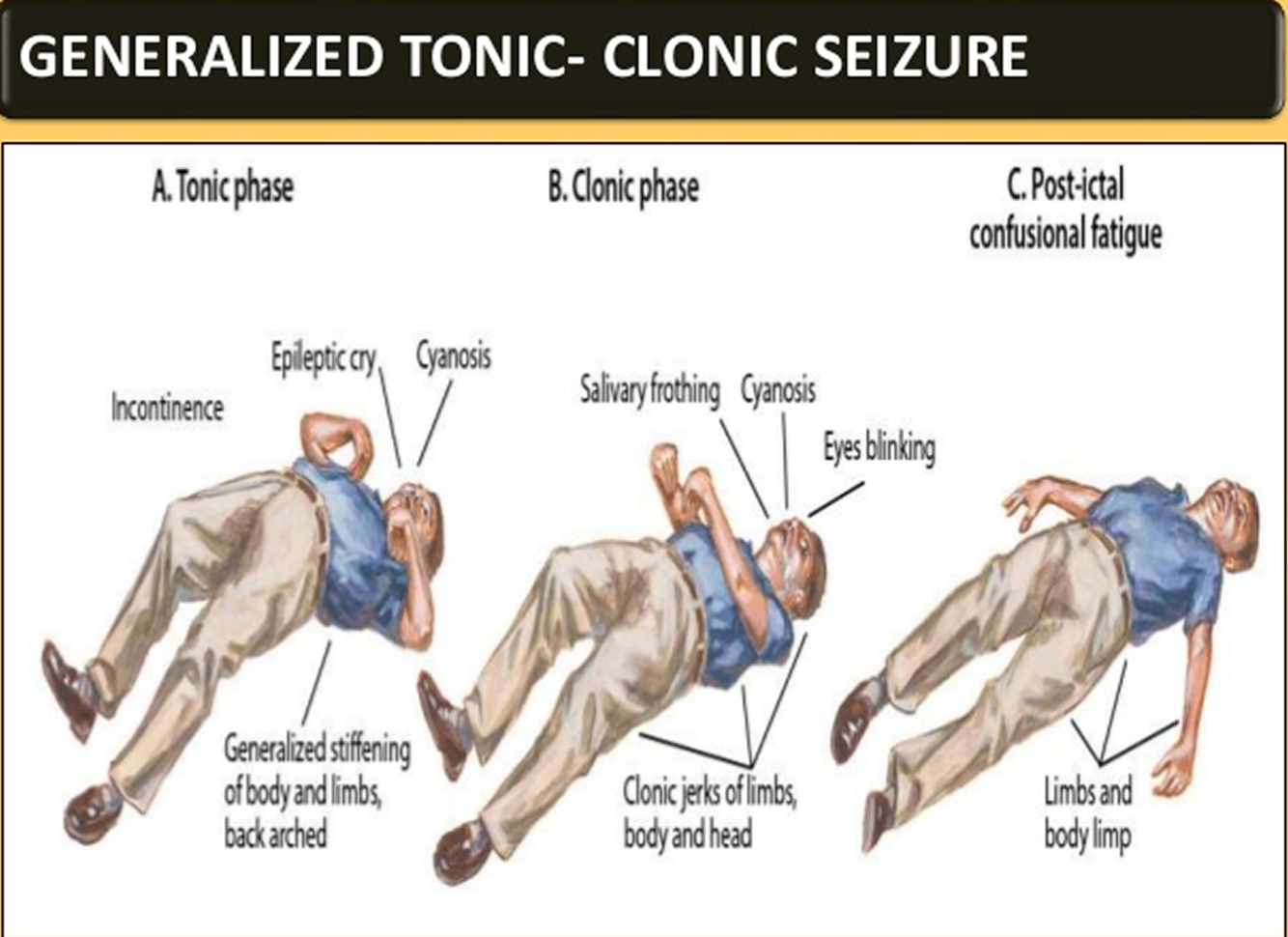
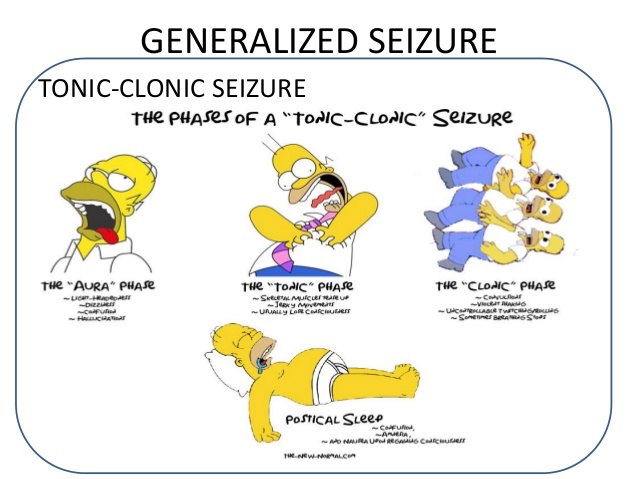
TONIC-CLONIC (GRAND MAL)
GENERALIZED SEIZURE
Generalized seizures: involve the whole brain. Patient loses consciousness and ability to maintain posture.
Grand-mal -
- Major motor seizure activity
- Violent total body seizure; both sides of brain
SYMPTOMS: Aura then loss of consciousness and falling, Tonic (stiffening of the body) first (20-40 seconds) then clonic (jerking of the extremities) after; Cyanosis, tongue or cheek biting, excessive salivation and incontinence may occur; Post-ictal symptoms: patient has no memory of the seizure
ATONIC SEIZURE
GENERALIZED SEIZURE
Generalized seizures: involve the whole brain. Patient loses consciousness and ability to maintain posture.
ATONIC SEIZURES:
- Drop and fall attack
- Patient needs to wear protective helmet at all times- hard to be compliant
SYMPTOMS: Loss of posture tone, Loss of consciousness
UNCLASSIFED SEIZURES
FEBRILE
- Seizure threshold lowered by elevated temperature.
- Only one seizure per fever
- Common in 4% of population under age 5; tend to occur in small children that have very high fevers
- Occurs when temperature is rapidly rising
SYMPTOMS: Lasts less than 5 minutes, Generalized, transient, and non-progressive; Doesn’t generally result in brain damage; EEG is normal after 2 weeks
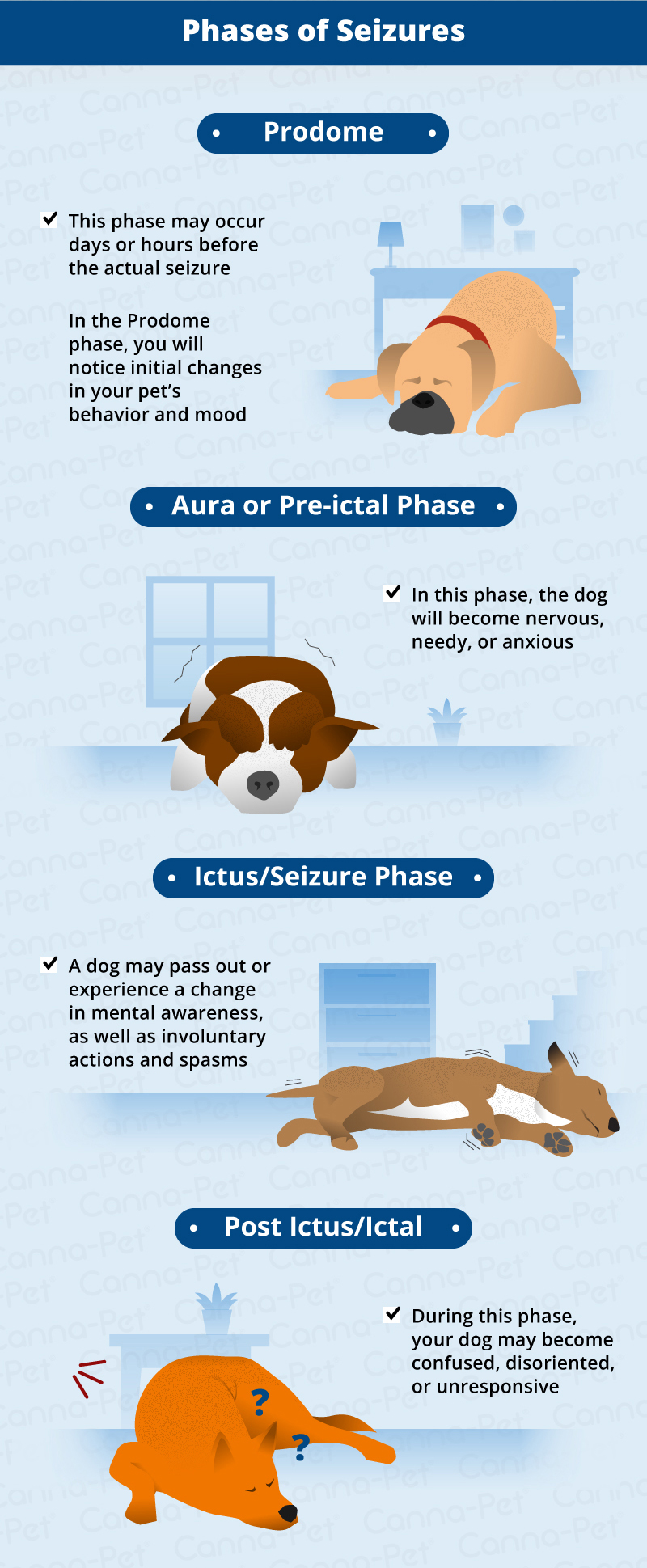
SEIZURE PHASES
Prodromal phase: signs or activity that precede a seizure. Patient may or may not be aware.
Aural phase: A sensory warning that precedes a seizure
Ictal phase: Full seizure; patients will have the tonic (stiffening) & clonic (muscle contractions)
Post-ictal phase: period of recovery after a seizure. Patient may be very lethargic and fatigued. (can sleep 10-12 hours)
(phase 1 & 2 do not happen for all people)
NOTE: THE CANINE IMAGE IS A GREAT REPRESENTATION OF THE HUMAN PHASES
STATUS EPILPTICUS
Prolonged or frequent repetition of seizures without interruption
- Results in anoxia; Can cause cardiac and respiratory arrest
- May be fatal !!!!!
- Tonic-clonic status epilepticus is most dangerous because it can cause acidosis, arrhythmias, resp arrest.
- Consciousness not regained between seizures
- Lasts more than 30 minutes
- May involve any type of seizure
- Permanent brain damage may result; Neurological emergency
- Patients given big doses of Valium- start with 10 mg IV push and go up from there; have to quiet the brain down→ give benzos followed by anti-seizure med
- Assessment findings: loss of consciousness, dyspnea, fixed and dilated pupils, incontinent of bowel and bladder
STATUS EPILEPTICUS
DIAGNOSTIC TEST FINDINGS
EEG: abnormal wave patterns, focus of seizure activity
CT scan: a space-occupying lesion
MRI: pathologic changes
Brain mapping: identification of seizure areas; possible ablation of foci


-
Exam 3 Burn Injuries25
-
Exam 3 Renal19
-
Exam 3 the Elderly3
-
Exam 3 GI11
-
Exam 3 Peri-Operative3
-
Exam 3 Liver7
-
Exam 4 Immunological Abnormalities33
-
Exam 4 Immunodeficiency Disorder HIV/AIDS17
-
Exam 4 Musculoskeletal Disorders27
-
Exam 4 Gerontological Nursing13
-
FINAL EXAM ABG and K, Na and Ca27
-
FINAL EXAM Heart19
-
FINAL EXAM Study Guide Version Part 166
-
FINAL EXAM Study Guide Version Part 254



