Generals about Retroviridae
A very large family of animal and human viruses
Causative agents of some types of cancer, immunosuppression or
immunodeficiency diseases
May exist as stable components of the host genome
Named “retrovirus” because of an important enzyme they encode “reverse transcriptase” – David Baltimore & Howard Temin
• Retro
• Retro = reverse/backward – reflects the character of the viruses to use the RNA genome to produce DNA intermediates by means of “RNA-dependent DNA polymerase” which is found in the virion of all retroviruses
Reverse transcriptase
• Reverse transcriptase is an RNA-dependent DNA polymerase
Retroviruses of veterinary importance were among the first retroviruses to be recognized e.g.,
• Equine infectious anaemia virus, bovine leucosis virus and jaagsiekte virus of sheep – described in 1800s
- Retroviruses of chicken – detected by Bang and Ellerman in 1908 in Denmark
- Rous sarcoma virus – detected by Rous as early as 1911 in species such as cattle,
cats, primates and mice
• Since 1980 we know that retroviruses cause human diseases too e.g., some lymphomas, leukemia and AIDS
Characteristics of retroviruses
• They are enveloped viruses formed by budding from the cell
membrane
• Have a diploid genome with two copies of single stranded, positive
sense RNA
• All replicate with use of the reverse transcriptase, an enzyme encoded by the virus
Positive sense RNA means:
RNA serves as mRNA from which protein translation can directly begin
What is special about Retroviruses?
They integrate into the genome of the host by means of an enzyme called integrase
IMPLICATION: they may alter or acquire host genome sequences, may activate or inactivate particular host genes located near the integration site
What is the taxonomy of Retroviridae?
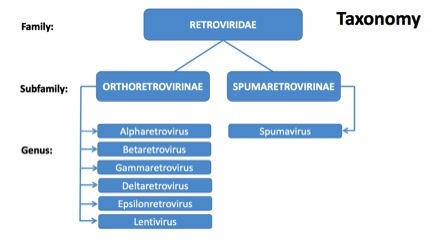
Morphology of retroviridae
Virions are spherical
Surrounded by an envelope consisting of a lipid membrane bilayer
The surface is studded by projections of envelope glycoprotein
A spherical layer of protein (matrix)
beneath the envelope
An internal capsid protein which encloses the viral RNA = nucleocapsid
• Inside the nucleocapsid - two single strand viral RNA, reverse transcriptase, integrase and protease
Virion properties
- Diameter 80-100 nm
- Each RNA genome is between 7 and 11 kb and has a 3’
polyadenylated tail and a 5’ cap
• Because virions are enveloped, they are easily inactivated by lipid
solvents or detergents and by heating
• Virions are resistant to ultraviolet or X-rays
What is required for replication of these viruses?
- At least 30 molecules of reverse transcriptase (RT) are included in the virion
- RT is required for replication
- RT serves as:
- RNA-dependent DNA polymerase
- DNA-dependent DNA polymerase • Rnase
- Virion has at least 3-4 important genes
What are the different genes that in the viruses?
gag, pol, env,, pro
The gag gene encodes
- The gag gene encodes the viruses core proteins
- Capsid (CA)
- Nucleocapsid (NC)
- Matrix (MA)
The pol gene encodes:
The pol gene encodes:
• Reverse transcriptase (RT)
• Integrase (IN)
The env gene encodes:
The env gene encodes:
• Virion envelope proteins, surface (SU) and transmembrane (TM)
The pro gene encodes
The pro gene encodes the protease
In lentiviruses
• the tat gene encodes a transactivator that enhances the efficiency of
cellular RNA polymerase
• the rev gene encodes a protein that facilitates transport of non-
spliced viral RNA from the nucleus to the cytoplasm
- the nef gene encodes Nef protein that:
- is essential for replication in target hosts but not in cell culture in vitro
- may downregulate expression of the CD4 molecule or alter the activation status of target cells
- the vif gene encodes a protein Vif which enhances replication in lymphocytes
Alpharetroviruses - characteristics
- Referred to as simple retroviruses
- Have a type C virion morphology
- Represented by avian leucosis and sarcoma virus (ALSV)
- The genome contains gag, pro, pol and env genes
- The pro gene is at the 3’ end of gag in the same reading frame • Mostly endogenous and exogenous viruses of chicken
Exogenous retroviruses
Exogenous retroviruses are those viruses transmitted horizontally and are rarely transmitted via in-utero or germline infection
Endogenous retroviruses
Endogenous retroviruses (retroviral elements) are those viruses included in the genome of most if not all animals
• Are transmitted vertically as part of the host genome • Are passed on from generation to generation
Betaretroviruses
• Simple retroviruses
Have type B morphology with round eccentric core or type D with cylindrical core
Exemplified by mouse mammary tumor virus (MMTV) and Mason-Pfizer monkey virus (M-PMV)
Virions are assembled in the cytoplasm via A type intermediate
The genomes contain gag, pro, pol and env genes
gag, pro and pol are all in different reading frames
MMTV additionally has the sag gene which encodes the superantigen
The genus contains both endogenous and exogenous retroviruses
Gammaretroviruses
Simple retroviruses with a C type morphology
Has the largest number of members e.g., murine leukemia virus, feline leukemia virus etc.
The genome contains gag, pro, pol and env
The gag, pro, pol are in the same reading frame
They contain both endogenous and exogenous retroviruses of mammals and reptiles
Deltaretroviruses
- Complex retroviruses with a C-type morphology
- The famous examples are: human T-lymphotropic virus (HTLV), bovine leukemia virus
- The genome contains gag, pro, pol, env and regulatory genes rex and tax
- The gag, prol and pol are presented in 3 different reading frames
- Expression of Gag-Pro-Pol requires 2 successive frame shifts
- Rex and Tax are expressed from an alternatively spliced mRNA • Rex and Tax control synthesis and processing of viral RNA
- There are no known endogenous deltaretroviruses
- Exogenous retroviruses are found only in a few mammals
Epsilonretroviruses
Complex retroviruses with a type C morphology
Prototype is the Walleye dermal sarcoma virus
Contain gag, pro, pol and env with gag, pro and pol in the same reading
frame
Additionally, 3 more genes termed ORF A, B, and C are present
The ORFa is a viral homologue of the host cyclin D and may regulate host cell cycle
Only endogenous retroviruses are found in fish and reptiles

-
Test 1534
-
Test 2- Prevention and control of Viruses71
-
Test 2- Poxviradae126
-
Test 2- Circoviridae41
-
Test 2- Asfarviridae41
-
Test 2- Parvoviridae80
-
Test 2- Diagnosis of Viral Techniques9
-
Test 2- Papillomaviridae37
-
Test 2- Adenoviridae42
-
Test 3- Reoviridae37
-
Final- Retroviruses52
-
Final- Orthomyxoviridae19
-
Paramyxoviridae34
-
Toka questions41



