What are the four layers of the epidermis - in order.
- Stratum basale - basal layer
- Stratum spinosum - spinous layer
- Stratum granulosum - granular layer
- Stratum corneum - cornified layer
Where is the skin the thinnest?
Inguinal and axillary regions
What is unique about scrotal skin histologically?
- Thicker than haired skin
- Rete ridges
- Epidermal pigmentatin is prominent
- Few pilosebaceous units
- Smooth muscle bundles present in the dermis
What is unique about the footpads histologically?
- Very thick
- Marked rete ridge formation
- Multilayered stratum spinosum
- Two-or-three cell thick stratum granulosum
- Wide, compact stratum corneum
- No pilosebaceous units
- Atrichial (eccrine) glands present in panniculus
What is unique about the nasal planum histologically?
- Thick epidermis
- Rete ridges
- Laminated stratum corneum
- Thin or absent stratum granulosum
- Melanotic stratum spinosum
- No hair follicles or pilosebaceous units
- Prominent nerves and vessels
What are some tips to obtain a good biopsy?
- Multiple biopsies from several sites
- Primary lesions are much better than secondary
- 6mm or excisional biopsy are ideal
- Minimize operator-induced artifact
- Don’t surgically prepare the sites
- Give signalment, history, DDX, etc
Define epidermal hyperplasia.
Increase in the number of nucleated cells in the epidermis.
Define acanthosis
Epidermal hyperplasia, specifically hyperplasia of the stratum spinosum.
Does epidermal hyperplasia always indicate chronicity?
No.
Even superficial traumatic injury - like tape stripping - can induce a burst of mitotic activity in the transient amplifying cell population that results in acanthosis by 36-48 hours. You will probably see mitotic figures in the basal layer.
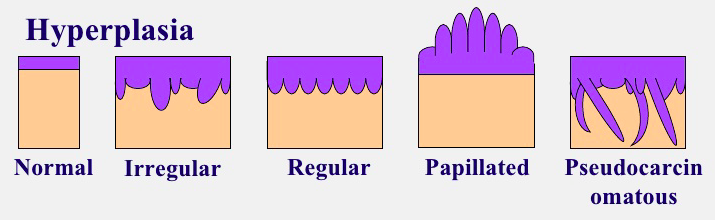
What are the four morphological types of epidermal hyperplasia?
- Irregular
- Regular
- Papillated
- Pseudocarcinomatous
Define irregular epidermal hyperplasia
Hyperplastic changes in which the rete ridges formed are uneven in shape and height. This is the most common form of epidermal hyperplasia.
Define regular epidermal hyperplasia
- Rete ridges are even in width and depth
- Uncommon
- Seen with lichenoid psoriasiform dermatosis of springer spaniels
- In humans, regular epidermal hyperplasia = psoriasiform hyperplasia
- Seen with psoriasis
Define papillated epidermal hyperplasia
Digitate projections of the epidermis
Seen with warts and papillomas
Seborrheic dermatitis
Callous
What is pseudocarcinomatous epidermal hyperplasia?
Extreme, irregular epidermal hyperplasia which is branched and fused. There are a bunch of rete ridges which branch and link up.
Define hypergranulosis
Increase in the width of the straytum granulosum
You will see a more dark blue granules of keratohyalin.
What is orthokeratotic hyperkeratosis?
Increased thickness of the stratum corneum
It is either because of an increase in the production of keratin, or a decrease in the normal attrition of the cornified layer.
Usually there is about 7-10 layers; don’t overinterpret this. In real life, there are usually 40+ layers to the stratum corneum.
If you see orthokeratosis without acanthosis, what should you suspect?
Disorders of keratinization, corneocyte adhesion or endocrine-related dermatoses.
What are the three morphological types of orthokeratotic hyperkeratosis?
- Basket-weave orthokeratosis
- Compact orthokeratotic hyperkeratosis
- Laminated orthokeratotic hyperkeratosis
What is basket weave orthokeratosis?
Excess of the normal type of keratin covering the haired parts of the body. This is an artifact of fixation. You will see this type of hyperkeratosis in endocrine skin disease, primary seborrhea or dermatphytosis.
What is compact orthokeratotic hyperkeratosis?
What is your top differential for it?
Loss of the basket weave, thick and packed keratin.
Seen with chronic low-grade trauma (licking) or on the footpads.
What conditions do you see laminated orthokeratotic hyperkeratosis?
Ichthyosis
What is parakeratotic hyperkeratosis? What does it indicate?
Thickened stratum corneum in which the nuclei of the keratinocytes are retained. Excess production of abnormally keratinized stratum corneum.
Indicates a failure of normal epidermal differentiation.
Give five examples of conditions where parakeratotic hyperkeratosis is seen.
- Zinc-responsive dermatosis
- Thallium toxicosis
- Superficial necrolytic dermatitis (hepatocutaneous)
- Lethal acrodermatitis of bull terriers
- Seborrheic diseases like Malassezia dermatitis
What is dyskeratosis?
Refers to premature keratinization of cells in the stratum spinosum. Often occurs in combination with parakeratosis - indicating an abnormality of epidermal differentiation.
This can be difficult to distunguish from apoptosis. The dyskeratotic keratinocytes have hypereosinophilic cytoplasm and degenerative changes of the nucleus. You should look at the picture as a whole to determine if apoptosis vs. dyskeratosis.




