Penetrance
Proportion of individuals with mutation who develop disease
Most diseases have incomplete penetrance
Incomplete penetrance may be due to genetic modifiers
Penetrance can be age-dependent
Variable Expressivity
Same gene associated with range of phenotypic severity
Expressivity may be age-dependent
Variable expressivity may be due to genetic modifiers
Example: Neurofibromatosis type 1 can be associated with range of disease severity from very mild to severe
Pleiotropy
Same gene/mutation can cause multiple different phenotypes
Locus heterogeneity
Many different genes can cause the same disease
Related term is allelic heterogeneity, referring to different mutations in same gene causing same disease
Imprinting
Mutation causes disease dependent on parent-of-origin
Sometimes will skip generations
Paternal imprinting: Paternal copy of gene is normally imprinted or silenced. Mutation must be inherited from mother to cause disease. Example: Angelman syndrome (can be 2/2 maternal uniparental disomy)
Maternal imprinting Maternal copy of gene is normally imprinted or silenced. Mutation must be inherited from father to cause disease. Example: Prader Willi syndrome (can be 2/2 paternal uniparental disomy)
Polygenic
1000s of genetic variants in the genome each contribute a small amount to disease risk
Often have strong environmental component
Typically won’t show classic Mendelian inheritance patterns
Example: Late onset Alzheimer’s disease
De novo
New mutations that arise in an individual•No family history
Severe, autosomal dominant disorders that are highly penetrant generally are de novo
Mitochondrial inheritance
Mutations in the mitochondrial genome
Are transmitted from mother to child
Demonstrate heteroplasmy: variable proportions of mitochondria carry mutation among cells
There are also mitochondrial genes encoded in the nuclear genome which don’t follow this pattern
Example: MT-TL1 mutations causing MELAS
Testing for structural variants
Karotype: Aneuplodies, major chsmal rearrangements
FISH: Tests for specific submicroscopic chsmal rearrangements, dels, and dups
Comparative genomic hybridization (CGH): Test for copy number variants via flurophobes
Chromosal microarray: Test for copy number variants by looking for regions with more or less DNA content than expected
Testing for SNPs
Whole genome sequencing
Whole exome sequencing
Gene panels
Genetic testing for repeat expansions
MC via Southern blot
Usually need to order a specialized test for a given repeat expansion
Genetic testing for mitochondrial DNA
- Specialized next generation sequencing methods to identify mtDNA
- Often done from biopsied tissues (e.g., muscle)
- Note that nuclear-encoded mitochondrial genes are detected by other methods
Fragile X syndrome
ID
XLR
Due to CGG repeat in FMR1
Normal: 6-55 repeats
Premutation and FXAS: 55-200
Fragile X when repeat length>200
MOA: Repeat expansion leads to epigenetic changes locally and altered FMR1expression.
Fragile X-associated tremor/ataxia syndrome (FXTAS)
ID
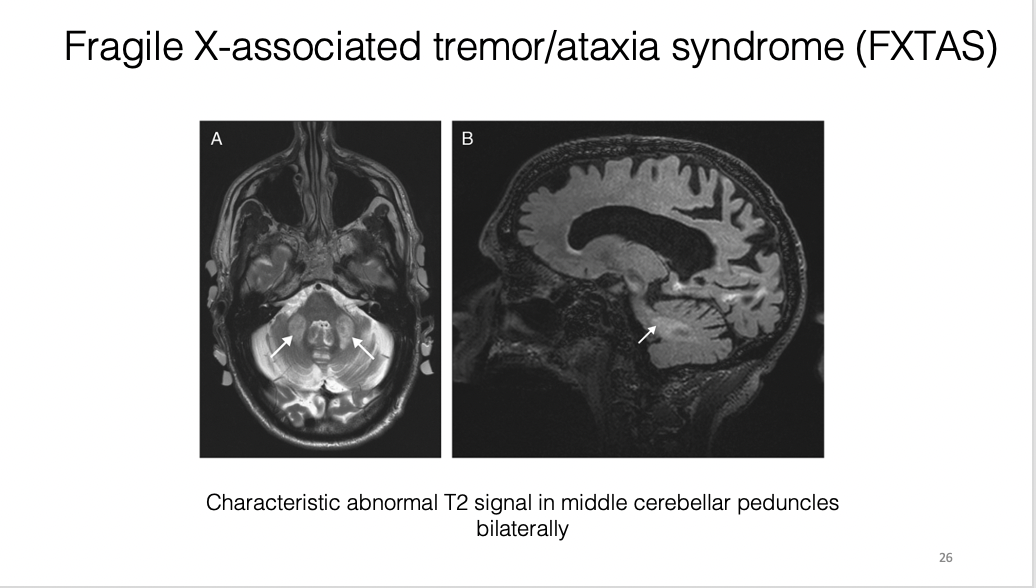
Presents in males (and sometimes females) in late-life (after age 50)
Tremor resembling essential tremor
Cerebellar Ataxia +/- cognitive and parkinsonian features
About ¼ of female carriers have premature ovarian failure.
Due to CGG repeat in FMR1 in the “premutation” range of 55-200
FXTAS imaging findings
Smith-Lemli-Opitz syndrome
ID
DHCR7 mutations (AR)->Deficiency of the enzyme 7-dehydroxycholesterol reductase -> altered cholesterol synthesis
ID, behavioral issues (self-injurious behavior), autism
Microcephaly, facial dysmorphism: ptosis, micrognathia, temporal narrowing, cleft palate, epicanthal folds
Growth retardation
Rett Syndrome
ID
XLD, MECP2 gene
Normal development from 0-6 months -> head growth deceleration at 3 mo-4yo ->Developmental regression ~1-4 yo: loss of purposeful hand movements and speech, social withdrawal, stereotypic hand movements (“washing” or “wringing”), gait dyspraxia, epilepsy
Prader-Willi syndrome
ID
Occurs in the setting of maternal imprinting where maternal copy of gene/chsm 15 is silenced
Can be 2/2 deletion of paternal arm of chsm 15, maternal isodisomy, imprinting defect. All can be detected via genetic methylation studies.
Clinical features: Neonatal hypotonia, hyperphagia, rapid eight gain, hypogonadism, developmental delay
Angelman syndrome
Occurs in the setting of paternal imprinting, where paternal copy of gene is slence
Can be 2/2 deletion of maternal arm of chr15, paternal isodisomy, mutation is UBE3A, impriting defect
Clinical features: Developmental delay, movement disorder (gait ataxia, tremor), behavioral abnormalities: frequent laughing, smiling, hand flapping, little or no spoken language, seizures
Familial hemiplegic migraines
Channelopathy
Genetics: Can be familial or sporadic. Most often mutations in ATP1A2 or CACNA1A, less commonly SCN1A (also implicated in Dravet)
Episodic Ataxia Type 1
Channelopathy
Due to mutations in KCNA1 (AD)
Episodic Ataxia Type 2
Channelopathy
Due to mutations in CACNA1A (AD)
50% of patients with EA2 have hemiplegic migraine
Hyperkalemic periodic paralysis
Channelopathy
SCN4A (AD) mutations are most common
Hypokalemic periodic paralysis
Channelopathy
CACNA1S or SCN4A mutations, typically AD



-
Embryology79
-
Metabolic disorders110
-
AEDs pharmacology41
-
Pediatric epilepsy20
-
Genetics91
-
Channelopathies19
-
Development and common neurodevelopment conditions36
-
Neurocutaneous disorders31
-
White matter disease11
-
Ching-Ching Pediatrics72
-
Neurochemistry, toxic/metabolic122
-
Epilepsy132
-
Nerve, muscle, and NMJ36
-
Neuromuscular disease (including some myelopathies)380
-
Neurophysiology99
-
Neurodegeneration and movement disorders308
-
MS87
-
Neuroanatomy32
-
Stroke/ICU366
-
Headache102
-
Psychiatry204
-
Neuroendocrine42
-
Neuro ID129
-
Neuro Onc145
-
Neuroanatomy334
-
Neurology of systemic disease49



