What is the most common skin manifestation of Osler-Weber-Rendu syndrome?
- Telangiectasia
- Purpura
- Clubbing
- Cyanosis
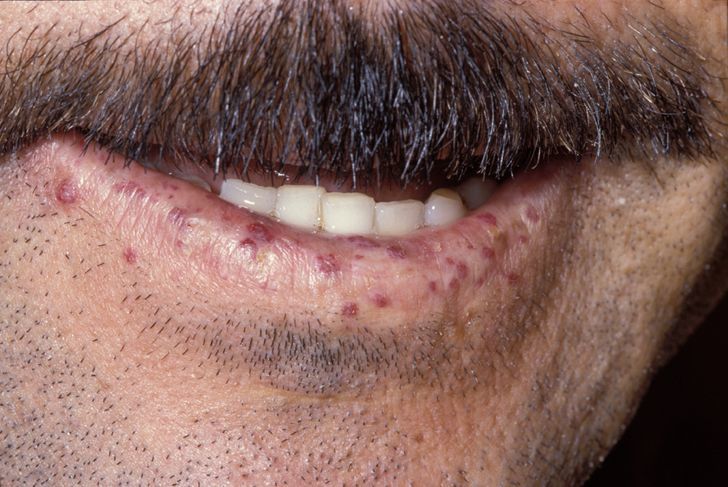
1 - Telangiectasia
- The most common skin finding in patients with Osler-Weber-Rendu syndrome is telangiectasias.
- These lesions are usually seen on the oral mucosa, skin, and conjunctiva.
- The skin changes can include clubbing and cyanosis.
- The telangiectasias usually develop 12 months after the first nose bleed.
A 17-year-old patient with lamellar ichthyosis presents to the office for routine evaluation. Besides lamellar ichthyosis, she has a negative past medical history. On a daily basis, she uses emollients. She also uses an alpha-hydroxy acid medication. Her condition can lead to what type of anhidrosis?
- Obstruction
- Idiopathic
- Central/neuropathic
- Iatrogenic
1 - Obstruction
- Peripheral alteration in the eccrine gland itself is due to obstruction.
- Other examples of obstruction are psoriasis, miliaria, eczematous dermatoses, porokeratosis, and bullous diseases.
- The prognosis of anhidrosis varies, depending on the type of anhidrosis. Anhidrosis associated with a genetic syndrome is generally lifelong. It is important to recommend lifestyle modifications to all patients and ensure a cool environment.
- For those disorders due to clogged sweat glands, frequent and gentle exfoliation can be useful.
An 18-year-old female complains of multiple brown-red macules and papules, flushing, and itching. Scraping a fingernail along her skin produces a wheel. Biopsy of one of the lesions shows collections of perivascular mononuclear cells. These stain with toluidine blue. Which of the following is the most likely diagnosis?
- Urticaria pigmentosa
- Dermatographic urticaria
- Lymphocytoma cutis
- Mycosis fungoides
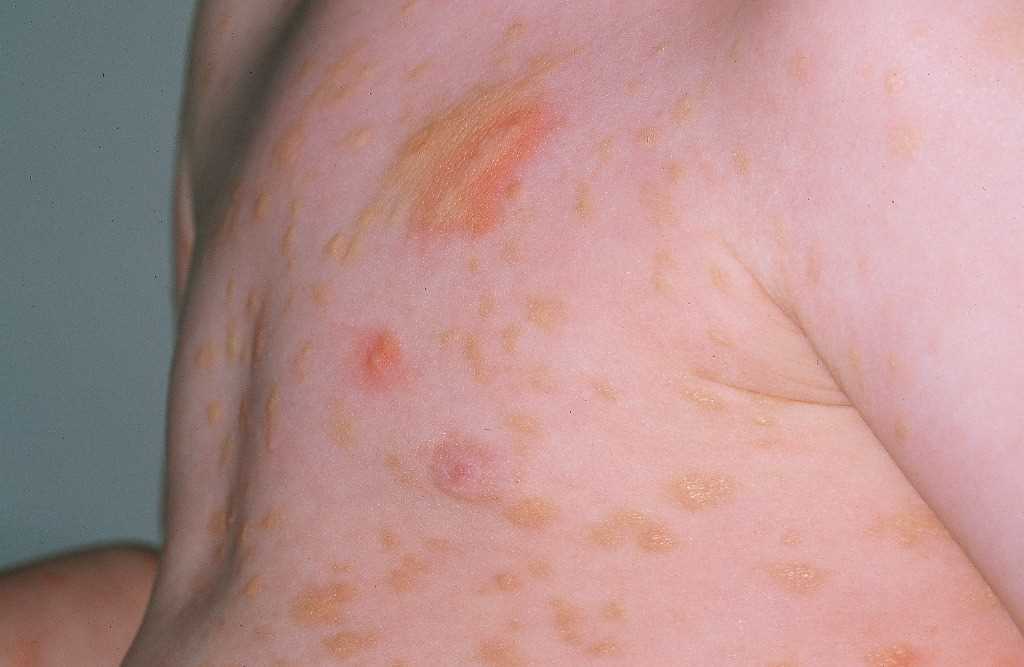
1 - Urticaria pigmentosa
- The patient demonstrates dermatographic urticaria or development of a wheal after abrasion or rubbing of the skin.
- In addition, she exhibits pigmentation of these lesions, making the diagnosis urticaria pigmentosa.
- This is a form of cutaneous mastocytosis and is secondary to mast cells proliferating in the dermis followed by melanocyte proliferation.
- The granules of mast cells are best visualized with metachromatic stains, including toluidine blue or Giemsa stain.
A 42-year-old male presented complaining of difficulty urinating at times. He stated that his urine looked dark. He has a history of lung cysts, spontaneous pneumothorax, multiple fibrofolliculomas, trichodiscomas, and acrochordons. Upon exam, there was blood in his urine. Which of the following carcinoma is most likely seen with patient’s underlying diagnosis?
- Hepatocellular carcinoma
- Squamous cell carcinoma
- Renal cell carcinoma
- Basal cell carcinoma
.
3 - Renal cell carcinoma
- Birt-Hogg-Dubé syndrome (BHDS) is an autosomal dominant genodermatosis usually manifesting in the third decade of life with multiple fibrofolliculomas, trichodiscomas, and acrochordons.
- The characteristic skin lesions of Birt-Hogg-Dube syndrome are trichodiscomas, fibrofolliculomas, and acrochordons. Lung cysts and pneumothorax may occur in adult life.
- Patients with BHDS are at increased risk of developing renal tumors lifelong, with an average age of onset at 50 years. Lifelong renal surveillance should begin at the age of twenty. Some experts recommend initial MRI followed by annual MRI or ultrasound, while others suggest CT scans every 3 to 5 years.
- Because of the risk of malignancies later in life these patients are best managed by an interprofessional team that includes a geneticist, pulmonologist, thoracic surgeon, dermatologist, urologist, and an internist. Patients with BHDS are at increased risk of developing renal tumors and renal carcinomas lifelong.
A 16-year-old female presents to the dermatology office with the concerns of multiple, firm, white papules clustered on her low back that she first noticed several months ago. They are asymptomatic and not changing. She has no other medical conditions but does report that her father has similar lesions on his nose and neck as well as a family history of renal cell carcinoma. Which of the following genes may possibly be responsible for her condition?
- TSC2 (Tuberous Sclerosis Complex 2 ) gene
- PTEN (Phosphatase and tensin) gene
- FLCN (Folliculin) gene
- CYLD (Cylindromatosis) gene
3 - FLCN (Folliculin) gene
- FLCN is the gene for Birt-Hogg-Dube syndrome (BHDS). This disease is characterized by fibrofolliculomas, trichodiscomas, and acrochordons.
- Patients with BHDS have an increased susceptibility to renal cell carcinoma, lung cysts, and spontaneous pneumothorax.
- Birt-Hogg-Dubé syndrome (BHDS) is an autosomal dominant genodermatosis. A germline mutation of FLCN, which encodes the tumor-suppressor folliculin, is responsible and is located on chromosome 17p11.2.
- Patients with BHDS are at increased risk of developing renal tumors lifelong, with an average age of onset at 50 years
StatPearls Publishing LLC. Dermatology: Specialty Review and Self-Assessment (StatPearls Review Series Book 128) (p. 178). StatPearls Publishing, LLC. Edición de Kindle.
20-year-old librarian presents in dermatology clinic with multiple flat-topped keratotic papules and plaques on his extremities that spare his sebaceous areas. He states they have been present since childhood and are refractory to topical treatment. He is in a monogamous sexual relationship with his girlfriend and smokes marijuana occasionally. However malodor from his skin lesion is causing him significant distress and he thinks he may lose his girlfriend. The patient wants to know if there is a permanent cure for his condition. What should be the response of clinician?
- The disease is self-limiting and requires no treatment
- The disease is cured by surgical excision of lesions
- The disease can be cured by long term treatment with antibiotics and intralesional steroids
- The disease can be managed symptomatically, but there is no permanent cure
4 - The disease can be managed symptomatically, but there is no permanent cure
- Acrokeratosis verruciformis of Hopf presents as multiple flat-topped and polygonal papules and verrucous plaques predominantly on the hands and feet.
- Acrokeratosis verruciformis usually appears at birth or in early childhood and is caused by an autosomal dominant mutation to ATP2A2 on chromosome 12q24.
- The treatment involves topical steroids and retinoids. Those refractory to topical treatment can be managed with acitretin or isotretinoin, usually given at a dose of up to 0.5 and 1 mg/kg per day, respectively.
- Surgical excision can lead to the recurrence of symptoms and there is no permanent cure for his condition.
A 25-year-old male presents with a several-year history of a red hyperkeratotic papular eruption on the scalp, face, and chest. Examination of the nails reveals red and white longitudinal streaks and distal nicks in the nail plate. The patient has areas where the disease is more pronounced. These areas seem to follow the lines of Blascko. The biopsy report returns stating “acantholysis and dyskeratosis with overlying hyperkeratosis and parakeratosis consistent with Darier’s disease.” The patient is diagnosed with Darier disease treatment is discussed with the patient. What is the mechanism for the areas of increased disease severity that follow the lines of Blaschko?
- Type 1 mosaicism
- Type 2 mosaicism (loss of heterozygosity)
- Variable penetrance
- Mitochondrial inheritance
2 - Type 2 mosaicism (loss of heterozygosity)
- There are two types of mosaicism in autosomal dominant diseases. Type one mosaicism is caused by a postzygotic mutation. This means that some cells have the mutation and others do not. In dermatology, type one mosaicism presents with areas of diseased skin intermixed with areas of normal skin reflecting the cells with and without the mutation respectively. The diseased skin often follows lines of Blaschko reflecting embryonic migration of skin cells. Type 2 mosaicism is caused by a postzygotic mutation in a patient that already has a “prezygotic” mutation. This patient starts out with one mutation(disease allele) in all cells and then another mutation happens farther in the cell division process that only some of the cells will have. These cells will have two mutations or two dominant alleles for the disease. This patient has essentially two types of cells: cells with one mutation (one dominant allele) and cells with two mutations (two dominant alleles). Although only one dominant allele is needed for disease, two dominant alleles will lead to a worse presentation. Clinically, this patient will have linear segments of increased disease severity in a background of already diseased skin. The areas of increased disease severity often follow the lines of Blaschko. This is also called loss of heterozygosity because the patient was originally heterozygous for an autosomal dominant mutation and then had another mutation making some cells homozygous for the autosomal dominant mutation.
- Darier disease has been shown to exhibit both types of mosaicism.
- Variable penetrance is a concept that describes the situation where not all patients with a certain disease genotype exhibit the disease phenotype. In mitochondrial inheritance, only females can transmit the disease but both genders in the offspring may be affected.
A mother and father bring their eleven month old infant to the office. They say the infant, although initially amicable, has become unconsolable, often does not interact with the parents, has developed a gluteal scaly rash, and they think the baby has stopped growing. History also revealed that the mother had stopped breastfeeding 5 weeks ago and was feeding the infant exclusively with a new fad homemade formula. What is the most cause of this child’s constellation of symptoms?
- Child abuse with emersion in hot water
- Botulinum
- Acrodermatitis enteropathica
- Vitamin D toxicity
3 - Acrodermatitis enteropathica
- Acrodermatitis enteropathica is a rare disease with an incidence estimated at 1 per 500,000 and is a disease of zinc malabsorption.
- Acrodermatitis enteropathica often becomes symptomatic 4 to 6 weeks after an infant has stopped breastfeeding. Clinical symptoms include irritability, withdrawn disposition, growth impairment, anorexia, and cutaneous involvement manifests as periorificial, gluteal, perineal, or an acral predominant burn-like psoriasiform lesions.
- Acrodermatitis Enteropathica occurs as an autosomal recessive mutation of the SLC39A4 gene on chromosome 8q24.3 that encodes the Zip4 transporter.
- Treatment of acrodermatitis enteropathica is 1 to 2mg/kg/day of lifelong zinc supplementation.



