GI Histo Flashcards

(225 cards)

1
Q

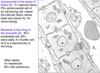
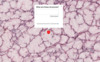
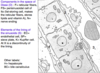
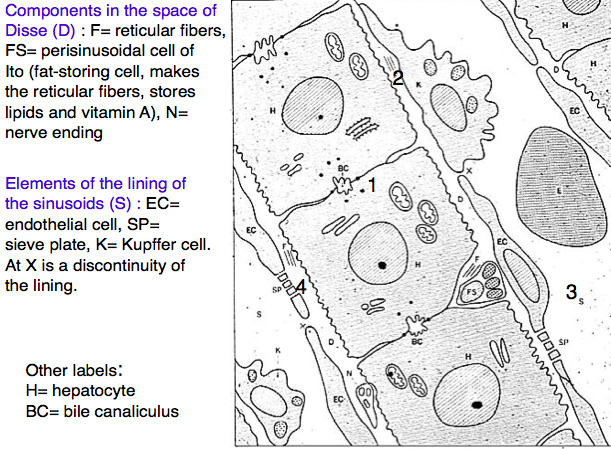
components of the space of disse

A

reticular fibers

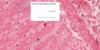
cell of Ito (fat storing, makes reticular fibers, stores lipids and vit E)

nerve ending
2
Q
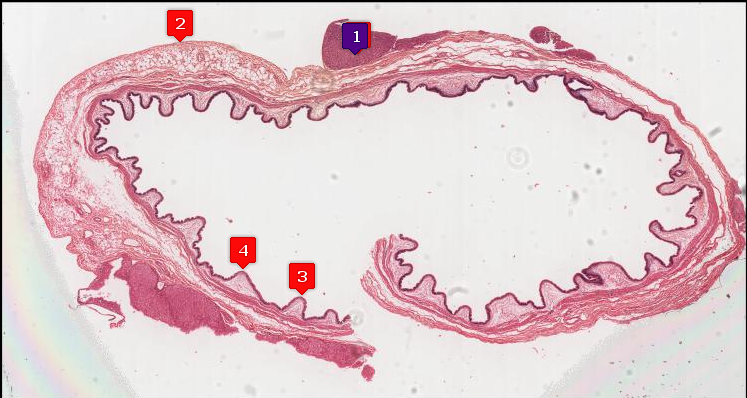
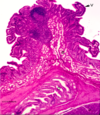
A

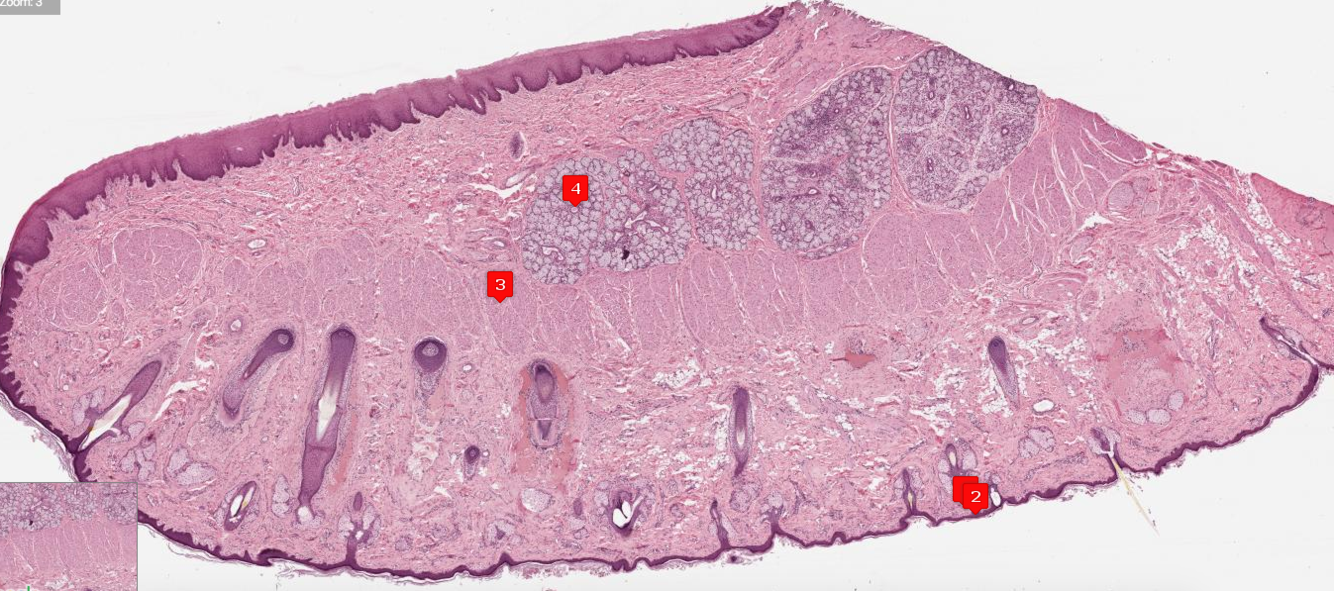
lip

3
Q
A

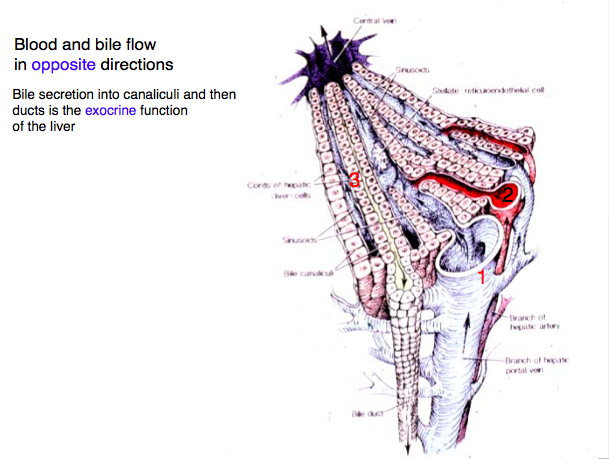
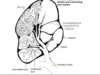
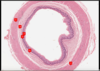
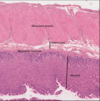
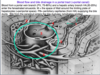
·So blood is flowing toward the central vein (i.e. toward the black star shape), whereas the bile, which is begin formed in these bile canaliculi, here indicated sort of diagrammatically as this green stuff, flows toward the portal tract.

·

·And again, what’s omitted here is the fact that there are lymphatics in the portal tract

·

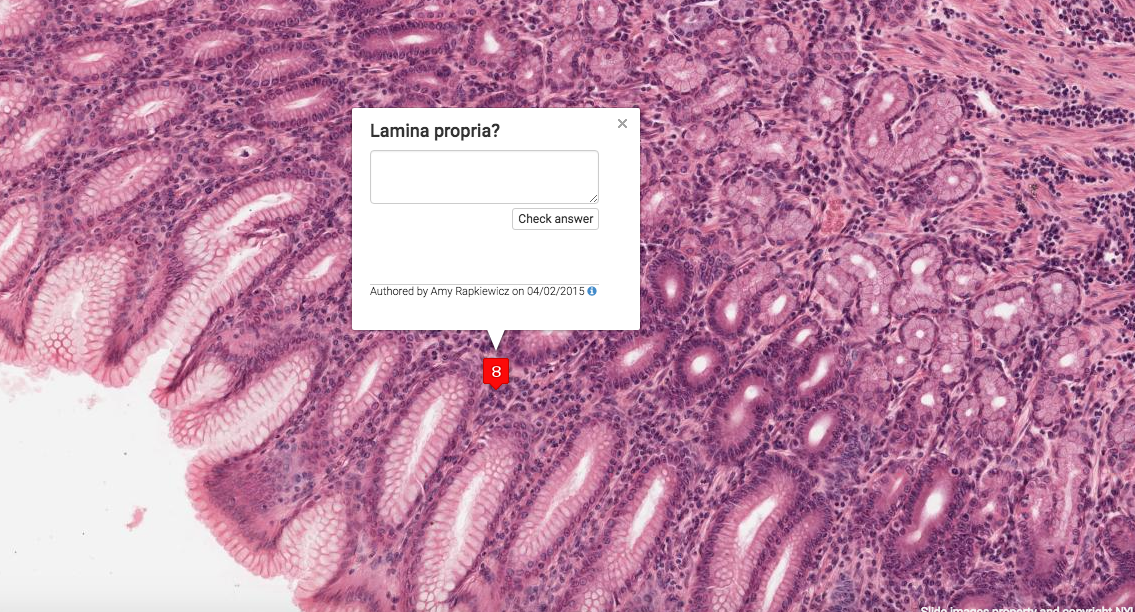
·So the secretion of bile into ducts is an exocrine function, and the secretion of albumin, lipoproteins, IgF1 in response to growth hormones – things like that into the blood are going to be the endocrine functions of the liver, and – as this points out – blood and bile flow in opposite directions in the lobules of the liver.
4
Q
A

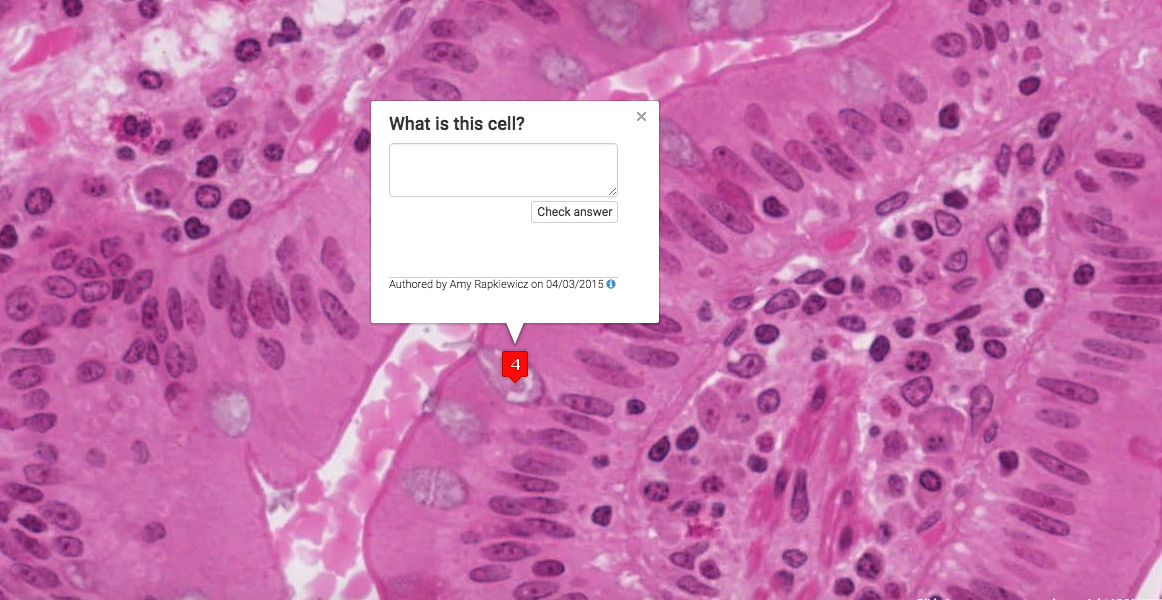
goblet cell

5
Q
A

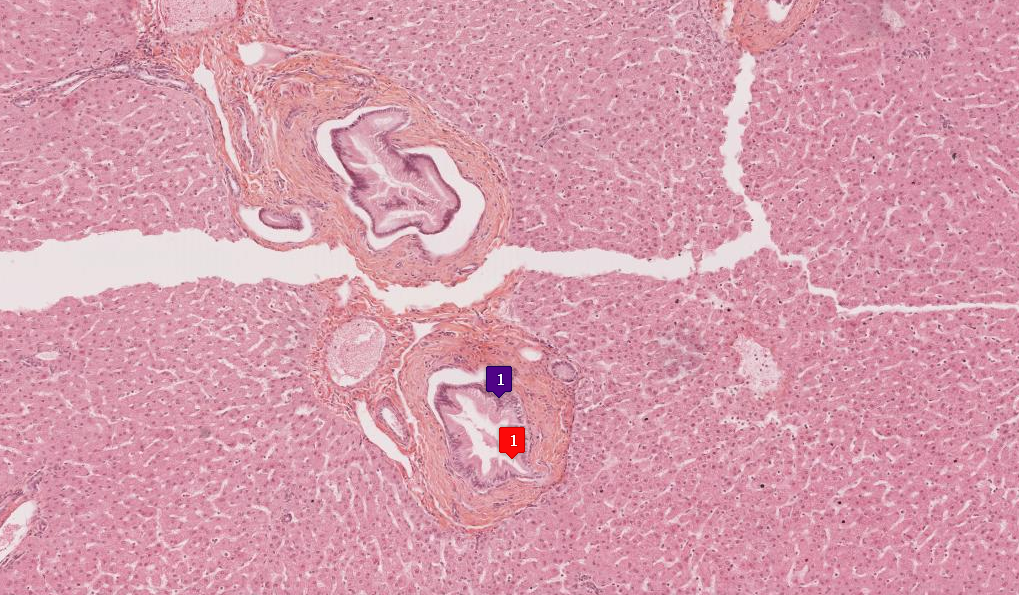
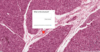
large bile duct in portal tract

6
Q
A

These are glands. Specifically they are the glands of Von Ebner - They secrete their product into the troughs on the sides of the circumvallate papillae.

tongue
7
Q
A

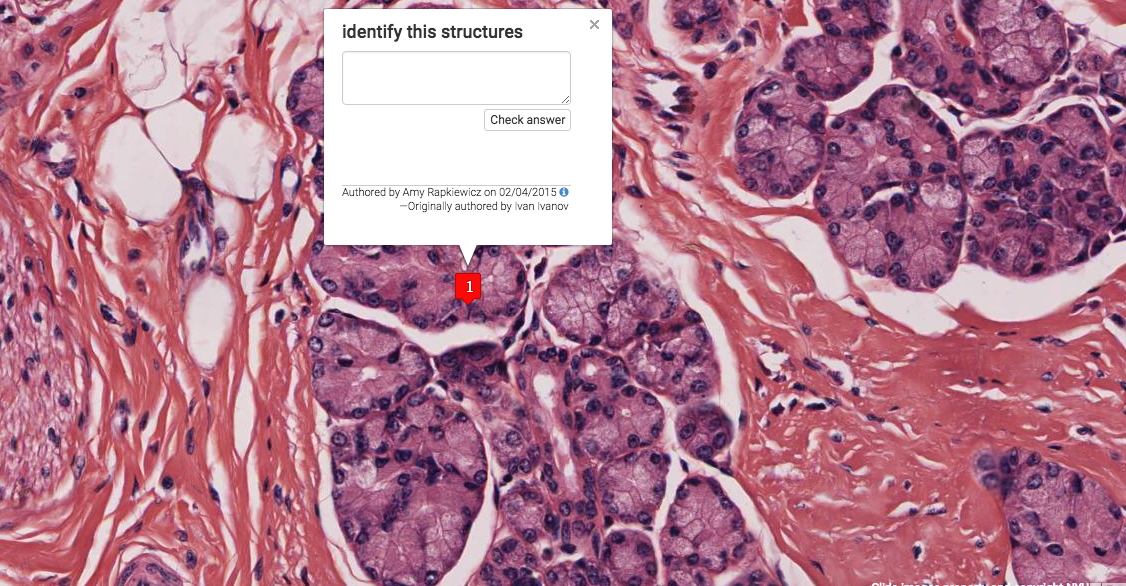
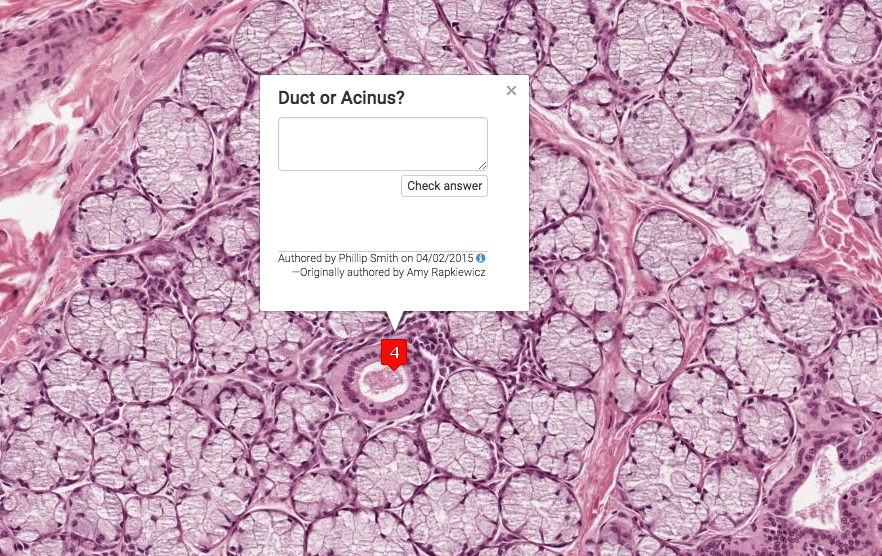
Duct of mucous gland.

8
Q
A

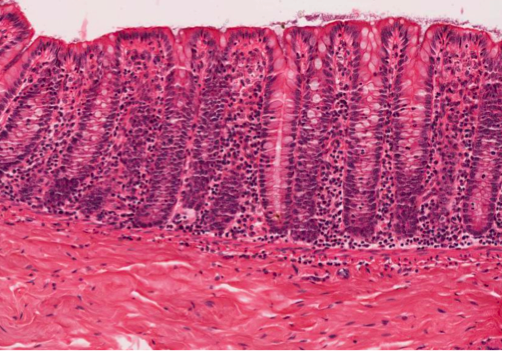
colon

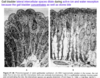
Straight tubular glands (like test tubes in a rack). You don’t really find Paneth cells as a general feature. There’s a smooth surface epithelium
9
Q
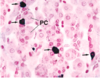
A

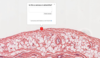
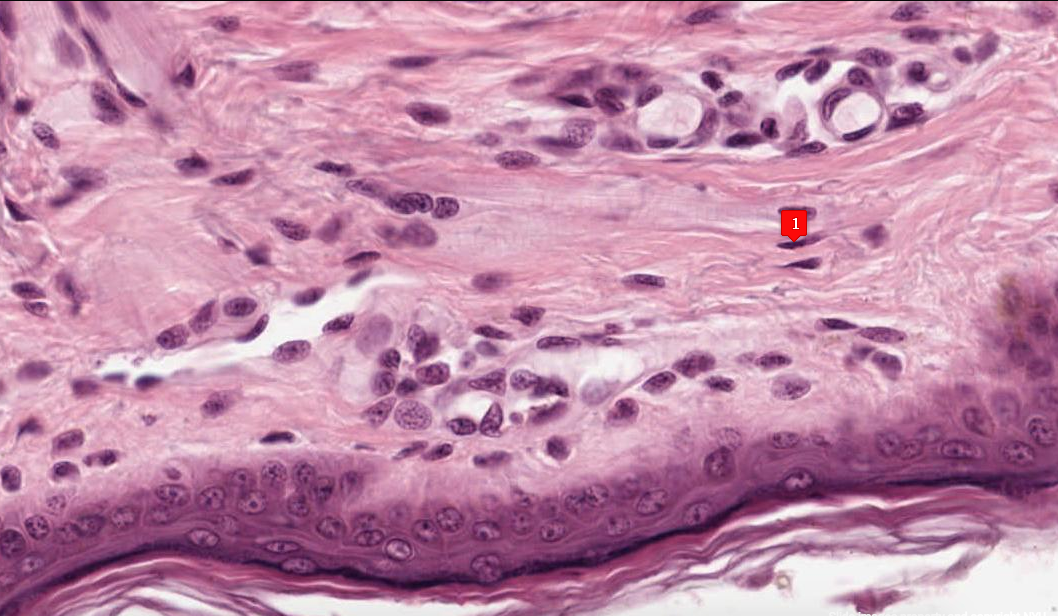
Loose Connective Tissue, Skin, Upper Lip

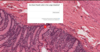
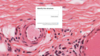
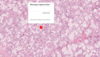
The marker is on a fibroblast. As you can see, the cell is beneath the epithelium and surrounded by a pink loose substance. What is this substance? Does the fibroblast produce it?

10
Q

parotid gland

A

almost all serous acini

long intercalated ducts

myoepithelial cells

many plasma cells

excretory ducts go from simple columnar epithelim to pseudostratified to stratified columnar
11
Q
A

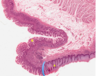
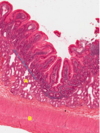
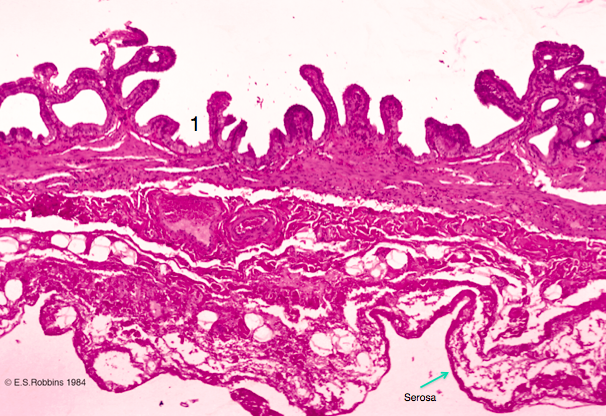
·gall bladder - no muscularis mucosa, submucosa, crypts

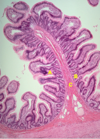
From the liver, bile obviously goes through those bile ductules into larger bile ducts that are found in the portal tracts out eventually to the gallbladder. Students confuse the gallbladder with the intestine, or the small intestine. So I’ve put some of the things that are not here, compared to the small intestine.

·

·There’s not going to be a muscularis mucosa, which you saw in intestine. There’s not going to be a separate submucosa, there’s not going to be crypts, although sometimes there’ll be downgrowths (1) called Aschoff sinuses that are abnormal. And the surface has folds, but these are not really villi.

·

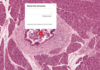
·And, in addition, if you think about – you’ve seen the abdominal cavity, right? So you know the gallbladder’s smack up against the liver. The side that’s against the liver doesn’t have a mesothelium – it just has an adventitia, but the part that faces the abdominal cavity has a mesothelium out here, and this layer is called the serosa. Again, the complex folds on the surface are not villi. Make sure when you look at the gallbladder that you can distinguish it from the small intestine.

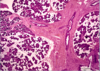
12
Q

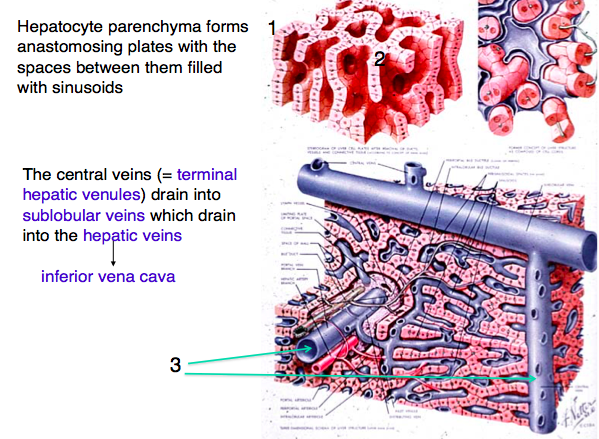
liver efferent blood flow

A

central veins (terminal hepatic venules)

sublobular veins

hepatic veins

IVC
13
Q
A

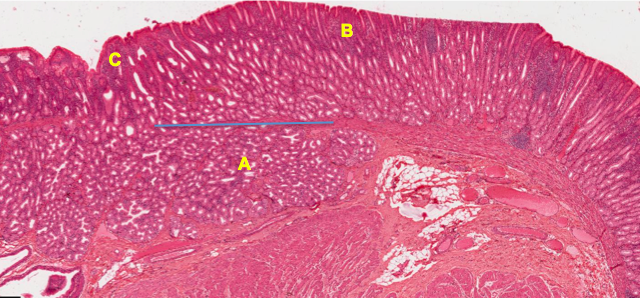
This one’s a little confusing – this is your pyloric stomach. Here’s your muscularis mucosa [line] which comes across and gets interrupted. Down here (A) we have glands below the muscularis mucosa, and I already told you there are only two places in the GI tract where you have submucosal glands: the esophagus and the duodenum.

This is the gastroduodenal junction: you have surface mucus cells (C) but over here you’re going to have a simple columnar epith with goblet cells here (B). [Note, I think he pointed to the wrong ones because later in the lecture he says that the intestine has the goblet cells, so the correction has been applied here].

The submucosal glands in the duodenum are the glands of Brunner.

14
Q

tissue?

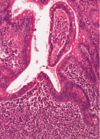
A

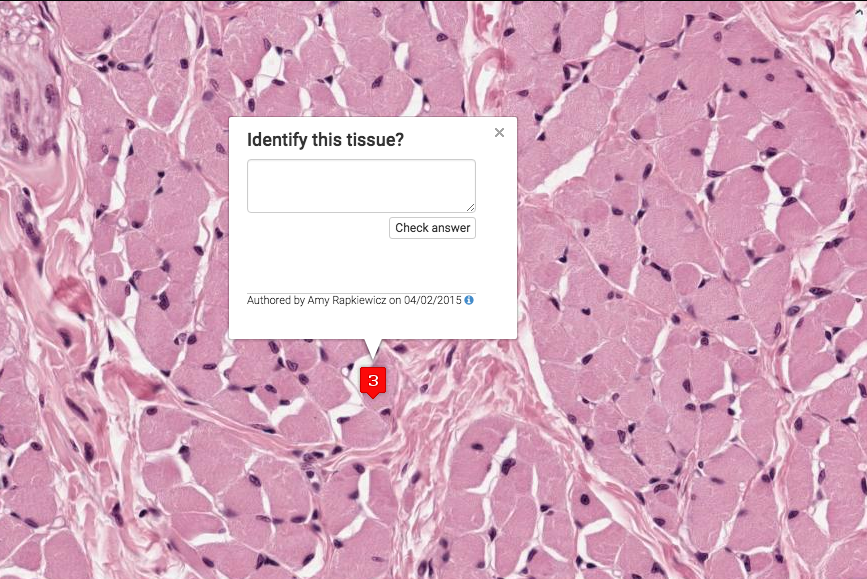
The tissue is skeletal muscle. The structure is the orbicularis oris facial muscle.
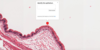
15
Q
A

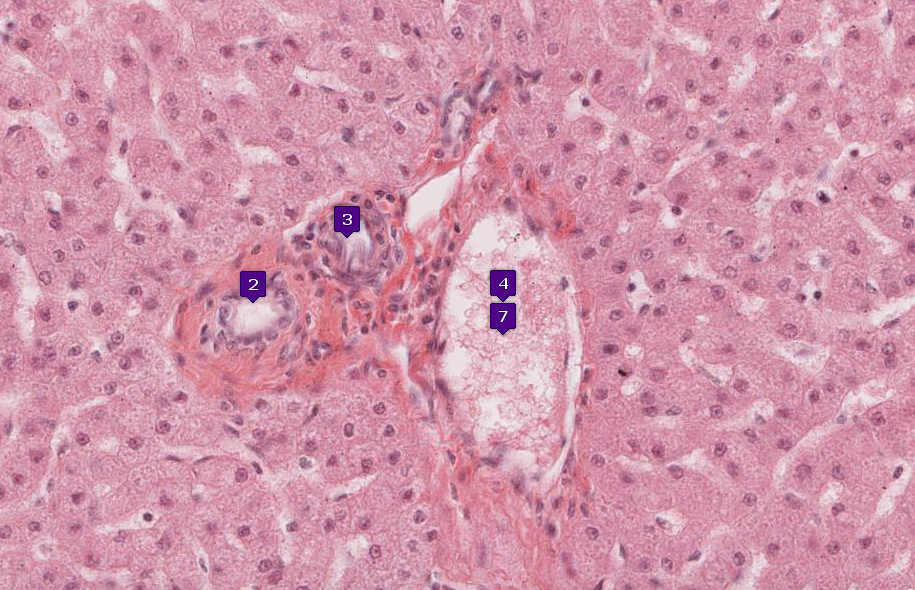
2: bile duct
3: hepatic arteriole

4/7: portal venule

16
Q

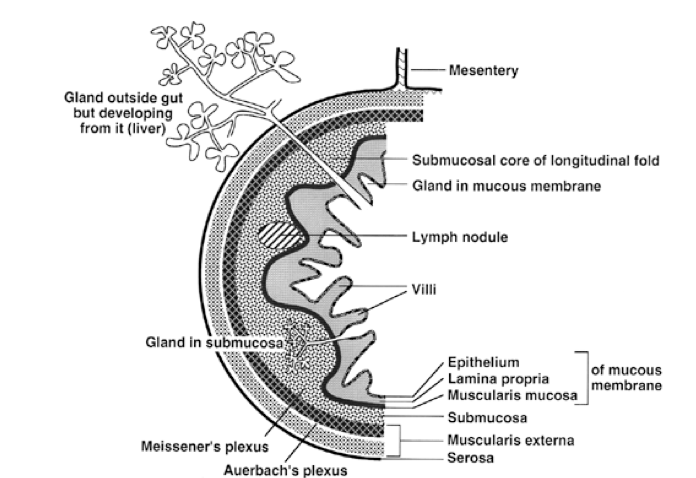
wall of gut - order of layers inside to outside

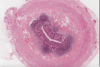
A

epithelium*

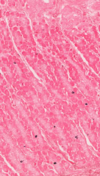
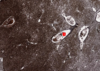
lamina propria* (loose CT)

mucularis mucosa* (small layer of muscle)

submucosa (dense irregular CT)

muscularis externa

serosa/adventitia (if retroperitoneal)

* mucosa
17
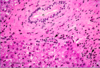
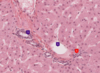
Q

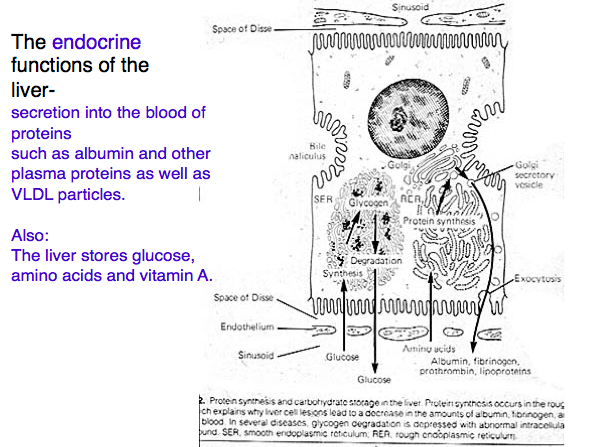
endocrine functions of the liver?

A

secretion into the blood of proteins like albumin and other plasma proteins and vldl particls

stores glucose, aa, vit a

·So the endocrine functions, secretion into the blood, including storing glycogen and secreting it as glucose (see arrows), making albumin, fibrinogen, prothrombin – again, all kinds of interesting things, including IgF1.

·

·And also stores vitamin A, especially in those lipid droplets in the perisinusoidal cells
18
Q
A

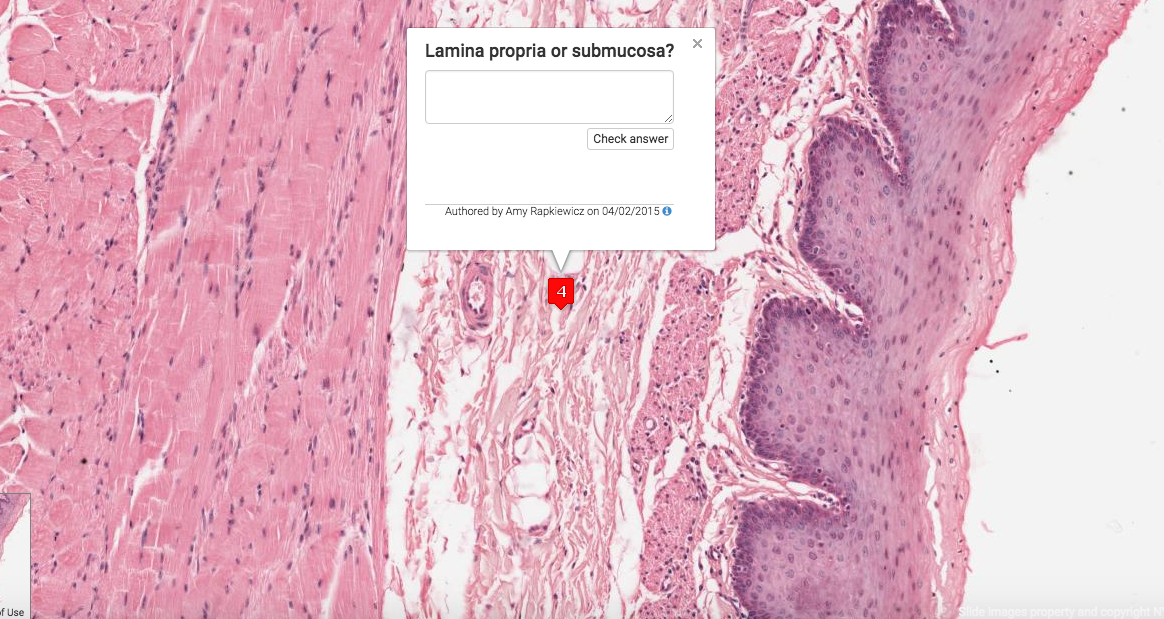
submucosa

19
Q

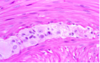
organ?

A

gallbladder

20
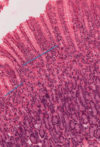
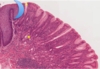
Q
A

Yes, the lamina propria is located in between the epithelium and the muscularis mucosa.

21
Q

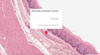
How do you know it’s ileum?

A

Peyer’s patches

22
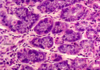
Q

ECL cell products

A

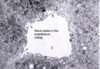
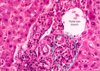
histimine (stim acid)

23
Q

exocrine function of the liver

A

bile acids are

·Ok so the exocrine function of the liver is to obviously secrete into the bile ducts, and I will leave the different problems with transport into the bile duct for the pathologists, but realize that it’s very important to get rid of, bilirubin, for example – and it gets conjugated; if you can’t get conjugated, you’re in trouble – problems with glucuronyltransferase.

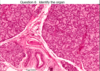
·

·But many other things go into the bile, as waste products, and that’s one of them. And that is the exocrine function of the liver. So the liver is both an endocrine function – it secretes into the blood, and also secretes into the bile, and that’s its exocrine function.

24
Q

sinusoidal capillaries

A

what we call sinusoidal capillaries that are found at either side of hepatocytes (2).
25
colon - pedunculated polyp
26
serous gland cell - zymogen granules! human parotid
27
Muscularis mucosae.
28
Duodenal mucosa with Brunners glands.
29
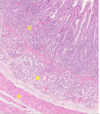
The Muscularis Externa Inspect the bundles of muscle fibers in the neighborhood of this marker. Note: inner circular and outer longitudinal layers a gradual transition from skeletal muscle in the upper portion of the esophagus to smooth muscle in the lower portion the muscularis externa of the lower esophagus is continuous with the muscularis externa of the stomach
30
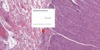
Central vein
31
esophagus epithelium
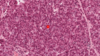
non-keratinized stratified squamous epithelium
32
Yes, but many fewer than the more proximal regions of the gut
33
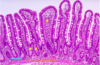
The final types are called fungiform papillae (they kinda look like fungi?) and filiform papillae. How do you know it’s a fungiform papillae? These have taste buds only on the top!
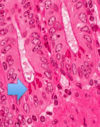
34
2:
This is one of the gastric rugae, which are folds that accommodate the expansion of the organ when it is loaded with food.
35
Here’s the muscularis mucosa [line], and these are villi. You see between the villi, there’s an intestinal glands (A). The margin between the villi and the glands is around that level. On the villi themselves you see goblet cells. In this area (B) you’re going to see loose connective tissues with lymphatics and vessels (potentially branches of the inferior mesenterics). These are the glands and these are the villi. The cells down here with a little bit of color here are going to be the Paneth cells (arrows)
36
H.pylori organisms. What do you think are some of the clinical consequences of destroying the peptic glands in the stomach?
37
pancreas note 4 islets adipose tissue and interlobular ducts
38
mucus neck cell products
mucus HCO3
39
organ?
tongue
40
stomach body and pyloris
41
orientation of hepatocytes
basal surface toward sinusoids and apical surface is bile canaliculi
42
1 = parietal cell 2 = chief cell - not present in cardiac or pyloric region this is the body
43
taste buds
44
organ and layers?
Here’s a higher mag of the upper esophagus. A = You’ve got non-keratinizied stratified squamous epith. B = submucosa (loose connective tissue that epith sits on) C = muscularis muscosa D = submucosa [my note: I think this is the real submucosa and not B] E = muscularis externus: predominant tissue is skeletal muscle that is voluntary, important in swallowing.
45
Enteroendocrine cell.
46
perniscious anemia
Pernicious anemia Patients with pernicious anemia have autoantibodies to parietal cells leading to decreased levels of intrinsic factor and decreased absoprtion of B12. What cell would be lost in the stomach in these patients? What cell type might show hyperplasia?
47
G cell products
gastrin (stim acid)
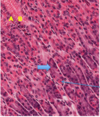
48
Cholangiole, ductule of Hering
49
Islet of Langerhans.
50
Crypts (glands) of Lierberkuhn
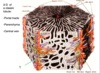
51
Intercalated duct (seen in cross-section)
52
Myenteric plexus
53
3 cell types in tastebud?
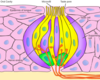
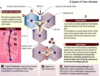
Three basic cell types in a taste bud: Yellow = sensory cells, synapsed by a sensory neuron. They have microvilli to taste stuff at the taste pore. Purple = supporting cells Green = basal cells = stem cells! They give rise to either supporting or sensory cells. It turns out that different parts of the tongue don’t taste different flavors! This belief came from a mis-translation of a German transcript… all regions can sense all flavors! (Some trivia for the class)
54
The tissue is skeletal muscle. We are looking at soft palate and the muscle you expect in this location is skeletal rather than smooth.
55
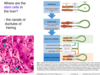
where are the stem cells in the liver?
canals or ductules of hering
56
serosa
57
duct progression
intralobular duct acinar - intercalated - intralobular - interlobular - excretory
58
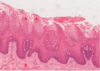
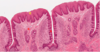
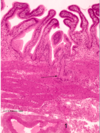
gall bladder empty and full
contracted when empty (mucosal folds) stretched when distended lateral intercellular spaces dilate during active ion and water reabsorption! gall bladder concentrates as well as stores biles
59
compond gland
secretory portions and branching duct systems lobules incompoletely sep by CT
60
central vein
61
esophagus
62
One of the three taenia coli found on the colon
63
Cross section of intestinal glands (crypts)
64
chief cell products
pepsiogen gastric lipase
65
· So when you get upstairs, how are you going to tell the difference between a portal tract and a central vein? Well, the easiest way at medium magnification is going to be to find some area where we have a large stain – that’s always going to be the portal tract (1). ·Something with cuboidal to columnar epithelium, there may be several sections, that’s going to be a bile duct (2). · ·And, the hepatic artery is not in this section but again, if we have several different elements, this is going to be a portal tract. In contrast, the central veins (3) have very little connective tissue, and you can see sinusoids draining into them. So that’s the easy way to tell the difference, ok? The central veins are going to have very little connective tissue and if you’re lucky you’re going to see at least some of these sinusoids draining in, whereas the portal tracts are going to have multiple elements – by the way this particular one, even in the paraffin section has a little lymphatic in it (4), something I mentioned is there in the portal tract, however the hepatic artery is missing from this particular section. · ·
66
submandibular gland lobules, serous and mucus striated ducts some fat · We’ll look at a plastic section – what you see first of all is very abundant striated intralobular ducts (1), you do have mucous elements, but look at the mucous elements here (2), what do they have? They have caps, called demilunes, of serous cells on them. So if you look at them around (2) and over on the right hand side too (3). So all the mucous elements of the submandibular gland have serous demilunes – caps – abundant striated ducts, less of the intercalated ducts. Again, it’s a mixed gland and notice I picked an area that’s mostly serous, so if you saw a section like this you might confuse it with the pancreas, but if you look under power, you’ll always find a few patches, even though they aren’t uniformly distributed through the gland of mucous tubules with serous caps, known as demilunes.
67
epithelium changes in compound gland
·This scheme is in your syllabus to read when you’re looking at slides. · ·So where have these flask-shaped long tubules of mucous cells with very flat nuclei against the base (1) · ·And more cuboidal cells with well preserved secretory granules and round nuclei that are called acini (2); these are called serous acini, and these are called mucous alveoli, or tubules (see on figure where labeled) · ·One of the things that you’re going to see is that these very small ducts (3), the first one’s called intercalated ducts; have a very small lumen so that this cartoon is a little long. · ·And that the ducts progress through columnar epithelium often through pseudostratified columnar and stratified cuboidal right where they go in the mouth, and we’ll talk about the salivary glands – that’s not true of the pancreas – there’s no stratified; the simple columnar with goblet cells is what you’re going to see in the pancreatic duct. · ·Nevertheless, there’s another feature here – a cell type called the myoepithelial cell – also called a basket cell – and I’m going to show you some pictures of it. Myo- because it has muscle function; it’s full of actin, it contracts; -epithelial because it is an epithelial cell, and it sits within the basal lamina. · ·Alveoli are sometimes interchangeably called acini. So we have secretory portions of our exocrine glands and duct systems of various types. And we’re going to look at each of the types.
68
region and layers?
The pyloric region. There are shallow pits, there’s your muscularis mucosa (A), there’s your submucosa (B). These are mucosal glands (C), and there are your pits [topmost layer]. Notice that there aren’t any chief or parietal cells. Like the cardiac region of the stomach, this is just a mucus secreting region probably to protect the intestine as food moves through. We have a huge amount of smooth muscle, your pyloric sphincter muscle (D) (unlike the cardiac stomach, which looks very similar and is sometimes difficult to tell apart..
69
cholangiole
·So here’s a plastic-embedded section, preserved for electron microscopy and embedded in plastic in a thin section. Here is a tiny bile duct, a so-called cholangiole – or canal of Hering – we’ve got lots of names. · ·And notice that the space of Mall basically doesn’t exist. And there’s also a large bile duct in this particular area (1). And again, you can see the little slits (2) that are endothelial-lined, that are lymphatics.
70
submandibular gland mucous and serous secretory elements intercalated and striated ducts adipose tissue
71
Serous gland
72
secretory elements of parotid glands
almost all serous! few mucus
73
lamina propria
74
duodenal papilla
75
intralobular duct acinar - intercalated - intralobular - interlobular - excretory
76
6:
Transition from Stomach to Duodenum
77
Interlobular duct
78
·This is a more my aged parotid than yours, because as we get older, the pancreas and the parotid (and many other glands) become filled with fat. And so here on the acini (1), there are ducts, but here are the main excretory ducts (2) that are on the way out, and you can see why some elderly people have problems with dry mouth – the parotid gland becomes filled with fat (around 1) · ·If you remember back when we looked at the parathyroids, you see the same thing – as we get older, the parenchyma of the gland, the functional cells, become replaced by adipose tissue
79
A:
The most common specialization are these finger like projections that have an orientation toward the pharyx = filliform papillae (A)! They help you push food to the back of your mouth. In humans these are really soft, but animals (like cats) have different keratin so it’s stiffer.
80
basic layers of GI tract
81
sinusoid
82
Filiform papilla tongue
83
Submucosal lymphatic vessel
84
Sieve plates
·So this just shows you how in an electron micrograph how really thin the endothelium is, with those so-called sieve plates. · ·This is a rat –it was fixed with perfusion so there’s nothing in the lining of the lumen, the lumen of the sinusoid, but it really gives you a sense for how much contact there’s going to be between the blood and the hepatocytes out here (1) and the contents of the blood in here (2) · ·And these are called sieve plates (arrows) in the sinusoidal epithelium.
85
Non-keratinized stratified squamous epithelium.
86
structure?
Circumvallate papillae - note the taste buds on the sides and that none are found on the other side of the trough. tongue
87
epithelium?
Skin - lip Skin is composed of stratified squamous epithelium that has a layer of keratin on the top. Beneath the squamous epithelium and basement membrane of the skin is the dermis, which has both loose and dense connective tissue.
88
This is the smooth muscle of the muscularis mucosa.
89
cholangiole portal vein branch above it
90
· So when you get upstairs, how are you going to tell the difference between a portal tract and a central vein? Well, the easiest way at medium magnification is going to be to find some area where we have a large stain – that’s always going to be the portal tract (1). ·Something with cuboidal to columnar epithelium, there may be several sections, that’s going to be a bile duct (2). · ·And, the hepatic artery is not in this section but again, if we have several different elements, this is going to be a portal tract. In contrast, the central veins (3) have very little connective tissue, and you can see sinusoids draining into them. So that’s the easy way to tell the difference, ok? The central veins are going to have very little connective tissue and if you’re lucky you’re going to see at least some of these sinusoids draining in, whereas the portal tracts are going to have multiple elements – by the way this particular one, even in the paraffin section has a little lymphatic in it (4), something I mentioned is there in the portal tract, however the hepatic artery is missing from this particular section. · ·
91
what kinds of glands?
·However, you can also in some glands, and this happens in rodents, have mucous elements – you can see how empty these cells are (1) – with caps of serous cells. This are called demilunes – “half moons.” And I put this slide here of a rodent just to show the difference between mucous with demilunes (1) vs. pure mucous elements (2) · ·And you can see these intralobular ducts here (3) that go from fairly small to columnar epithelial
92
skeletal upper
93
Fundus / body --------- Gastic pits lined by surface mucus cells. The pit ends there (at the line), everything below here is gastric glands. The big pink cells are parietal cells, the little basophilic ones are the chief cells. These are the major cell types [seen better in next slide].
94
appendix
95
B?
Here’s the end of the strat sq epith, then a row of simple columnar cells, aka surface mucus cells, [they line either side of the pit) that form gastric pits. You can see the gastric glands (B), aka cardiac glands because this is the cardiac stomach. This is a very short region right at the junction of the esophagus.
96
This is a silver reaction. Here you can see the little black cells, the neuroendocrine cells! Sometimes called argitapine cells [couldn’t find the real spelling on the internet…] because they react with silver. The parietal cells are the big pink ones.
97
muscularis mucosa
98
stomach - gastric glands int he fundic region parietal cells
99
liver acinus
direction of arterial flow determines a metabolic gradient ## Footnote ·So if you talk about a liver acinus (2), you’re describing tissue, roughly football-shaped tissue, arranged around a portal tract, but dividing the zones of the liver into regions close to the source of oxygen that is periportal (see labels already on slide), and where the blood that’s delivered has the most glucose in it and you get the most glycogen. A middle zone – the second zone here – and a third zone, closest to the central vein, which gets less oxygen and less glucose and has different amounts of enzymes. So the focus here is on oxygen delivery, as well as glycogen storage.
100
gastroesophageal junction
101
submandibular gland
serous and mucous secretory elements much is pure serous and mucous have demilunes shorter intercalated ducts many striated ducts myoepithelial cells plasma cells in the CT simple columar to pseudostratified to stratified
102
pathway of ducts
smalled = intercalated (secrete ions - HCO3, Cl) drain into intralobular (some are striated) drain into interlobbular (in CT between lobules) each has one or more main excretory ducts that drain into oral cavity (salivary glands) or duodenum (pancrea)
103
Pulse granuloma A pulse granuloma is a foreign-body reaction to the implantation of food particles of plant origin. Find the multinucleated giant cells.
104
epithelium of gallbladder
simple columnar
105
enteroendocrine cells silver stain!!!
106
sublingual gland
mostly mucus tubules with serous demilunes short or no intercalated ducts few non striated intralobular ducts simple columnar to pseoduostratified to stratified columnar
107
lymphocytes - Peyer's patches - ileum! M cells
108
An intercalated duct. (It's a centroacinar cell.)
109
sublobular vein. Note the central vein draining into it.
110
elements of sinusoidal lining?
endothelial cell sieve plate kupffer plate ·This is the sinusoidal surfaces (2) of the hepatocyte, facing the sinusoids (3), and the sinusoids are very interesting – they have sieve plate, holes in the endothelium. They have very sparse collagen in this space of Disse(4), which is a connective tissue space. And if you think about it, this is the cell that’s making albumin, for example, this is the cell that’s doing detoxification, this is the cell that needs intimate contact with the blood that coming from the digestive tract, so it makes sense to have these endothelial cells with holes in them or with spaces between them to maximize the contact that the blood would be having with the hepatocytes.
111
Glands of Von Ebner
tongue - associated with circumvalate papillae
112
lip epithelium
non-keratinized stratified squamous epithelium
113
region?
This is duodenum again: you see villi, glands, there your muscularis mucosa (line), then submucosal glands of Brunner (A). You see muscularis externus (B), the muscularis mucosa = gut You see villi = the small intestine You see glands of Brunner = duodenum DONE
114
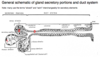
Reticular fibers in the space of Disse.
115
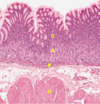
Away (from); it is not part of a portal tract
116
serous and mucous glands of the tongue (skeletal muscle)
117
gall bladder simple columnar epithelium some epithelial cells hav emucus droplets
118
Pylorus. Note the absence of chief cells as evidenced by lack of blue color in the base of the gastric glands. Presence of chief cells would indicate that it was the body of the stomach. The cardiac region is very short and you would expect to see the esophagus in the section.
119
glands of von Ebner
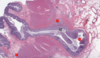
circumvale papillae ## Footnote Another thing that’s characteristic are the glands of von Ebner (B). They have ducts that are going to drain into the clefts around the circumvallate papillae.
120
Again, this is your cardiac stomach. Cardiac stomach is purely stomach, you don’t have chief or parietal cells. You have surface mucus cells. Let’s talk about the neck cells [Goes back to slide 23.]
121
This is something important for you to recognize. They love to show this in histology. Same non-kerat strat sq epith (A) then abrupt transition right here (blue crescent). This is where the esophagus joins the stomach = gastro-esophageal junction! You can that the epith from this point on is simple columnar epith. These cells here are surface mucus cells which are very characteristic of the stomach (B)
122
7
interlobular duct
123
sublingula gland all mucus! few intralobular ducts pseudostratified columar epithelium of excretory ducts
124
intercalated duct cut in cross section
125
myoepithelial cells
sometimes called basket cells epithelial in origin and within basal lamina NOT in pancreas contractile epithelial cells within basal lamina form junctions with the gland cells in salivary, sweat, upper respiratory, mammary
126
You also have submucosal plexi. There’s your muscularis mucosa, so this (with all the black areas) is the submucosal plexus = Meissner’s plexus.
127
Mucous gland.
128
organ?
liver
129
Lymphoid follicle with reactive germinal center within the lamina propria.
130
serous acinus
131
how to identify lower esophagus?
smooth muscle
132
secretory elements of the liver
hepatocytes
133
Space of Disse
·So the main cell type, the parenchymal cell in the liver is the hepatocyte, and this so-called space of Disse (7), which was noticed because it shrinks in routine sections originally, Disse being the person who identified it. This is the only place where we’ll have a little bit of connective tissue as you’ll see.
134
GALT
This brings me to an important thing called the gut-associated lymphoid tissue (GALT). Here’s a Peyer’s patch (on the left) – they’re part of the GALT but they’re not found in the entire GI tract. You have GALT in most of the GI tract. - Here are the M cells sampling things and presenting them to the dendritic cells. - You have intraepithelial lymphocytes. You remember you kept seeing extra nuclei in the simple columnar epith? That’s because these cells climb right in there between the epith. - You have plasma cells, basically mature B cells, they make secretory IgA that goes into the gut in response to something - Receptors on the epith to sense and reduce the amount cytokines to signal immune system - Then you have macrophages and dendritic cells which are antigen presenting. The dendritic cells can actually stick an arm out into the lumen to see whats around. - All this together is the GALT!
135
rugae in stomach ## Footnote What do rugae do? This little line here is muscularis mucosa, here’s your submucosa [super hard to ID even in the video, I think as long as you know where they ought to be, you should be fine). Both of these layers are in the infolding. The rugae allow for stomach expansion by flattening out! We’ll see something that looks a little similar later, so I’m showing this to you know.
136
parenchyma of the liver central vein and small portal tract some hepatocytes are binucleate
137
diverticulosis ## Footnote abnormal outpouching through a weakening in the wall vasa recta is under it and it's dilated can get food stuck in there - avoid seets invagination if looking from outside inflammation can damage the wall and lead to rupture - can get peritonitis - increase fiber, more in the colon than SI bc fecal contents more solid and increased pressure
138
Simple columnar epithelium.
139
pancrease glands
exocrine portion is entirely serous islets of langerlans no myoepithelial cells!!! few to no plasma cells
140
exocrine pancreas: acini with zymogen granules and basal basophilia ## Footnote ·Two good things about this slide. First, you can see that these cells are filled with zymogen granules – these are the storage form of the digestive enzymes, and only get released when there’s food to get digested, obviously. If you got a field like this, how would you know this isn’t parotid which is also serous? Well there are two diagnostic characteristics, and one is easy. · ·If you have a well preserved carotid, you would also see lots of ·zymogen granules. ·Do you see this nucleus right here? That’s called the centroacinar cell. Depending on how you section the _acini_, you’ll see these apparently floating. What they are is the first cell of the intercalated duct. They have a very light cytoplasm, so what you see is an open nucleus that appears to be floating in the center of an acinus. Are you going to see it in every acinus? No, because you can section every which way. If you look carefully, you’ll find it. What they represent is the first cell of the intercalated duct.
141
chromosomes
142
peyer's patch in ileum light area is germinal center
143
ileum
144
What do paneth cells secrete?
bacteriostatic components
145
This is a close-up of the taste buds. It’s the full thickness of the epithelium, and it has a little pore. There are some specialized cells inside. The right image is an even higher mag. You find taste buds in three papillae, and not in the filliform papillae.
146
How do you know it's jejunum?
process of elimination! ## Footnote What I didn’t tell you is, how do you know if it’s jejunum Duodenum has glands of Brunner. Ileum has Peyer’s patches. Jejunum has neither, so it’s a negative ID, though you do have well developed plicae. Now we’ll transition from small to large intestine [the image of the small intestine has the three divisions, indicated by the blue lines). The large intestine doesn’t have villi! A smooth surface epith but the same surface layers = submucosa, muscularis mucosa, the lamina propria, the tunica muscularis externa.
147
Now we’re moving into the ileum. You see very dark staining, basophilic – you should know this usually means lymphatic. What we have here are lymph nodules that are permanent residents of this area = Peyer’s patches. You see these, you know you’re in the ileum. We’re going to talk about lymphoid organs, but again muscularis externa and submucosa. Over here (far right at the bottom) is where the mesentery would attach the ileum to the body wall. You’d have visceral peritoneum going around the ileum. àPeyer’s patches are almost always on one side, and almost always toward the lumen away from the mesentery. They are permanent, they have their own reticular fibers like a regular lymph node. The little pointy area (A), that’s an important
148
Mucous
149
7
Sublobular vein of small collecting vein (efferent blood from the liver)
150
how to identify upper esophagus?
skeletal muscle
151
secretory elements of pancreas
all serous!
152
secretory elements of sublingual
mostly mucus! some serous demilunes
153
how to identify middle esophagus?
skeletal and smooth muscle
154
serous demilune
155
gallbladder:
Simple columnar epithelium, no goblet cells.
156
2 places in the GI tract you have submucosal glands?
esophagus duodenum
157
A/B
fundus/body ## Footnote The mucus neck cells are here (A), those are surface mucus cells (B)
158
Cirrhosis At this edge of the tumor, there is this wide band of fibrosis and chronic inflammation, that is consistent with the fibrosis you see in cirrhosis.
159
Muscularis mucosae. This is a biopsy, therefore only the muscularis mucosae would be reached with biopsy forceps
160
Intercalated duct - almost a cross section
161
hepatocellular carcinoma
162
Submucosal plexus
163
5. bile ductule 6 (purple). porta
164
Kupffer cells; phagocytosis
165
small intestine villi stained goblet cells
166
Mucous neck cell.
167
Oxygenated- it is a hepatic artery (arteriole) branch
168
plicus circularis
There’s another order of specialization in the epith. Left side: Here you see the villi, but then you get another big infolding that kinda resembles the rugae of the stomach Right side: You see these circular infoldings, the plicus circularis. Their function is to 1) increase surface area, 2) slow down progression of food through SI in order to help absorb. Remember, you see the same organization here as in the rest of the GI tract: two muscular layers, the submucosa… The plicus circularis are absent at the beginning of the duodenum and get more numerous toward the jejunum, where they are the most numerous. Eventually we’ll learn how to tell these regions apart.
169
parotid gland accumulation of adipocytes
170
it looks almost exactly like the gastro-esophageal junction. The stratified squamous epith from constant exposure to acid has undergone mucus metaplasia, and I know you’re going to hear more about that. This is called Barrett’s esophagus = part of the epith transforms to look more like stomach epith or intestinal epith in some cases.
171
These are really big papillae. They’re called circumvallate papillae (A)– we’ll be able to see these on gross anatomy. There’s a row of these circular, singular papillae, and they separate the anterior 2/3 from posterior 1/3 of tongue. We have a dozen or 15 of these, but we have thousands of filiform papillae. These are very characteristic, you shouldn’t confuse this with anything. Also, notice the taste buds on the lateral surfaces. What we have is a cleft, a trench around it, and on the opposite wall you don’t have taste buds. With foliate papillae, they exist side by side so you’d be able to see taste buds on the opposite wall. However, because these circumvallate papillae are separated by the trench, there aren’t taste buds on the opposite side adjacent to the papillae. Another thing that’s characteristic are the glands of von Ebner (B). They have ducts that are going to drain into the clefts around the circumvallate papillae.
172
pancreas no islet centroacinar cells and intercalated ucts, no myoepithelial cells arrow = cross section of an intercalated duct
173
Lymphoid tissue in the lamina propria.
174
Paneth cells.
175
sublingual gland demilunes few intercalated and intralobular ducts excretory ducts ·In contrast to the parotid, the submandibular, and the pancreas, the sublingual gland is predominately mucous. But almost all the mucous tubules – and they’re mostly tubules not acini – have caps of serous cells on them (1) Predominately mucous with serous demilunes – very few intercalated ducts, very few striated ducts – mostly mucous
176
neutrophils (gastritis)
177
lip
178
·So this is from one of your slides- a low power of a parotid gland. You can see the intralobular ducts here (1) – that mostly turn out to be striated ducts. · ·You can see the beginning of the excretory ducts (2), the interlobular duct, although the main excretory duct is probably up above left of the slide someplace. And you can see that the organization is into lobules (3) · ·Much too low magnification to see any intercalated ducts. In fact, the intercalated ducts are so small that students often don’t appreciate their existence – we’ll get to some, ok?
179
why do serous glands stain purple?
lots of RER - in the cytoplasm
180
pancreas with main pancreatic duct arrows = islets
181
region?
This is duodenum again: you see villi, glands, there your muscularis mucosa (line), then submucosal glands of Brunner (A). You see muscularis externus (B), the muscularis mucosa = gut You see villi = the small intestine You see glands of Brunner = duodenum DONE
182
pancreas:
Excretory duct. The lumne has desquamated epithelium.
183
blood flow in a portal tract
blood flow from a portal vein branch and a hepatic artery branch enter the fenestrated sinusoids ## Footnote ·The portal vein (3), when you look at it histologically as you’ll see, is going to be the biggest element in this space – you can see it here opening into the sinusoid (4). · ·And the hepatic artery (5) opens into the same space and since these plates of hepatocytes anastomose, in fact, oxygenated blood and the deoxygenated blood are bringing nutrients and things from the digestive tract, pancreas, and spleen, mix together in the sinusoidal capillaries. · ·What’s omitted here from this classic diagram is the fact that there are lymphatics out here (waves mouse following circle) · ·In addition, the hepatic artery breaks up into capillaries here in the portal tract (6) that supply the vessels of the portal tracts with oxygenated blood
184
This is a second specialization. These aren’t true papillae: they are parallel ridges on the sides of your tongue that look like individual papillae when they are cut in cross-section. These are called **foliate papillae**. The important characteristics are that you seem then in rows, and taste buds are located in the lateral side of the foliate papillae (A, the clear little circles)! You also see mucus/serous glands in the lamina propia (B). The surface epithelium is the same as everywhere else in the upper GI tract: nonkeratinized stratified squamous epithelium (C). IF you ever see a row with taste buds on the side, you know it’s foliate papillae!
185
submandibular gland: lobules, serous and mucus, straited ducts, myoepithelial cells, plasma cells ## Footnote ·At higher power, you can see a striated duct here (1), with its basal striations, nuclei of myoepithelial cells (2), you can also see the diameter of a typical intercalated duct (3) – here’s a beautiful one cut in cross section. Look how small the lumen is – it’s tiny, which is why you very rarely see one cut through the lumen. Here’s another one (3) – with a tiny lumen, nucleus, and myoepithelial cell. · ·Lots of sections of other striated ducts (4) and again a mucous tubule here with a serous cap (5), and then pure serous elements as well (6). And if you want to count, I think I found 9 intercalated ducts in this section.
186
portal lobule
·The portal lobule, as you can see (3), it says here that it includes the bile canaliculi that run into the duct (4). So the portal lobule idea is a focus of the exocrine function of the liver, saying this roughly triangular or, in 3D, pyramidal-shaped area of the liver focuses on all the hepatocytes that drain into a bile duct in a particular portal tract. Again the focus here is on the exocrine function of the liver. · ·And so what I’ve done is talk about the classic one, the liver acinus, which I show you here (5), tending to show you the hepatic arteries and its flow toward the central vein. And then the portal one (3), which focuses on exocrine secretion.
187
plicae circulares.
188
This is colon. Colon has straight glands with a lot of goblet cells (more than in the SI) but the surface is smooth so no villi. If you look at the muscularis externa, the bulge (A) is the teniae coli! There are three longitudinal bands of teniae coli, if you see these you think colon and you’re done.
189
lymphatic
190
Finally, the appendix! The same type of epith as the colon (i.e. straight glands). You always have a lot of lymphoid tissue in the appendix. A sample of the human appendix will almost always have clear signs of inflammation because that’s why we took it out [then Tim laughs]: there are germnal centers. Small circumference, flat lumen, a lot of muscle in the wall, covered in the serosa and the mesentery wrapping around it. That’s the appendix. It comes before the colon, but it’s easier to describe the appendix as having a colon-like epith.
191
vinblastine
inhibits mitosis! look for cells in mitosis
192
pancreatic intralobular ducts
not striated no myoepithelial cells
193
These are mucous gland acini in the soft palate.
194
These are mucous gland acini in the soft palate.
195
H.pylori bacteria within the mucus on the surface of the mucosa.
196
Excretory duct
197
non keratinized stratified squamous
198
Mixed, more mucous than serous (demilunes)
199
Here are the Paneth cells. They’re at the bottom of the crypt, they are really eosinophilic bright granules that contain lysosyme and defensins, the antibacterial components, that are secreted into the lumen. We have a big lymphatic involement in the GI tract as well for defense.
200
bile duct
201
arrows?
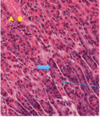
fundus/body Skinny arrow is parietal cell and big arrow is chief cells.
202
Thick basement membrane occuring in respiratory-type epithelium in the nasal passageway.
203
secretory elements of submandibular
mostly serous, some mucus
204
Brunner's glands.
205
Filiform Papillae
The most common specialization are these finger like projections that have an orientation toward the pharyx = filliform papillae (A)! They help you push food to the back of your mouth. In humans these are really soft, but animals (like cats) have different keratin so it’s stiffer. tongue
206
parietal cell products
HCL intrinsic factor
207
hepatic lobule
1 central venule components of the portal triad of the angles hexoganal lobule
208
These are APUD cells - amine precursor uptake and decarboxylation. They comprise the APUD system or diffuse neuroendocrine system (DNES).
209
Glands of Brunner
submucosal glands in the duodenum
210
· There’s much less connective tissue. But areas, if you look over here (1), you can sort of see the outline of where a lobule might be, and a central vein. ·Classic lobules are polygonal, and areas where you see two elements (2), even at low power like this, you can call a portal tract the way there’s a lot of connective tissue. · ·And so what we’re going to do is take a good look at the human liver.
211
Probably a mixed nerve.
212
Smooth muscle of the muscularis mucosae.
213
classic lobule
·Classic drawing of the so-called hexagonal-polygonal portal tract, emphasizing the edges of this classic lobule (1), with the portal vein here in purple, the hepatic artery in red, the bile ducts in green. Both the portal vein and the hepatic artery pour their blood into this sinusoidal capillaries (2), which flow past the hepatocytes toward the central vein (3). · ·So that’s the classic view
214
D cell products
somatostatin (inhibits acid)
215
striated ducts
216
tongue
217
·Here’s a plastic section, which is much prettier. This is a striated duct (1) – these nuclei (2) belong to myoepithelial cells, and so these are the biggest intralobular ducts · ·Also here, pointed out by a few arrows (see black arrows) are those plasma cells that are making the secretory IgA that’s found in the saliva. In this field, are many sections of light-staining intercalated ducts (3). I counted 9 at one point when I was getting this lecture ready · ·So the intralobular ducts are these smallest intercalated ones, with some myoepithelial cells, and then the striated ducts (1), which modify the saliva, and have basal infoldings and associated mitochondria, but also have these myoepithelial cells associated with the duct
218
·So classically, the liver is divided into lobules, which are really easy to see in animals like pigs, but not so in people, so we’re going to start out with pigs. · ·The portal tracts are at the edges of these so-called classic lobules. And out here, in this connective tissue (1) is where we’re going to find the branches of the hepatic artery, portal vein, bile duct, and lymphatics. And the blood is going to percolate past the hepatocytes toward this central vein (2), which is going to be the first venous outflow of the liver. And this is easy to see in a pig, and as you’ll see in a human, it’s less easy to find and distinguish portal tracts.
219
sublingual gland: lobules, mucous mostly with serous demilunes, few intercalated and striated ducts ## Footnote ·In contrast to the parotid, the submandibular, and the pancreas, the sublingual gland is predominately mucous. But almost all the mucous tubules – and they’re mostly tubules not acini – have caps of serous cells on them (1) Predominately mucous with serous demilunes – very few intercalated ducts, very few striated ducts – mostly mucous
220
3. portal vein 4. hepatic arteriole 5. bile duct in portal tract
221
This is a plicus circularis. When you see this picture, you should be screaming out small intestine. Notice the villi (A) and the intestinal glands (B). Here’s your submucosa and mucosa (C) The difference between the plicus circularis and the ruga is that the PC is a permanent feature of the epithelium. The rugae stretch out, but the PC do not, and it’s not as large as a rugae either. This is clearly small intestine, now we have to know what part of the SI.
222
These are your parasympathic ganglia between the circular and longitudinal smooth muscle layers. They are called myenteric (Auerbach’s) plexus. Just reminding you here because you have a ton of parasympatheric innervation in the gut.
223
M cells
in peyer's patches in ileum ## Footnote These M cells sit here and make a cavity that lymphocytes and dendritic cells can climb into. They M cells sample things from the lumen and pass it down to the APCs down there. This is an important way that the body monitors the gut contents!
224
bile canaliculi
Here are these bile canaliculi (1), these sealed spaces in between the cells into which we get our exocrine secretion that’s going to eventually join the bile ducts ## Footnote The bile canaliculi (BC) are sealed spaces between hepatocytes delimited by tight and adherent belt junctions. These are the apical surfaces of hepatocytes (= ZO, zonula occludens and zonula adherens = ZA). Note the large fenestrae (= HO, holes). These become more extensive as the sinusoid approaches the central vein. Also note the gap junctions (= NE, nexus) on the lateral cell membranes.
225
· This is again a plastic section, which shows a little better the epithelium, which is simple columnar epithelium without any goblet cells, in contrast for example to the small intestine where you have villi with goblet cells. No separate mucosa and submucosa, just the muscularis out here. And then either an adventitia or a serosa (1), depending upon whether you have mesothelium out here and whether the surface was toward the abdominal cavity or toward the liver.