Hearing is essential to enriching _______, and critical to _______ and ________, for children there is a very sensitive period where good hearing is essential
Hearing is essential to enriching communication, and critical to learning and educational development, for children there is a very sensitive period where good hearing is essential.
If the hearing issue is not picked up early ⇒ learning difficulties.
The auditory system is a powerful ______?
Processor; integrates complex info in space and time and creates a 3D image of the spatial auditory movement around you.
Can we ‘turn off’ sound around us? Why?
No, the awareness of environmental sounds provides ‘real world contact’ that we cannot turn off, but we can tune in and out
This is for safety to allow us to move in the world around us.
Detection of sounds in a noisy environment is a _____ process, and what type of hearing is critical to this?
Learned process, which requires ‘binaural hearing’ to do this. This is why loss of listening ability in background noise is an early sign of hearing loss, more common with elderly. (especially in classroms for kids)
How does the auditory system detect movement?
Via spatial hearing abilities, (animals can use this to find prey, or navigate in the dark). By using the reflections of sound waves you can detect and navigate your environment.
Bats do this far more effectively then humans
What two auditory issues have a really high prevalence in the community?
- Deafness
- Tinnitus
Whats Hearing Loss like in NZ
- Around 200,000 NZ people have mod-severe hearing loss
- Prevelance increases with age >55yr, 60% of those >70yr
- There’s a high prevelance of temp. hearing loss in kids, during the formative period of learning.
What are the statistics of hearing loss in NZ children, what are the causes and what are we doing to fix this?
- Around 2-3/1000 kids mod-severe hearing loss
- ~50% genetic cause
- Often middle ear infection; glue ear, otitis media w effusion etc
- meningitis (less common with vaccines)
- trauma
The ‘Newborn Hearing Screening Programme’ has been introduced that checks babys between 3-7days old in order to catch issues early
What are the main causes of hearing loss in NZ adults
- Age-related
- Noise Exposure: this is the most modifiable factor!
- Genetic
- Trauma: blow to the ear
- Tumour: acoustic neuromas
- Ototoxic drugs: aminoglycoside ABs, cytotoxic drugs
What’s the individual impact of hearing impairment?
- Poor speech, language and cognitive skill development
- Reduced learning, eeducation and employment
- Social isolation ⇒ increased risk of depression
- Societal Stigma
- Tinnitus: ringing in ears, indication of injury
Common co-morbidities of hearing loss?
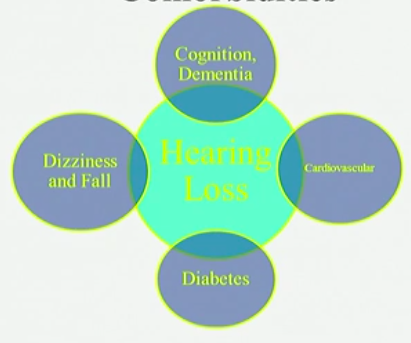
How does hearing loss affect healthy aging?
- Stops people being socially engaged
- People don’t utilize health resources due to social stigmitization and accessibility
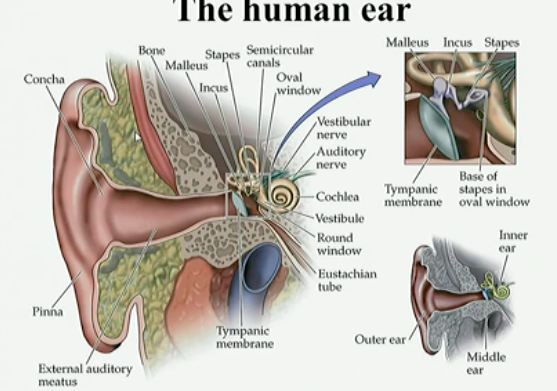
The auditory system breaks apart sound into fragments and then puts it back together. Where does the outer canal sit?
Sitting in the temporal bone is the outer ear canal (pinna +concha).
Where’s the middle ear, what does it contain and what does it do?
About 2.5cm into the temporal bone is the ‘middle ear’ a cavity. (12mmx6mm)
Inside are small bones which will take sound from the ear drum across to the inner ear (just a series of tubes)
What is the cochlea?
Snail-shell shaped (for maximising space) series of tubes in the middle ear, next to the vestibular system, which shares al the same system.
Inside the cochlea is the organ or corti which contains all the sensory cells.
How is the peripheral ear connected to the central brain?
The inner ear (peripheral) is connected to the brain (central) via CN 8 (cochlear nerve) via a series of pathways and nuclei to the primary auditory cortex in a hierachical way(via frequency and intensity of signal)
Overview on how the ear works
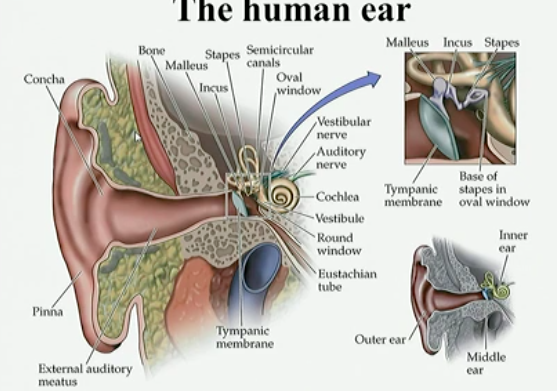
- Air goes down the aircanal and causes the air drum membrane to vibrate.
- This causes the tiny ossicle bones; malleus, incus and stapes of the air-filled middle ear to move also and knocks on the membrane of the inner air
- This causes fluid movement in the inner air, moving the sensory hair cells that are connected to nerve fibres, stimulating them
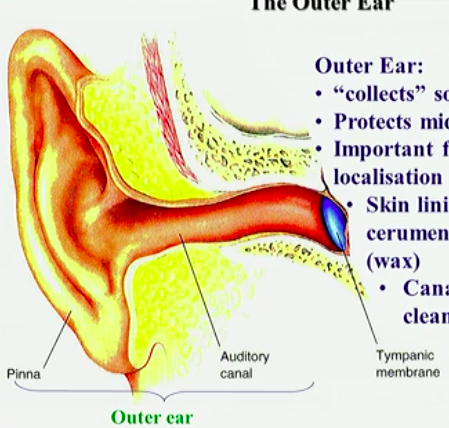
The Outer Ear function
- “collects” sound
- Protects the middle ear
- Important for sound localisation
- Skin lining contains cerumen glands → wax!
- Canal is self cleansing
Why is it bad to use cotton buds in your ears?
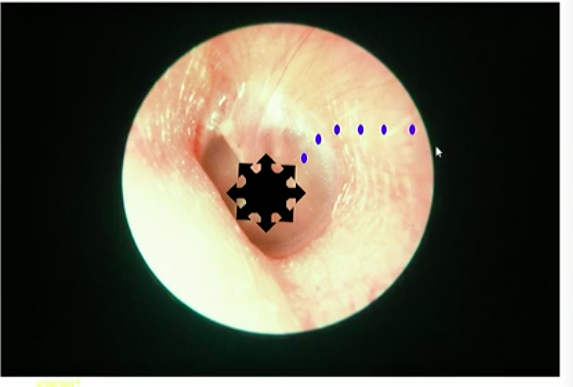
Because you will distrupt the natural skin migration of the ‘epithelial conveyor belt’ → excess skin debris in canal
- Canal skin shed from the surface, and pushed out of canal
- Growth starts at centre of eardrum and moves along the canal
- similar speed to fingernail growth
Why do we have ear wax/cerumen?
- Produced from sebaceous and sweat glands in the outer 1/3 of the canal
- 2 types: wet (caucasians and africans) and dry (asians)
- Helps cleaning and lubrication
- Repels water
- Traps dust and debris (with hairs also)
- Carried out by epithelial migration.
When can ear wax be a bad thing?
Build up → occluded canal → conductive hearing loss
- Worse in the elderly
- Biggest cause of hearing loss
How should we be cleaning our ears then?
- Via a professional with a microscope!
How is the middle ear organised and held together?
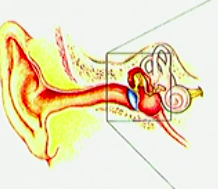
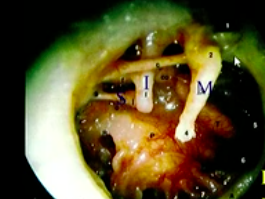
Starts at the tymphatic membrane, then held to 3 ossicle bones the malleus, incus and stapes.
These bones are held very tightly together and suspended by ligaments. They have very tight synovial joints (and contain a little marrow).
The head of the ossicles is above the eardrum.
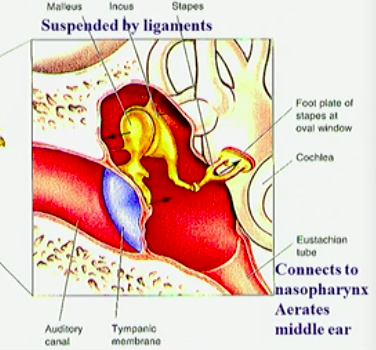
What bones are what behind the eardrum?
Also what sensory structure is also running with these bones?
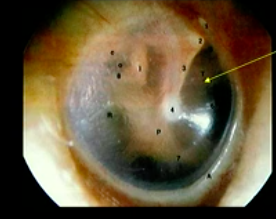
Chorda Tympani: branch of the facial nerve that originates from the taste buds in the front of the tongue, runs through the middle ear, and carries taste messages to the brain.


-
Subdivision and Organisation of the Human Brain25
-
Forebrain: Cerebral cortex11
-
Forebrain: Thalamus, internal capsule19
-
Spinal Cord29
-
Spinal Cord/brainstem16
-
Spinal cord/brainstem #27
-
Cranial Nerves23
-
Inhalation/intravenous anaesthetics .27
-
Local Anaesthetics25
-
Basal Ganglia1
-
The cerebellar and pyramidal motor systems of the brain0
-
Drugs of Abuse28
-
Sleep/EEG20
-
Hearing #126
-
Hearing #225
-
Hearing #326
-
Ear Disease and Hearing Loss26
-
Hearing Assesment27
-
Clinical 2: reflexes and muscle tone8
-
Analgesic Drugs 133
-
Analgesic drugs 1 (part two)11
-
Cerebellar Disease15
-
Disease of Motor Units19
-
Stroke20
-
Neurotransmission17
-
Clinical 4: Parkinsons Disease13
-
Amyotrophic Lateral Sclerosis (ALS)14
-
Vestibular Physiology 126
-
Analgesic Drugs 20
-
CSF & Intracranial Pressure33
-
Clinical evaluation of balance24
-
Clinical 1: sensation5



