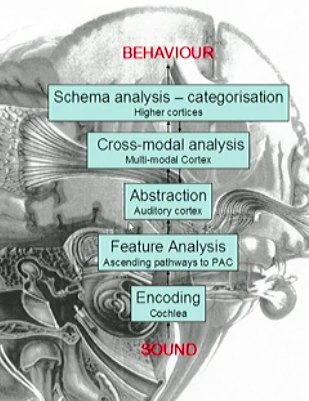
What are the levels of auditory processing from SOUND ⇒ BEHAVIOUR
- Sound
- Encoding of the signal via the cochlea. 20,000 nerve signals carrying info about that sound
- Feature analysis (about timing and intensity) via ascending pathways to PAC
- Abstraction in the primary auditory cortex
- Passed onto other regions of the cortex for ‘cross-modal analysis’; eg with visual and sensory areas
- BEHAVIOUR
Why is it that if a young childs hearing diability is left too long, then a cochlear implant may not be effective?
Because over time the visual system will have taken over the auditory cortex.
What exactly is hearing loss?
Loss of sensitivity and frequency tuning, speech perception and hearing in noise.
How are hair cells innervated?
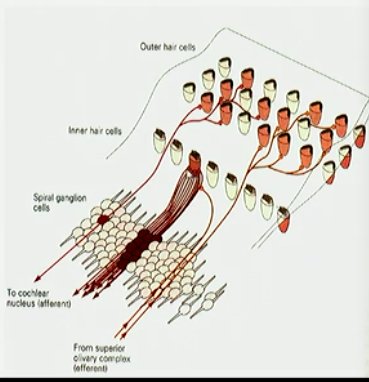
- Mainly by afferent nerve fibres of CN VIII in inner hair cells
- Fibres travel through the internal acoustic meatus, come down through a hole in the basilar membrane and have their cell bodies within the spiral ganglion.
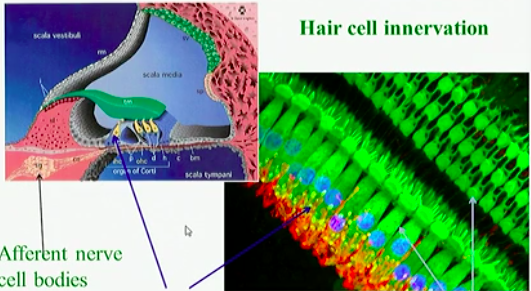
What types of nerve fibres innervate the hair cells?
Type 1: Innervate IHC (90-95%), about 20 fibres to each hair cell
Type 2: Innervate OHC (5-10%), very sparse, distributed pattern of innervation.
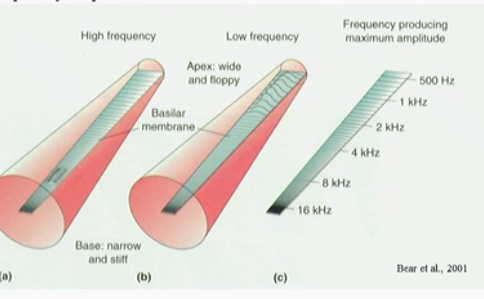
Each auditory nerve _____ is discretly tuned to a narrow band specific _____ stimulus corresponding to that location on the _____.
The basal end responds to _____ frequencies, whilst the apical end responds to far more ______ frequencies.
Each auditory nerve fibre is tuned to a narrow band specificfrequency stimulus corresponding to that discrete location on the cochlea
The basal end responds to higher frequencies, whilst the apical end responds to far lower frequencies.
This = tonotopic organisation of the cochlea
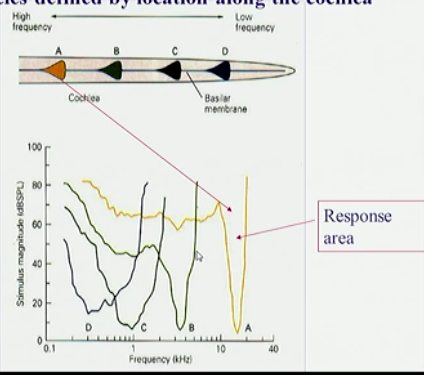
What actually determines the frequency response of the cochlea?
Variations in stiffness of the basilar membrane.
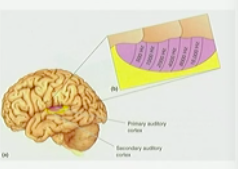
How does that tonotopic organisation of the cochlea organised in the brain?
It is the same! There is also a tonotopic organisation throughout the auditory system, that uses the same frequency/pitch detection
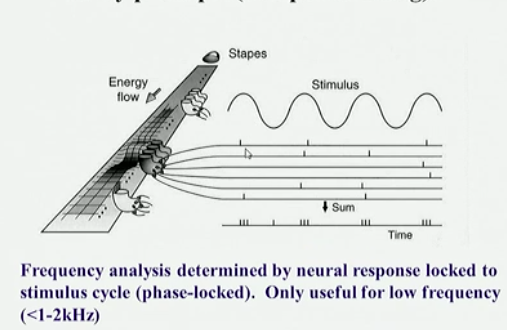
What are the 2 principles that cause frequency coding in the auditory nerve?
- Place principle: high frequencies
- Volley Principle: Low frequencies
What is the basis of the Place Principle?
Cochlea is a filter and is tonotopically organised so frequency can be detected spatially from base to apex → detection in a discrete place in the cortex.
Explain the basis of the volley principle.
Low frequencies are temporal firing of nerve fibres in time to the frequency of the stimulus.
as stereocilia move 1000x per sec it’ll fire a 1000x per second.
BUT due to the refractory period a fibre cannot fire more then 1000x per second, so only applies for low frequencies
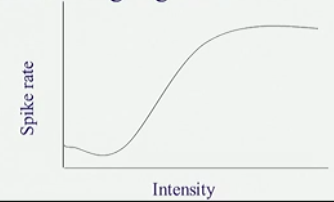
How is intensity of sound coded in the auditory nerve?
- Rate of firing of the individual nerve fibres increase with intensity
- Number of fibres increases as energy spreads along the organ of corti
What nerve takes the auditory info to the brain, and what path does it take?
the Vestibulocochlear Nerve
Goes through the internal acoustic meatus of the temporal bone, to the brainstem.
Goes to the coclear nucleus of the pons-medullary junction.
Why is the binaural aspect of the auditory system so important?
W
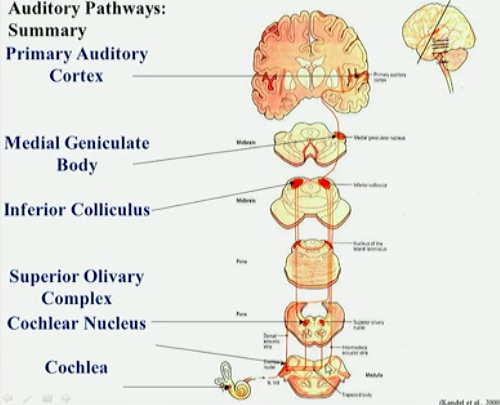
Do a step-by-step summary of the auditory pathways.
- Cochlea
- Cochlear Nucleus (pons)
- Superior Olivary Complex (pons) 1st binaural area
- Inferior Colliculus (midbrain)
- Medial Geniculate Body (thalamus)
- Primary auditory cortex
As you go up it gets increasingly compex with more processing.
What happens at the Cochlear Nucleus?
- Terminal end-point for all auditory nerve fibres.
- Neurons here respond to noise, tones, onset, offset (complex info)
- Clean-up area for biological noise of your body
- Lots of somatosensory influence.
What happens at the Superior Olivary Complex?
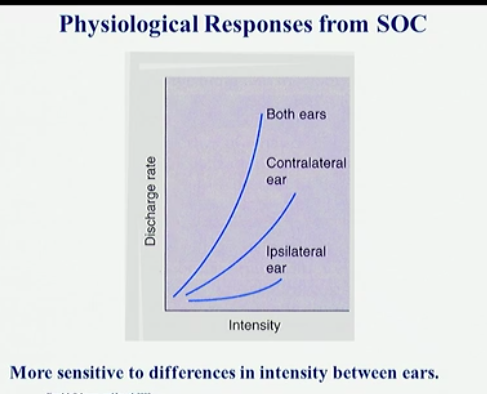
- Major binaural hearing centre; determines interaura; timing and intensity, by comparing info from each side.
- Speech localisation and detecting speech in noise.
What happens at the Inferior Colliculus?
- Major intergative centre
- Interacts with visual + somatosensory systems
- Integrate hearing and vision to enhance sound localisation
What happens at the Medial Geniculate Body of the thalamus?
It radiates to the auditory cortex in heschels gyrus of the temporal lobe
- Spatial localistation and speech recognition through interaction with language centres such as Wernicke’s and Broca’s
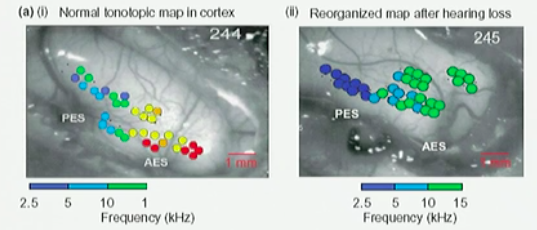
What happens to the tonotopic organisation of the brain with Hearing Loss?
The cortex’s tonotopically organisation becomes deranged with hearing loss.
The cells in the cortex that used to respond to the now absent frequencies are not being stimulated, and actually start to respond to different frequencies → over-representation of frequencies that remain!
Could be the reason of tinnitus/ hyper-acutness
How can a deranged tonotopic map be restored?
Via an electrical cochlear implant, works so well because it can use electrically stimulation to create the same pattern. Shows the plasticity of the brain!
What are the different portions of the cochlear Nucleus and what do they do?
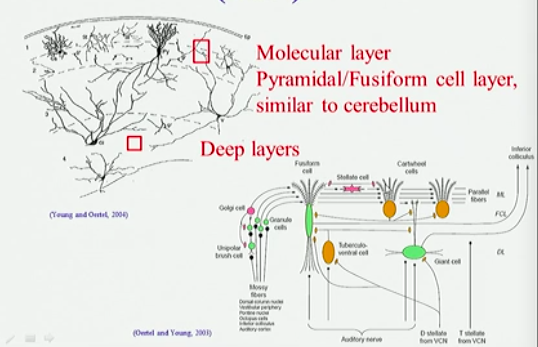
A small nucleus around the pons-medullary junction.
- Ventral Cochlear Nucleus: Extracts signals, passes those to the brainstem for sound localisation
- Dorsal Cochlear Nucleus: similar to the cerebellum, network of pyramidal cells, huge interaction with somatosensory information complex
Already started meshing information with other sensory information to allow you to move your head to the sound, for better sound localisation.
What types of nerve fibres are in the ventral cochlear nucleus
Sends signals similar to the primary auditory afferents, projects to the superior olivary complex.
Precise relay of timing/onset for sound localisation
At all levels above the ___________, binaural responses dominate, why is this important?
Important for
- Extracting speech in noise
- localising sound in 3D space
- Processing speech



-
Subdivision and Organisation of the Human Brain25
-
Forebrain: Cerebral cortex11
-
Forebrain: Thalamus, internal capsule19
-
Spinal Cord29
-
Spinal Cord/brainstem16
-
Spinal cord/brainstem #27
-
Cranial Nerves23
-
Inhalation/intravenous anaesthetics .27
-
Local Anaesthetics25
-
Basal Ganglia1
-
The cerebellar and pyramidal motor systems of the brain0
-
Drugs of Abuse28
-
Sleep/EEG20
-
Hearing #126
-
Hearing #225
-
Hearing #326
-
Ear Disease and Hearing Loss26
-
Hearing Assesment27
-
Clinical 2: reflexes and muscle tone8
-
Analgesic Drugs 133
-
Analgesic drugs 1 (part two)11
-
Cerebellar Disease15
-
Disease of Motor Units19
-
Stroke20
-
Neurotransmission17
-
Clinical 4: Parkinsons Disease13
-
Amyotrophic Lateral Sclerosis (ALS)14
-
Vestibular Physiology 126
-
Analgesic Drugs 20
-
CSF & Intracranial Pressure33
-
Clinical evaluation of balance24
-
Clinical 1: sensation5



