Heart Flashcards

(77 cards)

1
Q

Briefly explain the portal circulation

A
  1. venous blood from unpaired abdominal organs (stomach, intestine, pancreas, spleen) absorbed by intestine
  2. carried to v. portae
  3. collected in capillary bed in liver
  4. collected by vv. hepaticae
  5. conveyed to v. cava inferior
2
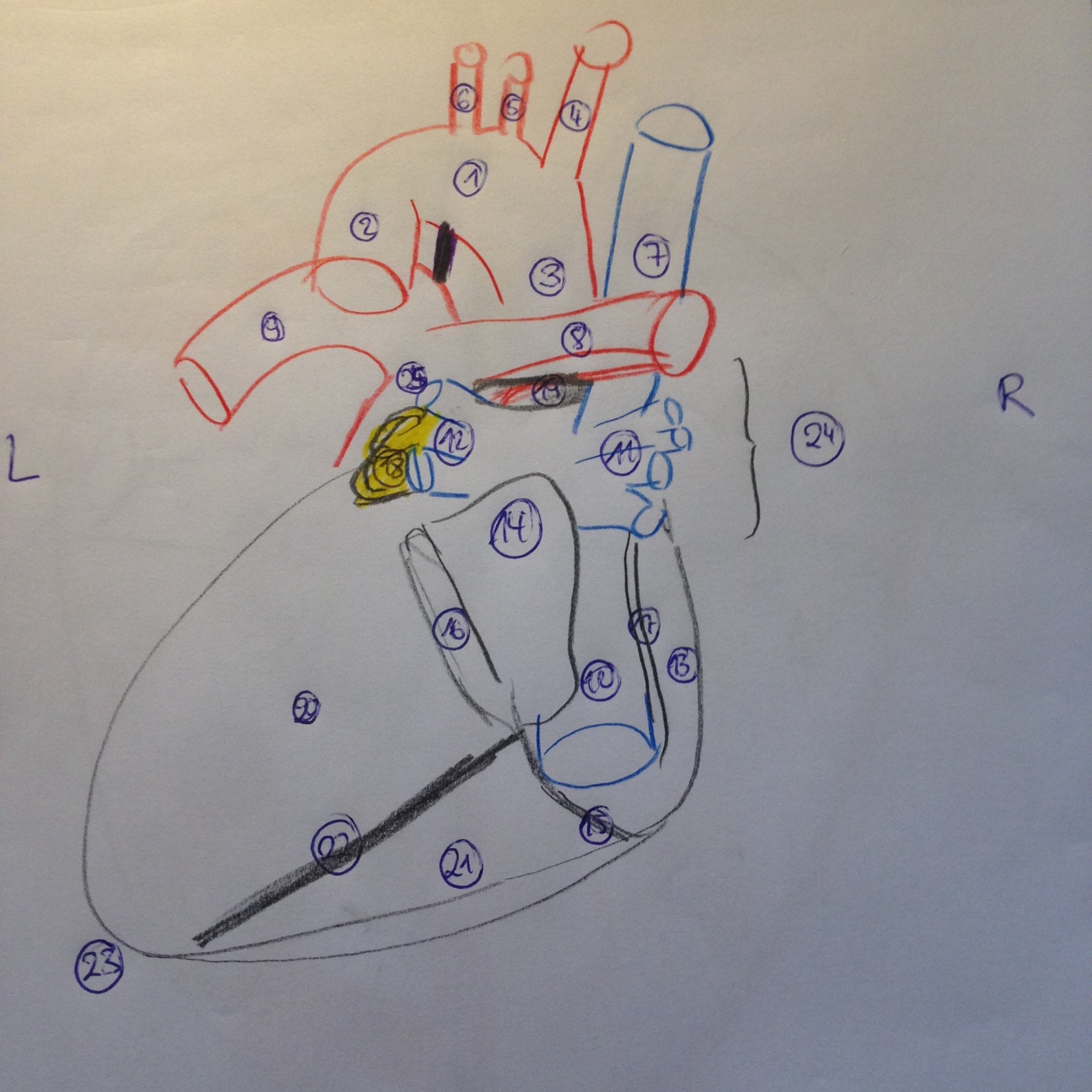
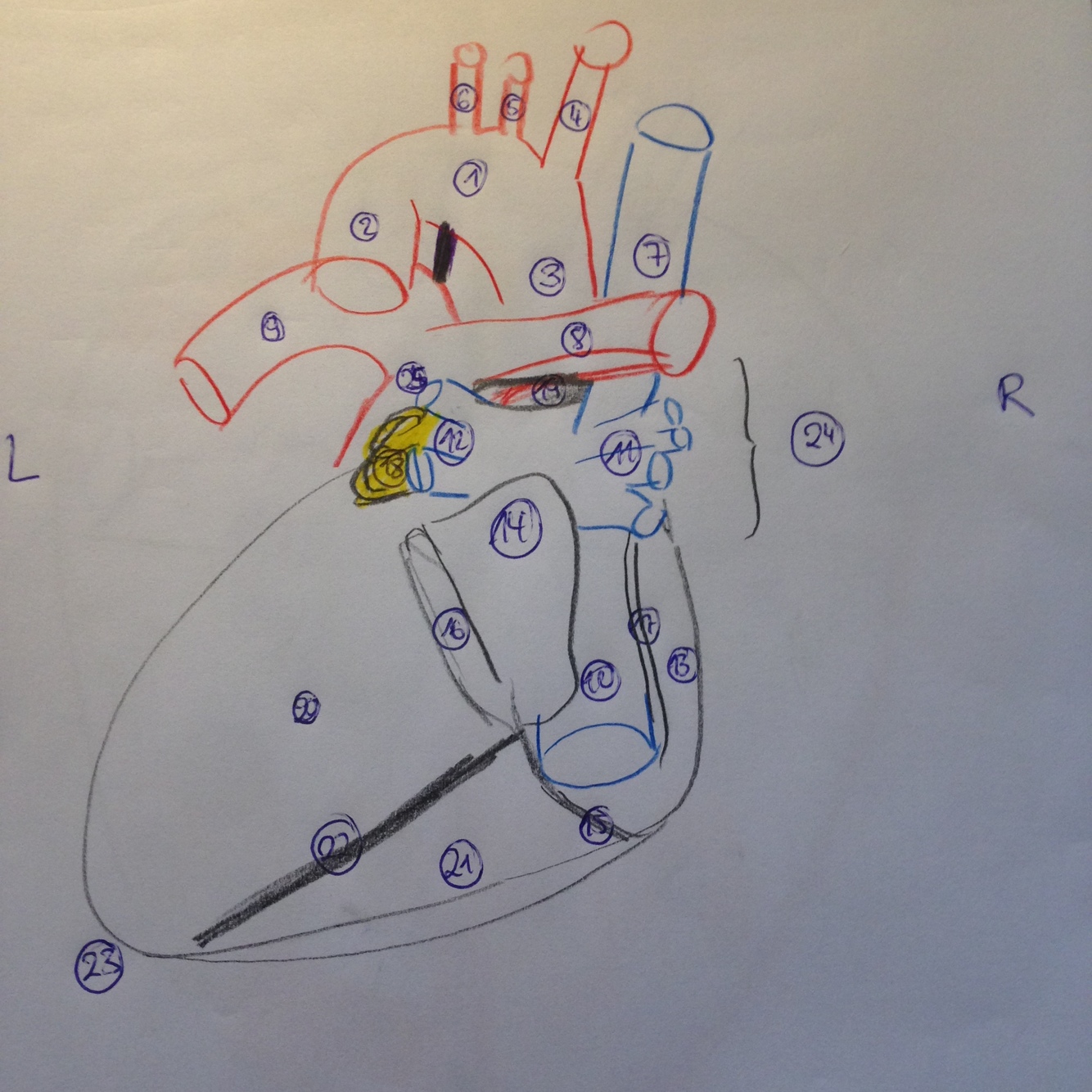
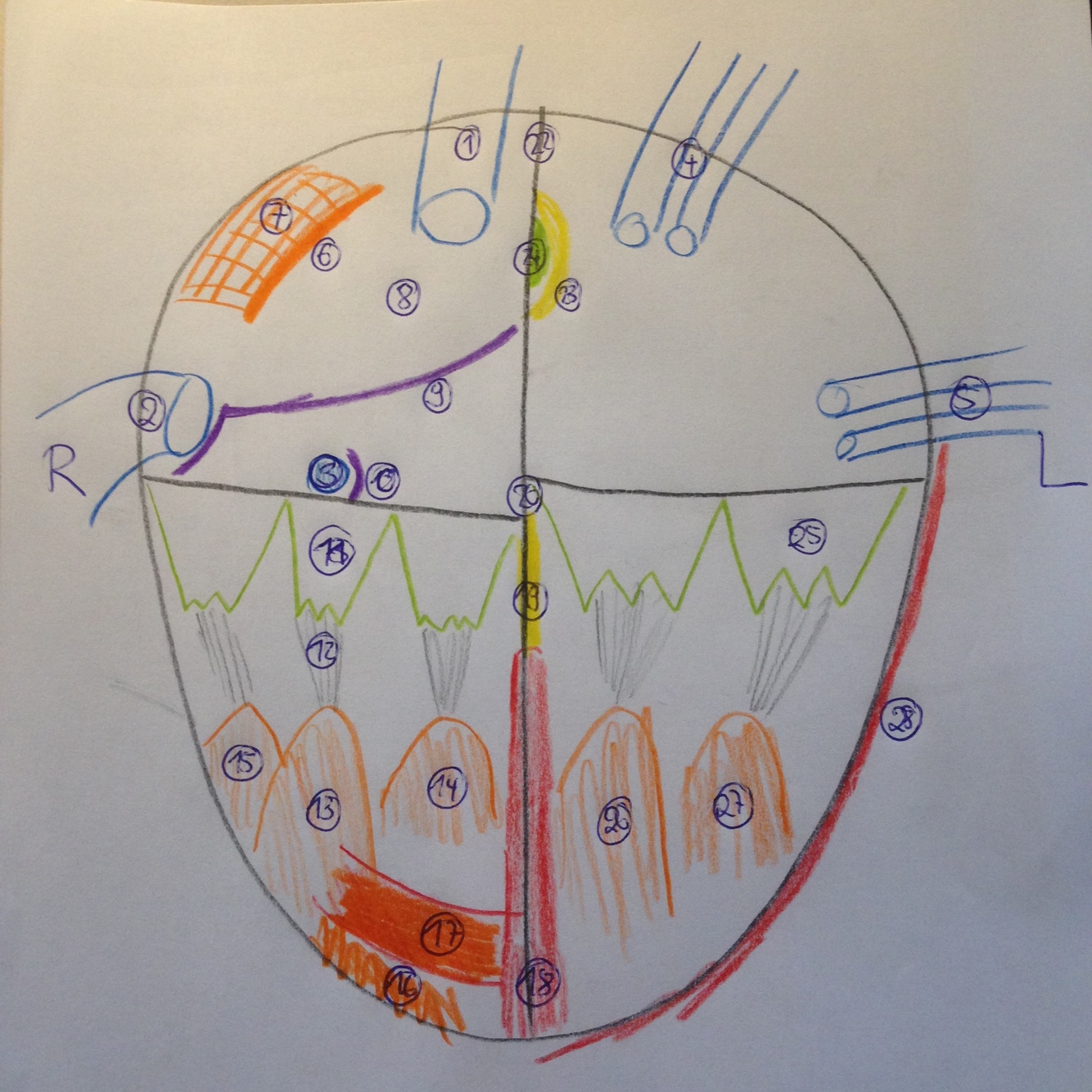
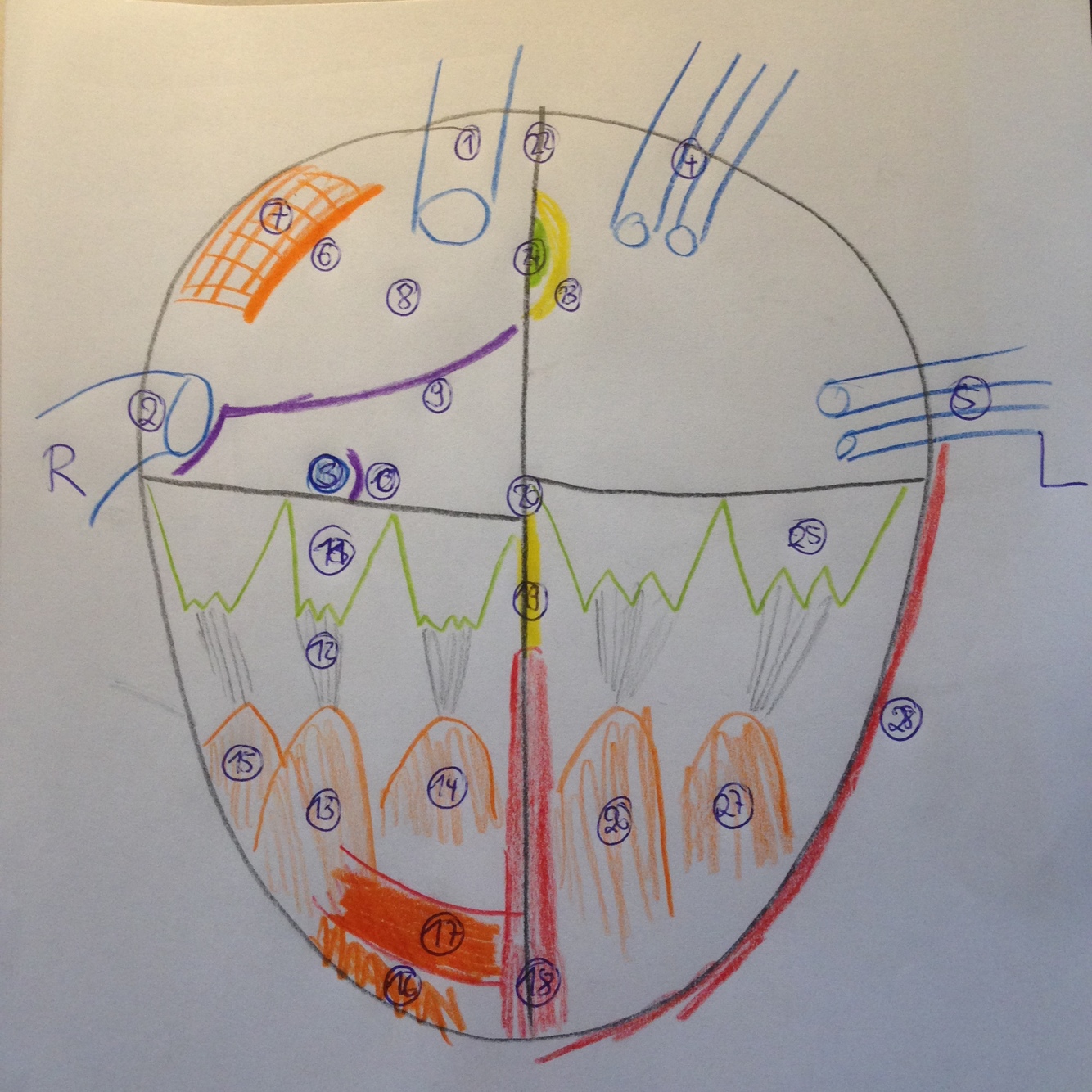
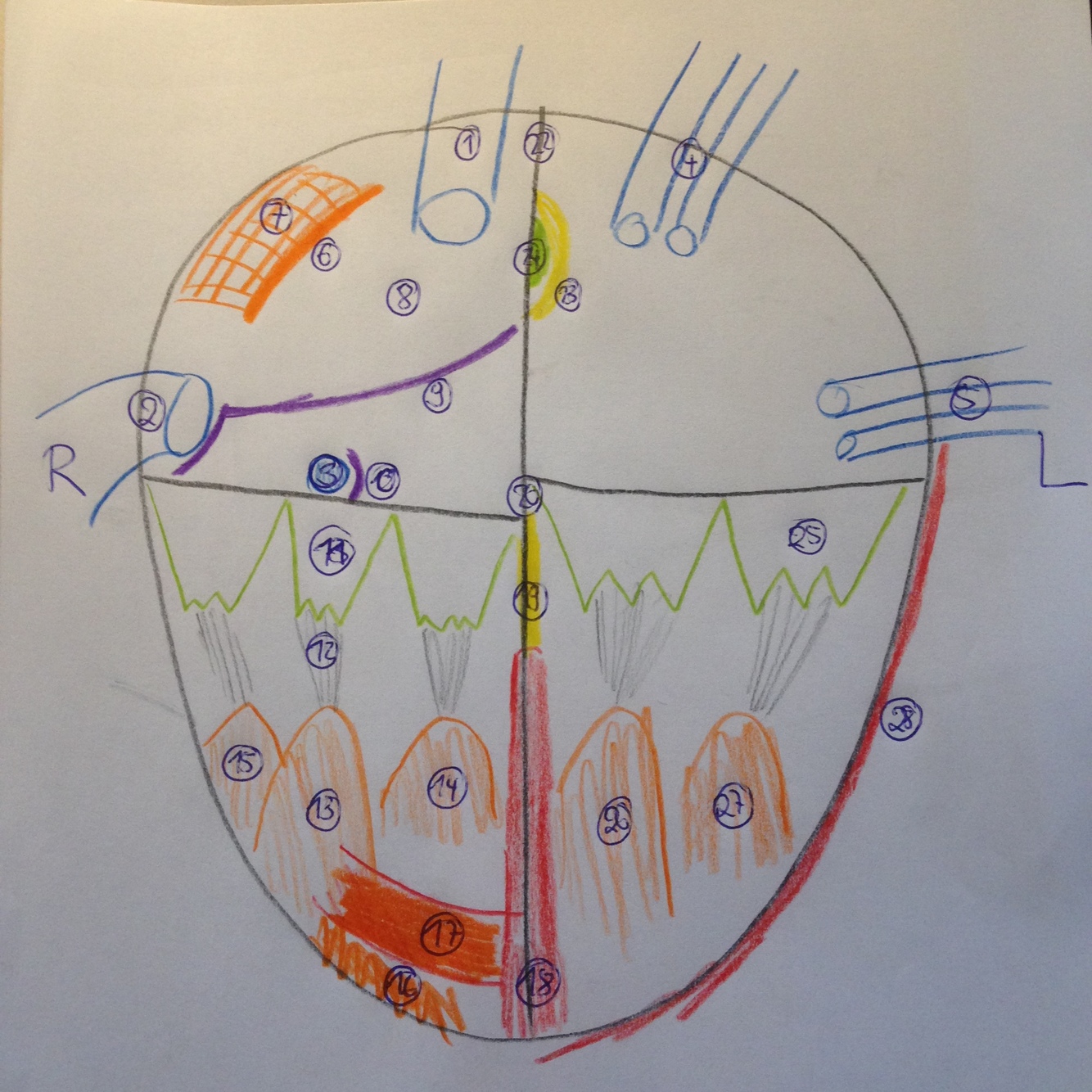
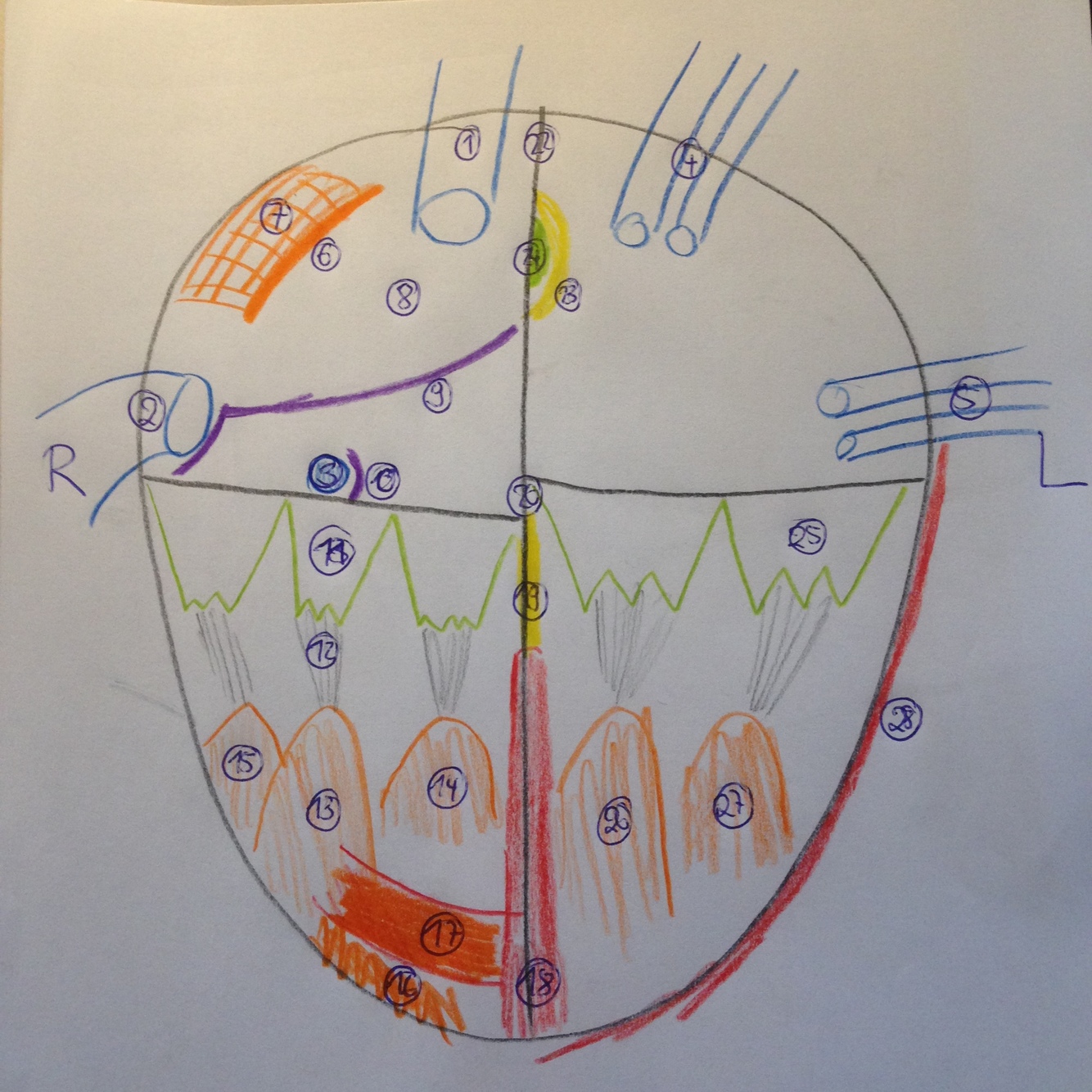
Q

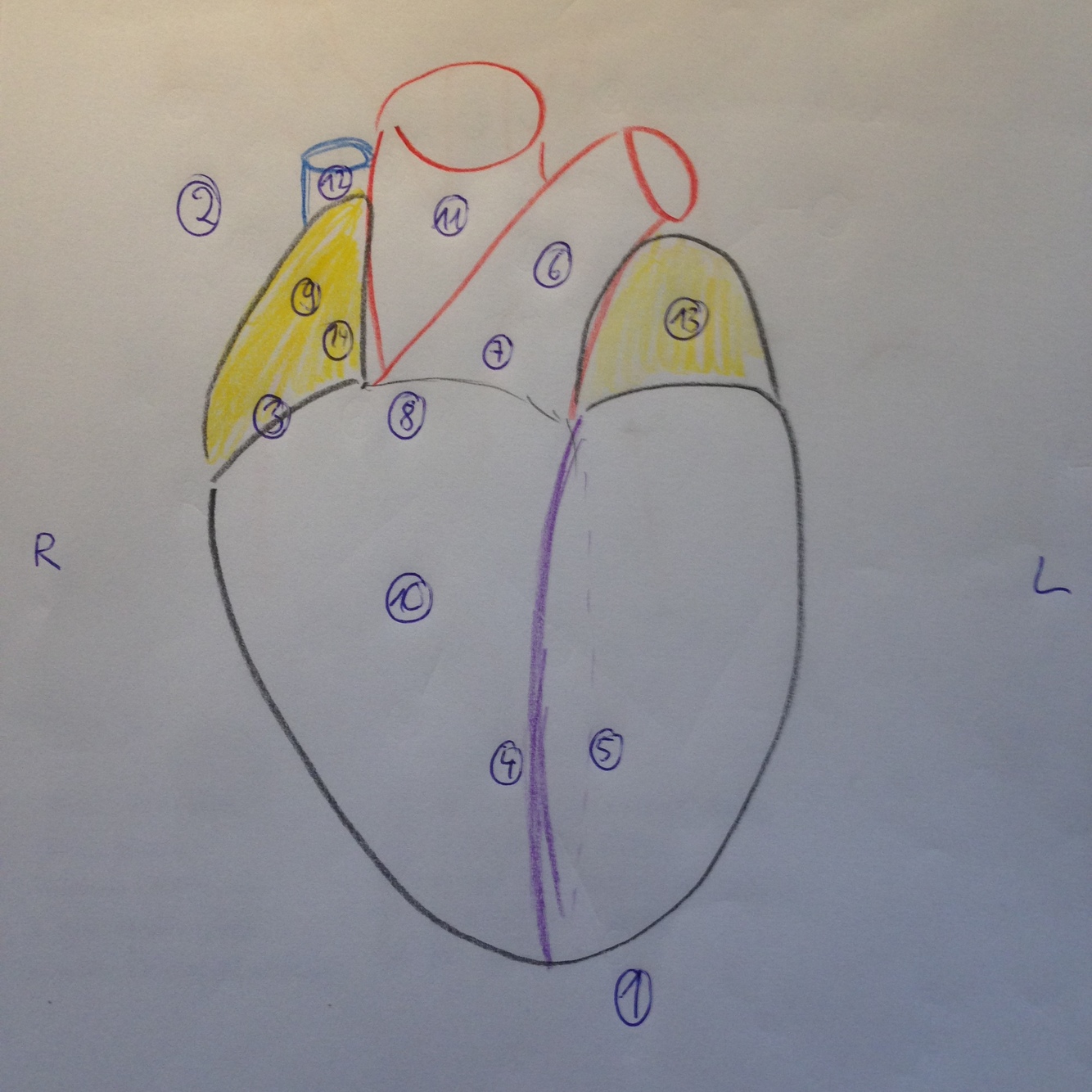
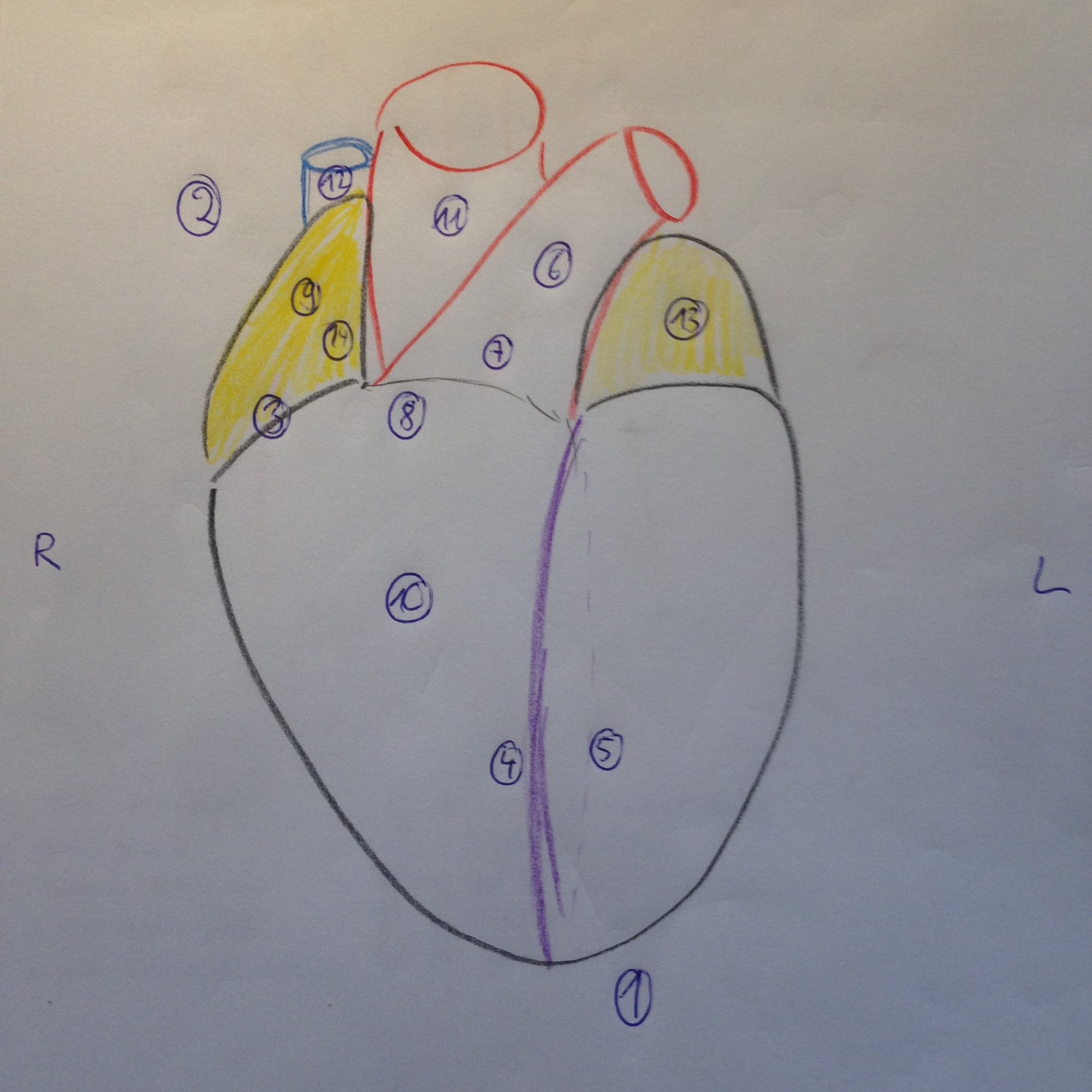
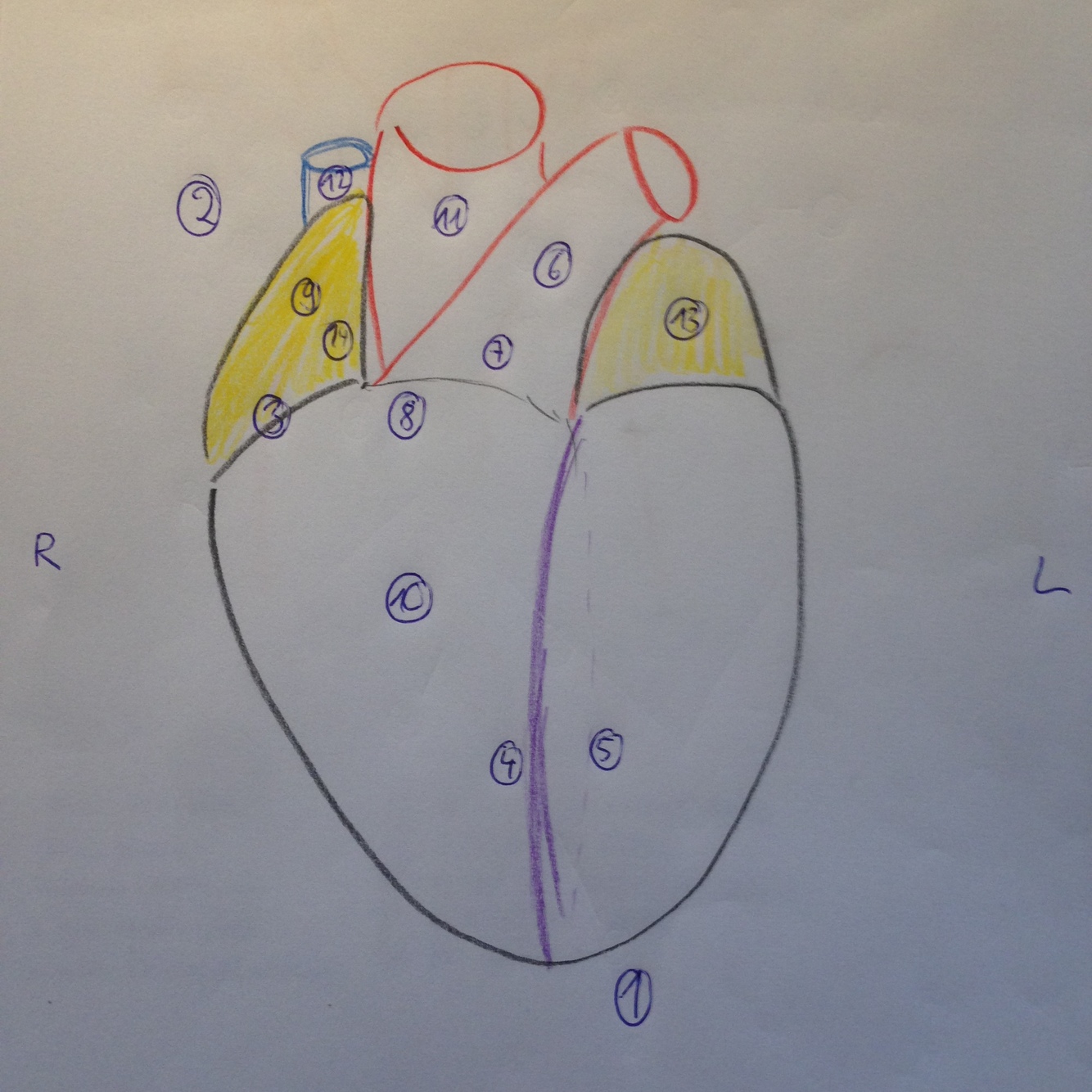
1 - 5

A

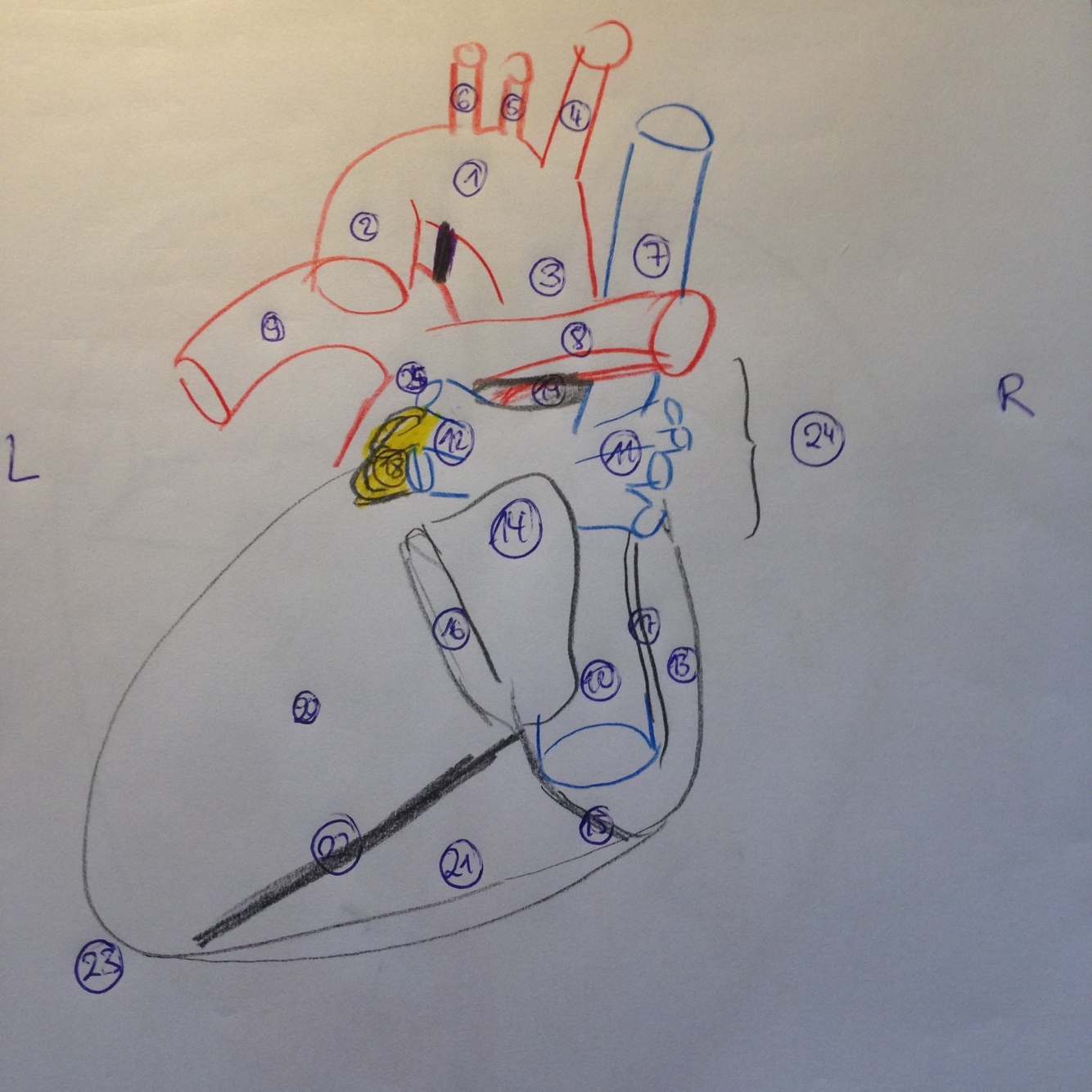
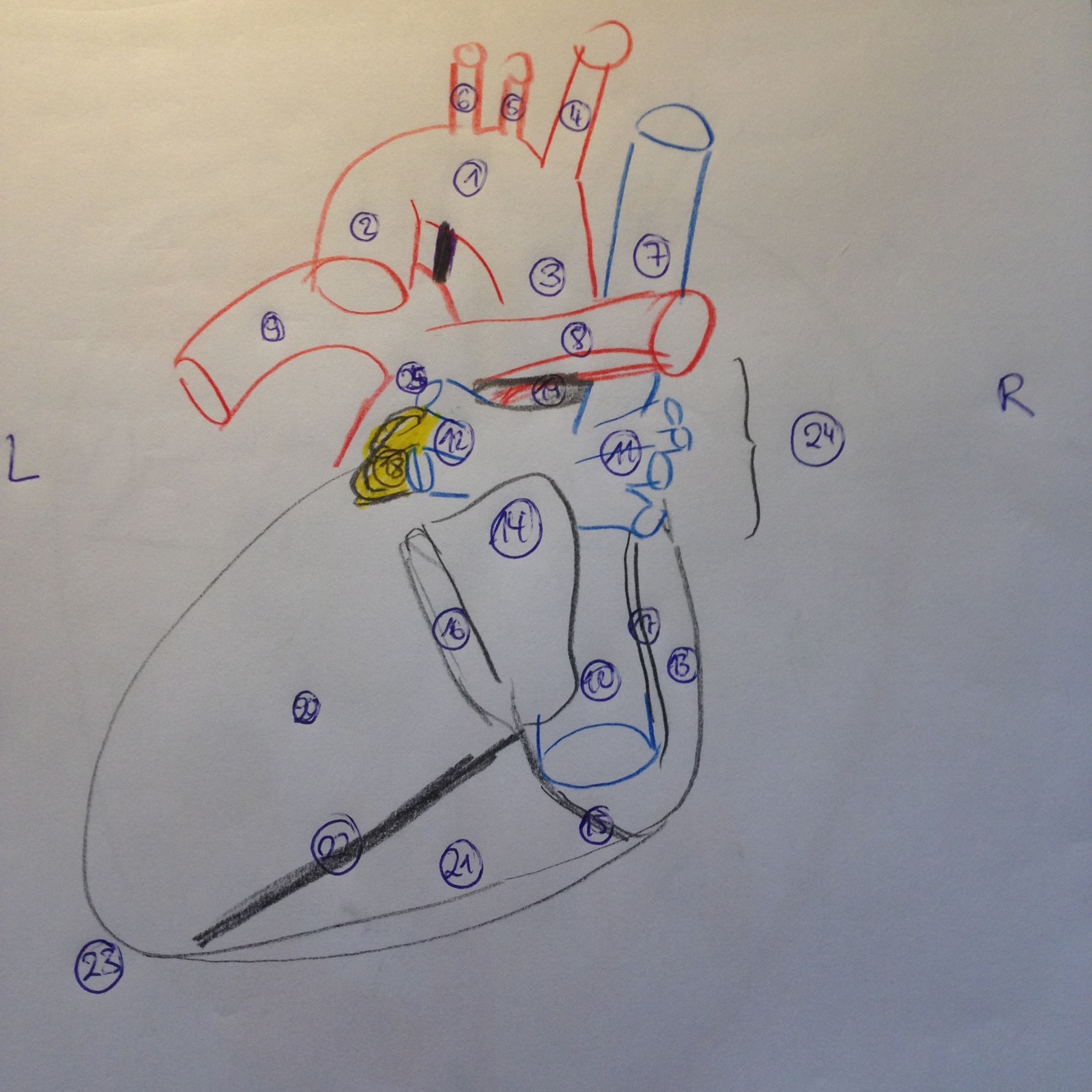
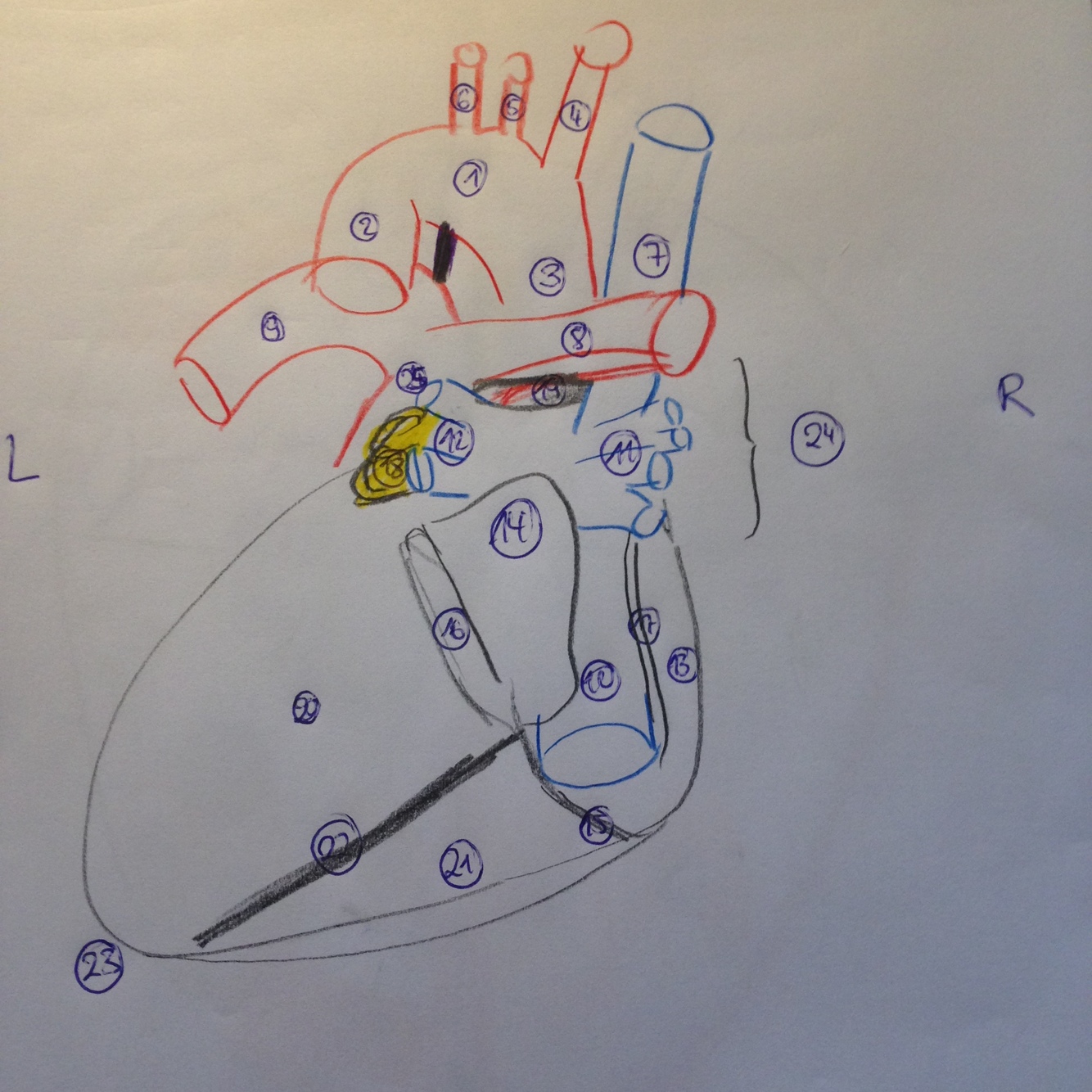
1) apex cordis
2) basis cordis
3) sulcus coronarius
4) sulcus interventricularis anterior
5) sulcus interventricularis posterior

3
Q

6 - 10

How is #8 called inside?

A

6) truncus pulmonalis
7) sinus trunci pulmonalis
8) conus arteriosus → inside: infundibulum cordis
9) atrium dextrum
10) ventriculus dexter

4
Q

11 - 14

A

11) aorta
12) v. cava superior
13) auricula sinistra
14) auricula dextra

5
Q

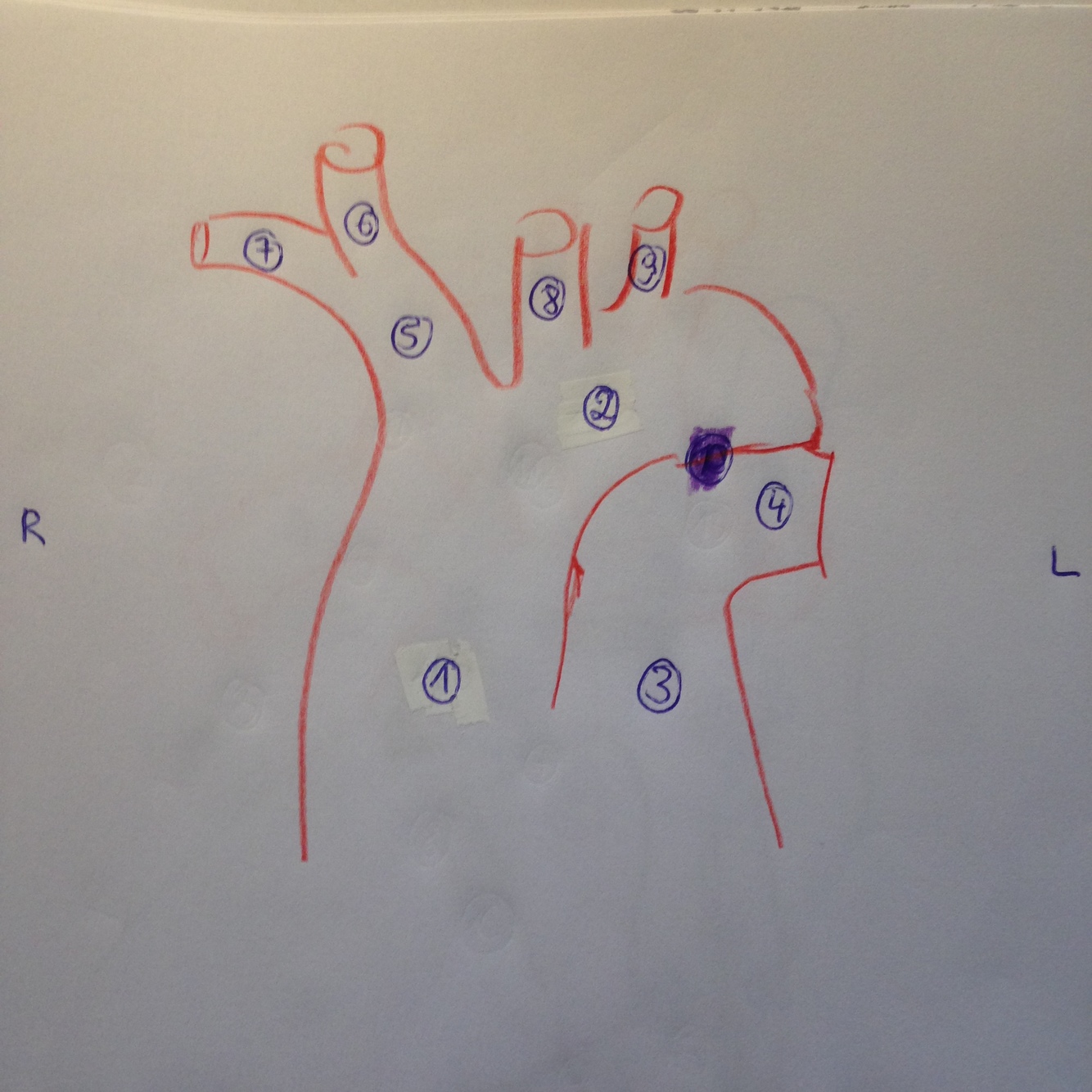
1 - 5

A

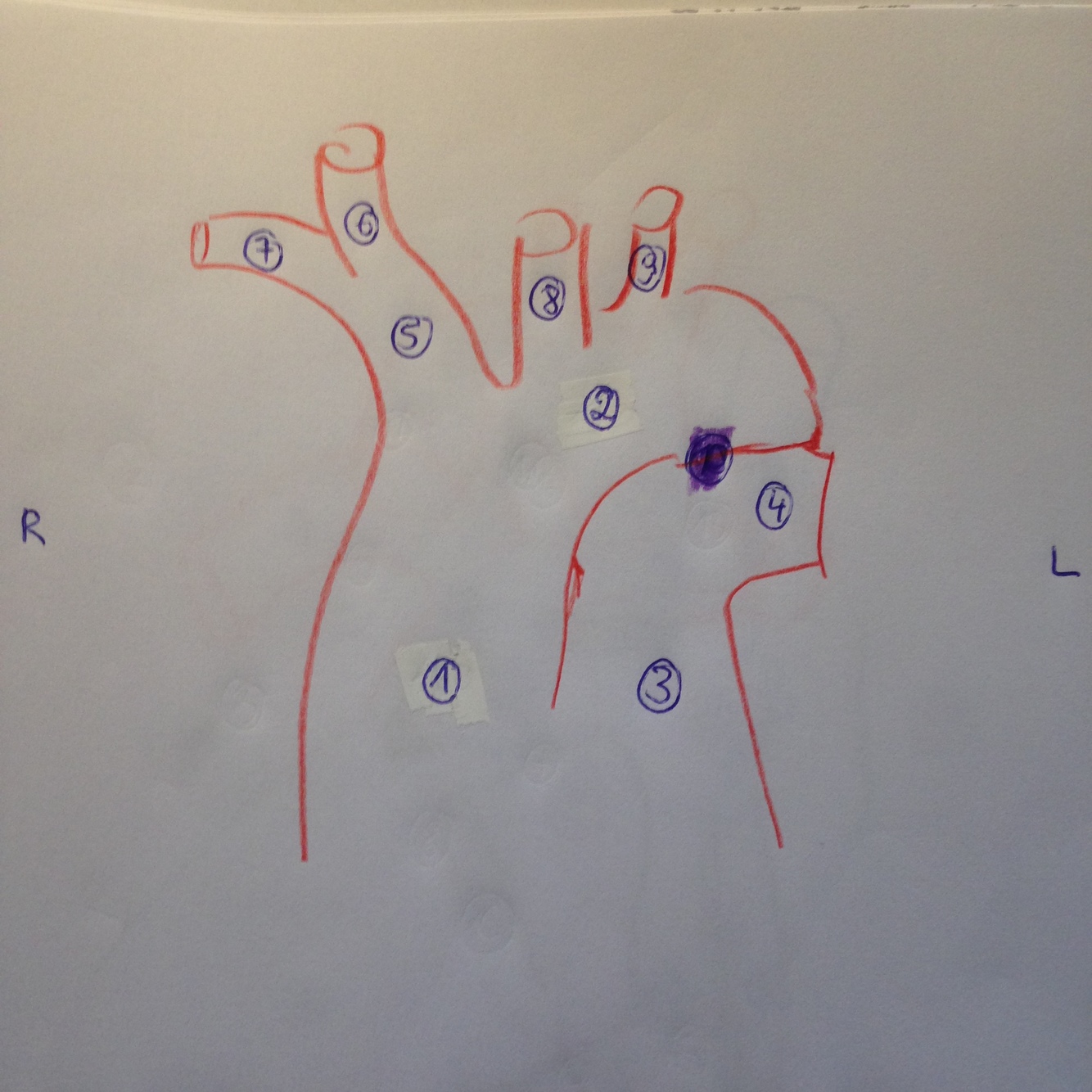
1) aorta ascendens
2) arcus aorticus
3) truncus pulmonalis
4) a. pulmonalis sinistra
5) truncus brachiocephalicus

6
Q

6 - 10

A

6) a. carotis communis dextra
7) a. subclavia dextra
8) a. carotis communis sinistra
9) a. subclavia sinistra
10) lig. arteriosum

7
Q

1 - 5

A

1) arcus aorticus
2) aorta descendens
3) aorta ascendens
4) truncus brachiocephalicus
5) a. carotis communis sinistra

8
Q

6 - 10

A

6) a. subclavia sinistra
7) v. cava superior
8) a. pulmonalis dextra
9) a. pulmonalis sinistra
10) v. cava inferior

9
Q

11 - 15

A

11) vv. pulmonales dextrae
12) vv. pulmonales sinistrae
13) atrium dextrum
14) atrium sinistrum
15) sulcus coronarius

10
Q

16 - 20

A

16) sinus coronarius
17) sulcus terminalis
18) auricula sinistra
19) sinus transverus pericardii
20) ventriculus sinister

11
Q

21 - 25

A

21) ventriculus dexter
22) sulcus interventricularis posterior
23) apex cordis
24) basis cordis
25) truncus pulmonalis

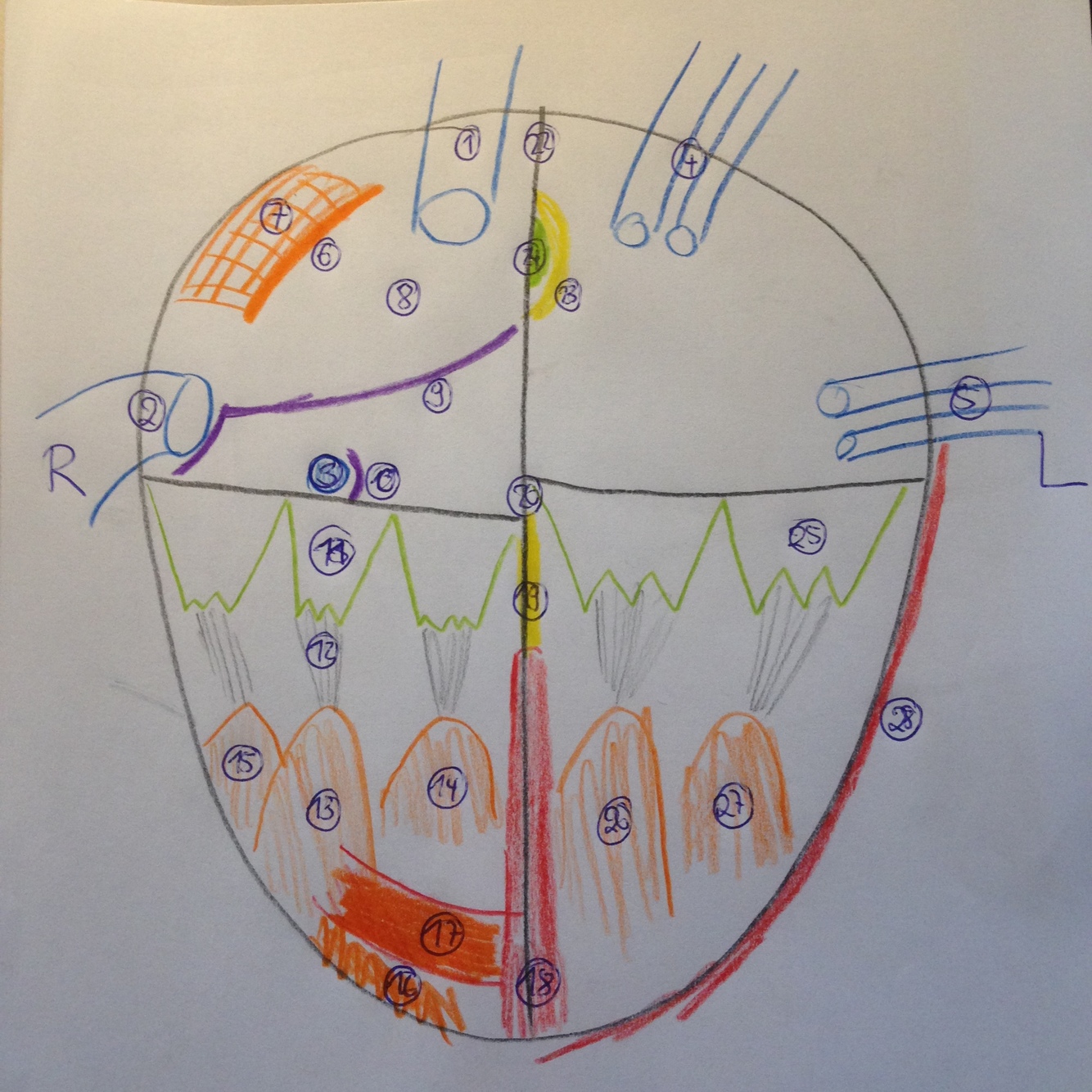
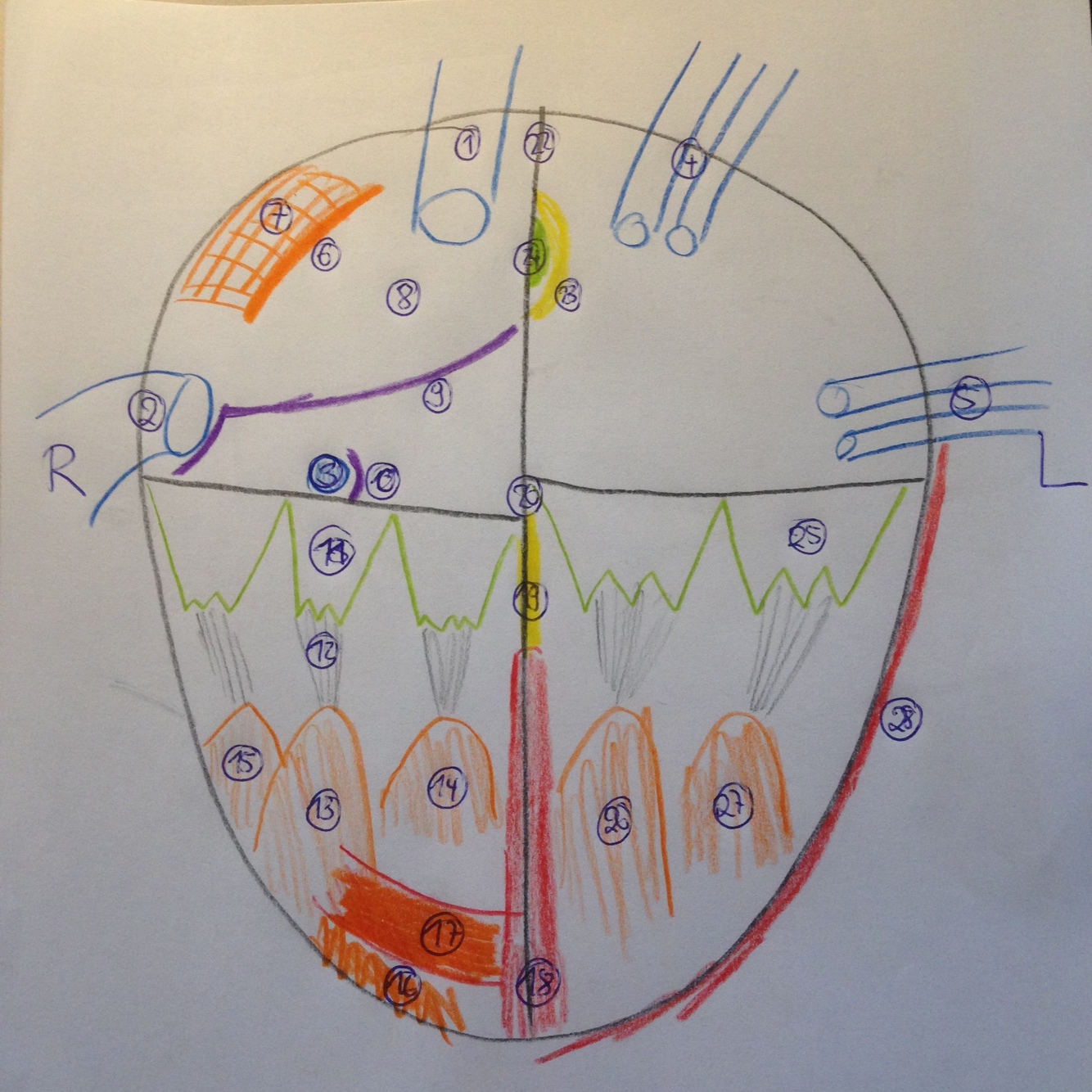
12
Q

1 - 5

A

1) v. cava superior
2) v. cava inferior
3) sinus coronarius
4) vv. pulmonales dextrea
5) vv. pulmonales sinistrae

13
Q

6 - 10

What forms #6?

A

6) crista terminalis → outside: sulcus terminalis
7) mm. pectinati
8) sinus venarum cavarum
9) valvula Eustachii
10) valvula Thebesii

14
Q

11 - 15

Give another name for #11.

A

11) valva artrioventricularis dextra → tricuspid valve
12) chordae tendinae
13) m. pappilaris anterior
14) m. pappilaris septalis
15) m. pappilaris posterior

15
Q

16 - 20

Give another name for #17.

A

16) trabeculae carnae
17) trabecula septomarginalis → moderator band
18) septum interventriculare pars muscularis
19) septum interventriculare pars membranacea
20) septum artrioventriculare

16
Q

22 - 25

Give another name for #25.

A

22) septum interartriale
23) limbus fossae ovalis
24) fossa ovalis
25) valva artrioventricularis sinistra → bicuspid valve

17
Q

26 - 28

A

26) m. pappilaris anterior
27) m. pappilaris posterior
28) thicker wall of right ventricle

18
Q

Describe the structure of a semilunar valve

Give another name for the smallest part

A
  • pars densa: lower part
  • pars flaccida: upper part
    • 2 lunuli: thickened edges
    • 1 nodulus (=corpus Arantii): closes cusps
19
Q

The inflow and outflow tract of the right ventricle are divided by.. ?

A
  • crista supraventricularis
  • trabecula septomarginalis
20
Q

The inflow and outflow tract of the left ventricle is divided by.. ?

How is the structure called?

A

anterior cusp of bicuspid valve

→ vestibulum aortae

21
Q

Which vessel leaves the left ventricle?

A

aorta

22
Q

What are the 3 layers that make up the heart wall?

A
  • endocardium
  • myocardium
  • epicardium
23
Q

Which structures make up the myocardium?

A
  • atrial muscle
  • ventricular muscle
24
Q

Differentiate btw atrial muscle layers

A
  • deep layer: surrounding each atrium
  • superficial layer: covers both atria
25
Differentiate btw ventricle muscle layers
* _stratum subendocardiale:_ forms trabeculae carnae, mm. papillares, sulcus coronarius, sulcus interventricularis ant./post * _stratum musculare:_ only septum interventr., wall of left ventricle * _stratum subepicardiale:_ forms vortex cordis
26
Describe the structure of the endocardium
= continuation of inner layer of wall vessels, therefore: * endothelium * conn. tissue
27
Describe the structure and function of the epicardium
* mesothelium * conn. tissue * adipose tissue → smoothes unevenness of heart surface
28
What is the function of the cardiac skeleton?
* electrical insulation of atria/ventricles * attachment site for: * myocardium * leaflets and cusps of valves * keeps orifices of valves stable
29
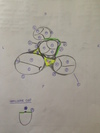
#1 - 5
1) valva atrioventricularis dextra 2) valva atrioventricularis sinistra 3) valva aortae 4) valva pulmonalis 5) cuspis anterior
30
#6 - 10
6) cuspis posterior 7) cuspis commisuralis 8) cuspis anterior 9) cuspis posterior 10) cuspis septalis
31
#11 - 15
11) cuspis semilunaris sinistra 12) cuspis semilunaris dextra 13) cuspis semilunaris posterior 14) cuspis semilunaris dextra 15) cuspis semilunaris anterior
32
#16 - 22
16) cuspis semilunaris sinistra 17) sinus trunci 18 - 20) sinus aorticus 21) a. coronaria dextra 22) a. coronaria sinistra
33
#23 - 27 Another name for #27?
23) anulus fibrosus dexter 24) anulus fibrosus sinister 25) tendo coni arteriosi 26) trigonum fibrosum dextrum 27) fasciculi atrioventricularis → bundle of HIS
34
#28 - 30
28) trigonum fibrosum sinistrum 29) lunulus valvulae semilunaris 30) nodulus valvulae semilunaris
35
Where do the aa. coronaria originate from?
right + left semilunar valves of sinus aorticus (therefore: left ventricle)
36
Where does all the deoxigenated blood from the vv. coronaria gather? Where does this structure drain into resp.?
sinus coronarius → right atrium
37
The veins of the heart form which structure on the posterior surface?
crux cordis
38
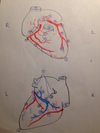
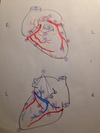
#1 - 5
1) v. cava superior 2) truncus pulmonalis 3) aorta 4) v. cava inferior 5) apex cordis
39
#6 - 11 #7 missing
6) apex cordis 8) a. coronaria sinistra 9) a. coronaria dextra 10) r. interventricularis anterior 11) r. interventricularis posterior
40
#12 - 16
12) r. circumflexus 13) r. marginalis dexter 14) r. marginalis sinister 15) rr. atriales 16) r. atrialis anastomicus
41
#17 - 21 Another name for #21?
17) rr. ventriculares 18) r. lateralis 19) rr. interventriculares septales 20) rr. atrioventriculares 21) v. obliqua atrii sinistra (= Marshall vein)
42
How is heart dominance determined? Describe the variations
Determined by supply of r. interventricularis posterior and AV-node. Usually (70%) right dominance * _right dominance:_ supplied by a. coronaria dextra * _left dominance:_ supplied by r. circumflexus (of a. coronaria sinistra) * _co-dominance:_ supplied by both
43
#22 - 25
22) v. cordis magna 23) sinus coronarius 24) v. cordis parva 25) v. cordis magna
44
What is the name of the structure btw v. pulmonalis dextra and right atrium?
Waterston's groove
45
List the innervation/conduction of the heart step by step
1. para-/sympathetic innervation pathway 2. plexus cardiacus 3. SA-node 4. AV-node 5. bundle of HIS 6. crus dextrum/sinistrum 7. Purkinje fibers, mm. papillares, myocardium
46
Which structures make up the sympathetic innervation pathway? Where do they fuse? What is their function?
_Structures_ * n. cardiacus cervicalis superior / medius / inferior * rr. cardiaci thoraci * ganglion stellatum (= fusion of inf. cerv. ganglion + first thoracic ganglion at C7 level) → fuse in plexus cardiacus _Function_ increase heart rate
47
Which structures make up the parasympathetic innervation pathway? Where do they fuse? What is their function?
_Structures_ * n. vagus * rr. cardiaci thoraci → fuse in plexus cardiacus _Function_ decrease heart rate
48
How can plexus cardiacus be differentied? Where are these parts located?
* _superficial part:_ in front of a. pulmonalis dextra * _deep part:_ behind arcus aorticus
49
#1 - 5 Another name for #1 - 3
1) nodus sinuatrialis (= SA-node) 2) nodus atrioventricularis (=AV-node) 3) fasciculus atrioventricularis (=bundle of HIS) 4) crus dextrum 5) crus sinistrum
50
#6 - 8 Another name for #6
6) trabecula septomarginalis (= moderator-band) 7) Purkinje fibers 8) septum interventriculare pars muscularis
51
GIve different names for nodus sinuatrialis. Where is it located?
* SA-node, cardiac pacemaker, Keith-Flack-node * located in sulcus terminalis near SVC inlet, subepicardiacally
52
GIve different names for nodus atrioventricularis. Where is it located? It is innervated by.. ?
* AV-node, Aschoff-Tawara-node * located in Koch's triangle, sub-endocardially * innervated by myocardium of right atrium
53
What are the borders of Koch's triangle
* _superiorly:_ tendon of Todaro * _inferiorly:_ tricuspid valve anulus * _posteriorly:_ valva Thebesii
54
What does the tendon of Todaro connect?
trigonum fibrosum dextrum → valva Eustachii
55
Give another name for fasciculus atrioventricularis. Where is it located?
* bundle of HIS * located in trigonum fibrosum dextrum
56
Give another name for crus dextrum/sinistrum. Which structures are innervated by crus dextrum/sinistrum? Name a special feature of crus dextrum and what does it innervate?
= right/left Tawara crus * mm. papillares (through Purkinje fibers) * myocardium crus dextrum innervates trabecula septomarginalis → m. papillaris ant.
57
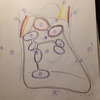
#1 - 5 #1 can be subdivided into? Give another name for #4
1) pericardium serosum → lamina parietalis/visceralis 2) pericardium fibrosum 3) porta arteriosa 4) porta venosa (= Sappey's T) 5) truncus pulmonalis
58
#6 - 10
6) aorta 7) vv. pulmonales dextrae 8) vv. pulmonales sinistrae 9) v. cava superior 10) v. cava inferior
59
#11 - 15 What is the function of #13? Which additional nerve not shown on the drawing innervates the pericardium?
11) sinus obliquus pericardii 12) n. phrenicus 13) a. + v. pericardiophrenica → blood supply of pericardium 14) n. vagus 15) lig. arteriosum → truncus sympathicus
60
#16 - 18
16) centrum tendineum (caudal border) 17) cavitas pleuralis (lateral borders) 18) sinus transversus pericardii
61
What are the caudal, ventral, dorsal and lateral borders of the pericardium fibrosum? It is attached to its ventral border by.. ?
* caudally: centrum tendineum * ventrally: sternum (attached to by ligg. sternopericardiaca) * dorsally: trachea, spine * laterally: cavitas pleuralis
62
Why is the sinus transversus pericardii of clinical importance?
allows surgeon to his fingers in and applies a ligature to stop the circulation for example in heart transplantation surgeries
63
What is the average weight of a male and female heart resp.?
* _female:_ 250-300g * _male:_ 300-350g
64
The mediastinum can be differentiated into..? It is seperated by.. ? List their contents.
* _medastinum superius:_ thymus, blood vessels + nerve pathways ------------- angulus sterni ------------- * _mediastinum inferius:_ * _​mediastinum anterius:_ conn. tissue * _mediastinum medium:_ heart, pericardium, loose conn. tissue, corpus adiposum retrosternalis, lymph vessels * _mediastinum posterius:_ esophagus, large blood vessels + nerve pathways
65
#1 - 5 #3 is mainly formed by... ?
1) facies sternocostalis 2) facies diaphragmatica 3) facies posterior cordis → mainly: left atrium 4) facies pulmonales 5) mediastinum posterius
66
#6 - 10
6) mediastinum medium 7) mediastinum anterius 8) pericardium 9) heart 10) esophagus
67
#12 - 14
12) lung 13) pleura / cavitas pleuralis 14) radix pulmonis
68
Why does the close relation of the left atrium to the esophagus have a clinical importance?
stenosis of mitral valve → enlargement left atrium → compression of esophagus → dysphagia
69
What is auscultation? Where can it be done best?
* listening to heart sounds * best heard at point on thoracic wall closest to regarding valve → auscultation sites
70
Give the location of the auscultation sites of the valves. Give the location of another very famous auscultation site and explain when it is used.
* _valva aortae:_ right 2nd interc. space, parasternally * _valva pulmonalis:_ left 2nd interc. space, parasternally * _bicuspid valve:_ left 5th interc. space, midclavicular line * _tricuspid valve:_ right 5th interc. space, parasternally * _punctum quintum:_ (= Erb's point) left 3rd interc. space, parasternally, esp. high freq. sounds of insufficient valva aortae / pulmonalis
71
When can the heart sounds be heard? Pathological heart sounds can be produced by.. ?
* _1st heart sound:_ contraction phase of systole * _2nd herat sound:_ beginning diastole → closure of cuspes semilunares aortae, trunci pulmonali * _pathological heart sounds:_ can be produced by stenosis / valvular insufficiency
72
List the different percussion sounds and where they can be heard
* _absolute cardiac dullness:_ at sternum * _relative cardiac dullness:_ at any other point of heart that is covered by lung tissue * _"undamped" sound:_ at "pure" lung tissue
73
#1 - 5 #4 can be two things
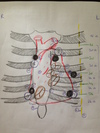
1) intercostal space 2) sulcus coronarius, left edge 3) apex cordis 4) sulcus coronarius, right edge / v. cava inferior, right margin 5) v. cava superior, right margin
74
#6 - 10
6) 2 cm 7) midclavicular line 8) 2 cm 9) 2 cm 10) right atrium
75
#11 - 15 Give another name for #12
11) v. cava superior 12) arcus aorticus, aortic knuckle 13) truncus pulmonalis 14) auricula sinistra 15) left ventricle
76
#16 - 20 Give another name for #18
16) auscultation site: valva aortae 17) auscultation site: valva pulmonis 18) auscultation site: punctum quintum (= Erb's point) 19) auscultation site: bicuspid valve 20) auscultation site: tricuspid valve
77
#21 - 23
21) valva trunci pulmonis/aortae 22) bicuspid/tricuspid valve 23) sulcus coronarius