What are the functions of the respiratory organs?
- gas exchange
- protection of resp. apparatus
- phonation
- olfactory perception
Which organs belong to the upper, which to the lower airways?
upper airways: head → larynx
- nasal cavities
- paranasal sinuses
- pharynx
lower airways: larynx → pleural cavity
- larynx
- trachea
- bronchial tree (lung)
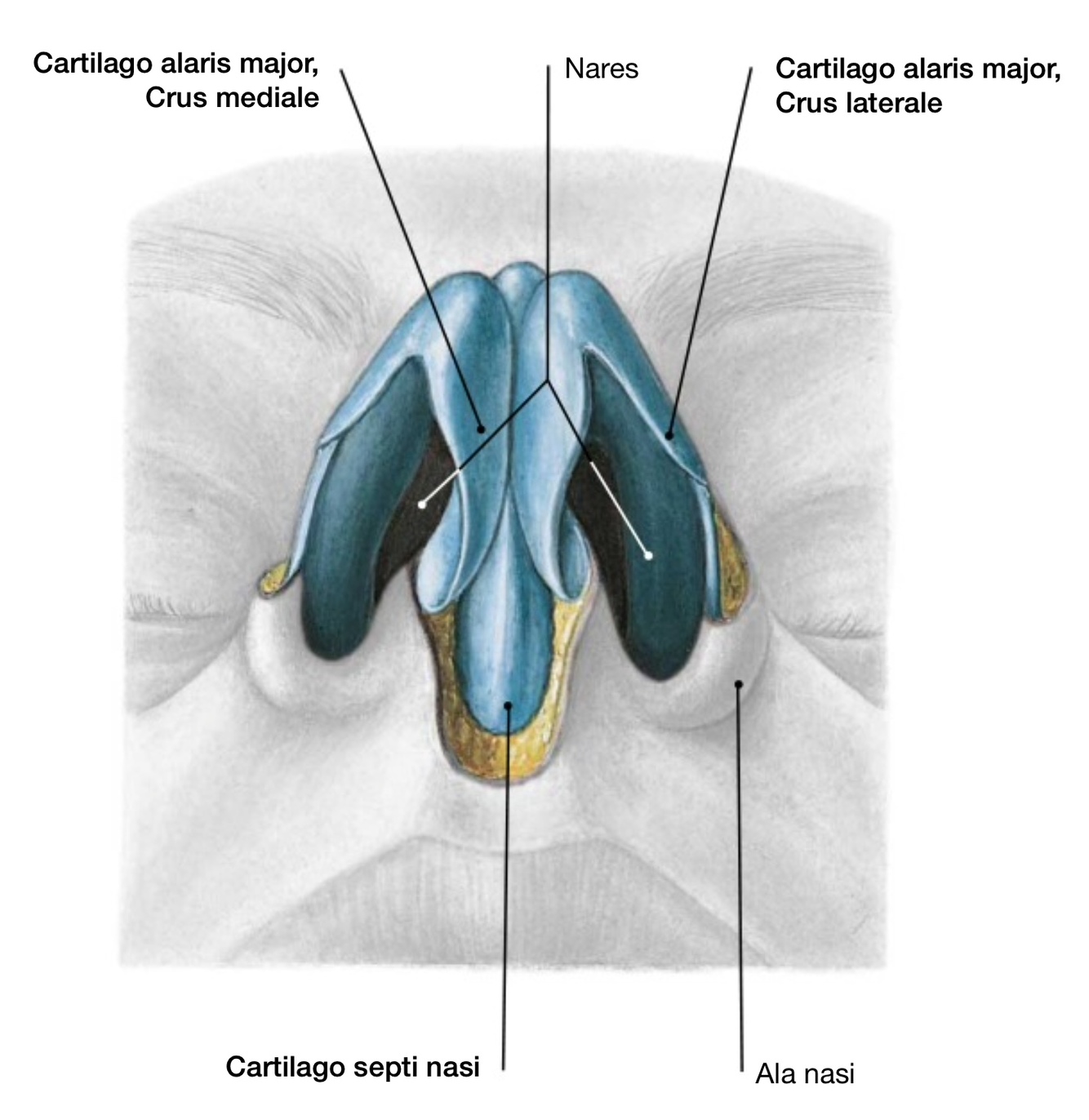
Which bones and cartilages form the skeletal framework of the external nose?
BONES:
- 2 ossa nasalia
- 2 procc. frontales maxillae
⇒ apertura piriformis
CARTILAGES:
- 2 procc. laterales ⇒ dorsum
- parts of nasal septum
- cartilago alaris major (on each side)
- ⇒ crus laterale/crus mediale
⇒ apex nasi
- ⇒ crus laterale/crus mediale
- 3-4 cartilagines alares minores
How do you call the hairs inside the nose?
vibrissae
Which vessels supply, drain the external nose, resp.?
Which nerves are responsible for the sensory and motor innervation?
supply:
- a. facialis → a. angularis
- a. ophtalmica → a. dorsalis nasi
- a. maxillaris → a. infraorbitalis
drainage:
- v. facialis → v. ophtalmica superior
innervation: (cf. supply)
- sensory: n. opthalmicus, n. maxillaris
- motor: n. facialis via rr. buccales
What may cause a venous sinus thrombosis and how?
vv. draining into v. facialis/ophtalmica anastomose btw medial angle of the eye and the root of the nose
in case of inflammation involving lat. part of face + external nose bacteria can reach deep venous sinuses → venous sinus thrombosis
1 - 5
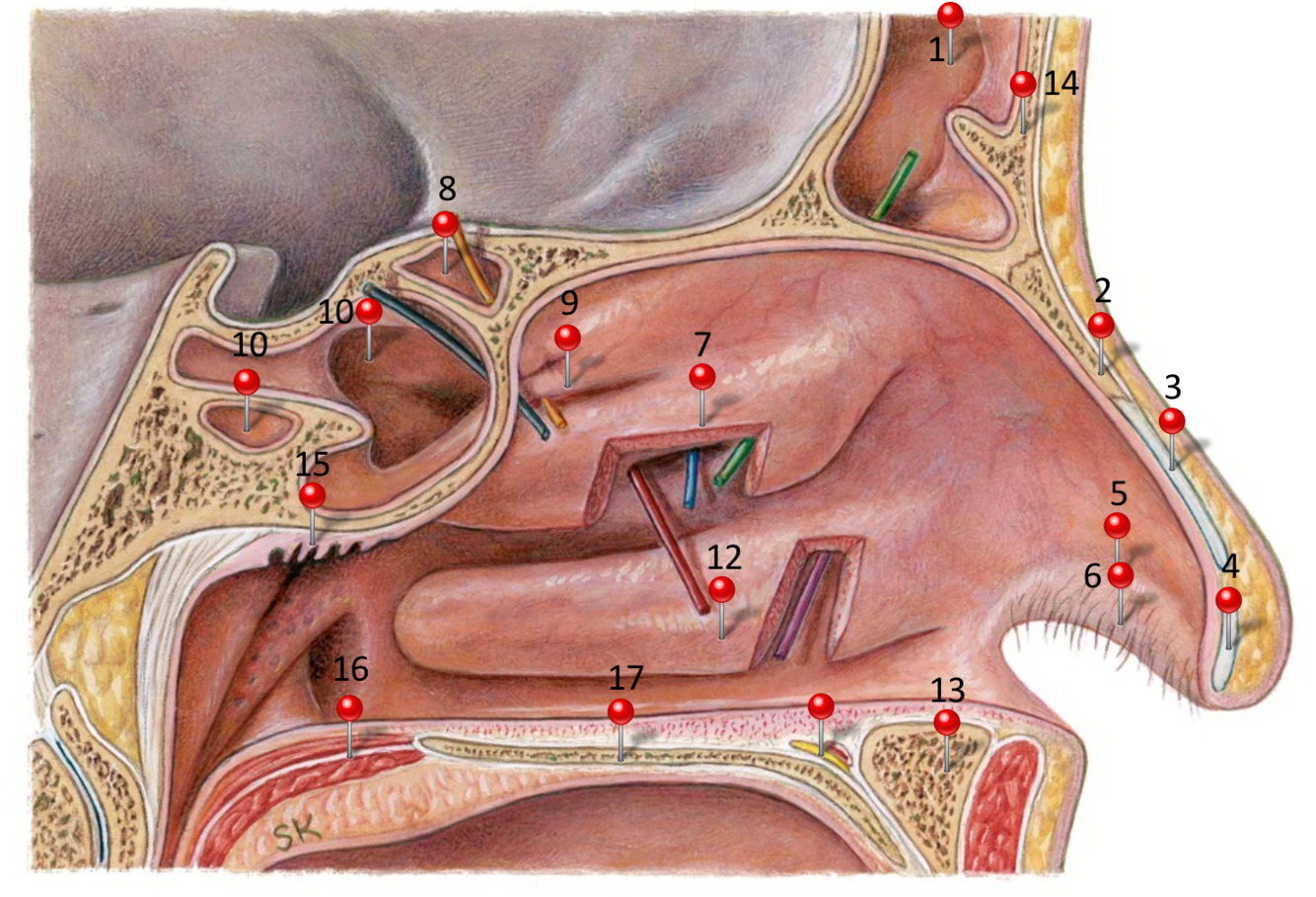
1) sinus frontalis
2) os nasale
3) proc. lateralis
4) cartilago alaris major, crus laterale
5) limen nasi
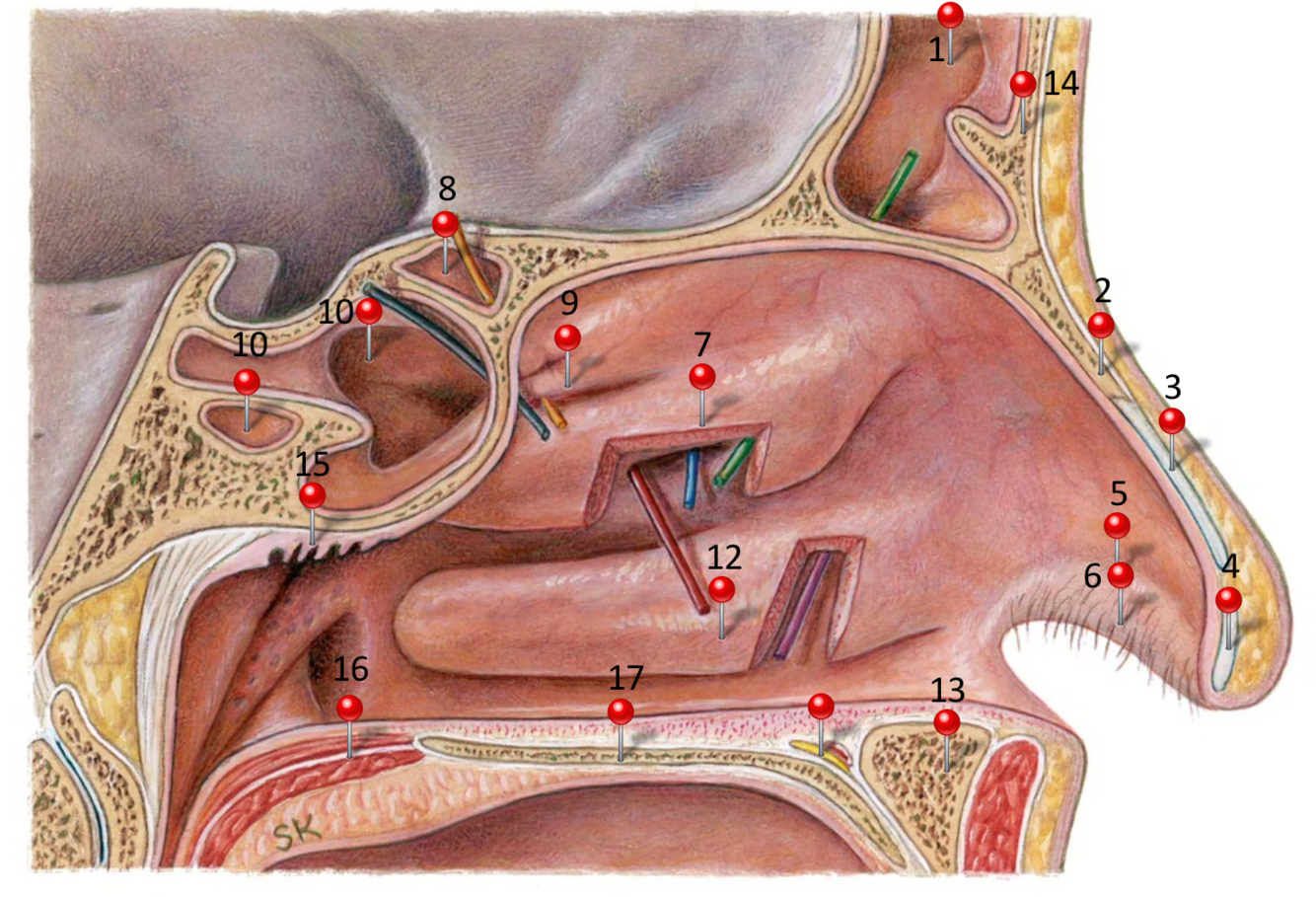
6 - 10
6) vestibulum nasi
7) concha nasalis media
8) cellula ethmoidalis post.
9) concha nasalis sup.
10) sinus sphenoidalis
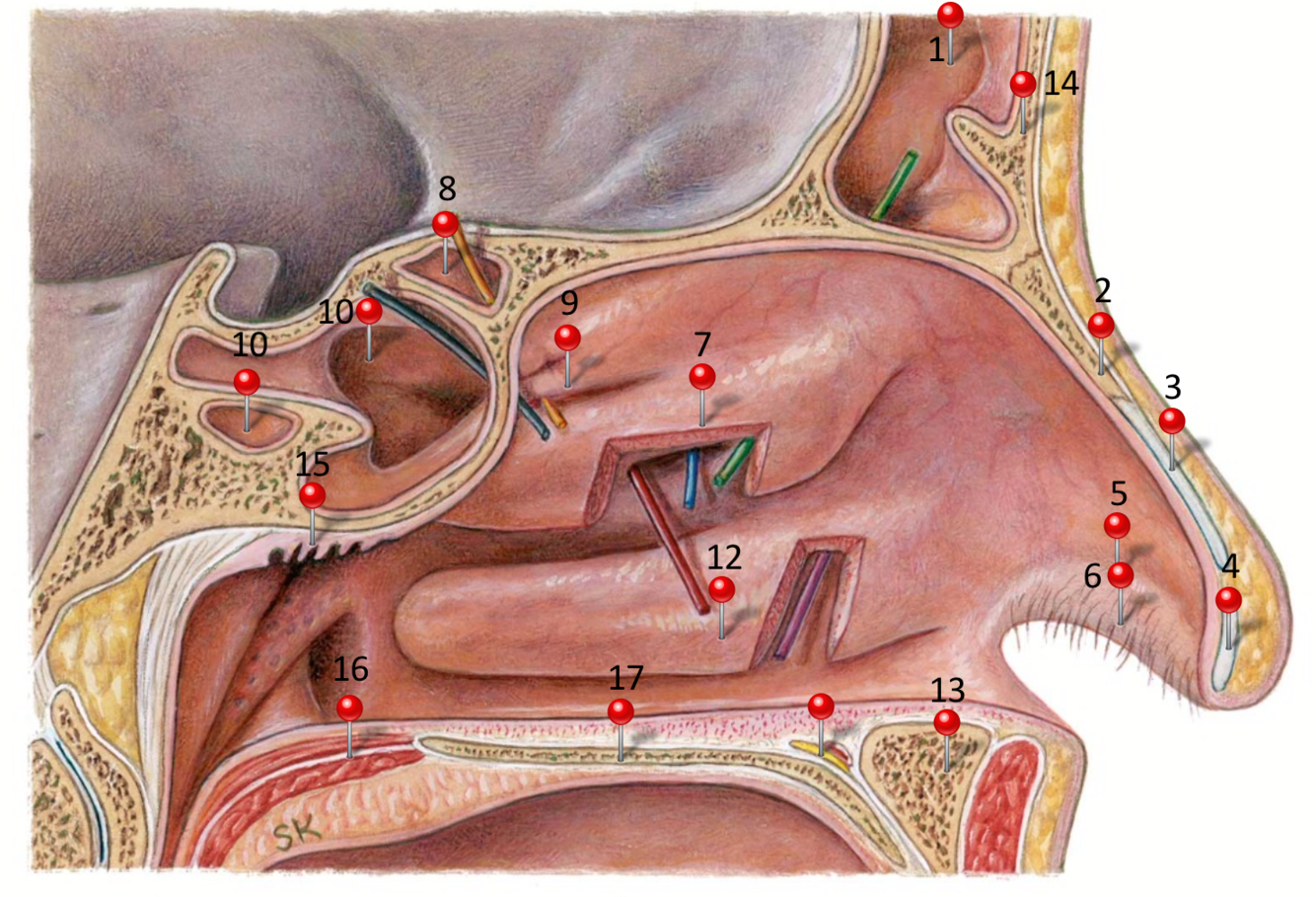
11 - 17
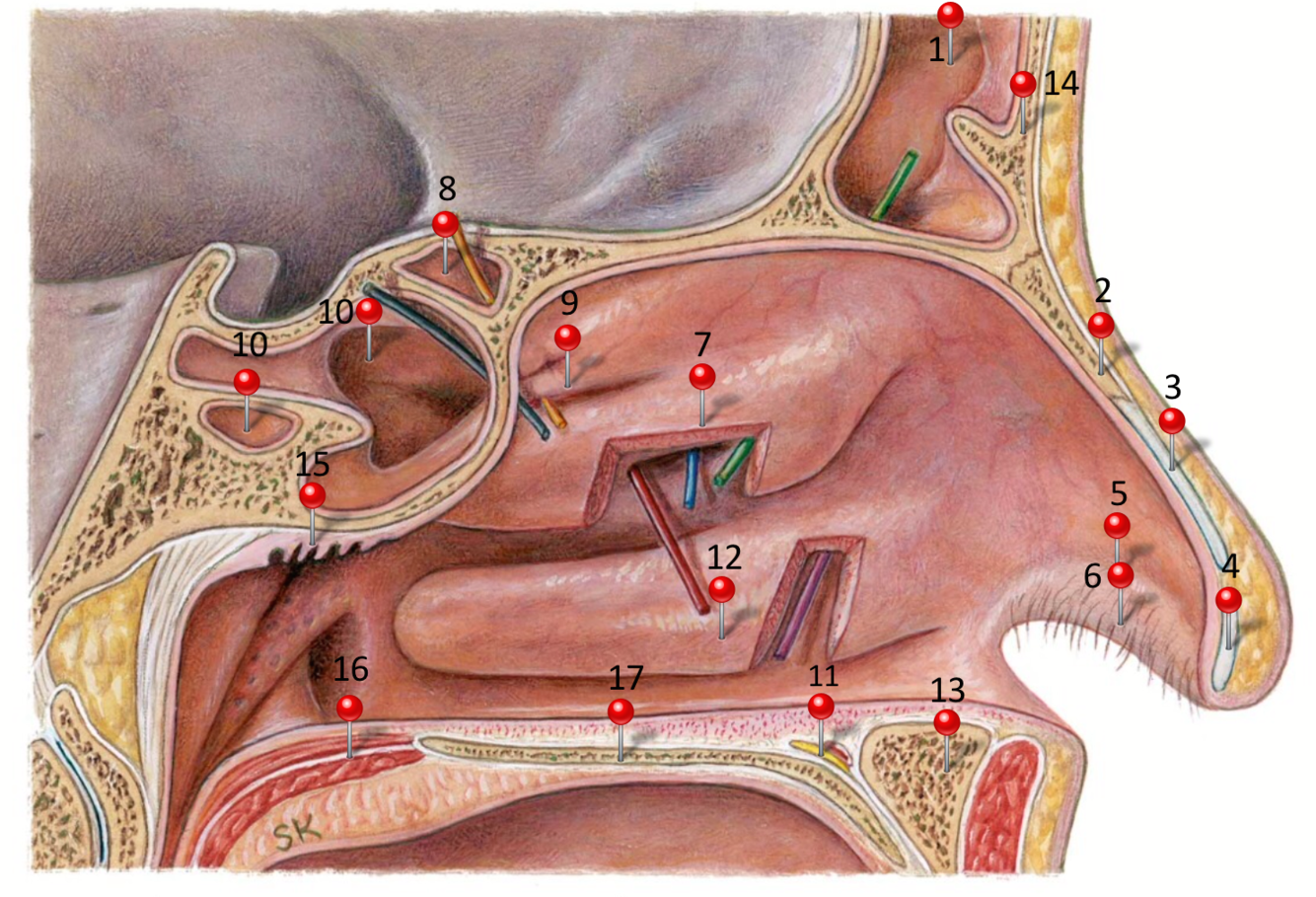
11) n. nasopalatinus
12) concha nasalis inferior
13) maxilla
14) os frontale
15) tonsilla pharyngea
16) palatum molle
17) palatum durum
Label the access routes to the 3 nasal meatus.
Which structure is located posteriorly behind the superior nasal meatus?
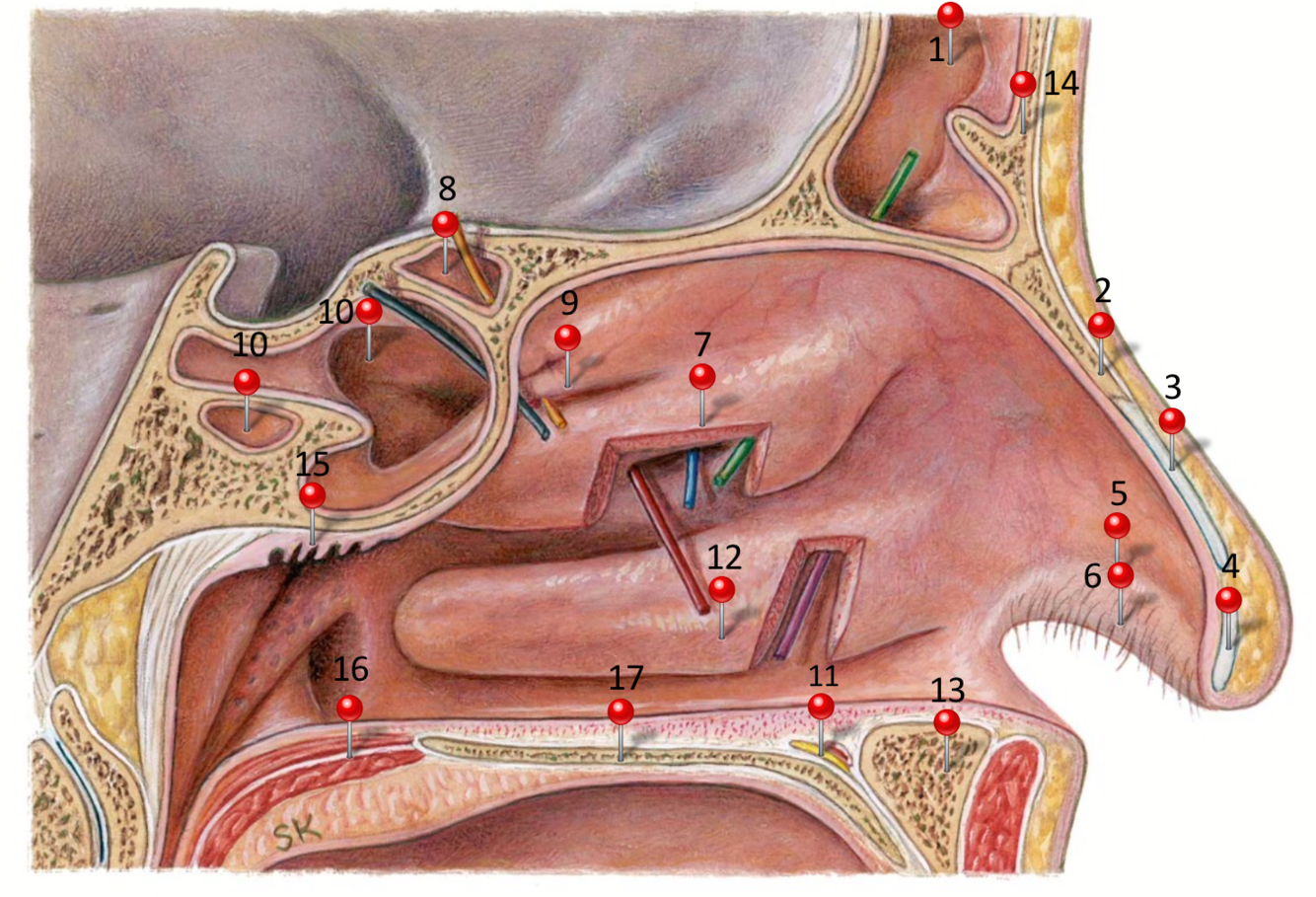
⇒ olfactory organ
- dark blue**: sinus sphenoidalis
meatus nasi superior
- yellow: post. ethmoidal air cells
meatus nasi medius
- green: sinus frontalis
- light blue: ant. + med. ethmoidal air cells
- red: sinus maxillaris
meatus nasi inferior
- purple: ductus nasolacrimalis
Which vessels supply, drain the nasal cavity, resp.?
Which nerves are responsible for the sensory innervation?
supply:
- ant. 1/3: a. ophthalmica → a. ethmoidalis
- post. 2/3: a. maxillaris → a. sphenopalatina (aa. nasales post. lateral. + rr. septales post.)
drainage:
- ant: v. facialis, vv. ethmoidales → v. ophthalmica sup.
- post: vv. ethmoidales → plexus pterygoideus
innervation: (cf. supply)
- sensory: n. trigeminus
- ant. 1/3: n. ophthalmicus
- post. 2/3: n. maxillaris
What is the most frequent site for epistaxis (= nose bleeding)?
plexus cavernosus conchae (= Kiesselbach’s plexus, locus Kiesselbachi, esp. a. sphenopalatina) on middle and inferior concha
Explain how nasal sprays work.
- PNS → swelling of plexus cavernosus conchae
- SNS → detumescing of plexus cavernosus conchae
⇒ nasal sprays bind to α-adrenoreceptors → activation of SNS → vasoconstriction
What are the 4 paranasal sinuses?
What is their function?
- cellulae ethmoidales
- sinus maxillaris
- sinus frontalis
- sinus sphenoidalis
⇒ lightweight construction of head + resonance to voice
What are the boundaries of sinus frontalis?
- ant. - post.
- roof - floor
- med.
Access route to nasal cavity via .. ?
- ant.: arcus superciliaris
- med.: septum
- roof + post.: anterior cranial fossa
- floor: orbit
⇒ can be accessed via meatus nasi med.
What are characteristics unique to ethmoidal air cells?
What are their boundaries?
- med. - lat.
- floor - roof
Access route to nasal cavity via .. ?
can be grouped into ant./med./post. ethmoidal air cells
⇒ biggest: bulla ethmoidalis
BORDERS
- medially: upper part of nasal cavity
- laterally: orbit
- roof: anterior cranial fossa
- floor: maxillary sinus
⇒ can be accessed via meatus nasi sup./med.
What are the boundaries of sinus maxillaris?
- roof - floor
- dorsal - ventral
- med.
Why are they clinically relevant?
Access route to nasal cavity via .. ?
biggest paranasal sinus (12 - 15 ml)
- roof: orbita
- ventrally: facial surface of maxilla
- dorsally: tuber maxillae
- medially: nasal cavity
- floor: dental arch of maxilla ⇒ inflammation can cause toothache, ALSO: extraction of teeth can cause infection of sinus max.
⇒ can be accessed via meatus nasi med.
Any characteristics unique to sinus sphenoidalis?
What are its boundaries?
- vent. - caud.
- lat.
Why are they clinically important?
Access route to nasal cavity via .. ?
divided into right and left sinuisoidal sinus by a septum
- anteriorly: ethmoidal air cells, canalis opticus
- posteriorly: fossa hypophysialis ⇒ used for access to pituitary gland in case of tumors
- laterally: sulcus caroticus (a. carotis int., sinus cavernosus)
⇒ can be accessed via rec. sphenoethmoidalis
On which vertebral level can we find the larynx?
Where does it open into?
- newborns: C2-4
- adults: C5-7 (in men lower than in women)
⇒ opens into hypgopharynx AKA laryngopharynx
What are the 2 main functions of the larynx?
closure of lower airways during swallowing
larynx retracted below corpus adiposum preepiglotticum
phonation
- closure + tension of vocal folds
- expirational pressure → vibration of vocal folds
- pitch depends on tension of vocal folds:
the more tense, the higher the tone - loudness depends on volume + velocity of exhaled air
1 - 5
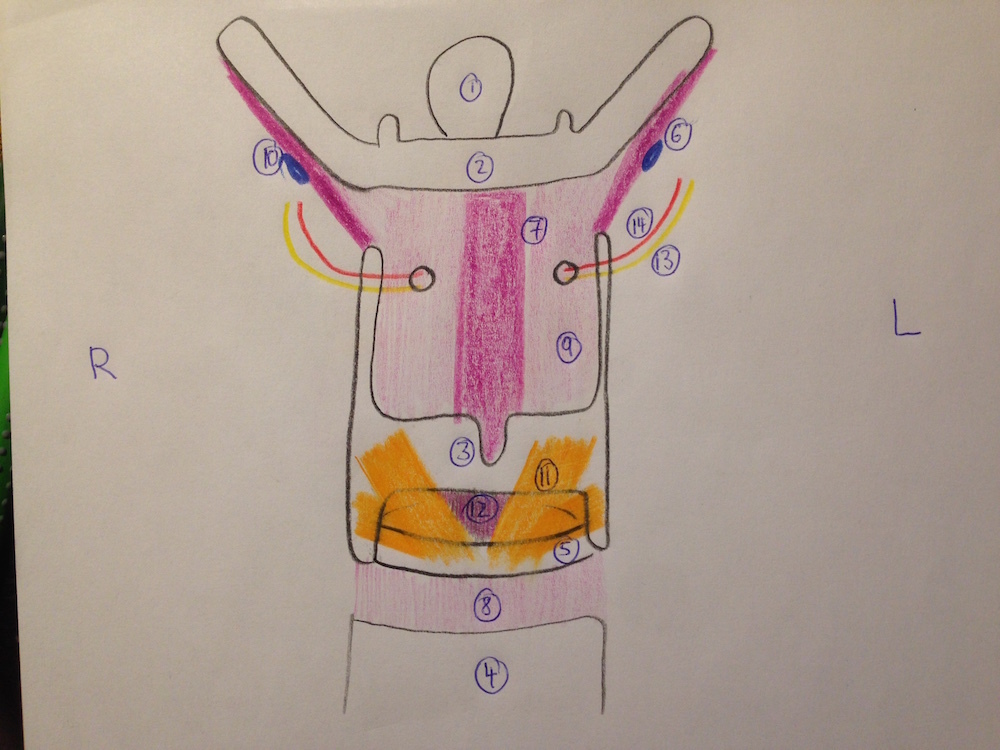
1) epiglottis
2) hyoid bone
3) cartilago thryoidea
4) trachea
5) arcus cart. cricoideae
6 - 10
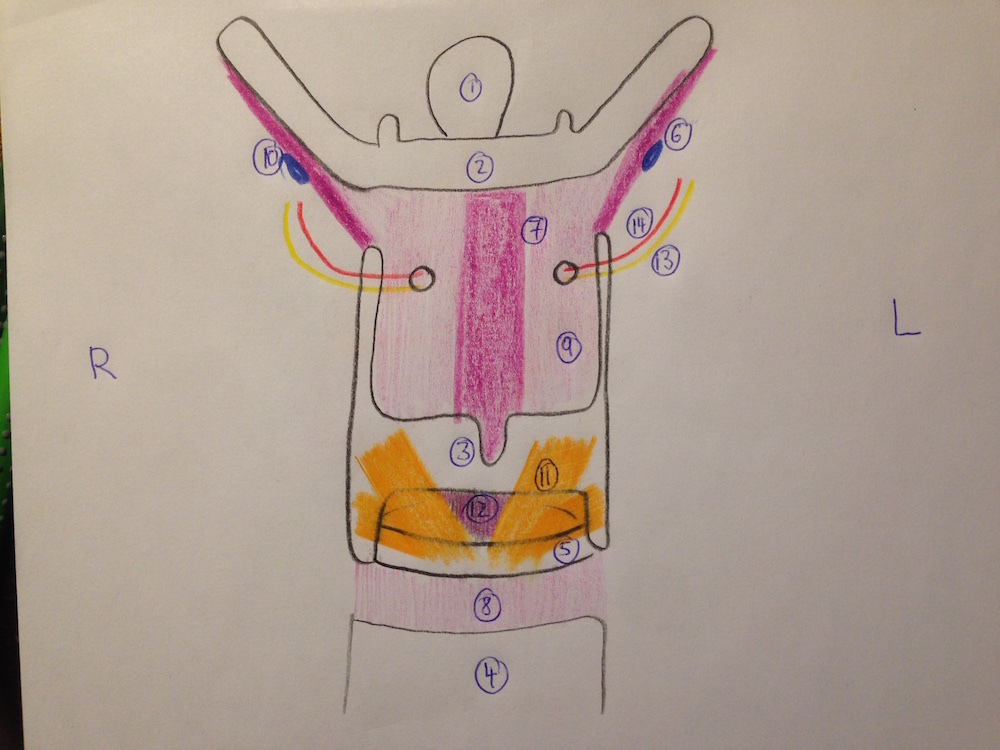
6) lig. thyrohyoideum lat.
7) lig. thyrohyoideum medianum
8) lig. cricotracheale
9) membrana thyrohyoidea
10) cart. triticea
11 - 14
What are the 2 parts of #11?
Another name for #12.
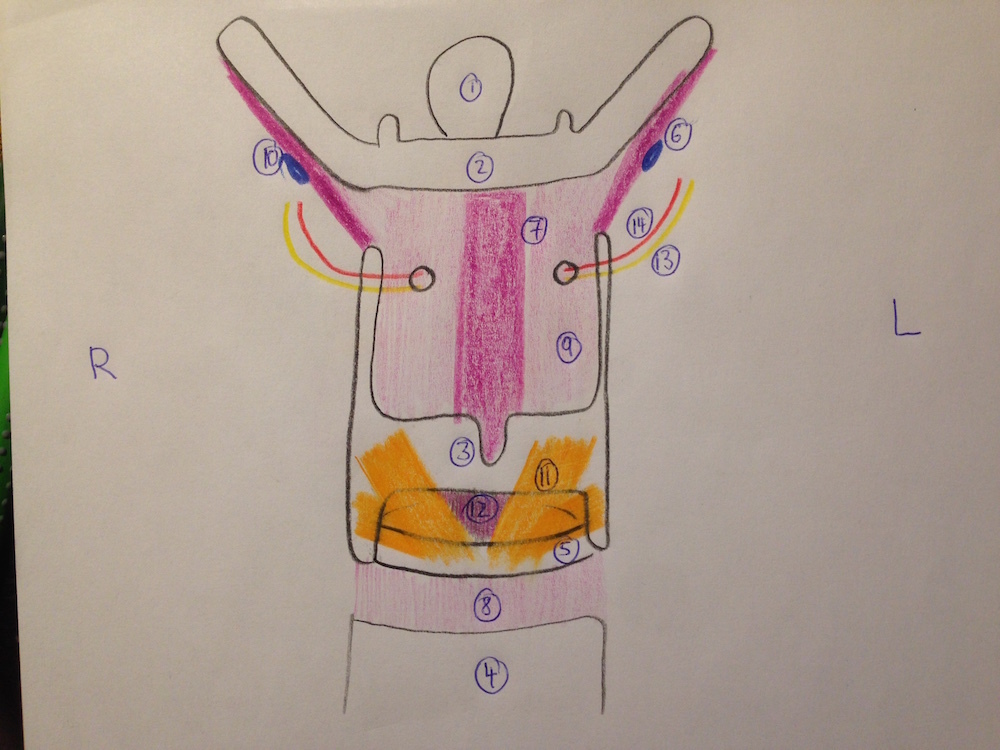
11) m. cricothyorideus (pars recta + pars obliqua)
12) lig. cricothryoideum medianum (= lig. conicum)
13) n. laryngeus sup. r. int.
14) a. laryngea sup.
1 - 5
Another name for #4.
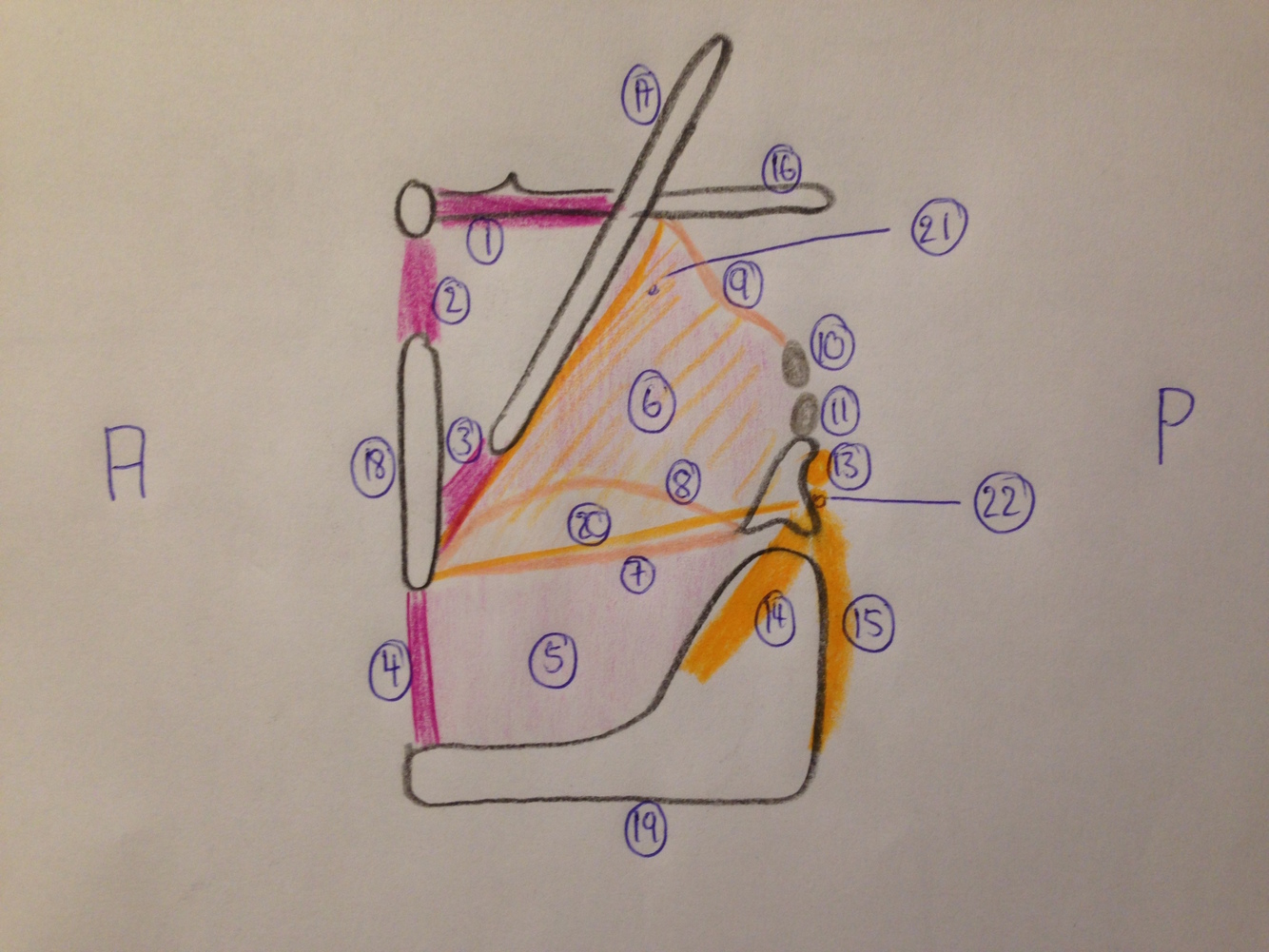
1) lig. hyoepiglotticum
2) lig. thyrohyoideum medianum
3) lig. thyroepiglotticum
4) lig. cricothryoideum medianum (= lig. conicum)
5) membrana triangularis




- right hand: 3 fingers (1st) + 2 fingers (2nd) = 5 fingers (3rd)
- left: 9 (total) - right hand (1st) = 4 (2nd)



