Which conditions are most favorable for survival of A. caninum larvae?
Above freezing
Below 37 celcius
Clinical cases are most common in warm weather
How would you describe the eggs of A. caninum in fresh feces?
Oviparous (morula present)
Typical strongyle-type egg
Which stage of A. caninum is infective?
How long does it take for this stage to develop?
Sheathed L3
Egg to L3 takes 2-8 days
What is the prepatent period of A. caninum?
Swallowing: 16 days
Skin penetration: 30 days
Transmammary infection: 10-12 days
List the modes of infection for A. caninum
Ingestion of L3 in paratenic host
Skin penetration by L3
Transmammary
Transplacental (considered unimportant)
List the most likely migration pathway for Ancylostoma L3 based on the various modes of infection.
Skin penetration
- blood-lung migration
- trachea, coughed up, swallowed
- somatic migration, hypobiotic larvae
Ingestion
- mucosal migration
- emerge as adults in the gut lumen
Lactogenic
- direct development to adult in gut (has already undergone migration in the mother)
For what time period can Ancylostoma larvae be detected in the milk of a lactating female?
20 days post-whelping
Where do hypobiotic Ancylostoma larvae live in the host?
Muscles (from somatic migration)
Small intestine mucosa
Define “larval leak” as applied to Ancylostoma infections
In persistent infections, hypobiotic larvae are continually reactivated and find their way to the small intestinal lumen.
- If the lumen is populated by adults, the larvae will probably pass in the feces.
- If no hookworms are present, they will develop into adults.
- If adult hookworms are killed by an anthelmintic, the larvae can quickly repopulate the gut.
Describe the pathogenesis of hookworm infections.
Blood sucking activity
- Attach to a mucosal plug and macerate with teeth
- Secrete proteolytic enzymes and anticoagulant
- Lesions continue to bleed after worms move to new sites
When you see a puppy with severe anemia, what should your first differential be?
Hookworm infection
Describe the anemia that results from hookworm infections
Initially normocytic normochromic
Progresses to microcytic hypochromic over time due to iron deficiency
Describe the factors that influence the severity of hookworm infections.
Dosage of infecting L3’s
Age of host, immunity of host
Iron reserves (low in puppies)
Nutritional status
Stress factors, infections
Position of Jupiter. What you had for breakfast that morning. [JUST KIDDING PLEASE DON’T KILL ME JOSE]
List the clinical signs associated with canine hookworm infection.
Anemia
- pale mucous membranes, decreased stamina, increased CRT
Melena
Unthrifty appearance
Respiratory signs, pneumonia
- Larval migration through lungs
Dermatitis, usually interdigital
- Inflammation as a reaction to L3 skin penetration
List the 4 clinical syndromes of canine hookworm disease
Peracute neonatal ancylostomiasis
Acute ancylostomiasis
Compensated ancylostomiasis
Decompensated ancylostomiasis
Describe peracute ancylostomiasis
Result of lactogenic transmission from the dam
- 50-100 adults can be fatal
- Signs
- appear healthy first week, crash by second week
- Worms suck blood as immature adults (may not see eggs)
- Often fatal by 10-24 days of age
In the case of a peracute Ancylostoma infection, when will adults begin to lay eggs?
16 days (prepatent period)
THIS IS IMPORTANT
Puppies may be showing severe clinical signs (anemia, diarrhea, severe weakness), but you may not be able to detect eggs.
Describe acute ancylostomiasis
Older pups acquires a large number of L3 in a short period of time.
Signs: normocytic, normochromic anemia, melena, weakness.
Will see strongyle-type eggs in feces.
Will often die unless promptly treated.
Describe compensated ancylostomiasis
Chronic condition
Mature dogs with low number of hookworms
Asymptomatic unless stressed
Low to moderate numbers of strongyle-type eggs in feces
Describe decompensated ancylostomiasis
- Occurs in mature, usually malnourished dogs
- Moderate number of eggs + many worms
- Will see melena, and may develop diarrhea
- Thin, rough hair coat
- Can be fatal
What are the lesions associated with LARVAL hookworms?
- Skin penetration
- erythematous papular or vesicular skin rash
- Tracheal migration
- petechial to ecchymotic hemorrhages in the lungs
What are the symptoms associated with ADULT hookworms?
Multifocal hemorrhagic enteritis
Generalized pallor
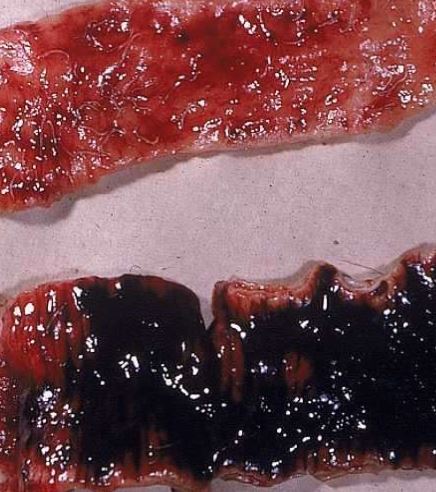
What is the ONLY basis for antemortem diagnosis of peracute neonatal ancylostomiasis?
Signalment and clinical signs
Recall that in peracute infections, the patient will not yet be shedding eggs. Prompt treatment is important, or the patient may die.
Describe the treatment for peracute neonatal ancylostomiasis.
Anthelmintics
Supportive care, including blood transfusions and CO2.
Poor prognosis.






