What is immunopathogenesis? Give some examples
Pathologies following infection caused by immune reactions rather than pathogen replication Viral bronchiolitis, Septic Shock
What is viral bronchiolitis?
Inflammation of the bronchioles following viral infection
What are the aetiological agents of viral bronchiolitis?
–Respiratory syncytial virus (Paramyxoviridae)
–Rhinovirus (Picornaviridae)
–Influenza virus (Orthomyxoviridae)
–Human metapneumovirus (Paramyxoviridae)
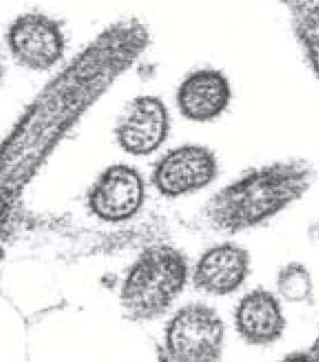
Describe RSV on an electronmicrograph
Long filamentous
Smaller
Who is at particular risk of severe disease as a result of RSV?
The frail elderly
Infants
The immunocompromised
– Prophylactic monoclondal antibody given to high risk infants (bronchopulmonary dysplasia; <32 weeks gestation; congenital heart disease)
What is the disease burden of RSV wordwide?
Why?
64million infections per year and 160, 000 deaths
No vaccine or specific therapeutic
What are the risk factors for severe disease (caused by RSV) in infants?
- Prematurity (born more than 4 weeks early)
- Chronic lung disease or congenital heart disease
- Low birth weight
- Child care or day care attendance
- School-age brothers and sisters at home
- Crowded living conditions
- Multiple births (twins, triplets)
- Family history of asthma
- Exposure to tobacco smoke or other environmental air pollutants
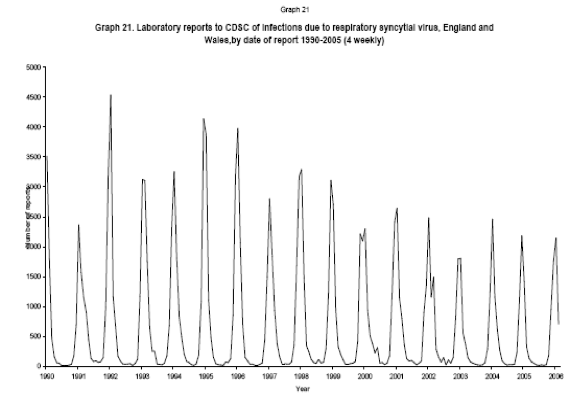
When is there a peak in RSV infections?
In WINTER - Nov, Dec, Jan
What are some RSV - induced diseases?
Descending infection
- Rhinitis
- Otitis media
- Tracheobronchitis
- Bronchiolitis
- Pneumonia
- Asthma
B+P = 25-40% during first infection
What is the pathology of Bronchiolitis and pneumonia?
–Necrosis and sloughing of small airway epithelium
–Oedema
– Increased mucus secretion (Obstructs airflow in small airways)
–Interstitial infiltration
–Alveolar filling
In Bronchiolitis - the airway becomes obstructed due to swelling of the bronchiole walls
What are the clnical implications of Bronchiolitis and Pneumonia?
- Hyperinflation
- Atelectasis
- Wheezing
What is the pathogenesis of RSV?
Virus replication triggers immune response in lungs
- Cytokine/chemokine release
- Infiltration of
- neutrophils
- lymphocytes
- eosinophils
- Prevascular and peribronchiolar cuffing (blood vessel is surrounded by cells that are trying to get out into the lungs)
- Trapping of air in lower lungs (lung hyperinflation)
- Once the immune response is triggered, removal of the RSV will NOT stop the pathogenesis
Nb most of the damage is caused by the immune response
What are the principal infiltrates in an RSV infection?
Neutrophils
Lymphocytes
Eosinophils
(Disease is immune-mediated)
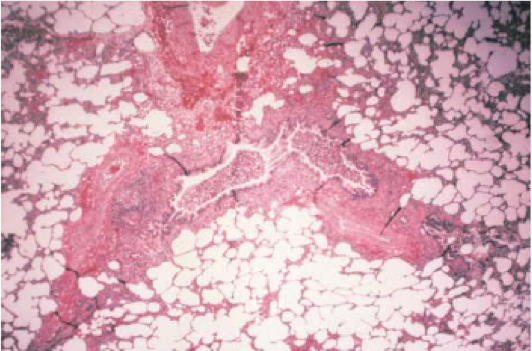
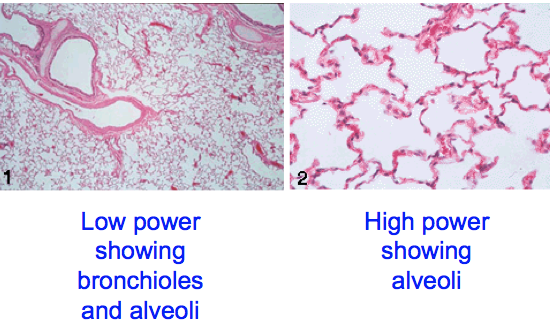
Describe the histology of a normal lung
Single layer of cells around alveoli
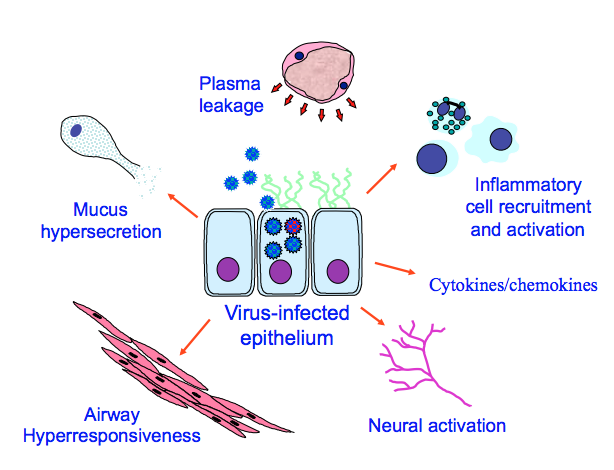
Describe the mechanism of RSV-induced airway inflammation
- Virus infected epithelium
- Cytokines and Chemokines
- Inflammatory cell recruitment
- Neural Activation
- Airway hyperresponsiveness
- Mucous hypersecretion
- Plasma Leakage
This viral replication triggers intracellular signaling pathways that lead to increased secretion of multiple cytokines (tumor necrosis factor-alpha, granulocyte colony-stimulating factor, and interferon-gamma [IFN-g]), and chemokines (interleukin-8 [IL-8] and RANTES), and also to increased expression of adhesion molecules
These chemokines and cytokines are increased in airway secretions during viral infections. Their actions are thought to involve recruitment and activation of the inflammatory cells (neutrophils, eosinophils, and activated T cells) that have been linked to asthma exacerbations. Neutrophils are the main cells found in nasal and lower airway secretions during acute viral infections, and increases in blood and nasal neutrophils correlate with cold and asthma symptom scores and cold-induced changes in airway hyperresponsiveness.
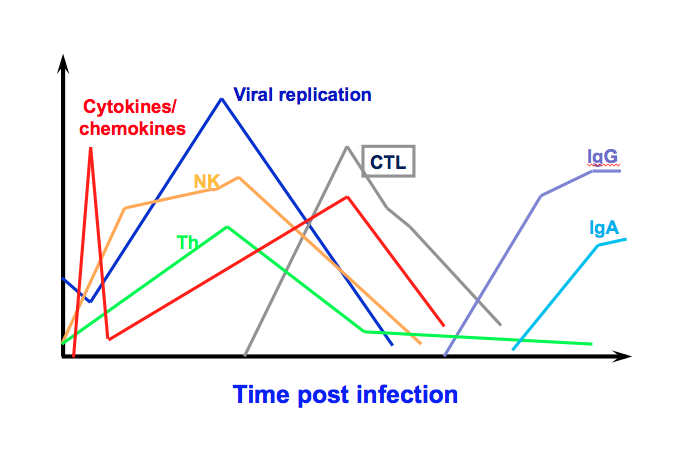
Outline the primary immune responses in terms of cell level to RSV infection
Intially: Cytokines/Chemokines - show a later peak which is indicitive of invading leucocytes releasing cyto/chemokines
Then: Viral Replication, NK cells, Th cells, CTL cells
Lastly: IgG, IgA (much less important role in primary infection than the innate immune system)
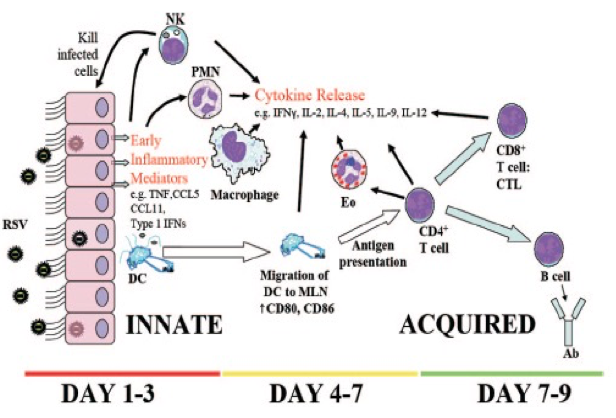
What are the primary immune responses to RSV infection over the first 9 days?
Day 1-3
- Early inflammatory mediators (TNF, CCL5, CCL11, T1 IFNs)
- NK and DC and macrophages
Day 4-7
- Cytokine Release (IFNgamma, IL-2, IL-4,5,9,12)
- Migration of DCs and antigen presentation to CD4+ cell
Day 7-9
Acquired immune response - B cell
What is Sepsis?
The presence of SIRS associated with a confirmed infectious process.
What is SIRS?
Systemic inflammatory response syndrome
At least 2 of the following symptoms:
- Temperature >38ºC or <36ºC
- Heart rate >90 beats/min
- Respiratory rate >20 breaths/min or PaCO2 of <32 mmHg
- White blood cell count >12,000 cells/mm3, <4000 cells/mm3, or >10% immature forms
What is Severe Sepsis?
Sepsis with either hypotension or systemic manifestations of hypoperfusion
•Lactic acidosis, oliguria, altered mental status
What is Septic Shock?
Sepsis with hypotension despite adequate fluid resuscitation, associated with hypoperfusion abnormalities
What is the burden of Sepsis in the UK?
–36,800 deaths/year
–2nd leading cause of death
What are the causes of septicaemia in a previously healthy adult?
- Skin - Staphylococcus aureus and other Gram-positive cocci
- Urinary Tract - Escherichia coli and other aerobic Gram-negative rods
- Respiratory Tract - Streptococcus pneumoniae
- Gall Bladder or Bowel - Enterococcus faecalis, E. coli and other Gram-negative rods,
Bacteroides fragilis
- Pelvic organs - Neisseria gonorrhoeae, anaerobes
In normal conditions these don’t cause problems, only if they get into the bloodstream
What are the causes of septicaemia in hospitalized patients?
- Urinary catheter - Escherichia coli, Klebsiella spp., Proteus spp., Serratia spp., Pseudomonas spp.
- Intravenous Catheter - Staphylococcus aureus, Staph. epidermidis, Klebsiella spp., Pseudomonas spp., Candida albicans
- Peritoneal Catheter - Staph. epidermidis
- Post Surgery
- Wound Infection - Staph. aureus, E. coli, anaerobes(depending on site)
- Deep Infections - Depends on anatomical location
- Burns - Gram-positive cocci, Pseudomonas spp., Candida albicans
- Immunocompromised Patients - any of the above



-
I1 - Intro to Immunology70
-
I2 - Cell Mediated Immunity29
-
I3 - Innate Immunity48
-
I4 - Immunopathogenesis35
-
MB 5 - Diagnostic Techniques41
-
I5 Antibodies and the Humeral Response1
-
MB6 Antimicrobials 132
-
I6 Drivers of Inflammation and Immunodeficiency33
-
MB7 Antimicrobials 236
-
I7 Hypersensitivity and Autoimmunity27
-
MB 8 Respiratory Infections29
-
MB9 Gastrointestinal Infections 134
-
MB10 Urinary Tract Infections26
-
MB11 Gastrointestinal Infections 223
-
MB12 Sexually Transmitted Infections - Mucosal36
-
MB13 Sexually Transmitted Infections - BBVs36
-
MB14 Obstetric and Perinatal Infections35
-
MB15 CNS Infections50
-
SPR L1 Childhood Exanthems and Selected Skin Manifestations37
-
SPR L2 Infections of Muscles, Bones and Joints0
-
SPR L3 Infections of Skin, Soft Tissue, Muscle, Bone and Joints36
-
SPR L4 Intro to Clinical Genetics0
-
SPR L5 Fever of Unknown Origin26
-
SPR L6 Ethical Aspects of Clinical Genetics18
-
SPR L7 Healthcare Acquired Infections24
-
SPR L80
-
SPR L90
-
SPR L10 Genetic Testing and Genetic Counselling41
-
SPR L110
-
SPR L12 Infection Prevention and Control16
-
SPR L13 Vaccinations and Immunotherapy 127
-
SPR L14 Vector-bourne Infections and Zoonoses27
-
SPR L15 Vaccines and Immunotherapy 224
-
SPR L16 Infections in the Immunocompromised Host33
-
SPR L17 Genetics Module Overview13



