Immunisation
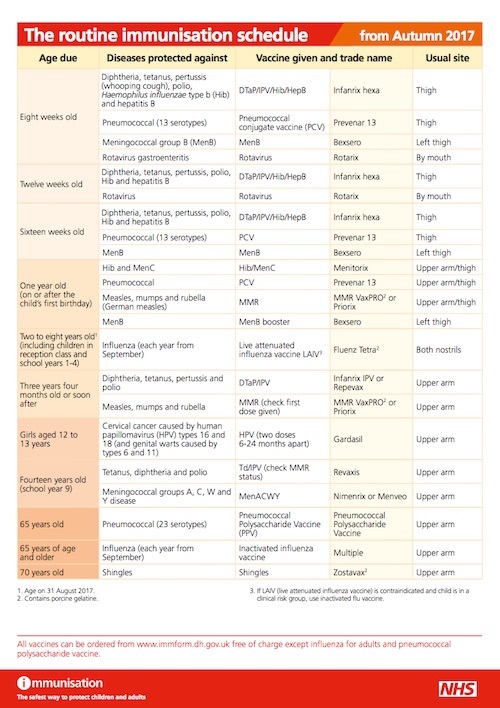
In the new born–
- BCG is given to infants at high risk of infection
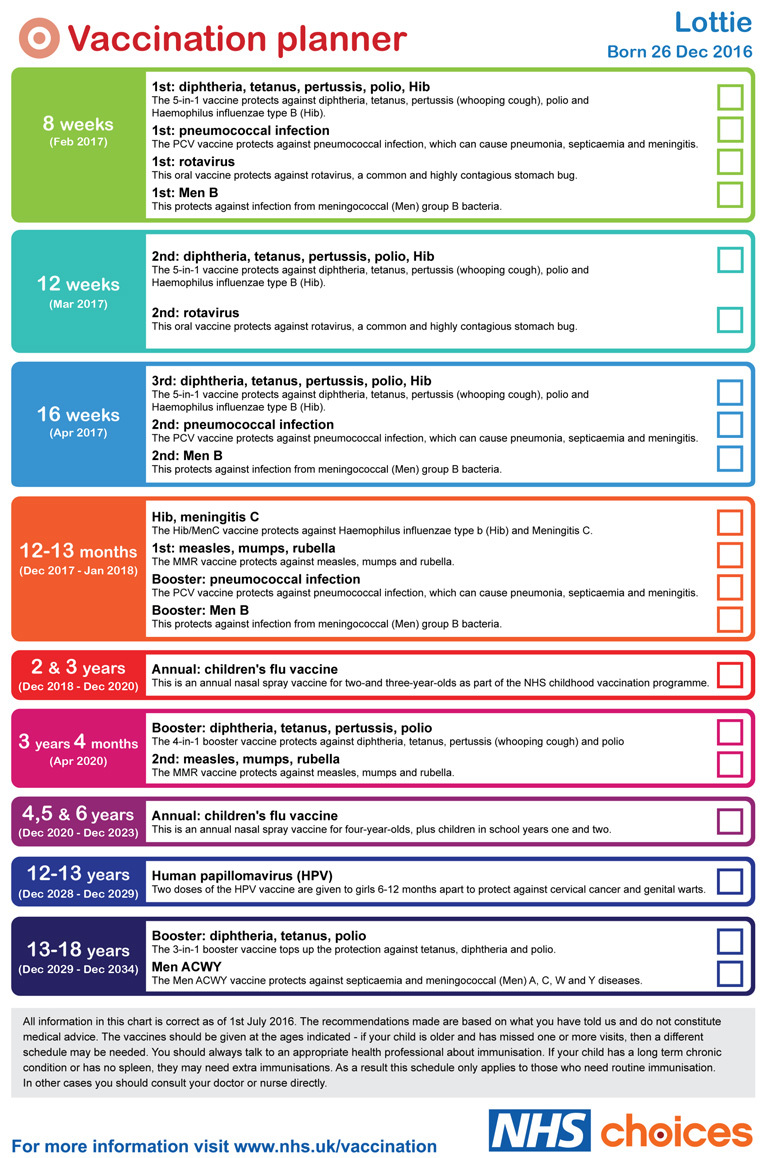
At 2, 3 and 4 months of age –
- the ‘5 in 1’ vaccine is given, against diphtheria, tetanus, pertussis, H. influenzae type b (Hib) and polio.
- The oral, live polio vaccine has been replaced by killed-vaccine given by injection, owing to the risk of vaccine-associated polio in unvaccinated family members or immune-deficient people following contact with gastrointestinal excretions of vaccine recipients
At 2, 4 and 13 months,
- the pneumococcal conjugate vaccine (PCV13) is given
At 3 and 4 months,
- the conjugate vaccine against group C meningococcus (MenC) is given by separate injection
At 12–13 months,
- a booster Hib vaccine is given, MenC and MMR (measles, mumps, rubella) is given
At 12–13 years of age,
- the human papillomavirus (HPV) vaccine is given to girls. The rubella vaccine is no longer given to adolescent girls.
BCG is no longer given to adolescents
Immunisation
Rationale behind the immunisation programme(1)
Diphtheria – infection causes local disease with membrane formation affecting the nose, pharynx or larynx or systemic disease with myocarditis and neurological manifestations. Immunisation has eradicated the disease in the UK
Pertussis – Huge decline in incidence with immunisation, but epidemics recur when immunisation rates fall
Haemophilus influenzae type b – causes invasive disease in young children The number of reports of infection dropped dramatically after the introduction of Hib vaccination
Poliovirus infection – Although most infected children are asymptomatic or have a mild illness, some develop aseptic meningitis and <1% develop paralytic polio
Meningococcal C – The marked fall in the number of reports in all age groups is shown in
Immunisation
Rationale behind the immunisation programme(2)
Pneumococcal vaccination –
- introduced into the immunisation programme in 2006. Prior to this, about 530 children under 2 years of age developed invasive pneumococcal disease in England and Wales each year
Human papillomavirus (HPV) vaccine –
- introduced in 2008. Provides protection against the two strains (HPV16 and 18) that cause 70% of cervical cancer.
- Three doses of vaccine are given over a 6-month period to all girls aged 12–13 years of age
BCG immunisation –
- although the number of notifications of TB is rising, it remains uncommon and mainly confined to high-risk populations
- BCG immunisation in the neonatal period is therefore targeted to those at increased risk
Hepatitis B and varicella vaccination –
- included in the immunisation programme in the USA and many other countries.
- in the UK, but may be given to the siblings of ‘at-risk’ children (e.g. those undergoing chemotherapy)
Immunisation
Complications and contraindications
- The MMR vaccine is only contraindicated in children with proven non-HIV-related immunodeficiency and those who are allergic to neomycin or kanamycin, which may be present in small quantities in the vaccine
- Children with a history of anaphylaxis to egg (the virus is grown in fibroblast cultures generated from chick embryos) should be immunised with MMR under medical supervision
- There is a 10% vaccine failure rate from primary vaccination with MMR at 12–13 months of age, but the proportion of susceptible school-age children in the UK has been reduced by the introduction of a preschool booster of MMR.

-
Paediatrics - History Taking8
-
Paediatrics - Respiratory Examination5
-
Paediatrics - Geeky Medics History16
-
Paediatrics - Cardiovascular Examination7
-
Pattern of child development5
-
Perinatal Medicine8
-
Maternal conditions affecting the fetus15
-
Routine examination of the newborn infant10
-
Neonatal medicine (1)26
-
Neonatal medicine (2)10
-
Growth and puberty17
-
Paediatric gastroenterology19
-
Paediatric rashes13
-
Malabsorption7
-
Infection and Immunity16
-
Common viral infections9
-
Uncommon viral infections5
-
Tuberculosis3
-
Malignant disease - Leukaemia4
-
Malignant disease - Brain tumours4
-
Malignant disease - Lymphomas7
-
Malignant disease- Neuroblastoma3
-
Malignant disease - Wilms tumour (nephroblastoma)6
-
HIV infection3
-
Lyme disease3
-
Immunisation4
-
Respiratory disorders - respiratory infections13
-
Cardiac Disorders - Epidemiology13
-
Cardiac Disorders - Right-to-left shunts10
-
Cardiac disorders - Outflow obstruction in the well child7
-
Kidney and urinary tract disorders - Assessment of the kidneys and urinary tract1
-
Kidney and urinary tract disorders - Congenital abnormalities1
-
Kidney and urinary tract disorders - UTI16
-
Kidney and urinary tract disorders - Hypertension1
-
Congenital Heart Disease (1)5
-
Congenital heart disease (2)7
-
Congenitlal heart disease - Coarctation of the aorta7
-
Aortic Valve Disease6
-
Transposition of the great arteries4



