5 Principles that form the foundation for successful practice?
- Process Matters
- Get in Early
- Follow Through
- Look Beyond First Costs to Long-term Savings
- Include and Collaborate
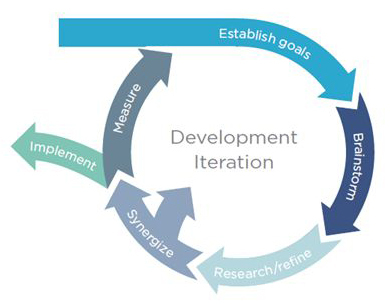
An iterative process is ___ and ___.
circular and repetative
What are the 6 steps to the Iterative Process?
- Establish Goals
- Brainstorm and develop creative solutions
- Research and refine ideas
- Explore synergies between specific strategies
- Establish metrics for measuring success
- Set new goals based on the work
What is a project champion?
the person within an organization implementing a project who takes on the burden of ensuring everyone involved is on board and behind the ultimate success of the project.
Qualities of an experienced facilitator?
- encourages people to voice their thoughts
- assists the team in expressing new ideas and ensuring that varying perspectives are valued
- brings group to explore how proposals either achieve or hinder the project goals
____ are an important tool in an iterative process.
Charrettes
Stakeholders
More than just decision-makers and includes those who must live with the decisions and those who must carry them out. (ie building owner, developer, client, design team members, facility managers, community representatives, local regulatory agencies, local environmental groups, tenants, and other building users).
What characteristics of a charrette are different from other forms of meetings?
Aspects of brainstorming, different perspectives, and focus.
Typical Charette Agenda?
- Background briefing of basic info
- Brainstorming, usu in small groups, or reports
- Synthesis of work, recommendations and identification of deliverables
- Initial response from owner/developer to the recommendations
- Follow up written report documentation of the charette and action items sent to all participants
Team Meetings
where the group works together on new synergies; ideally with members of different specialties (ie architect, civil engineer, lanscaper, structural engineer, etc).
More effective when facilitated by a neutral party who encourages all team members to speak up.
Small Task Groups
groups that explore particular topics, conduct research and refine ideas for presentation at a later team meeting.
- generally existing team members but can also be outside experts
- do not need to be multidisciplinary unless appropriate for the task
- investigating high-risk ideas can be the most innovative aspect of a project
Stakeholder Meetings
held with neighbors, community members and others with a vested interest in the project. They add the value of knowing the local context, culture and history as well as knowing the strengths and needs of the community.
The team process favors a ____ or ____ contracting process rather than the traditional design-bid-build.
Design-build or IPD
this enables team members to participate from the early project stages
Ideally, evaluation of bids is based on the ___ bid rather than the lowest bid.
best low
Clear goals help articulate what the project will be designed to accomplish, by:
- making sure that the vision is ___
- Providing a frame of reference for the ____
- Defining the ____ targets and keeping the project on track to meet them
clear
whole project
sustainability
goals need to be accompanied by ___ and ___
(Things that can be measured and levels of achievement that should be reached)
metrics / targets
note: metrics & targets can be quantitative and/or qualitative.
Effective goals must be ___.
Goals should reflect the ___ scales and ___ horizons.
achievable
spatial / time
( a project can only affect its surroundings relative to its own space/time constraints)
___ thinking and ___ principles encourage setting goals that go beyond deciding to seek specific LEED credits or specific certification level.
systems / integrative
Setting goals ___ selecting a location for the project ensures that the location contributes to the overall project plan.
before
Geographical information systems (GIS) illustrate what kind of overlapping information?
soils, infrastructure, shade, wind patterns, species distribution, land uses, demographics, roads and transit routes, traffic patterns, walkways and barriers, material flows and solid waste pathways.
- When systems thinking is applied to sustainable design, it is often necessary to consider information beyond ___.
- Even if the system is evaluated using a complex computer model, the best solution may depend on the team’s ___, ____ & ____.
- When deciding between two alternatives, the project team must ask whether there is a ___ ___.
- Sustainable design means finding not only the measures that perform best in a model but also the solutions that will perform best over the ___ of the project.
- cost
- goals, metrics & targets
- third option (or 4th or 5th…) - finding solutions means being creative
- life
For existing building projects, the evaluation process should take the following steps:
- Set ___
- Benchmark ____
- Identify ___ opportunities
- Prioritize and align improvement with the project ___
- Implement the ___
- Measure ___ and undergo 3rd party verification
- Set revised or new ___
- goals
- performance
- improvement
- goals
- program
- performance
- goals
Value engineering
formal review based on the project’s intended function and conducted to identify alternatives that reduce costs and improve performance.
Any value engineering must keep the big picture in mind and include all stakeholders so that decisions support the project goals.
Construction activity pollution prevention plan
addresses measures to prevent erosion, sedimentation and discharges of potential pollutants to water bodies and wetlands.

-
EPG: Chapter 1 - Becoming a LEED Green Associate21
-
EPG: Chapter 2 - The Test Process9
-
EPG: Chapter 3 - LEED v4 Core Concepts and Themes48
-
EPG: Chapter 4 - Overview and USGBC and LEED73
-
EPG: Chapter 5 - Location and Transportation51
-
EPG: Chapter 6 - Sustainable Sites43
-
EPG: Chapter 7 - Water Efficiency52
-
EPG: Chapter 8 - Energy and Atmosphere67
-
EPG: Chapter 9 - Materials and Resources55
-
EPG: Chapter 10 - Indoor Environmental Quality46
-
EPG: Chapter 11 - Innovation and Regional Priority4
-
EPG: Chapter 12 - Primary References0
-
LCCG: Section 127
-
LCCG: Section 221
-
LCCG: Section 334
-
LCCG: Section 460
-
LCCG: Section 525
-
RG BD+C: Intro (pages 1-18)25
-
RG BD+C: MPR (pages 27-30)7
-
RG BD+C: Rating System (pages 33-35)21
-
RG BD+C: Credit Overview (pages 35-68)36
-
Standards to memorize for exam11
-
Memorization for LEED v4 BD+C Project Checklist17



