Transformation Process
Consists of:
- Informal
- Work
- Formal
- People
tools the organization uses to convert inputs into outputs
Formal Organization
Explicit, codified systems and structures
Formalization
Extent of written rules, procedures, and instructions
Structure
Formalized patterns of interactions that link a firm’s people and tasks/jobs
Structure provides the means of balancing conflicting demands for specialization and integration
Formalization: How much? What kind?
- Production order information is communicated to the production line:
The order information is quickly incorporated into the production line - Timely production:
Efficiency producing vehicles with different specifications one at a time in a timely manner while ensuring high quality - Replacement of parts used:
Only those parts that have been used up are retrieved in a timely manner - Production of parts retrieved:
Efficiently producing and replenishing only those parts that have been retrieved
Semi formalization: creativity process
- Problem
- Understand
- Define
- Ideate
- Prototype + Test
Formalization helps innovation if?
- It captures learning from previous experiences
Memory, for not reinventing wheels - Enables people to understand how “the system” works
Transparency, why am I doing this? - Helps to coordinate large scale projects
Who does what and when?
Motivational advantages in formalization
Advantages:
- Self-efficacy (belief in ability to succeed)
- Decrease in role ambiguity (clarity)
Disadvantages:
- Loss of autonomy
Elements of structure
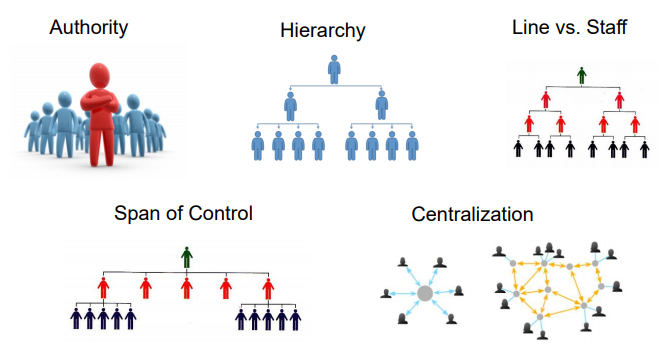
Types of structure
- Simple
- Functional
- Divisional
- Matrix
Simple structure
When is it useful
- Young/ small organizations
Characteristics
- Highly informal
- Little task specialization
- Centralized decision-making
- Coordination of task by direct supervisor
- Informal evaluation and reward system
- Staff are basically an extension of the top execs personality
Functional structure
Advantages
- High centralization = coordination and control
- Efficient use of managerial and technical talent
Disadvantages
- Possible silo thinking (e.g. functions vs. whole org)
- Difficult to set uniform performance standards
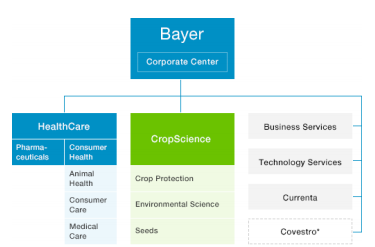
Divisional structure
Advantages
- Separation of strategic and operating control
- Development of general management
Disadvantages
- Can be very expensive (duplication)
- Can create a dysfunctional competition among divisions
- Differences in image and quality across divisions
Matrix Structure
Advantages
- Specialized personnel, equipment and facilities
- Broader range of responsibility & experiences
Disadvantages
- Can cause uncertainty and intensive power struggles
- Working relationships become more complicated
- Decisions may take longer - higher admin costs
What drives stucture? Environment
Stable environment:
- Focus on efficiency
- Favors centralized, taller structures
Turbulent environment
- Focus on flexibility
- Favors decentralized, flatter structures
What drives structure? Strategy
Cost leadership strategy
- favors efficiency
- favors a centralized, taller organizational structure
Differentiation strategy
- favors flexibility
- favors a decentralized, flatter organizational structure
Takeaways structure
- Structures are devices to focus the attention and efforts of organizational members
- There needs to be a fit between the organizational structures, strategy, environment
- Balances separation and integration
- Change structure as organization evolves
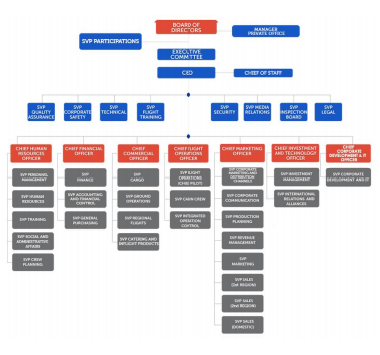
Real organizational chart
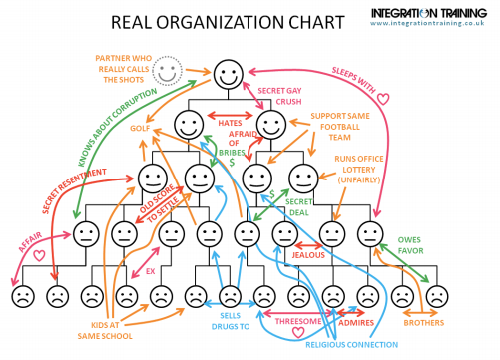
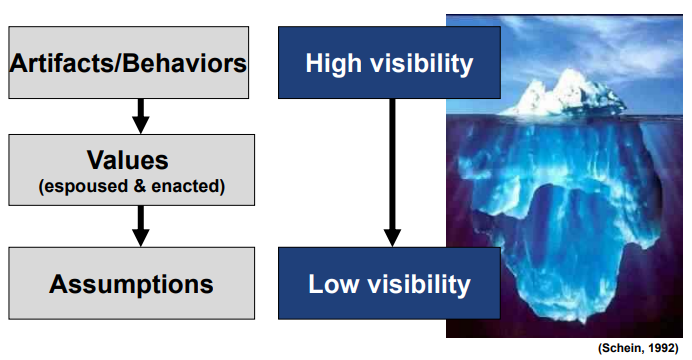
Informal organization: culture
Definition: a system of shared values and benefits that shape a company’s people, structures, and control system to produce behavioral norms
This system is “taken-for-granted” in organization and is taught to new members as the correct way to think, feel and behave
Many organizations have clear dominant culture, but subcultures and countercultures are also common
The elements of “strong” cultures:
- Charismatic leaders/heroes
- Clear vision/direction
- Shared norms/values
- Ritual and ceremony