Structures of the eye
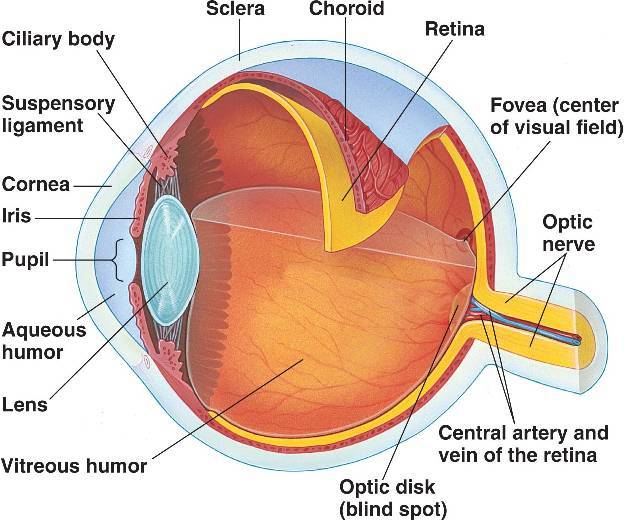
The cornea, anterior chamber, lens and posterior (vitreous) chamber are considered to be dioptrics of the eye, that lead to the optical media. What is their main feature
Transparent, so light can reach the retina.
Light passes through the cornea –> AC –> pupil –> crystalline lens –> VC –> to reach retina
Trajectory of light rays
- We see the reflected light
- Light refelcted initially diverge, and become more parallel as they travel
- Light rays from >6m are regarded as parallel
- Light rays need to be focused so that we can see an object clearly
Lenses of the eye
Cornea - 1st spherical lens of the eyes
- It is the main lens (2/3 of the total refracting power)
Crystalline lens - 2nd lens
Also the iris, which controls pupil, acts as a constricting diaphragm to restrict overall light and stops peripheral rays of light that can’t be focused clearly
The cornea
- On average it is 12 mm wide
- Avascular
- Rich bed of nerve fibre endings
- The epithelial layer is thin, but this layer can also regenerate rapidly when damaged (~24 hours)
Anterior Chamber
- It is fulled with a clear fluid (aqueous humour)
- It’s secreted, flows and drains
- This fluid nourishes the cornea and lens, and provide structure to the eye
The iris
- The colour of the iris is created by the presence of melanin. The darker the melanin the more melanin present.
- The iris controls light levels inside the eye
- The pupil acts as a central aperture
- When the sphincter muscle of the iris contracts, the pupil becomes smaller
- The dilator muscle runs through the iris, when it contracts, it helps dilate the pupil.
Crystalline lens
- Transparent
- Biconvex with the anterior portion less convex than the posterior
- Located behind the pupil and iris and in front of the vitreous humor
The lens
- If the light rays are close to you they will be diverging
- This means that the eye needs to expend more energy
- The intraocular lens is capable of altering its shape to do this
- It needs to be more convex in this case
Accommodation - Lens
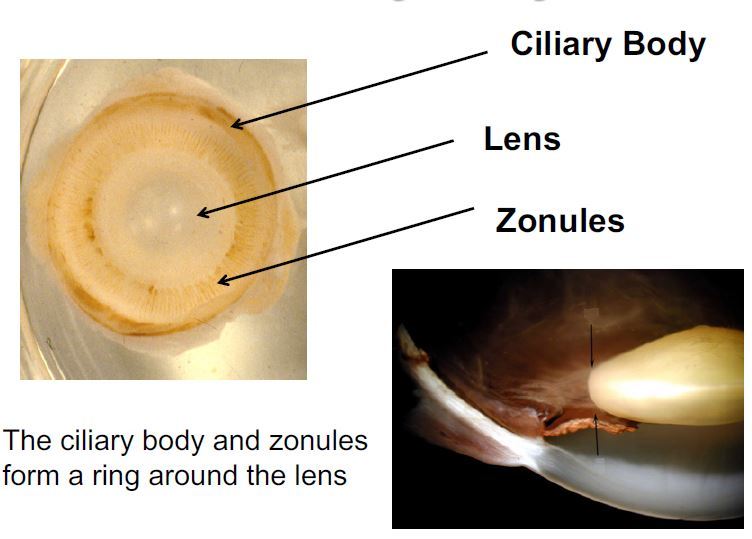
- The cililary body helps with accommodation
- It lies behind the iris
- It is also as sphincter and dilator muscles
- Processes on the ciliary body are attached to ligaments
- Known as zonules, which insert into the lens around its diameter
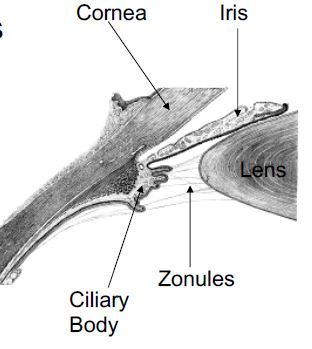
Draw a diagram of the ciliary body
Posterior chamber
- Located behind the ciliary body and lens and next to the retina
- It’s filled with a clear gelatinous substance known as vitreous humour
- It is in contact and adheres slightly to the retina
What is emmetropia?
The eye refracting light aberration-free, where there is no error of refraction in the eye is what is known as emmetropia. The optical power of the cornea and intra-ocular lens will bring the light rays entering the eye to a perfect focus on the fovea.
Two systems contributing to sight
The optical system - which transmits and focuses light
The sensory system - allows the detection and interpretation of light, including the transmission of visual signals
Retina’s function
The retina is a thin neural tissue. It converts light –> chemical –> electrical signals. The retina contains light sensitive cells (photoreceptors). They obtain pigments which absorb the light and convert it. Two types of photoreceptors (rods and cones)
The retina
- Starts behind the iris and wraps the whole back of the eye
- At its centre is the macular, central and darker (blood vessel free)
- In its centre is the fovea (responsible for best vision)
- To the nasal side is the ONH (optic nerve head), is oval and white, which is also known as the lind spot
Optic nerve - is pale in colour because the nerve fibres are surrounded by myelin




