What was the purpose of the FSMA 2000?
- Adopted a 3 pronged system consisting of the BoE, the Treasury and the FSA.
- It simplified and rationalised the regulatory system, whilst broadening its scope to ensure an appropriate level of protection.
- The Treasury had overall control of the new regulatory system and the FSA implemented it.
- It acted as enabling legislation, conferring broad powers to the FSA
The FSMA 2000 gave the FSA what?
Regulatory and supervisory authority over:
- Self regulatory organisations (SROs)
- Building Societies
- Registrar of Freindly Societies
- Insurance Directorate of the Treasury
The Financial Services Act 2012 made what changes to previous legislation?
- Made changes to the FSMA 2000, BoE Act 1998 and the Banking Act 2009
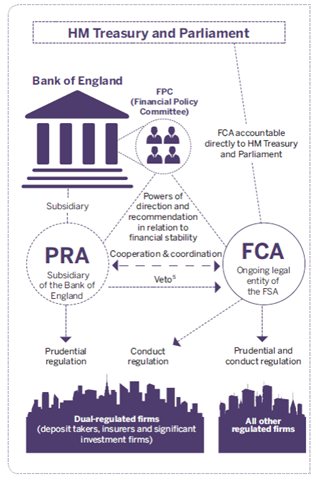
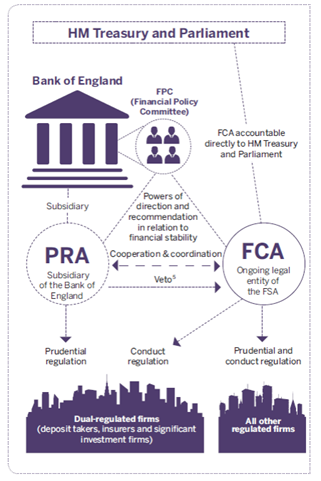
- The Financial Conduct Authority (FCA) took over non-prudential regulation of firms from the FSA
- The Prudential Regulation Authority (PRA) took repsonsibility for prudential regulation (achieving an appropriate balance between risk and reward) and authorisation of banks and investment firms that pose risks to the financial system stability.
The issue with the FSA was that it had to consider the safety and soundness of the financial system and worry about whether they were treating customers right. It wasn’t able to sufficiently focus on the latter. The two jobs conflict with each other - hence this was split into 2 authorities. The FSA was a soft touch regulator. The FCA will now talk directly to the bank CEO’s and ask where their areas of growth are so that the FCA can prepare. (MSE interview with Wheatly, head of FCA).
Who are now the key regulatory bodies?
- The Financial Policy Committee:
- Identifies, monitors and takes action to remove/reduce systemic risks in the UK financial system
- the fire prevention offices, not the brigade.
- The Prudential Regulatory Authority: responsible for prudent regulation of financial firms using a judgement-based approach: Prudential regulation imposes standards that require firms to control risks and hold adequate capital, with the goal of protecting the markets from the sort of meltdown that is currently under way.
- The FCA: responsible for promoting confidence in the financial system
- Regulates/supervises firms
- Protects consumers
- Ensures customers are treated fairly
- Enforces required behaviourial change
- Her Majesty’s Treasury: maintains control over spending and setting the direction of the UK economic policy
What are the FCA’s operational objectives?
- To secure an appropriate degree of protection for consumers
- To promote effective competition in the interests of consumers
- to protect and enhance the integrity of the UK financial system
What is the FCA Handbook?
- Incorporates a framework of rules which all financial service providers must abide by
- Sourcebooks set down more detailed rules that are legally-binding
- Manuals contain provisions relevant to the relationship between regulated firms and the FCA.
- Guidance: not legally binding
What are the FCA 11 Key Principles (PRIN) as laid out in the FCA Handbook, High Level Standards section?

- Integrity – conduct business with integrity
- Skill, care and diligence – conduct business with skill, care and diligence
- Management and control – organise and control the affairs of the business with adequate risk management systems
- Financial prudence – adequate financial resources must be maintained
- Market conduct – observe proper standards of market conduct
- Customer interests – pay due regard to interests of customer and treat them fairly
- Communication with clients – pay due regard to information needs of customer, and communicate clearly and fairly
- Conflicts of interest – manage fairly
- Customer relationship of trust – ensure suitability of advice
- Clients’ assets – provide adequate protection of assets
- Relations with regulators – deal with the regulator in an open and cooperative manner and disclosures must be made to the FCA with reasonable notice
What is the Banking Conduct of Business Sourcebook?
BCOBS regulates certain banking services. The regulations should be considered alongside the eleven high level principles (PRIN) that apply to all regulated firms and the rules set out in related legislation such as the Payment Services Directive.
What does the BCOBS lay out in relation to post-sale service?
- Service must be prompt, efficient and fair
- Customers must be treated fairly (specific references are made to the need to consider the order in which payments are processed and the requirement to deal with customers experiencing financial difficulties fairly)
- Requests to move to another provider must be treated promptly and fairly, including all the processes and formalities associated with terminating the service such as cancellation of electronic mandates
- Firms must assist customers to trace dormant accounts and obtain access to them
- If a customer denies having made a transaction, the onus is on the firm to prove that they have done so
- Where a customer claims that a transaction has not been properly executed, the burden of proof lies with the firm
- Where transactions have not been authorised, the firm must reinstate the account to the position that existed prior to the transaction within a reasonable time
- The maximum liability of the customer is £50 in respect of unauthorised transactions following loss or theft of a passbook, or failure to preserve the secrecy of personalised security features
- The liability of the customer may be greater if the loss is due to gross negligence on the part of the customer or fraud
- Except where deposits are made by paper cheque, the value date for calculating interest must be the date the funds are credited to the account of the firm, or the date of the reciept of cash (if this is in the same currency as the account)
- In relation to incorrect payment routing, it is up to the firm to take reasonable steps to recover the funds and any charge imposed for doing so must accurately reflect the costs
When did the Mortgage Conduct of Business (MCOB) come into effect?
What do they apply to?
What must be issued during the sales and application process?
- They came into effect in 2004
- They apply to:
- regulated mortgage contracts - loans by way of first legal mortgage to individuals or their relatives secured on residential land (where at least 40% of the property is used for residential purposes)
- regulated lifetimes mortgage contracts - these are mainly loans to older borrowers for equity release purposes, usually repayable on death of the borrower or sale of the property
- During the the sales and application process customers who are likely to do business with the firm must be issued with:
- an initial disclosure document (IDD) at the outset: specifies the level of service being offered. Precise wording must be used, e.g. early repayment charge for paying back the mortgage early. The advisor must help the customer understand the implications of taking out a mortgage for debt consolidation.
- A key facts illustration (KFI)
When is authorisation needed?
What functions need approval?

- Authorisation is mandatory by law to be able to offer financial services in the UK. Permission is granted by the FCA.
- Individuals must be approved by the FCA to perform one or more ‘controlled functions’ on behalf of an authorised firm. The individual must:
- Satisfy the regulator that he/she can meet and maintain the criteria for approval (‘the fit and proper test’)
- Perform the controlled function in a manner that is consistent with the statements of principle and code of practice for Approved Persons
The controlled functions are:
- Significant management functions
- FCA required functions
- Customer-dealing functions
What are regulated activities?
The new regulatory regime demands that those oocupying certain functions must be competent to do so. They include:
- Giving advice, dealing, arranging or managing investments on any form of investment previously regulated under the FSA 1986 including long-term assurance products, pensions, unit trusts, investment trust shares, open-ended investent company shares, company shares and loan capital, futures, options, warrants and swaps
- Advising, arranging, manageing or administering regulated mortgage contracts as defined in the MCOB rules
- Advising on general insurance contracts as defined in the Insurance Conduct of Business (ICOB) rules
What is Treating Customers Fairly?
In order to demonstrate that it is paying due regard to fair practices, regulated firms must consider the following outcomes identified by the FCA as critical to customers’ interests:
- OUTCOME 1: consumers can be confident that they are dealing with firms where the fair treatment of customers is central to the corporate culture
- OUTCOME 2: Products and services marketed and sold in the retail market are designed to meet the needs of identified consumer groups and are targeted accordingly
- OUTCOME 3: Consumers are provided with clear info and are kept appropriately informed before, during and after the point of sale
- OUTCOME 4: Where consumers receive advice, the advice is suitable and takes account of their circumstances
- OUTCOME 5: Consumers are provided with products that perform as firms have led them to expect, and the associated service is of an acceptable level.
- OUTCOME 6: Consumers do not face unreasonable post-sale barriers imposed by firms to change product, switch provider, submit a claim or make a complaint
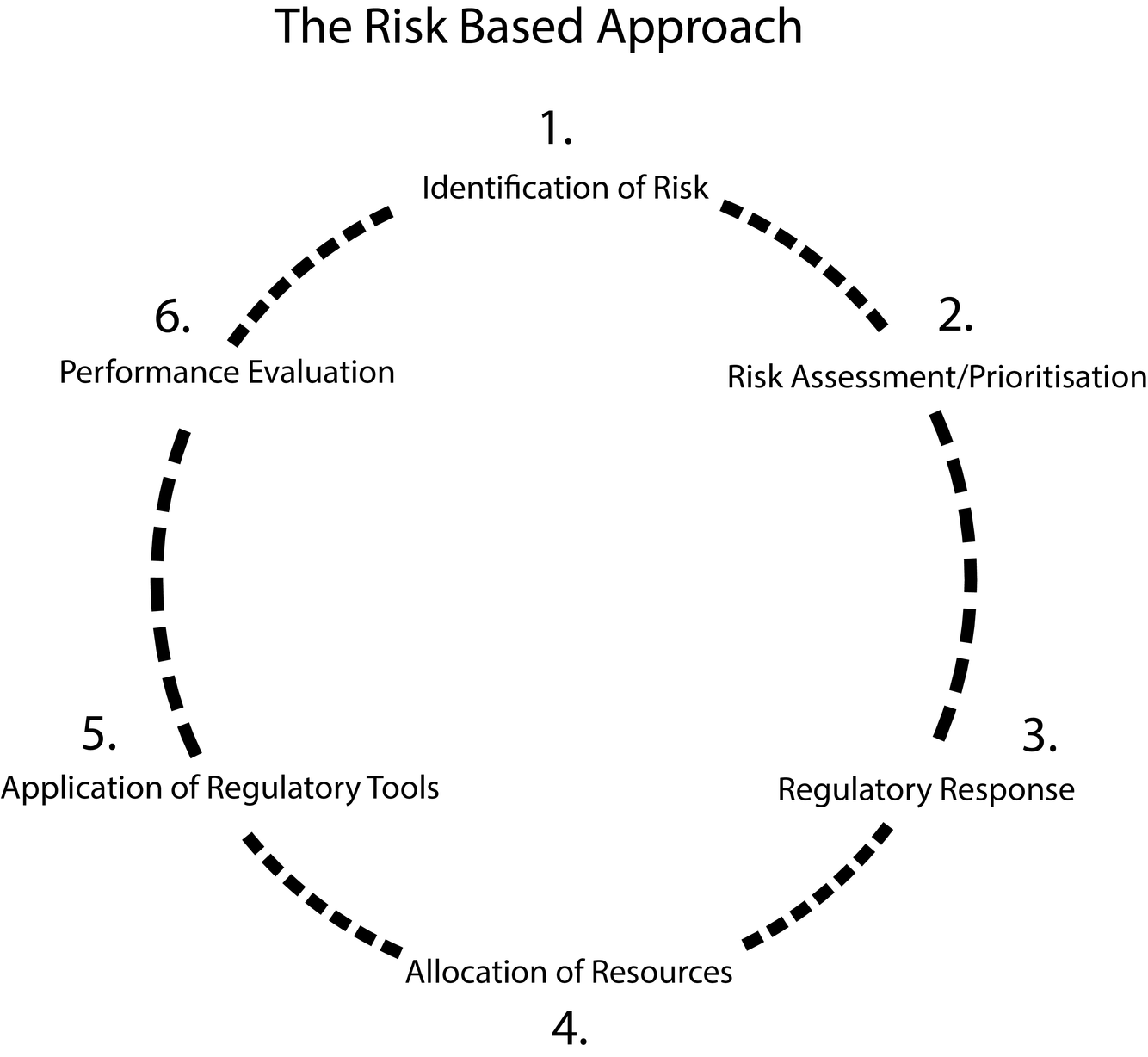
What is the FCA’s risk based approach to regulation and supervision?
What are the PRA’s statutory objectives?
- To promote the safety and soundness of firms
- Secure an appropriate degree of protection for policyholders and investors
What is the objective of the FPC?
The FPC’s objective is to identify, monitor and take action to remove or reduce systemic risks in the UK financial system with the aim of enhancing the resilience of the system

-
Retail Banking20
-
A Client Centered Approach26
-
A Client Centered Approach II17
-
Distribution channels and the impact of technology14
-
People, Processes and Risk13
-
People, Processes and Risk II11
-
Leadership and Management21
-
Leadership and Management II17
-
Legislation16
-
Legislation II12
-
Legislation III12



