When and how were viruses initially discovered?
Initially described as “des agents filtrables” by Ivanovsky in 1892
What are viruses?
An agent that can be filtered
An obligatory intracellular parasite —> dependant on the machinery of the host for replication
Cannot produce energy or proteins with a host cell
Viral genome made of DNA or RNA
Infectious agent —> composantes individuelles sont assemblées, donc qui ne se reproduit pas par division cellulaire
Fun facts about viruses: (6+3)
- Viruses are not living
- Viruses must infect other cells to stay alive
- Viruses must be able to use cellular machinery to produce its own components
- Viruses must encode for all necessary processes that are not “provided” by the host cell
- Viral components must be self-assembling
- Not all viruses can infect all cells or hosts
- They must be able to enter
- Once entered, the cell must have the machinery the virus needs to replicate
- Once replicated, the virus must be liberated from the cell to transmit the infection
Structure et composition de la particule virale (viron)
Measured in nanometers (nm)
Smallest (18nm —> parvovirus)
Biggest (300nm —> poxvirus)
Rule of thumb: bigger viron = larger genome —> can encode for more proteins
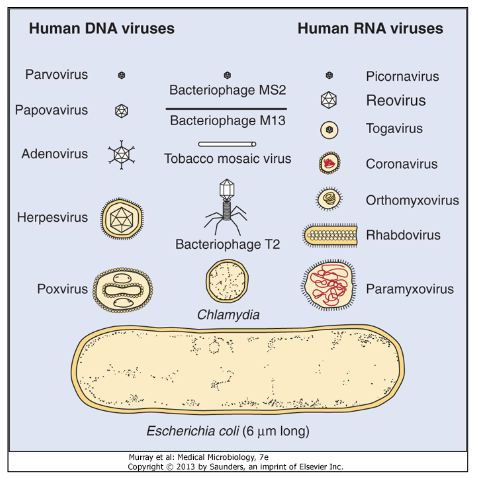
How is genetic information contained in a viron?
Genome (nucleic acid) covered by a protective layer of protein (capside)
Genome + capside = nucleocapside
(Icosahédrique, Hélicoïdale, Complexe)
All virons have a nucleocapside with or without an envelope
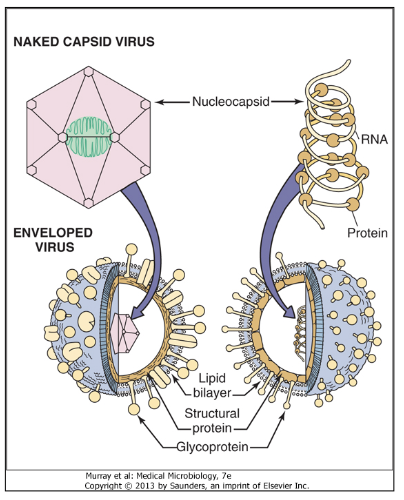
DNA vs RNA in virus:
DNA: single or double strand, linear or circular
RNA: single strand (positive polarity or negative),
- double stranded (reovirus) —> polarité+/–ou double sens
- Segmented or not
What are the capsid and enveloppe?
The outermost layer of a virus (either one or the other)
- Constitutes the structure, protection and transmission mechanism of the virus.
- The structures present on the surface of the capsid or envelope allow interaction between the virus and the host cell via a viral attachment protein (VAP) or other structure
If the outermost layer is destroyed —> the virus is inactivated
What is the capsid?
Made of proteins
Rigid structure capable of resisting unfavourable environmental conditions
Naked (non-enveloped) viruses are generally resistant to dryness, acidity, detergents, etc (including bile and acid in GI tract)
Symmetric (icosaédrique ou hélicoïdale) or asymétrique (complexe)
What is the capside isosahédrique?
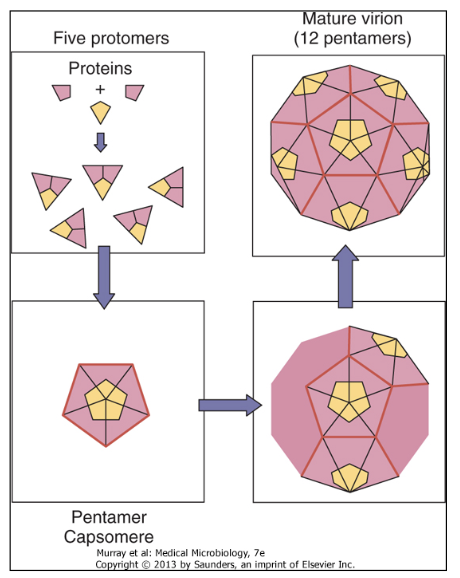
Les sous sous-unités protéiques virales s’unissent en protomères. Cinq protomères s’unissent pour former des capsomères (pentamères) qui s’assemblent en capside
Made of 12 capsomeres called pentamères/pentons
Information:
- The Icosahedral capsid resembles a sphere and is made up of an assembly of protein subunits.
- All the faces of the simple icosahedron are identical.
- The nucleic acid is contained in the centre of the capsid which protects it from the environment.
- Larger capsid virions are made by inserting capsomers (hexons) between the pentons.
- Ex: Herpes (12 pentons, 150 hexons), Adenovirus (12 pentons, 240 hexons)
What is the capside hélidoïdale?
The protein subunits interact with each other and with the nucleic acid to form a structure that resembles a hollow, rigid or flexible protein rod or cylinder
What is the enveloppe?
The envelope is a membrane composed of lipids, proteins and glycoproteins.
- Structure similar to cellular membranes.
- Viral glycoproteins are anchored to the envelope and project out of the surface of the virion, like spikes.
- Some act as viral attachment proteins (VAPs), capable of binding to target cells.
- Are major antigens that can elicit protective immunity
- Easily deactivated by environmental factors (dryness, acidity, detergents, solvents) —> survive in GI tract
- The structure of the envelope can only be maintained in an aqueous solution (must remain wet).
- These viruses are usually transmitted by fluids such as blood, respiratory droplets and tissue.
What are the two ways in which viruses can be classified?
- Nature of their genome:
- DNA or RNA
- Single or double stranded
- Segmented or not segmented
- Linear or circular
- Structure (morphology):
- Symmetry of the nucleocapsid (icosahédrique, hélicoïdale, complexe)
- Envelopped or not envelopped
- Number of capsomers
What is the international classification of DNA viruses?
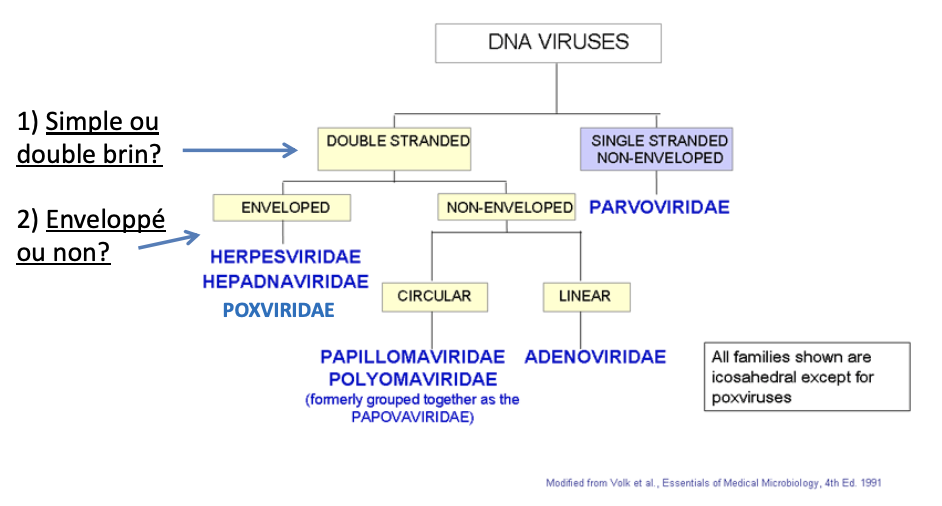
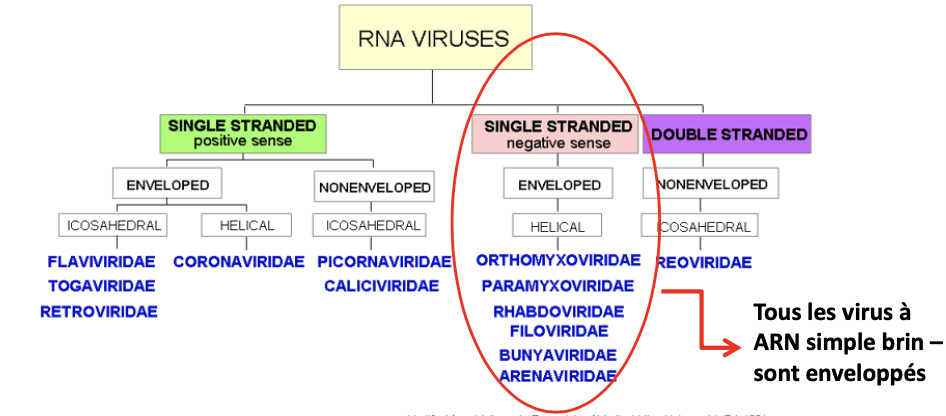
What is the international classification of RNA viruses?
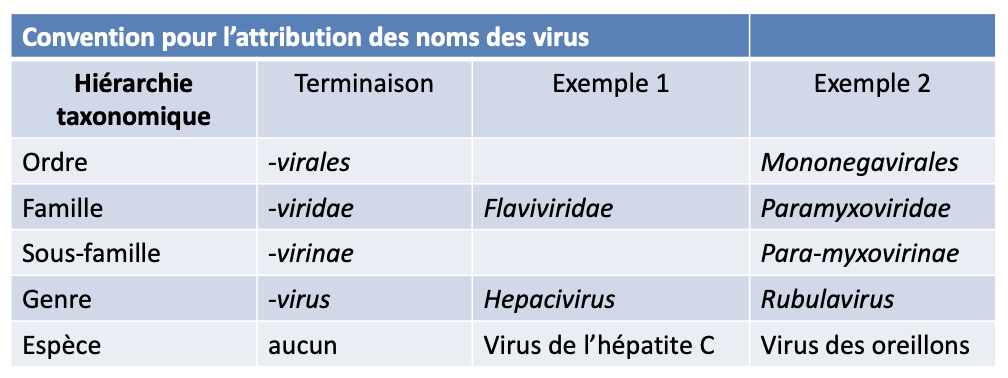
What is the convention for naming viruses?
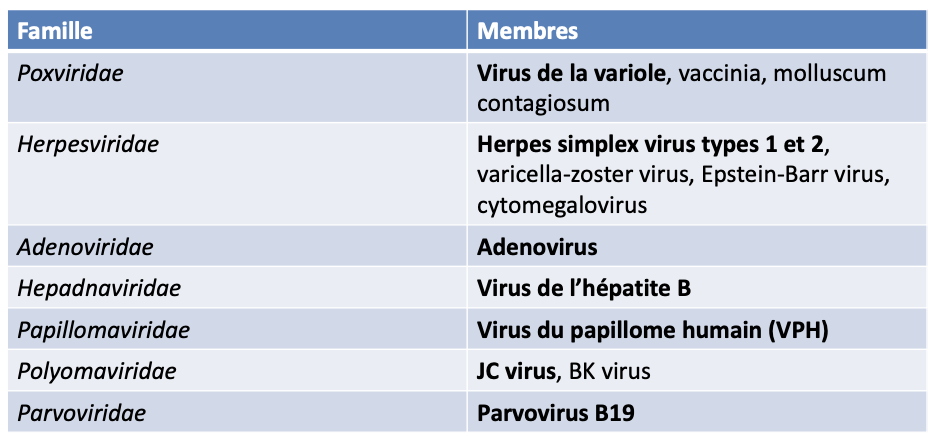
What are some important members of the DNA virus family?
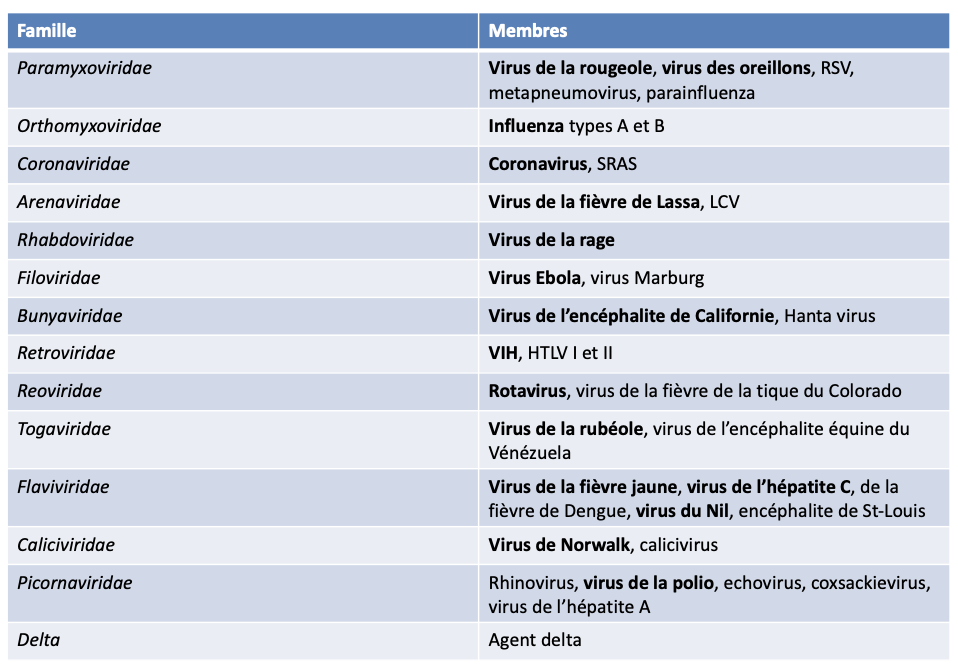
What are some important members of the RNA virus family?
Generalities about viral replication:
- The main stages of viral replication are the same from one virus to another
- The host cell acts as a factory, providing the substrates, energy and machinery necessary for viral protein synthesis and genome replication.
- What is not provided by the host cell must be encoded in the virus genome
What are the steps of viral replication? (8)
- Recognition of the target cell
- Attachment
- Entry into the cell through the plasma membrane
- Decapsidation
- Synthesis of viral constituents (viral multiplication)
- Synthesis of early mRNA and non-structural proteins
- Genome replication
- Synthesis of late mRNA and structural proteins
- Post-translation modification of the protein
- Virus assembly
- Budding of enveloped viruses
- Release of the virus from the host cell
Steps 1 and 2:
1) Reconnaissance et 2) attachement à la cellule cible
Examples of PAVs —> gp120 of HIV, HAgp of the virus
Examples of receptors —> CD4 and chemokine co-receptor on the “helper T-cell” T-lymphocytes for HIV and Sialic acid from epithelial cells for Influenza A
Step 3:
No envelope: endocytosis mediated by receptor
Enveloped: fusion of the membranes of the virus and the target cell (whether or not preceded by endocytosis), the nucleocapsid or viral genome is then released into the cytoplasm
Step 4:
Decapsidation
After internalization, the nucleocapsid arrives at the site of replication and breaks off.
- The DNA genome is usually transported to the nucleus (exception: poxvirus).
- The RNA genome usually remains in the cytoplasm (exceptions: orthomyxovirus and retrovirus).
Step 5:
La synthèse des constituants viraux (multiplication virale)
- Most DNA viruses use polymerases from the host cell to synthesize mRNA in the nucleus (exception: poxviruses).
- RNA viruses replicate in the cytoplasm (except for orthomyxoviruses and retroviruses) and must themselves encode the enzymes necessary for transcription and replication (the host cell does not have what it takes to replicate RNA)
- The cellular machinery necessary for mRNA transcription is located in the cell nucleus
Steps 6 and 7:
The site and mechanism of virus assembly depend on where replication has taken place and whether the final structure is that of a naked or enveloped virus.
- DNA viruses are assembled in the nucleus (except poxviruses).
- RNA viruses and poxviruses are assembled in the cytoplasm.
- Viral capsids can be assembled and then filled from the genome or can be assembled around the genome.
- The envelope is acquired during the budding of the virus.
- The ppt of RNA viruses budding from the plasma membrane without killing the cell
- Other viruses acquire their envelope from the endoplasmic reticulum and the Golgi apparatus.
- Errors are made during assembly and result in the formation of virions that are empty or contain a defective genome.

-
La fièvre39
-
Le Staphylococcus aureus40
-
Escherichia coli38
-
Les virus37
-
Introduction aux antibiotiques46
-
VIH-SIDA35
-
Les Zoonoses108
-
Les mycoses58
-
Introduction à la parasitologie médicale85
-
Principes de prévention des infections24
-
COURS 13.2 : Diagnostic laboratoire38
-
COURS 13.1 : Épidémiologie des maladies infectieuses19



