Pupil
The dark circle in the middle of the eye which lets light in.
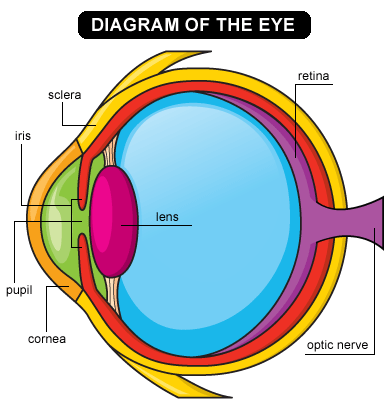
Eye Diagram
Pupil - The black dot in the middle of the eye which lets light in.
Iris - A ring of muscles that control the size of the pupil and the amount of light that is let in.
Retina - The back of the eye which has cones and rods, which receives the light.
Lens - A transparent lens that lets focuses light onto the retina.
Optical Nerve - The nerve that transmits the information of the image the eye sees to the brain.
Visible Light Spectrum
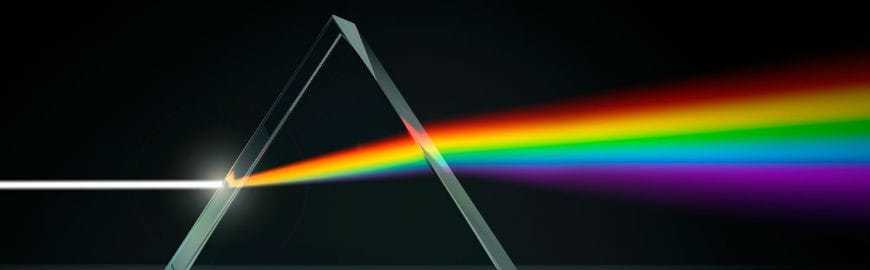
The order is red, orange, yellow, green, blue, indigo and violet.
- The parts of light that are reflected off an object give the object its colour!
- When we see things that are white, it means that those objects are reflecting all parts of the visible light spectrum.
- The opposite is happening when we see things that are black; it means that those objects are absorbing all parts of the visible light spectrum.
- The colour of an object also depends on the colour of the light source. Sunlight hitting an object will produce a colour that is different to a fluorescent bulb’s light.
- A fluorescent bulb has a greater amount of blue parts than sunlight, leading to objects looking colder under that light.
- Red has the lowest frequency of the colours while violet has the highest frequency.
- When passed through a prism, red would refract the least while violet the most.
- Colours with high frequencies have low energy while ones with low frequencies have high energy.
Transparent Objects
- Transparent objects allow light to pass through, so they do not have reflected parts of light for us to see as colour.
Translucent Objects
- Translucent objects will appear tinted a certain colour because they reflect a portion of the light that hits them.
- This kind of colour is determined by how much light is allowed through compared to how much is absorbed.
Light as a Wave
- Light is much more than something that happens when we flick a light switch. It is energy that travels as a wave called electromagnetic radiation.
- Electromagnetic radiation, or EMR, is a travelling energy that acts like a wave. It is not quite a wave, however.
- For example, EMR travels through the vacuum of space. Most waves need a medium to travel in - but not EMR. This is why you can see in space, even if no-one can hear you.
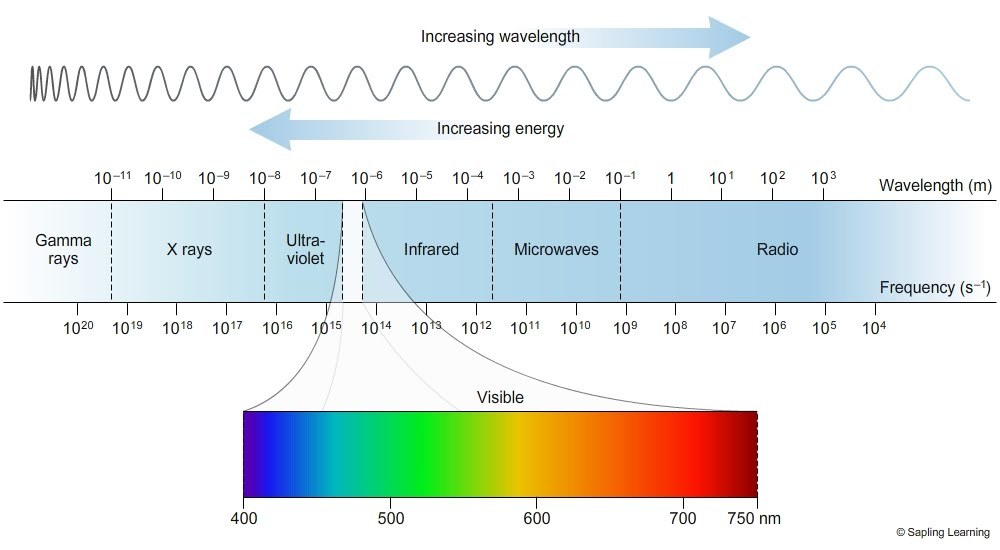
- Electromagnetic radiation exists on a spectrum of different types of wave.
- Light exists in the middle of this spectrum, and is defined as the wavelengths of electromagnetic radiation that we can see.
- Other types of EMR include infrared, microwaves, radio waves, ultraviolet, x-rays and gamma waves.
- Light, and all other EMR waves, are transverse waves, not longitudinal waves like sound.
This is because when light moves through a medium the energy vibrates at right angles to the direction that it is travelling in.
Ocean waves are also transverse waves!
- Light travels with a velocity, and has a frequency and wavelength.
- Light moves through space as a little parcel of energy, not needing to travel through particles like other waves do.
- Light travels at 3.0×10⁸m/s in a vacuum. This is the same as travelling 300,000 kilometres in one second.
- This is the speed limit of the universe. It is impossible for anything to travel faster than the speed of light!
- Light and the other EMR waves are the only things that can travel at this speed.
Transverse Waves
- Sound travels as a longitudinal wave - the particles of the medium vibrate in the direction of the wave’s movement.
Light waves travel as transverse waves - the particles of the medium vibrate at a right angle to the wave’s movement.
- A transverse wave wiggles up and down (or back and forth) as it moves forwards, much like a snake.
- The most well-known type of transverse wave is a water wave. The surface of the water bobs up and down as a wave moves forward from its point of origin.
- When the wave passes through a medium, none of the particles of the medium move forward - they just go up and down.
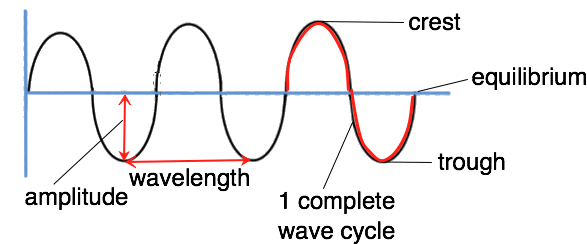
- The top of a wave is called the crest, and the bottom of the wave is called the trough.
- Half-way between the crest and trough is the equilibirum - this is where all parts of the wave would be if the system was at rest.
- The height of a crest from equilibrium is called the amplitude. This is also the distance from equilibrium to trough.
So the height of a wave is double the amplitude.
- The distance between two peaks or two troughs is the wavelength.
- A wave consists of many wavelengths. One complete wave cycle, from crest to crest, takes place over one wavelength.
- The frequency of a light wave is the number of crests that pass a certain point in one second.
Visible light has an extremely high frequency and a very short wavelength.
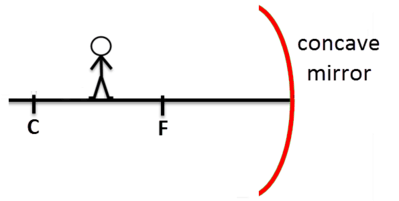
Standing with your feet between its centre of curvature and its focal point.
Image appears:
- Inverted
- Enlarged
- Real Image
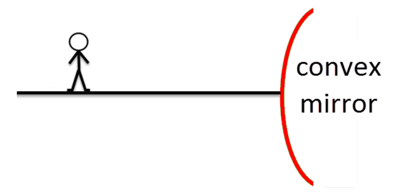
Standing in front of the mirror.
Image appears:
- Upright
- Diminished
- Virtual image
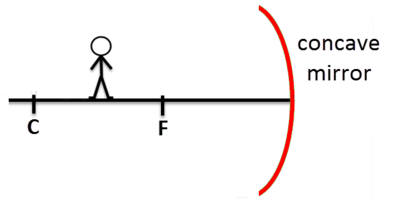
Standing with your feet between its centre of curvature and its focal point.
Image appears:
- Inverted
- Enlarged
- Real image
Law of Reflection
- A ray is a way of representing light as it travels in a straight line.
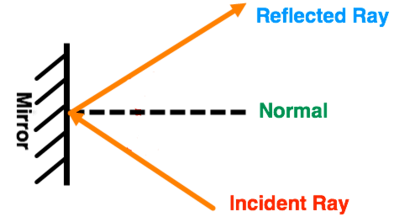
- When we talk about reflection, there are two important rays we need to know about. These are the incident rays and the reflected rays.
- A reflected ray is a ray that has been reflected from a mirror.
It is represented by an arrow that points away from the mirror.
- There is another important line called the normal.
This is a line drawn along the point where the incident ray hits the mirror and reflects away. It is usually used to help draw a reflection diagram.
The normal is always at a right angle (90∘) to the surface of the mirror.
- The angle of reflection is the angle between the reflected ray and the normal.
- The Law of Reflection states that the angle of reflection is equal to the angle of incidence.
This means that a light ray reflects off a mirror at the same angle that it hits the mirror at.
*
Nature of Images
- Several different types of image can be formed by a mirror or lens.
The image will be either:
real or virtual
enlarged or diminished
upright or inverted
- A real image is formed when the light rays actually cross.
- A virtual image is formed when the rays only appear to cross. Virtual images are formed when diverging rays are traced back to where they appear to cross.
- An image which is enlarged is bigger than the object.
A diminished image is smaller than the object.
We can see the size of the image by looking at the arrows representing the object and image. If the image arrow is longer it means the image is enlarged and vice versa.
- An image is upright if the image arrow is pointing up.
It is inverted if the image is pointing down. This means that the image is upside down.
- When we look in a plane mirror we see a virtual image.
This is a special type of image which is formed when the light rays do not actually cross. They only appear to cross.
In the mirror, it appears as if the object is behind the mirror even though the light is being reflected from the front. These images are not magnified. This means that the image is the same size as the object.
- The images formed in plane mirrors are upright.
It is also reversed sideways. This means that left and right are flipped over. This is called lateral inversion.
The distance from the image to the mirror is the same as the distance from the object to the mirror.
*
Lenses
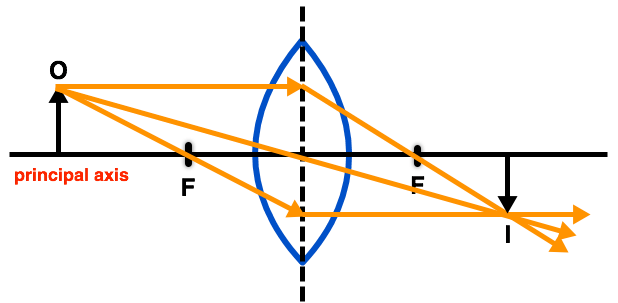
- We can also use lenses to form an image.
Convex lenses are used to converge parallel light rays. The point where parallel rays meet is called the focus.
An image is formed at the point where light rays meet.
- We use ray diagrams to work out where an image is formed.
We can also use them to figure out the nature of the image, such as if it is upright or inverted.
- We use three rays to work out where images form.
The first ray travels parallel to the principal axis and passes through the focus on the other side of the lens.
We use an arrow labelled with an “O” to show where the object is.
- The second ray goes from the object straight through the center of the lens.
- The third ray travels through the focus closest to the object and then travels parallel to the principal axis on the other side of the lens.
- Every lens has two foci; one on each side of the lens.
They are the same distance away from the middle of the lens, so you find one focus from the converging rays and use that to find how far away the other focus should be.
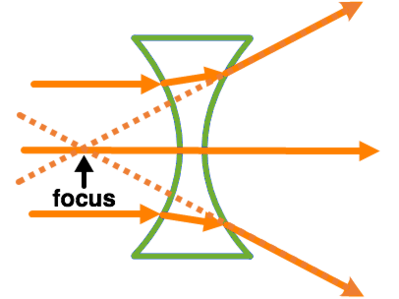
- In order to draw a ray diagram, you need to know where a lens’ focus is.
The focus is the point where parallel light rays converge.
- It is slightly harder to find the focus of a concave lens because the rays do not actually cross.
We need to trace the rays backward, behind the lens to find the point where they appear to cross.
Refraction
The medium that a light wave is traveling through affects the speed of that light wave.
This is because different media have different densities.
- In a vacuum, there are no particles, so light has a straight path from point to point.
This allows it to travel at the speed of light. It is not slowed down by particles getting in the way.
- Light in an object is more like someone running down a footpath that is packed with people.
They still travel at the same speed, but bouncing between people and moving in random directions means that overall they take a lot longer to get through.
Refraction
- Light traveling at different speeds in different media can have pretty major effects.
In particular, it causes a phenomenon called refraction to occur.
- Refraction is a bending of light rays.
It occurs when light travels from one medium into a medium with a different density.
The pencil in the picture below looks disjointed due to refraction.
- We can use a car to visualise how light rays bend when they are refracted.
Let’s imagine a car on concrete driving onto sand at an angle. The first wheel that touches the sand will slow down, while the rest of the car travels at the same speed.
With one wheel going slowly, the car will turn towards the slow wheel. This causes the car to change direction
- A similar thing happens when light rays travel into a different medium.
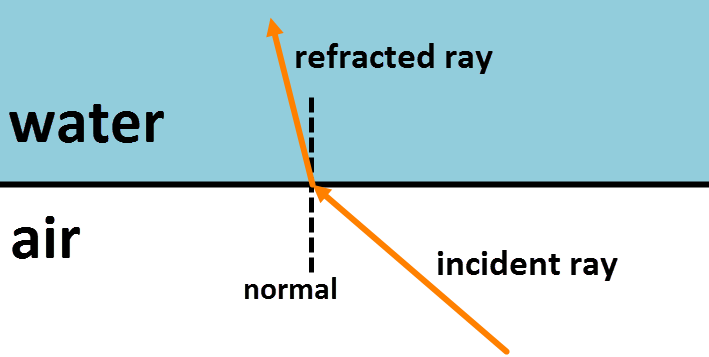
When a light ray travels into a denser medium, it will bend towards the normal.
This is because the light ray travels slower in the new medium.
- When a light ray travels into a less dense medium, it bends away from the normal.
This is because the ray travels faster in the new medium.
- The ray which approaches the place where two mediums meet is called the incident ray.
The ray which leaves is called the refracted ray.
*
Mirrors
- Concave mirrors make everything look HUGE.
- Convex mirrors make everything look SMALL.
- Concave mirrors produce REAL IMAGES.
- Convex & Plane mirrors produce VIRTUAL IMAGES.
- Virtual images cannot be projected onto a screen.
- Real images can be projected onto a screen.
Eye
- Rods detect light brightness.
- Cones detect colour.
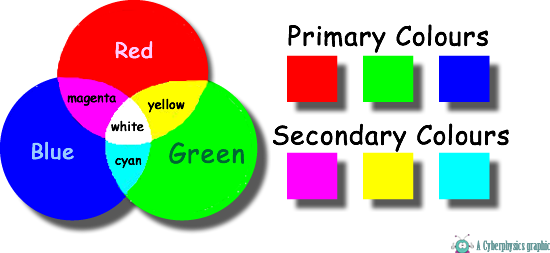
Secondary Colours