What is the limbic lobe?
The limbic lobe is part of the cortex and forms part of the limbic system
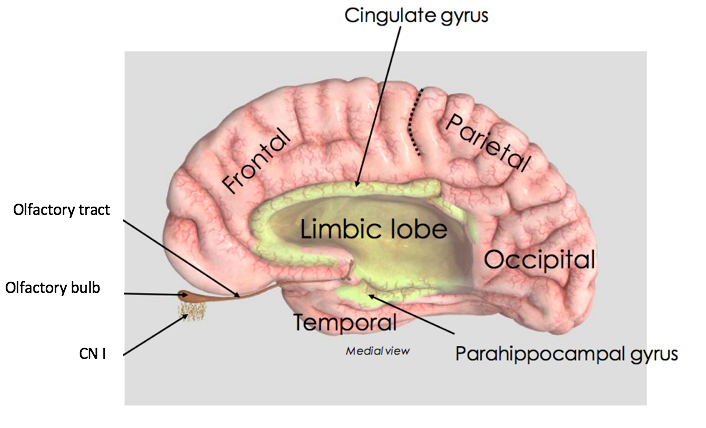
Location of CN I?
Nasal epithelium (olfactory mucosa)
Where is the olfactory bulb and tract outgrowths from?
Telencephalon
What is the only sensory system to bypass the thalamus?
Olfactory
The olfactory system is intimately invovled with the limbic system. How can this be seen?
Smell can trigger powerful emotions, memory and ANS responses
What does the limbic lobe consist of?
- Cingulate gyrus
- Parahippocampal gyrus
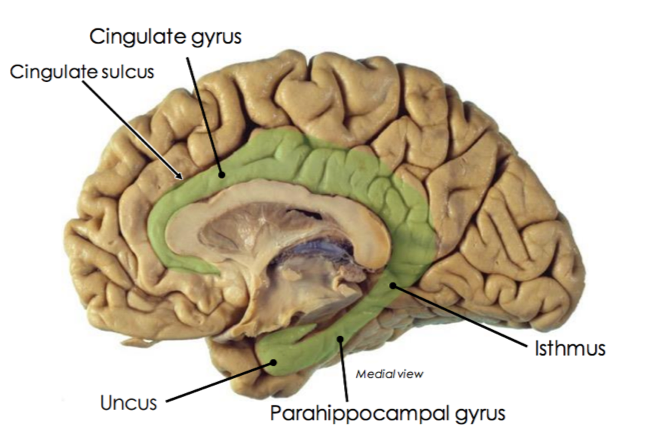
Where is the cingulate gyrus located?
Immediately below cingulate sulcus but above corpus callosum
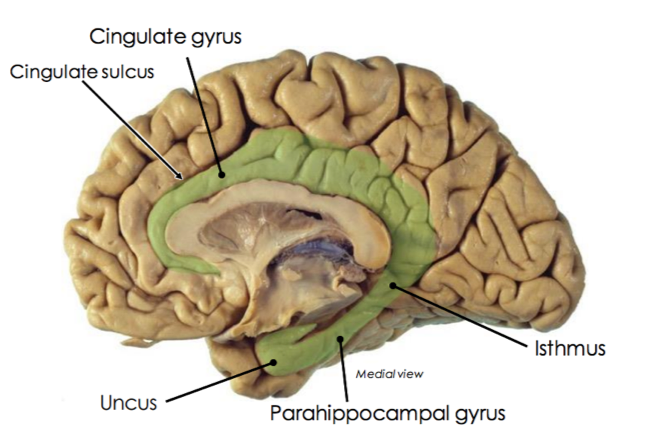
What is the isthmus of the cingulate gyrus continuous inferiorly with?
Parahippocampal gyrus
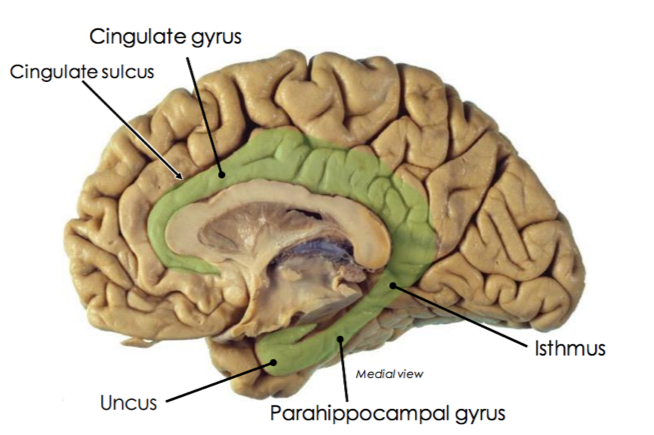
In which lobe is the parahippocampal gyrus located?
In temporal lobe
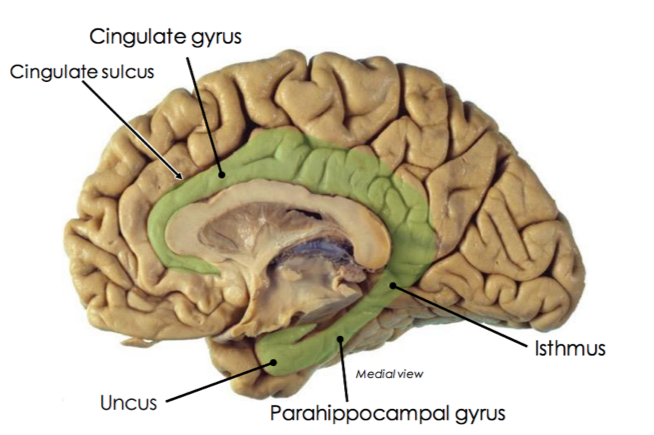
What is the uncus?
The uncus is an anterior extremity of the parahippocampal gyrus.
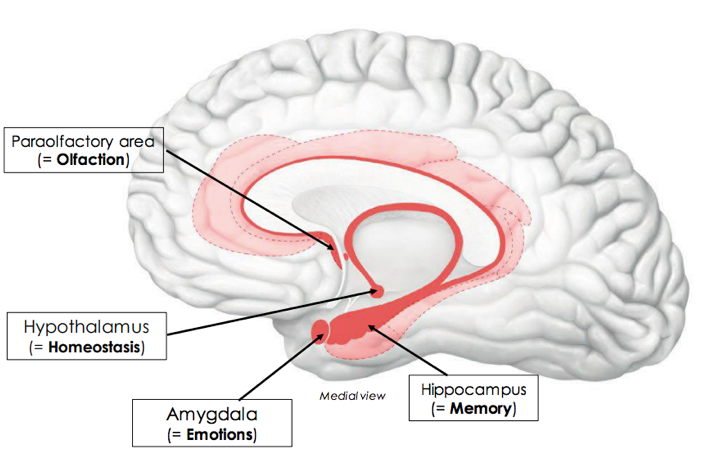
The limbic system mediates the ‘HOME’ functions. What are these? Which part of the limbic system are they mediated by?
- Homeostasis e.g. BP, HR, temperature, hormones; mediated by the hypothalamus
- Body temp too low = shivering
- Body temp too high = sweating
- Olfaction; mediated by para-olfactory area
- Memory; mediated by hippocampus
- Emotion; mediated by amygdala
What is the neocortex?
Involved in higher-order brain functions such as sensory perception, cognition, generation of motor commands, language and spatial reasoning. This is highly developed in humans.
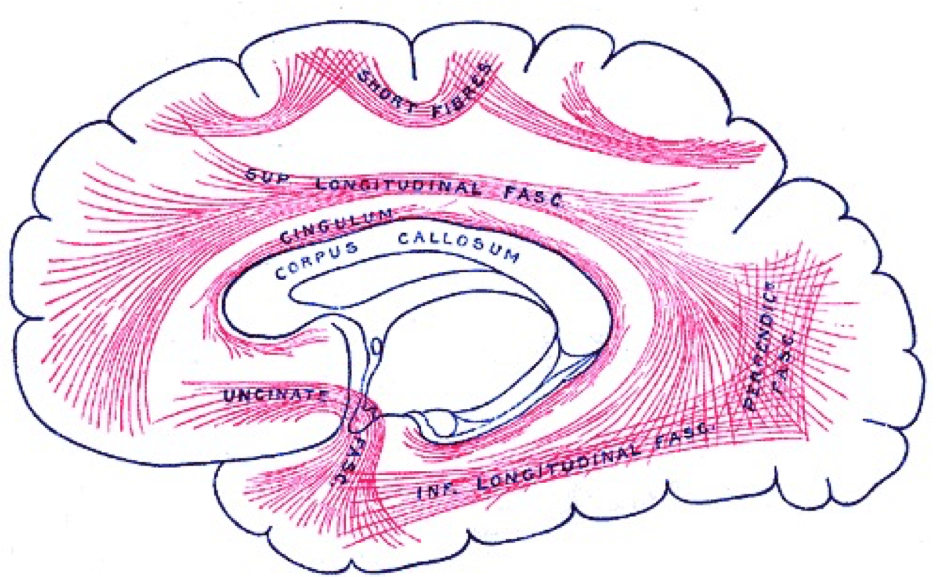
What is the cingulum? What type of fibres does it consist of?
- Bundle of white matter fibres underlying the cingulate gyrus
- Association fibres; connect cortical areas within the same hemispheres
Function of cingulum?
- Receives information from pre-frontal, parietal, occipital, temporal gyri
- It is involved in the formation of memories and emotions
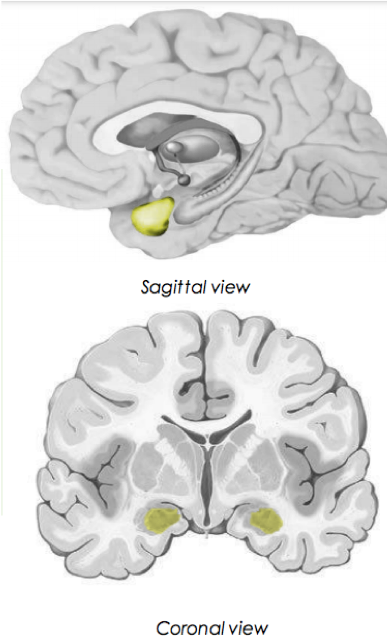
What is the amygdala? Where is it located?
- Almond shaped nuclear (collection of cell bodies) complex in the medial temporal lobe
- Deep to the uncus
Main function of amygdala in humans? How does this differ in animals?
- Mainly involved in emotions and behaviour
- Primitive role in survival in animals (not humans); stress responses, feeding, sexual behaviours
- Humans have neocortex so can rationalise (e.g. won’t kill to eat for survival)
How can lesions of the amygdala present?
May affect patient’s evaluation of events, may lack emotions
What is the hippocampal formation? Where is it located?
- Nuclear complex in the medial temporal lobe
- Deep to the parahippocampal gyrus
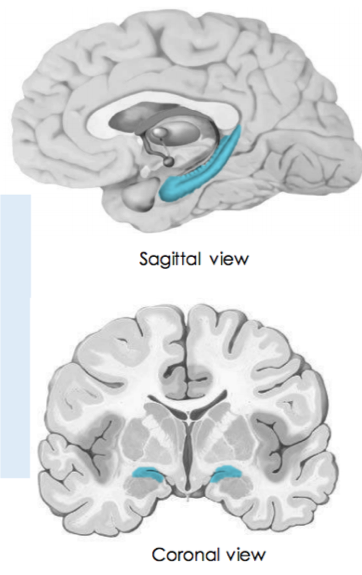
Main function of hippocampal formation?
Mainly involved in memory (mainly short-term memories)
How can lesions of the hippocampal formation present?
Single lesion capable of causing short-term memory loss but NOT long-term memory loss
The cingulate gyrus, parahippocampal gyrus and uncus are bumpy (i.e. have something underneath them). What is found underneath each structure?
- Cingulate gyrus; bundle of white matter association fibres underneath (cingulum)
- Uncus; collection of grey matter cell bodies (amygdala)
- Parahippocampal gyrus; hippocampus
What is the stria terminalis? What does it connect?
- C-shaped band of fibres that runs along the ventricular surface of the thalamus (in lateral ventricle)
- Is the outflow tract of the amygdala; connects it to the hypothalamus
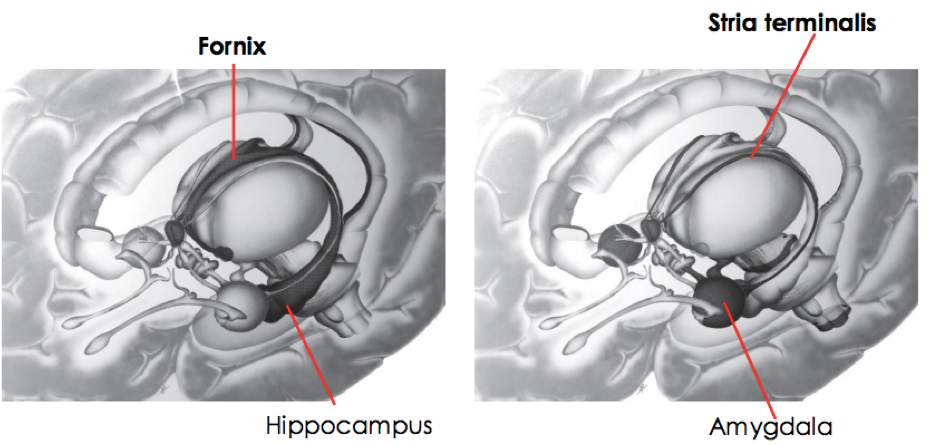
What does the fornix connect?
- Fornix; C-shaped tract that connects hippocampus to hypothalamus (including mamillary bodies)
- Explains why emotions can trigger autonomic responses (e.g. increased HR)
Why are the stria terminalis and fornix C-shaped?
Follow the curves of the lateral ventricles


-
Development of CNS53
-
Intro to Human Brain78
-
The Skull146
-
Head and Neck 1: Front of Neck SDL124
-
Meninges and Ventricles106
-
Blood Supply128
-
Head and Neck Practical 1111
-
Head and Neck 2: Face and Skull93
-
Head and Neck Practical 284
-
Braindeath29
-
Brainstem119
-
Neuroanatomy 1 SDL59
-
Neuroanatomy Practical 1113
-
Cranial Nerves83
-
Forebrain (Cerebrum)61
-
Control Week 1 MCQs16
-
Neuroanatomy Practical 2112
-
Neuroanatomy 2 SDL: Brainstem, Cerebellum and Cranial Nerves130
-
Localisation91
-
AFL 522
-
Muscles of Mastication12
-
Facial Nerve Revision30
-
Arteries of the Head and Neck29
-
Vertebral Column89
-
Spinal Cord and Nerves90
-
Backpain32
-
Ascending Sensory Pathways122
-
Descending Motor Pathways91
-
Contents of the Vertebral Canal SDL45
-
Vertebral Column and Contents Practical71
-
Revision - Different Regions of the Spine23
-
Control Week 2 MCQs11
-
AFL 624
-
Neuroanatomy 3 SDL: Forebrain, Ventricles and CSF40
-
Neuroanatomy Practical 3107
-
Autonomic Nervous System76
-
Skin Histology0
-
Somatosensory Disorders - Sensory Loss1
-
Headache60
-
Skin SDL44
-
Somatosensation Revision49
-
Epilepsy - Clinical Lecture85
-
Clinical - Tumours of the CNS44
-
Spinal Reflexes54
-
Muscle Weakness37
-
Trigeminal Nerve Revision27
-
Control Week 3 MCQs17
-
Pain & Somatosensory Disorders45
-
Peripheral Somatosensory System17
-
Cerebellum90
-
Head Injuries SDL33
-
AFL 726
-
Pain49
-
Local Anaethesia85
-
General Anaesthesia60
-
Visual Pathway112
-
Visual Defects119
-
Visual Defects COPY40
-
SDL - Eye and Ear70
-
Auditory Pathway95
-
Clinical - Multiple Sclerosis0
-
Control Week 5 MCQs15
-
Control Week 6 MCQs32
-
NeuroAnatomy Revision57
-
ANS Revision97
-
Skin and Sensory Receptors MCQs10
-
Basal Ganglia73
-
Limbic System62
-
AFL 825
-
Physiology of Vision27
-
AFL 925



