Liver
- The liver is the largest gland in the body and can weigh up to 2.3kg in the adult, and is described as having two lobes.
- Following absorption in the small intestine the nutrient rich blood passes via the Portal vein to the liver
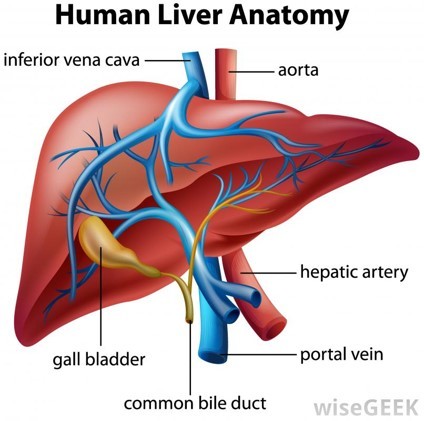
•Blood leaves the liver via the Hepatic veins, which almost immediately enter the inferior vena-cava
The liver has many functions, those which are associated with the digestive process include
The liver has many functions, those which are associated with the digestive process include
- Conversion
- Breakdown
- Production
- Secretion
- Storage
- Synthesis
- metabolism
Conversion of excess amino acids to urea
Conversion of excess glucose to glycogen
Breakdown of stored fat, for use by the body tissues to produce energy
Production of heat
Secretion of bile
Storage of vitamins A,D,E,K,B12, iron and copper
Synthesis of plasma proteins, including blood clotting factors
Inactivation of drugs and hormones
Metabolism of alcohol
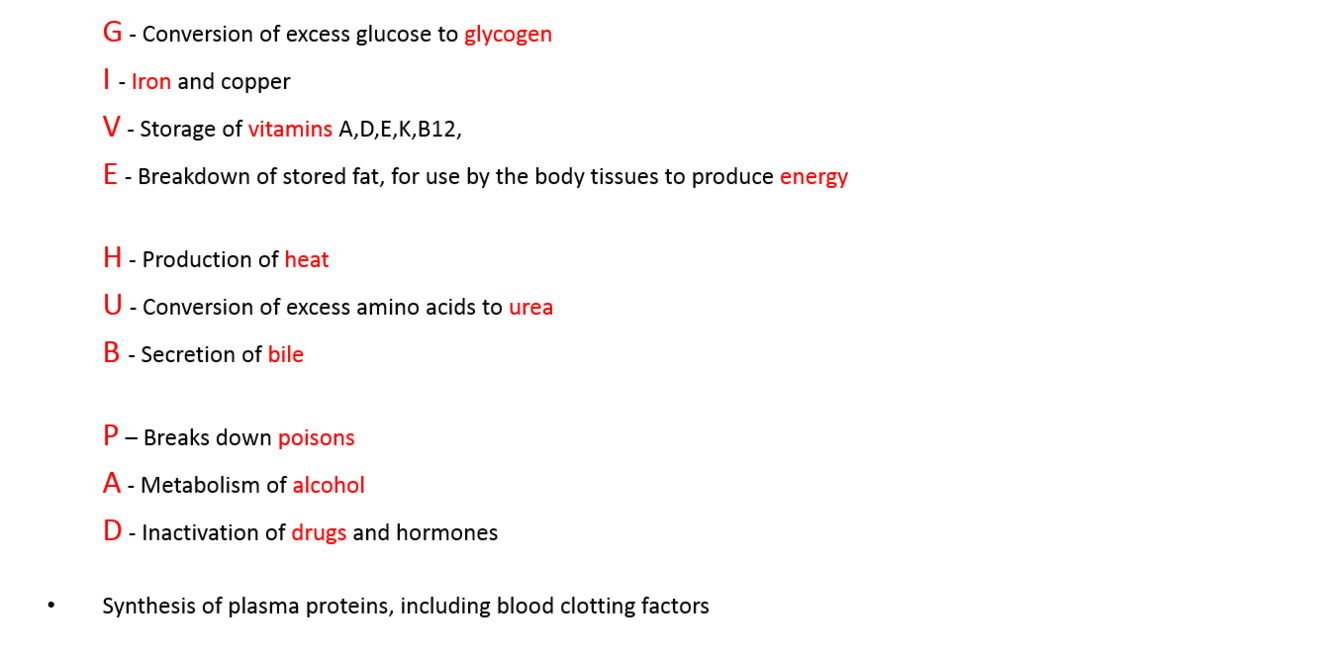
Functions of Liver
S G - Conversion of excess glucose to glycogen
T I - Iron and copper
O V - Storage of vitamins A,D,E,K,B12,
R E - Breakdown of stored fat, for use by the S body tissues to produce energy
•
Produces H - Production of heat
U - Conversion of excess amino acids to urea
B - Secretion of bile
•dures
DESTORYS P – Breaks down poisons
A - Metabolism of alcohol
D - Inactivation of drugs and hormones
•
•Synthesis of plasma proteins, including blood clotting factors
Pancreas
•The pancreas is situated posterior to the stomach and anterior to the abdominal aorta and inferior vena cava
•
•It has two main functions………
Functions of pancreas
- Production of pancreatic juice which is secreted into the duodenum via the pancreatic duct
- •Realses Glucogon
- Production of insulin :- Insulin is a hormone produced by specialised cells in the pancreas called the “Islets of Langehans”
glucose blood stream
glycogen stores liver
glcogon realsed from pancreases
glcolysis
Peritoneum
•A serous membrane which lines the abdomen and covers the abdominal organs
•
•It prevents friction as the organs move against each other and helps to keep them in position
Organs covered by the peritoneal lining
- Spleen
- Liver
- Stomach
- Gall bladder
Bowel
Other Abdominal and Pelvic Organs
- Spleen – peritoneal
- Kidneys – retroperitoneal
- Bladder and Ureters - retroperitoneal
- Urethra – pelvic abdomen
- Ovaries, Uterine tubes and Uterus [female] - pelvic
Spleen
•Lies in the left hypochondrial region of the abdominal cavity, between fundus of the stomach and the diaphragm
•
•Size varies but usually approx. 12cm long, 7cm wide and 2.5cm thick
•
•Weighs approx. 200g
Functions of the Spleen
- Produce new leucocytes (white blood cells) and lymphocytes
- Store erythrocytes (red blood cells)
- Destroy old red blood cells
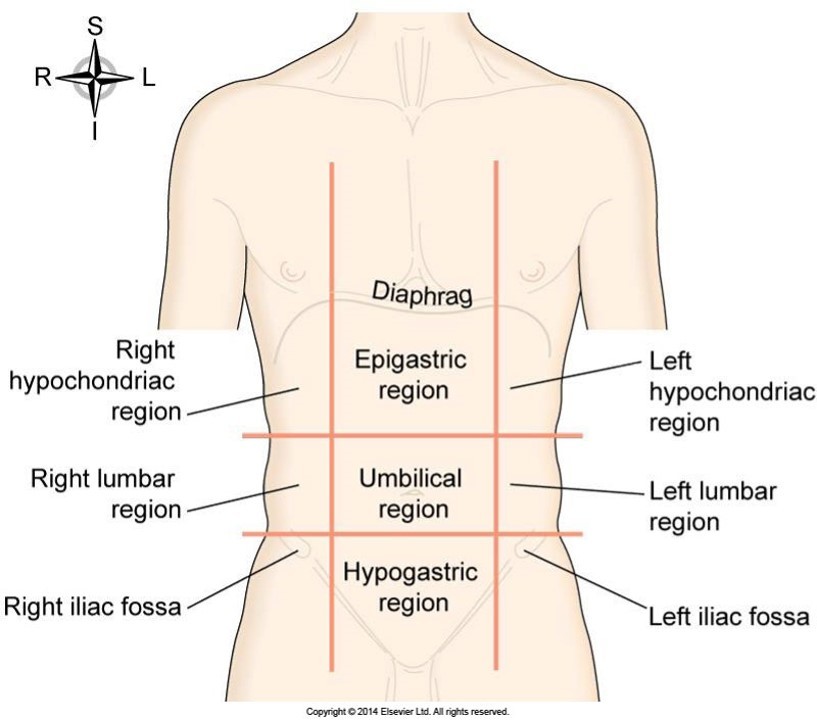
regions of adominal
Pancrease
12-15cm long
Produces and releases
- Digestive enzymes into the duodenum via pancreatic duct (exocrine function)
- Insulin and Glucagon directly into the blood (endocrine function)
Contains specialised endocrine cells called ‘Islets of Langerhans’ which contain 4 types of hormone secreting cells
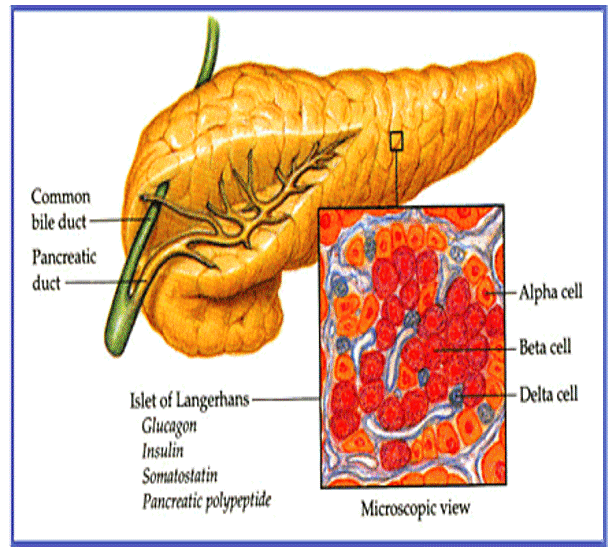
Islets of Langerhans
- Alpha Cells – secrete the hormone Glucagon which raises the blood glucose levels
- Beta Cells - secrete the hormone Insulin which lowers blood glucose level by allowing it to pass into the cells that need it.
- Delta Cells – secrete growth hormone inhibiting cells (GHIH) or somatostatin, inhibiting secretion of Insulin and Glucagon
- F – Cells – secrete pancreatic polypeptide which regulates digestive enzymes
INSULIN
A naturally produced hormone
Insulin is released in response to rising blood glucose levels
Insulin is required to ‘unlock’ the cells to allow the glucose to enter and be transformed into energy.
Also converts excess glucose to glycogen for storage in the liver. This is called glycogenesis.
Types of Diabetes Mellitus
Types of Diabetes Mellitus
- Type 1
- Insulin Dependant Diabetes Mellitus (IDDM)
- Sudden onset
- More common in children and young adults
•
- Type 2
- Non Insulin Dependant Diabetes Mellitus (NIDDM)
- Gradual onset
- More common in the over 40 age group
- May require Insulin as the disease progresses
Type 1 Diabetes
- Autoimmune disease
- Beta calls in the pancreas are destroyed
- No insulin produced
- Glucose cannot get into the cells to produce energy.
- This accounts for 10% of all cases in the UK
Type II Diabetes
- This is more complex than Type I as more factors are at work
- Insulin may be less effective
- Cells may not respond as well to it
- This is more common than Type 1 accounting for 90% of all cases in the UK.
Hyperglycaemia
- •The body attempts to reduce the high glucose levels in the blood
- •One way is via the kidneys causing excessive urine output (Polyuria) and glucosuria
- •Patients lose a lot of water leading to an excessive thirst (Polydipsia)
- •The body also tries to remove Ketones, a complication of too much glucose, through the lungs.
- •Deep sighing respirations and have an acetone / pear drop smell on their breath (1 person in 4 cannot smell this)
- This is called Kaussmaul’s respirations.
- •The signs and symptoms of Hyperglycaemia become evident over a number of hours or days.
- •he cells still require energy which leads to excessive eating (Polyphagia)
Management of Hyperglycaemia
ABCD assessment and manage any problems appropriately.
Measure and record the blood glucose level
Assess for dehydration , SpO2 levels and record ECG
These patients should be managed in hospital.
A Paramedic may be required to administer IV fluids if the patient is hypovolemic.
e patients should be managed in hospital.
A Paramedic may be required to administer IV fluids if the patient is hypovolemic.
Hypoglycaemia
•This is defined as blood sugar reading of less than 4mmol/l
•
- Symptoms come on very quickly over minutes
- Example causes:
–Overdose of medication
–Excessive exercise
–Not enough food
–Alcohol
–Recent or current illness
Hypoglycaemia – signs and symptoms
- Sweating
- Palpitations
- Shaking
- Hunger
- Headache
- Nausea
- Drowsiness
- Odd / aggressive behaviour
- Speech difficulties
- Fitting
- Confusion
- Unconsciousness
Management of Hypoglycaemia
- Assess ABCD’s and correct any problems
- BM pre and post-treatment
Conscious and able
Encourage oral carbohydrates
üSugary milk
üDextrose tablets
üToast and Jam
üHypostop gel
ü
TAKE EXTREEME CARE WITH AIRWAY
Lowered GCS
- IM Glucagon
- IV Glucose (Paramedic)
Hypoglycaemia clinical performance indicator (CPI)

-
Principles of good documentation12
-
Physiology Changes In Pregnancy14
-
Mnumonics16
-
Functions Of The Kidney2
-
Mental Capacity Act14
-
Response to 999 calls7
-
organisational structure15
-
AAP Manual Handling11
-
Legal, ethical and professional issues14
-
Patient centered care1
-
ABC Terminology3
-
roles within the ambulance service5
-
Eca Test18
-
Tech Drugs full14
-
intro to human body17
-
Anatomical Directional Terminology2
-
Respiration65
-
Tech Recognition and Management of cardiac conditions29
-
Tech Cardiovascular System42
-
Tech Nervous System37
-
Technician Drugs general questions24
-
poisoning substance20
-
drug administer4
-
Respiratory conditions asthma25
-
Respiratory conditions COPD11
-
Recognition and Management of cardiac conditions27
-
Recognition and management of diabetes31
-
Nervous Disorders36
-
Digestive system19
-
Liver24
-
skeleton/muscle21
-
unit25 management of a child27
-
child bronchiolitis and Asthma13
-
Chest injuries3
-
Anatomical, physiological & developmental differences1
-
Management of Obstetrics and Gynaecology37
-
childhood deseases Bronchiolitis7
-
childhood Asthma6
-
Croup childhood7
-
Feverish illness in childre5
-
Febrile Convulsions child2
-
Meningitis & Septicaemia6
-
extremes of heat13
-
Changes in Old Ag10
-
head injuies and maxillo facial13
-
Conditions of the Nervous System12
-
Major Incident Training8
-
Mental Health, Awareness, Wellbeing10
-
other types of injuries18
-
Management of Wounds,19
-
Head Injury17
-
What is trauma?14
-
Traumatic Cardiac Arrest (TCA)11
-
Shock34
-
Care of Older People21
-
Silver Trauma (+small bit of Frailty12
-
Digestive processes16
-
Poisoning & substance misuse8
-
Organisation Of The Body System31
-
Questions212
-
MOD F TECH 48 Maternity67
-
shock types6
-
pain relief1



