Lower Limbs Flashcards

(123 cards)

1
Q

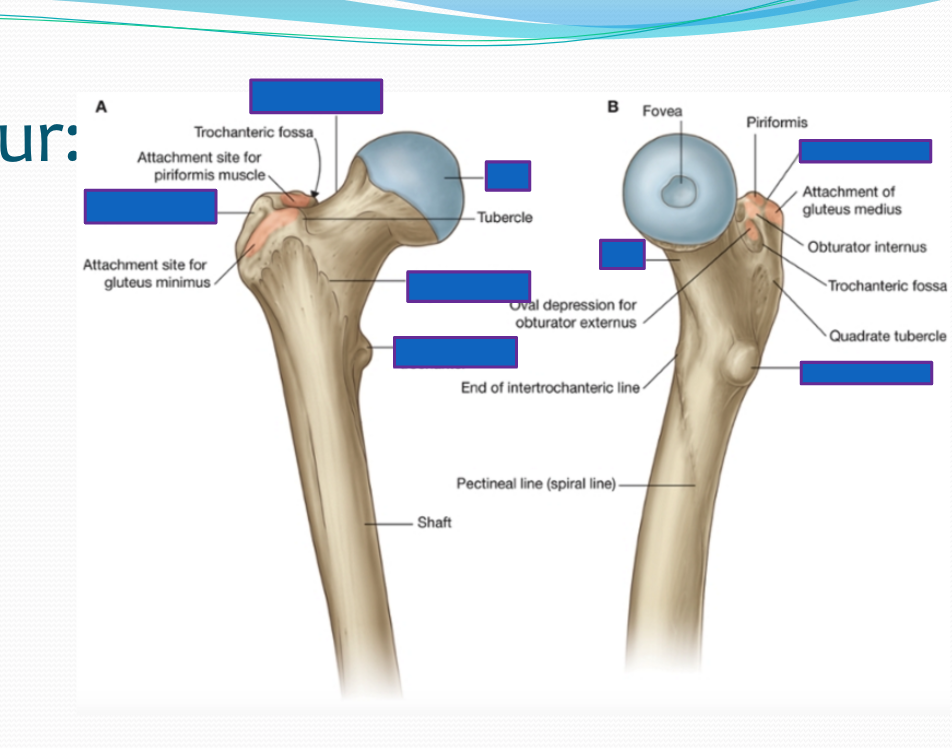
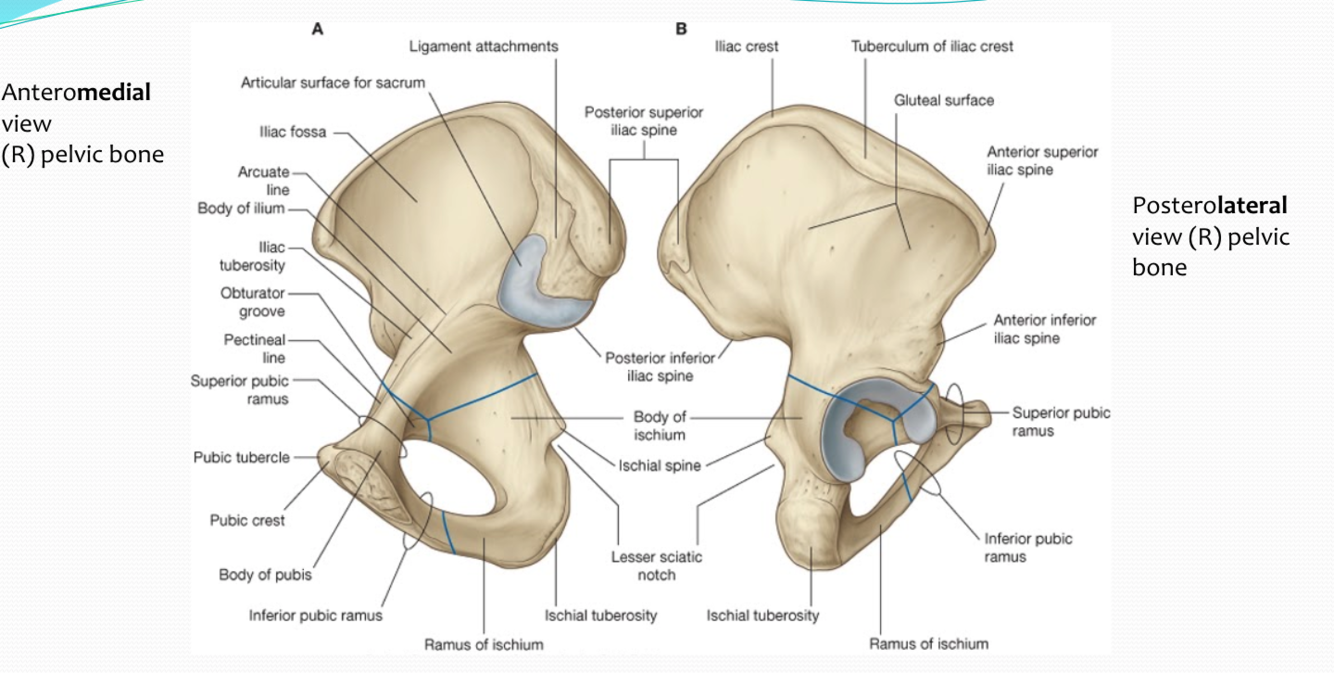
Label this diagram

A
2
Q

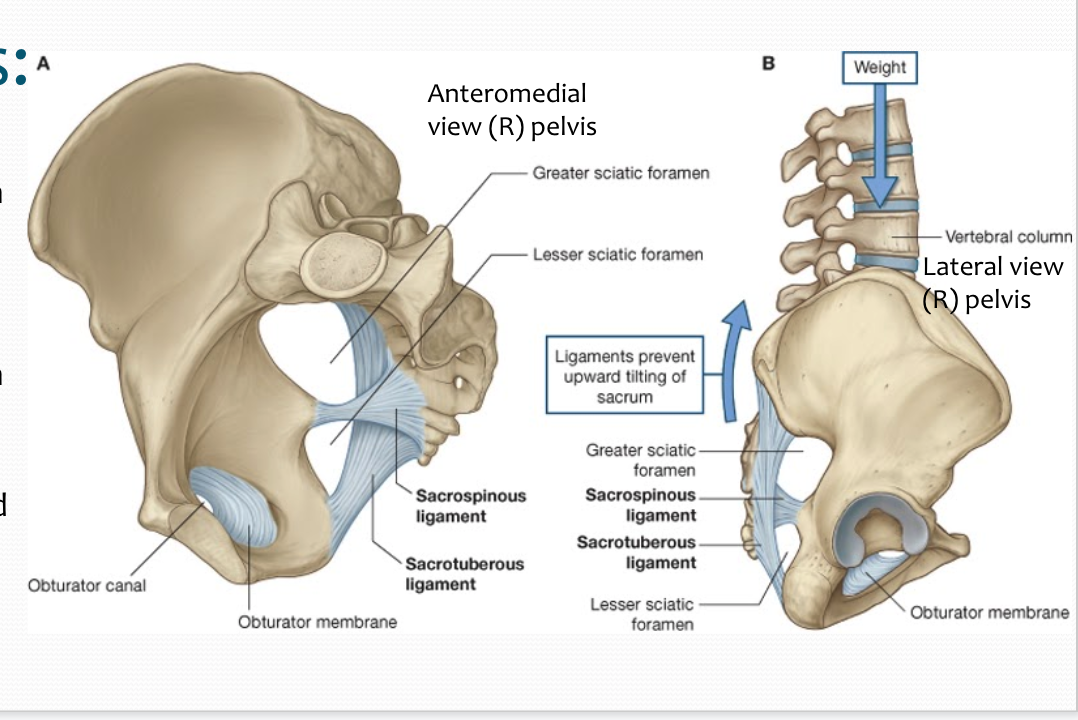
whatv are the 2 main ligaments formed between the sacrum and the ischium.

give a function of them

A

Sacrospinous ligament

Sacrotuberous ligament -

  • connect sacrum to ischial tuberosity.
  • Prevents upwards tilting of the sacrum
3
Q

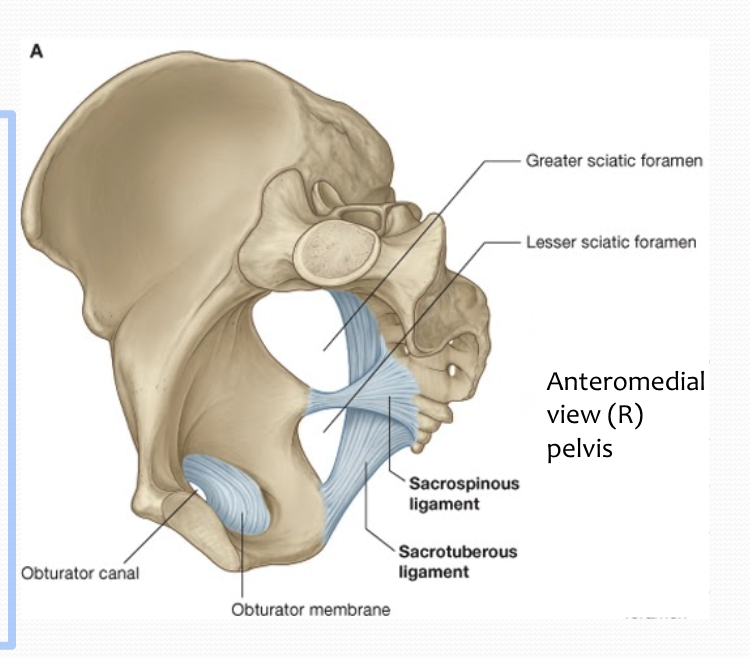
what are the two main foramina formed between the ischium and the sacrum.

What forms it and what passes through them

A

Greater sciatic foramen

  • Formed by the greater sciatic notch and the ligaments
  • It transmits sturctures leaving the pelvis to the lower limb. e.g. sciatic nerve

Lesser sciatic foramen

  • Formed by the lesser sciatic notch and the ligaments
  • Transmits structures passing from the pelvis to the perineum
4
Q

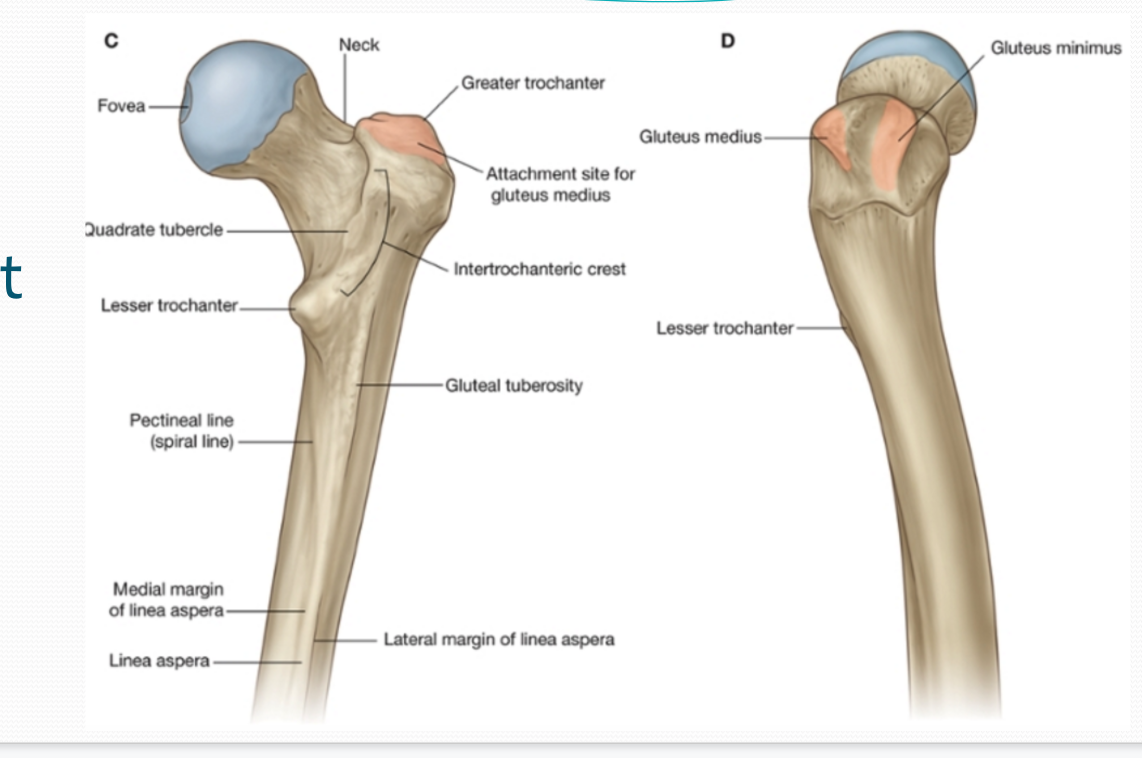
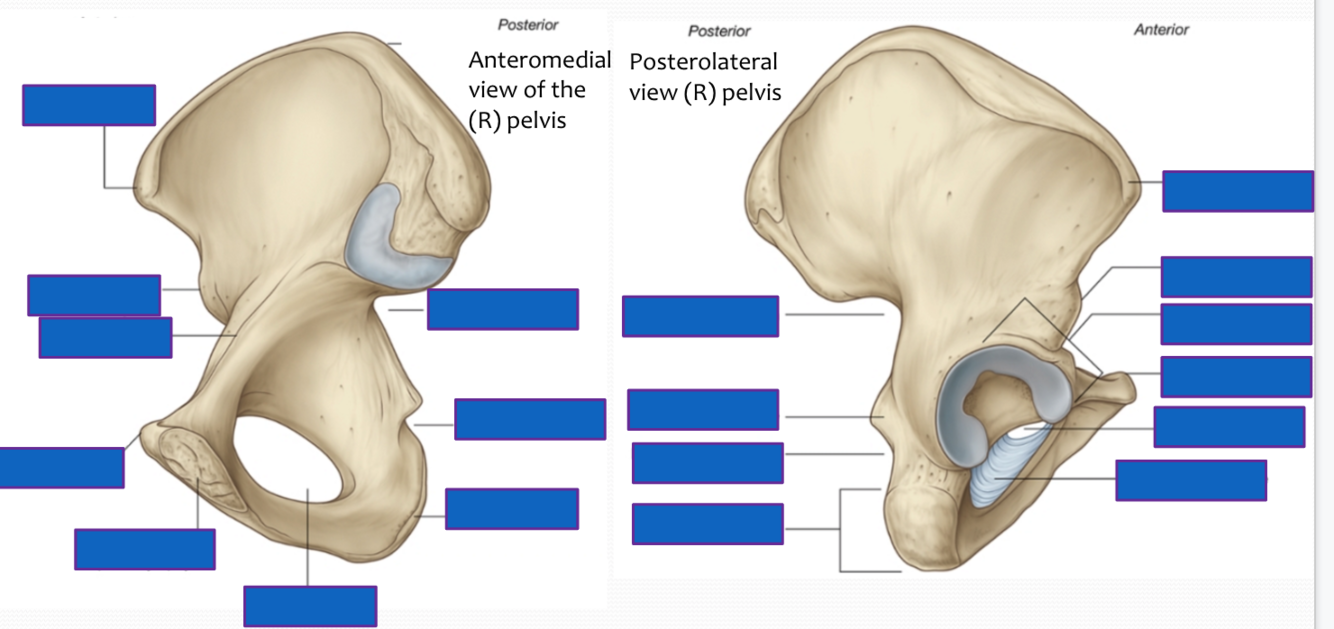
Label this diagram

A
5
Q

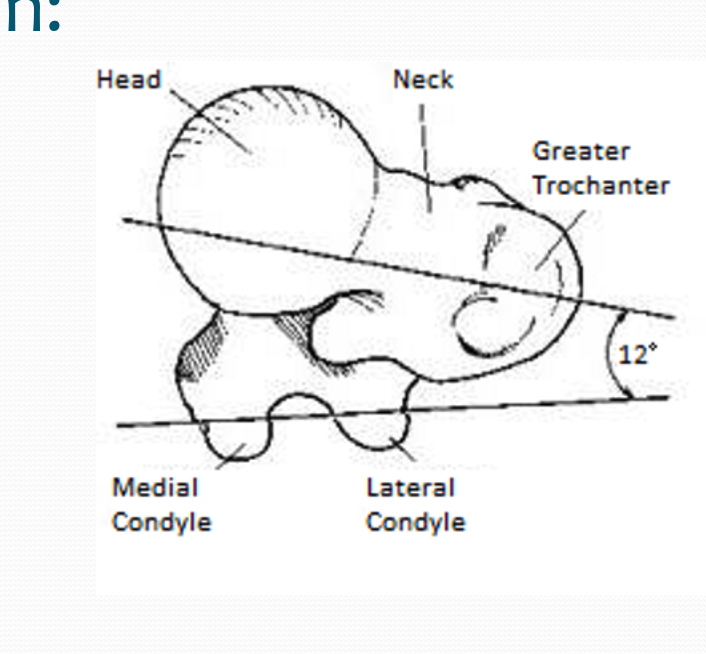
What is the angle of anterversion and when is it larger

A

The angle of anteversion is between the axis of femoral head and transcondylar axis of knee

it’s around 12 degrees

At birth it’s around 30 degress; this leads to intoed foot
6
Q

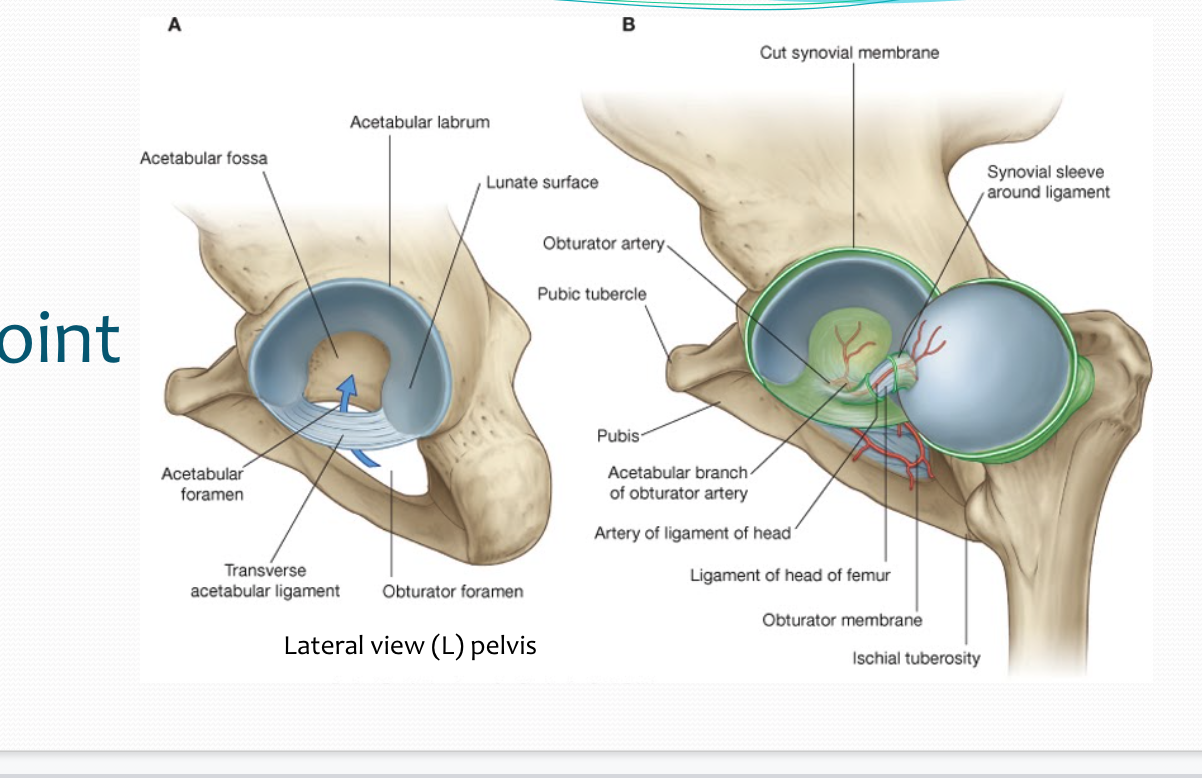
what type of joint is the acetabular hip joint and what movemetn does it perform

A

ball and socket synovial joint

Allows all types of movement
7
Q

what completes the bony acetabular labrum

A

Transverse acetabular ligament

8
Q

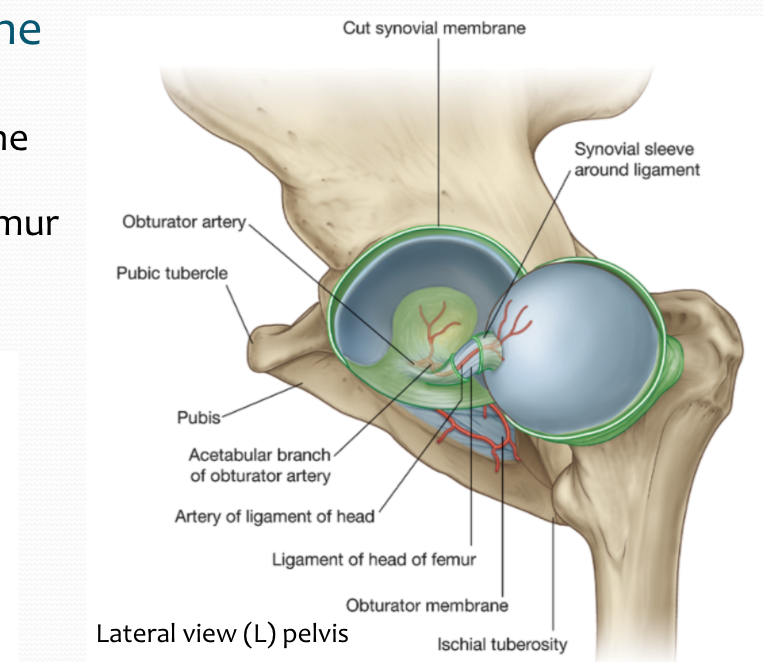
what attaches the head of femur to the acetabulum

A

ligament of the head of the femur

9
Q

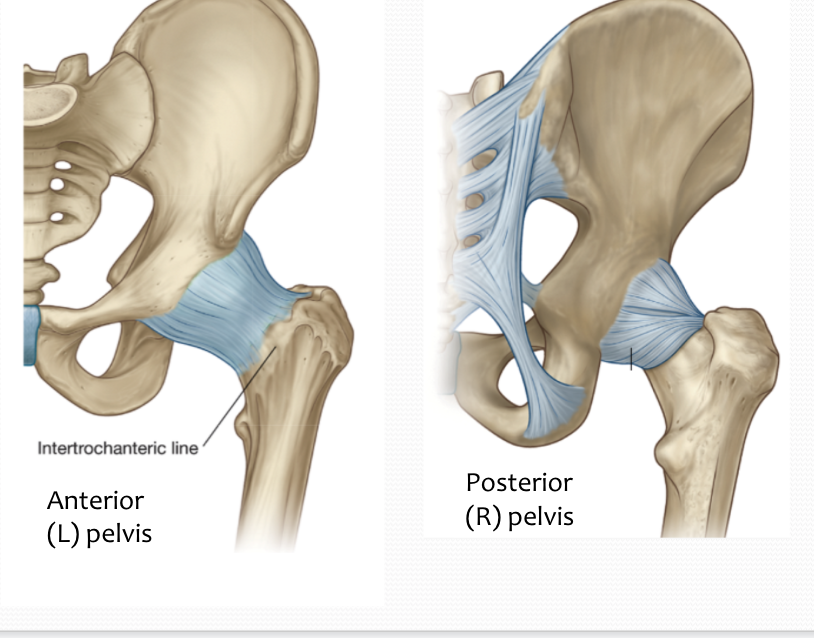
A synovial membrane surrounds the head of the femur, what structure surrounds the synovial membrane.

Give it’s features and how is it related to fractures

A

A capsule surrounds the membrane and the capsule extends down the neck of the femur

It runs more anteriorly than posteriorly

Fractures can either be intracapsular or extracapsular
10
Q

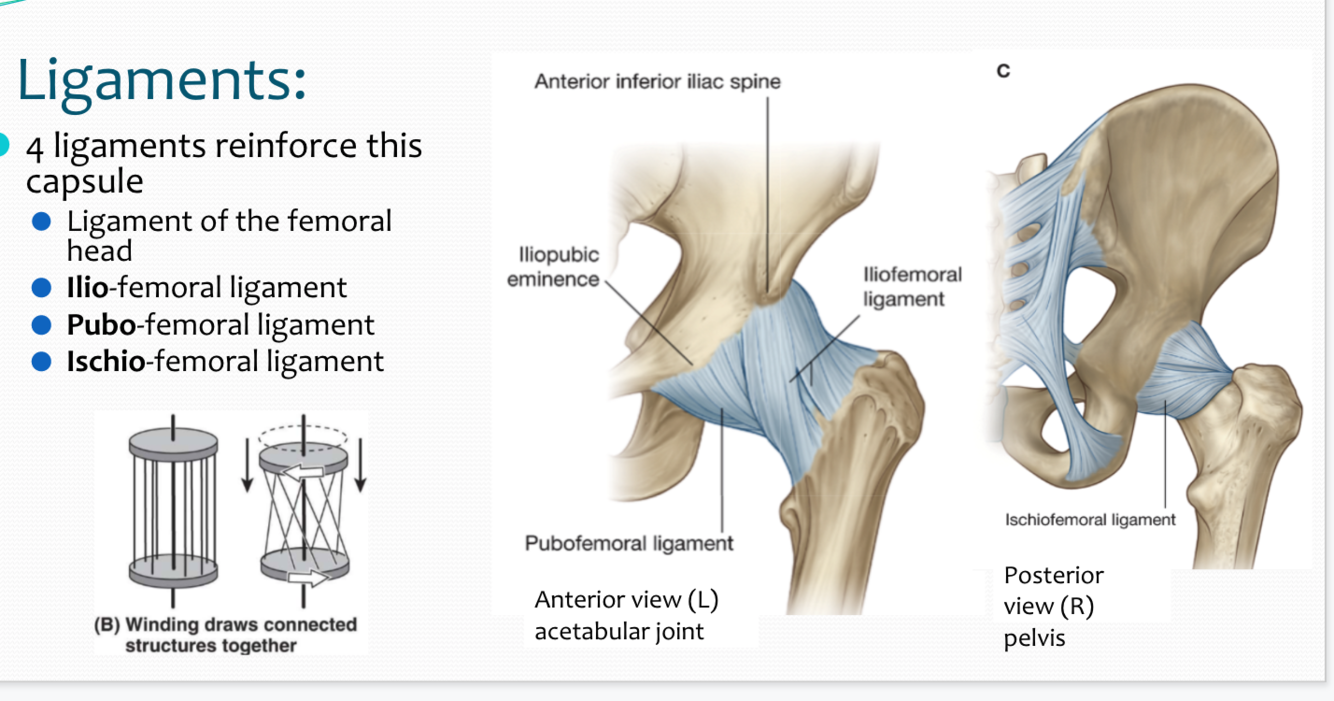
there are 4 ligaments that reinforce the femoral capsule.

What are they?

A
  • Pubofemoral
  • Ischio-femoral
  • Ilio-femoral
  • Ligament of head of femur
11
Q

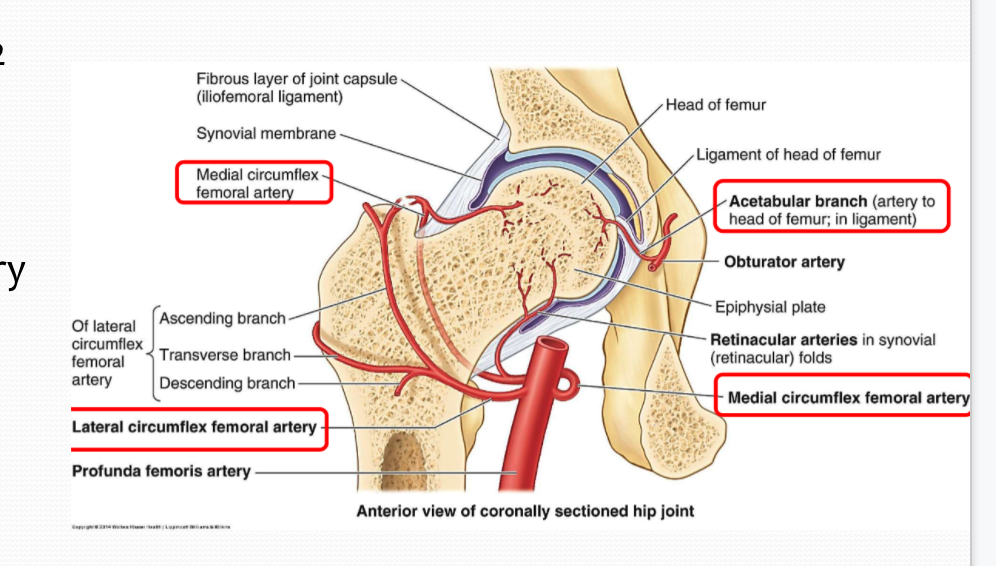
Extensively describe the blood supply to the femoral head

A

It is primarily supploied by 2 branches of the profunda femoris:

  • lateral circumflex artery
  • Medial circumflex artery

It can alsio be supplied by the acetabular branch of the obturator artery
12
Q

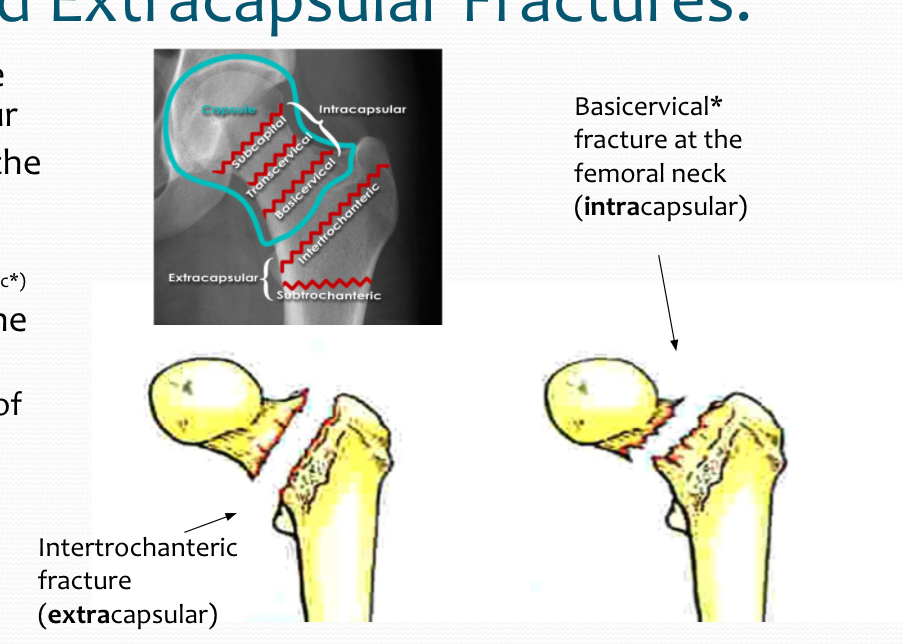
Contrast intracapsular and extracapsular fractures

A

Extra-

  • it’s at intertrochanteric line: less common

Intra:

  • it’s at femoral head OR neck
  • there’s risk of avascular necrosis due to damage to the cirucmflex arteries
13
Q

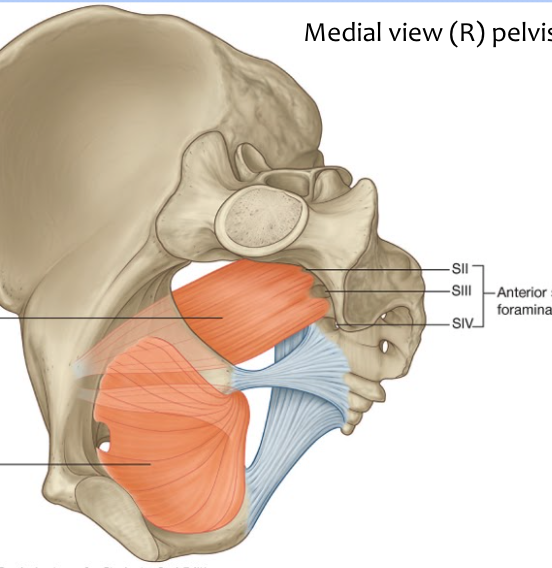
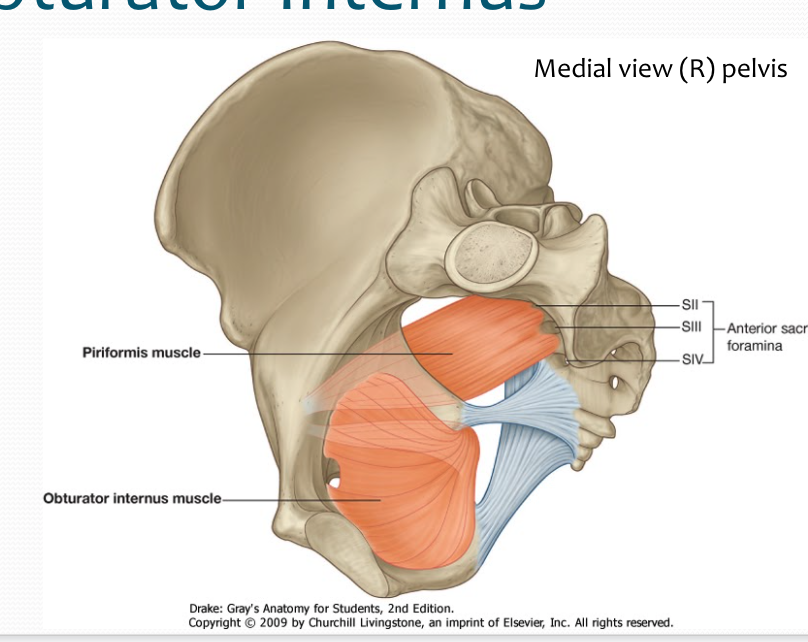
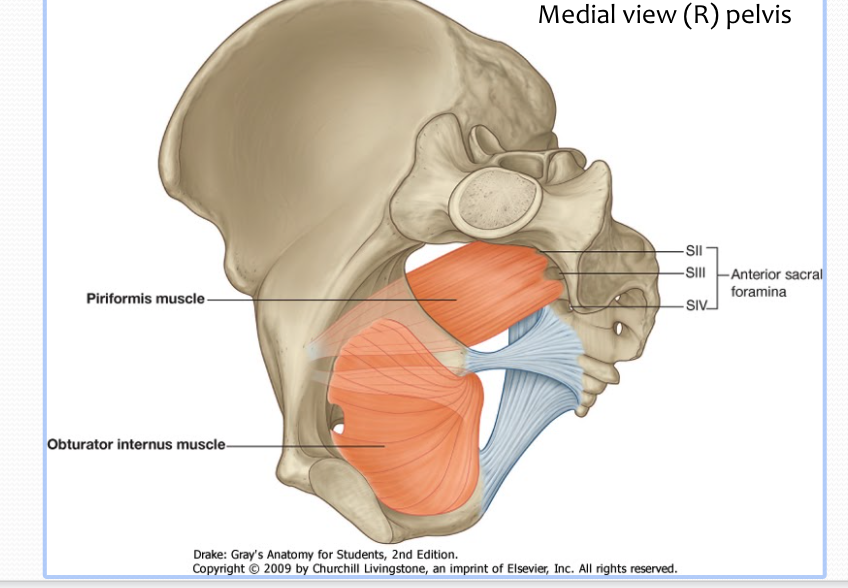
label the two muscles seen

A
14
Q

what proximal (origin) and distal attachments (insertion) of the piriformis.

What does it split?

A

Proximal: Anterior Sacrum

Distal: Medial aspect of greater trochanter

IT splits the greater sciatic foramen into 2 parts
15
Q

what are the attachments of the obturator internus.

A

Proximal: Internal obturator membrane

Distal: Medial aspect of Greater trochanter

16
Q

Describe the path of the tendon of the obturator internus

A

it makes a 90 degree turn as it passes through the lesses sicatic foramen

17
Q

Name as much gateways that allows nerves, vessels and tendons to pass from abdomen to lower limbs

A

Greater sciatic foramen above piriformis

Greater sciatic foramen below piriformis

Lesser sictic foramen

Obturator canal

Gap between inguinal ligament and pelvic bone

18
Q

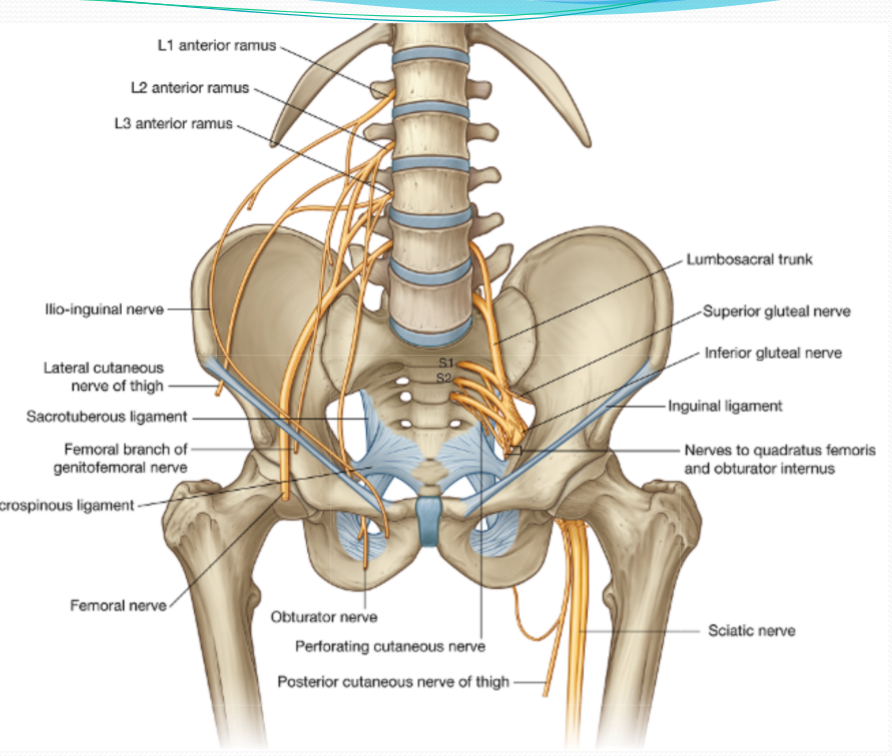
label aas much enrve vessels as you can
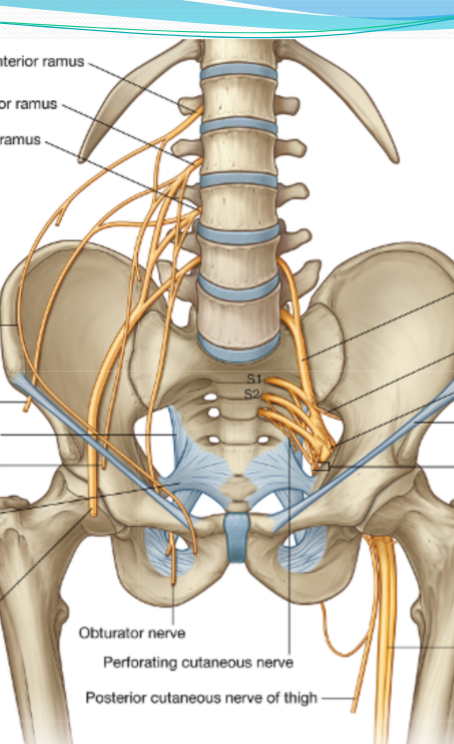
A
19
Q

what are the subcompartments of the gluteal compartment

A

Superficial gluteal compartment

  • Gluteus maximus
  • Gluteus medius
  • Gluteus minimus

Deep gluteal compartment (Short external rotators of the hip)

  • Piriformis
  • Obturator internis
  • Superior gamellus
  • Inferior gamellus
  • Quadratus femoris
20
Q

what are the 3 compartments of the thigh

A

Anterior: Hip flexors and knee extensors

Adductor (Medial): Hip adductors

Posterior: Hip extensors and knee flexors

21
Q

Name all the muscles of the anterior compartment of the thigh and give innervation

A

Tensor fascia latae- superior gluteal nerve

the rest are innervated by the femoral nerve

Sartorius

Quadriceps femoris

  • Rectus femoris
  • Vastus medialis
  • Vastus intermedius
  • Vastus lateralis

ilio psoas

22
Q

what are the muscles fo the adductor compartment of thigh and it’s innervation.

any exceptions

A

Mostly innevrated by the obturator nerve.

They are:

  • Adductor longus
  • Adductor brevis
  • Adductor magnus
  • Gracilis
  • Obturator externus

EXCEPTION

Pectineus- femoral nerve

23
Q

what are posterior thigh compartments muscles and give it’s innevration

A

All supplied by the sciatic nerve

they are the hamstrings which are:

  • Semimembranous
  • Semitendinosus
  • Biceps femoris
  • Hamstring component of the adductor magnus*- supplied by sciatic nerve
24
Q

What forms the lumbar plexus and sacral plexus

A

Lumbar plexus:

  • Ventral ramis of L1-L4

Sacral plexus formed by:

  • Lumbosacral trunk (L4,5)- a branch of lumbar plexus
  • Ventral rami of S1-S4
25
Describe how the femoral nerve arises and it's motor and snesory innevratio/vbranches
From posterior divisions of L2-L4 Innervates all anterior thigh muscles **EXCEPT** tensor fascia latae Also innervates **pectineus** muscle (**adductor** compartment) Sensory cutaneous branches are: * **Saphenous nerve**- anteromedial knee, medial leg and foot * Medial and intermediate femoral cutaneous nerve
26
How does the obturator nerve arise and give it's innervation
Arises from Anterior divisions of L2-L4 Innervates all aductor compartment muscle EXCEPT: * pectineus * Hamstring half of adductor magnus
27
Sciatic nerve (L4- S3) what are it's main branches and what does it innervate?
Composed of two nerves: 1. Tibial - the rest of the hamstring muscles 2. Common peroneal- short head of bicep femoris Innervates all hamstring muscles (posterior compartment of thigh) it also innervates everything from knee downwards
28
where is the safe area for gluteal injections
Superolateral quadrant- avoid damage to impprtant structures
29
Name all the nerves of the gluteal compartment and give the muscles they innervate. These nerves are derived from the sacral plexus
The superior gluteal nerve (L4-S1) * Gluteus medius, minimus and tensor fascia lata The inferior gluteal nerve (L5-S2) * Gluteus maximus The nerve to **piriformis** (S1,S2) The nerve to **obturator internus** (L5-S2) * Obturator internus and superior gamellus The nerve to the **quadratus femoris** (L4-S1 * Quadratus femoris and Inferior gamellus
30
list all the cutaneous innervation of the thigh
**Saphenous** Nerve- anteromedial knee, medial leg and foot lioinguinal nerves (L1) Genitofemoral nerve (L1,2) Lateral cutanenous nerve * Medial femoral cutaneous nerve: Medial part of anterior thigh* * Intermediate femoral cutaneous nerve: Middle part of anterior thigh* * Posterior cutaneous nerve of thigh*
31
Give the **origins** of the muscles of the anterior compartment of the thigh.
iliacus- i**liac fossa** Sartorius- **ASIS** Tensor fascia latae- **ASIS** Rectus femoris- **Anterior inferior iliac spine** 3 Vastus muscles- Anterior femur All these attachments at the anterior ilium
32
Give the origins of the superficial gluteal muscles
they all originate from the **posterior** ilium Gluteus maximus - blue on diagram Minimus- yellow Medius- purple
33
what are the orgins of the deep gluteal msucles
Piriformis: **Anterior sacrum** Obturator internus: **Obturator membrane** Superior and inferior gamelli: **Ischium** Quadratus femoris: **Ischium**
34
what are the origins of the adductor compartment of the thigh
All of them originate from the pubis or ischiopubis ramus. * Pectineus * Adductor longus * Adductor brevis * Adductor magnus * Gracilis EXCEPTION: obturator externus- **obturator membrane**
35
what are the origins of the posterior compartment of the thigh
All 3 hamstring muscles and hamstring componetn of adductor magnus all orginate from the **ischial tuberosity**
36
Gluteus maximus give insertion, innervation and function
Insertion: * Deep fibres: **Gluteal tuberosity** * Superficial fibres: **Iliotibial tract** Function * Hip Extension * Some lateral rotation and abduction Innervation: * **Inferior gluteal nerve**
37
Gluteus medius and minimus Give insertion, function and innervation
insertion: **Greater trochanter** Function: Hip abduction Innervation: Superior gluteal nerve
38
How do you perform the Trendelenburg test and what does it tests for?
tests for a weak or paralysed hip abductors. Tell them to raise a good leg and if the hip drops towards the side of th egood leg then it's a positive Trendelenburg test. They have a weakness or paralysis of the gluteus medius and minimus
39
outline the short external rotators of the hip. Give me their insertion
* Piriformis * Obturator internus * Superior gamellus * Inferior gamellus * Quadratus femoris INSERT at the greater trochanter
40
what are the two layers of fascia of the thigh
Superficial fascia- similar to other fascia in the body. Deep fascia * Area of the thigh called the **fascia lata** * Extends like a stocking beneath the skin * Lateral thickened area is the **iliotibial tract**
41
Tensor fascia latae give origin, insertion, innervation and function
Proximal- ASIS Distal * **Iliotibial tract** –Attaches to the lateral condyle of the tibia Function * Stabilise the knee in extension Innervation? **Superior gluteal nerve**
42
Sartorius give origin, insertion and function
Proximal- ASIS Distal * **Pes anserinus ligament**\* on medial tibia inferior to the tibial tuberosity Function * Hip and knee flexion
43
Rectus femoris Give origin, insertion and function
Proximal- AIIS * Distal* * Quadriceps femoris tendon * Function* * Hip flexion and knee **extension**
44
the 3 VASTUS muscles. Give the origin, insertion and function
Proximal * Medial, anterior and lateral femoral shaft respectively * Lateralis has other proximal attachments\* Distal * Quadriceps femoris tendon Function * Knee extension
45
3 Addcutor muscles (longus, magnus and brevis) give origin, insertion and function
Proximal * Pubis and ischiopubic ramus Distal * Femoral shaft Function * Adduction and medial rotation of hip joint
46
Gracilis (adductor compartment of thigh) Give origin, insertion and function
Proximal * Pubis Distal * Medial-proximal tibial shaft (PES anserinus) Function * Hip adduction and knee flexion
47
The Hamstring muscles. give orignin, insertion and function
Proximal * Ischial tuberosity Distal * Biceps femoris: Fibula * Semi-M and semi-T: Tibia * Adductor magnus\*: Hamstring part attaches to adductor tubercle Functions * Knee **flexion** and thigh extension
48
what are the borders of the femoral triangle
Base of the triangle (superior border of triangle) * **Inguinal ligament** Medial border: * **Adductor longus** Lateral border: * **Sartorius** Apex of the triangle (inferior end) * **Continuous with the adductor canal**
49
what are the contents of the femoral triangle
*Within the femoral sheath* * Femoral artery * Femoral vein * Lymphatics *Outside of the femoral sheath* * Femoral nerve * Psoas major tendon\* * Pectineus\* * Lateral femoral cutaneous nerve\*
50
describe the borders of the adductor canal
Anterior * Sartorius- curves around medially Posterior * Adductor longus and magnus Laterally * Vastus medialis
51
what are the contents of the adductor canal
Femoral artery Femoral vein Saphenous nerve * The other branches of the femoral nerve have left to supply the anterior compartment Nerve to the vastus medialis\*
52
where does the adductor canal end? how does the vessels of the canal change
Adductor hiatus of adductor magnus The femoral artery becomes the popliteal artery The femoral vein becomes the popiliteal vein
53
give the arrangement of the femoral artery, vein and nerve in the base of the femoral triangle
NAV
54
What are the branches of the femoral artery in the femoral triangle and describe it's course in the thigh
**Profunda femoris** * *the superficial circumflex iliac artery\** * *the superficial epigastric artery\** * *the superficial external pudendal artery\** * *the deep external pudendal artery\** After giving off the profunda femoris, the femoral artery continue in the adductor canal as the superficial femoral artery. At the hiatus (knee) it becomes the popilteal artery
55
where can you palpate the femoral artery
Halfway between ASIS and pubic symphysis. Lies on psoas tendon and easily palpable
56
What are the branches of the profunda femoris and why are they important clincially
Lateral femoral circumflex Medial femoral circumflex Clinical Importance: * Avascular necrosis of the femoral head can occur if there's an intracpasular fracture there are other branching perforating arteries
57
describe the venous drainage of the thigh
Superficial: Popliteal vein becomes the femoral vein at the knee Deep: The **superficial** femoral vein receives the **venae comitantes of the profunda femoris artery** The saphenofemoral junction occurs in the femoral triangle
58
describe the lymph drainage of the lower limb
All the lymph drains into Inguinal lymph nodes Lymph closely follow veins. Popliteal lymph drains the distal limb Superficial inguinal nodes drains into deep inguinal which drains into external iliac nodes
59
What passes throught he greater scitic foramen gateway
Above piriformis: * Superior Gluteal artery, vein and nerve Below piriformis: * Inferior gluteal artery, vein and nerve * Internal pudendal artery and vein and pudendal nerve * Sciatic nerve * Nerves to Obturator Internus and Quadratus Femoris * Posterior femoral cutaneous nerve
60
what are the contents of the lesser scitaic formaen and obturator foramen
Lesser sciatic foramina: * **Pudendal Nerve and Pudendal Vessels (going into the perineum)** * **Tendon of obturator internus** Obturator Foramen * Connects medial compartment of lower limb to pelvis * Contains obturator nerve and vessels
61
how do you measure true and apparent leg length in a pt
Lie patient supine and ensure the ASIS’s are at the same level and the hip is squared **True leg**: Measure distance between **medial malleolus** and **ipsilateral ASIS** (fixed) **Apparent leg**: Measure distance between medial malleolus and **xiphisternum** (non-fixed)
62
Describe the embryology of the lower limb development
- in early development, upper and lower limb buds extend laterally - internal rotation of lower limb below the hip = **permanent pronation** - structures that would have been anterior become posterior (and vice-versa) - flexors become become posterior and extensors anterior
63
what are the consquences of the permanent pronation of lower limb in early development
In adults: - **anterior** dermatomes have **twisted, oblique fields**, as opposed to the straighter fields in the upper limb - extensor muscles are anterior and flexors are posterior - in upper limb **thumb is lateral** and in lower limb homologous digit large toe is medial
64
Draw out the lumbar plexus and state 2 **important** nerves coming out with their corresponding nerve root
Femoral nerve- (L2, 3,4) and derived from the **posterior** divisions Obturator nerve - (L2,3,4) ansd derived from the **anterior** divisions
65
what are the other nerves of the lumbar plexus
Iliohypogastric (L1) Ilioinguinal (L1) GenitoFemoral (L1, L2) Lateral femoral cutaneous nerve (L2, L3)
66
Draw out the lumbosacral plexus and state the important nerves and their nerve roots. L4 and L5 from lumbar plexus joins the sacral plexus
**Sciatic nerve** **(L4-S3)**: divided into tibial and coomon peroneal nerve **Superior gluteal nerve- (L4, L5, S1)** **Inferior gluteal nerve ( L5, S1, S2)** Posterior cutaneous nerve of the thigh ( S1, S2, S3) Pudendal nerve ( S2-S4) Nerve to piriformis (S1, S2) Nerve to obturator internus ( L5-S2)
67
What are the key landmarks of transitons in the leg
From Thigh to Leg: via the Popliteal fossa From leg to foot : * Plantar: Tarsal tunnel- posteriomedial to ankle * Dorsal: Structures enter directly into the ankle
68
What forms the Tarsal tunnel and what structures pass through it
Formed by the **Flexor Retinaculum** behind the Medial Malleolus Structures are: **T**om, **D**ick **A**nd **V**ery **N**aughty **H**arry * **Ti**bialis posterior * Flexor **D**igitorum longus * Posterior Tibial **A**rtery * Posterior Tibial **V**ein * Tibial **N**erve * Flexor **H**allucis Longus They are arranged from anterior to posterior
69
what forms the floor of the popliteal fossa
posterior femur: linea aspera widens
70
what are the keyt landmarks on the proximal tibia
Anterior: * Tibial Tuberosity * Pes Anserinus (SGT) Posterior: * Soleal line
71
is the fibula a weightbearing bone? Explain
No- not involved in Knee joint It's superior medial surface articulates with th etibia to from proximal tibio-fibular joint
72
what type of joint is the knee joint and what movement can it allow
Hinge type (largest synovial joint in body. Normally flexion and extension, but allows some gliding, rolling and rotation
73
what are the cruciate ligaments of the knee joints and give their respective attahcments
ACL: * Superior: **Lateral** Wall of **Femoral** Intercondylar Fossa * Inferior: Anterior Tibial Intercondylar region PCL: * Superior: Medial Wall of Femoral Intercondylar Fossa * Inferior: Posterior Tibial Intercondylar region PMAL; acronym these cruciate ligaments are extrasynovial but intraarticular
74
what are the tests for assessing ACL/PCL integrity
Anterior/ posterior drawer test (knee at 80 degrees) Lachman's test (ACL)- knee at 30 degress You trying to see if there's excessive tibia displacement on the fixed femur A postive sag sign on inspection shows a PCL rupture
75
which menisci (shock absorber) is more susceptible to injury and why?
medial This is because it is also attached to the Tibial collateral ligaments to form a joint capsule
76
what forms the fibrous membrane of the knee joint
Extensions of tendons of the muscles it encloses the articular cavity and intercondylar regions
77
what is thew function of a bursae and how can it get inflamme
Minimise friction between bone and skin; it can get inflammed due to too much friction, infection or inflammatory diseases
78
Name the burase of the knee joints
* Pre-patellar * Suprapatellar * Infrapatellar * Popliteus * Subpopliteal bursae
79
How does the knee joint save energy when fully extended
Femoral condyles are flatter/broader anterior Medial rotation of the femur on the tibia which tightens the ligaments Body centre gravity is anterior to the knee joint
80
what are the contents of the popliteal fossa
Popliteal artery/vein Short saphenous vein (which changes to popliteal vein) The 2 branches of the sciativ nerve Popliteal lymph nodes
81
What are the boudnaries of the popliteal fossa
Floor: Knee capsule and Femur/Tibia Roof: Deep fascia Superio-Medial: Semi- Membranosis Superior lateral: long head of biceps femoris
82
Label this foot
83
There are sesamid bones in the foot; where exactly are they located?
Can only be seen on plantar surface of foot Located within the Flexor Hallucis brevis (FHB) These are located on the Ball fo the foot (Head of 1st Metatarsal)
84
What tpyr of joint is the ankle joint? and whatmovement does it permit
Hinge-like synovial joint Allow Dorsi and Plantar flexion
85
what forms the "mortice" face for the ankle joint
Roof- Inferior surface of Distal Tibia Medial Side- Medial Malleolus of Tibia Lateral Side: Lateral Malleolus of Fibula.
86
Ligaments in the ankle provide stabilisation of it. There are medial and lateral ligaments. Give the component of the Medial Ligaments. Label them
This is also called the Deltoid ligament. made up fo 4 components: * Tibiocalcaneal * Tibionavicular * Anterior tibiotalar * Posterior tibiotalar
87
What are the 3 components of the lateral ankle ligaments
**Anterior talofibular- MAIN ONE** Posterior talofibular Calcaneofibular
88
which ankle ligament do we commonly sprain and what do pts present with?
The ankle lateral ligaments due to over inversion of the foor pt present with: * Pain on outside of ankle * Swelling * Ecchymosis
89
what joint allows foot inversion and eversion
**Subtalar joint**- between posterior calceneal facet and inferior surface of talus. However, the clinical joint complex is called the **talocalcaneonavicular complex.** This allows gliding and rotation
90
what type of joint is the PTF and DTF (tibiofibular)
Proximal- synovial Distal- fibrous
91
Give the origin, insertion and function of the **gastrocenimus**
Origin: * Medial head- superior to medial femoral condyle * lateral head- superior to lateral femoral condyle Insertion- Achilles tendon Function: * Plantar flexion * Knee flexion
92
whats the origin, insertion and function of the plantaris?
Proximal * Inferior part of lateral supracondylar line of femur Distal * Calcaneal tendon Function: plantar flexion and knee flexion
93
what is the orgin, insertion and function of the Soleus
Proximal * Soleal line and medial border of tibia * Posterior fibular head Distal * Calcaneal tendon Function: Only Plantar Flexion
94
What is the origin, insertion and fucntion of the Popliteus (Deep muscle group of Posterior leg)
Proximal * Lateral femoral condyl Distal * Posterior surface of tibia Function * Unlocks the knee joint * Stabilses the knee joint and limit lateral rotation of the tibio-femoral joint
95
what is the origin, insertion and function of the Tibialis Posterior
Proximal * Posterior interosseous membrane * Tibia/Fibula Distal * Navicular Tuberosity * Medial Cuneiform Function * Plantarflexion, Foot Inversion * Also support of Medial Arch
96
what is the origin, insertion and function of the Flexor Hallucis Longus
Proximal * Posterior interosseous membrane * Fibula Distal * Plantar surface of Base of 1st Distal Phalanx Function: * Flexes the big toe
97
what is the origin, insertion and function of the Flexor Digtorum Longus
Proximal * Medial Tibia Distal * Plantar surfaces of Base of **Distal Phalanx of Lateral 4 Toes** Fucntion: * Flexion of Lateral 4 Toes
98
wbhat innevrates all the muscles of the posterior leg ,muscles?
Tibial nerve
99
what are the muscles in the lateral componet of the leg. What innervates them what are their functions:
* Fibularis longus * Fibularis brevis Innervation: **Superficial peroneal nerve**- a bramch of the Common Peroneal nerve Function plantar flexion and **eversion**
100
What are the origins and insertion and function of the Fibularis longus
Proximal * Upper lateral surface/Head of fibula Distal * Base of 1st Metatarsal * Medial cuneiform Function: Foot Eversion, Plantarflexion, **Support arches of foot**
101
What are the origins and insertion and function of the Fibularis Brevis
Proximal * Lower 2/3 of lateral surface of fibula Distal * Base of 5th Metatarsal Function; Foot Eversion
102
what are the muscles iof the anterior compartment of the leg and what innervates them
* Tibialis Anterior * Extensor Hallucis Longus * Extensor Digitorum Longus * Peroneus Tertius Innervation: **Deep** Peroneal Nerve- branch of common peroneal nerve
103
What are the origins and insertion and function of Tibialis Anterior
Proximal * Lateral Tibia * Anterior interosseous membrane Distal * Medial Cuneiform * Base of 1st Metatarsal Function: Dorsiflexion, Foot Inversion, **Support of medial arch of foot**
104
What are the origins and insertion and function of Extensor Hallucis Longus
Proximal * Medial Fibula * Anterior Interosseous Membrane Distal * Dorsal surface of 1st Distal Phalanx Function; Extension of Great Toe, Dorsiflexion
105
What are the origins and insertion and function of Extensor Digitorum Longus
Proximal * Medial Fibula * Lateral Tibial Condyle Distal * Dorsal surface of **Distal & Middle Phalanges** of Lateral 4 Toes via Dorsal **Digital Expansions** Function: Extension of Lateral 4 Toes, Dorsiflexion
106
What are the origins and insertion and function of Fibularis Tertius
Proximal * Distal, Medial Fibula Distal * **Dorsal surface of Base of 5th Metatarsal** function: * Dorsiflexion, **Eversion of Foot**
107
what are the functions of the arches of the foot. Give the name of the 3 arches
Absorb and distribute downward forces when standing/ diffferent surface types. Tendons and muscles support arches Names are: * Medial Longitudinal arch * Lateral Longitudinal arch * Transverse arch
108
draw out the vascualture of the leg
109
what are the deep and superifcial veins fo the leg
Deep- follow arteris via venae comitantes **except femoral and popliteal veins (on thier own)** Superficial * Great and small saphenous veins * Interconnect with deep system using perforating veins
110
describe the path of the GREAT Saphenous vein
Starts and the MEDIAL side of dorsal venous arch Then ascends anterioly to medial malleolus on the medial leg, knee and thigh Connect with the femoral vein just inferior to the inguinal ligament at the **Sapheno-femoral junction; 3-4cm below inguinal crease and medial to femoral artery pulse site**
111
Describe the path of the SMALL saphenous vein
Starts at the lateral side of dorsal venous arch it ascends POSTERIOR to the lateral malleolus it penetrates deep fascia and drain into popliteal vein (just below the knee)
112
Describe the foot muscle innervation
Tibial nerve innervates all of them EXCEPT **Extensor digitorum brevis** EDB innervated by a branch of the deep peroneal nerve. The Tibial nerve branch into: * Medial and Lateral Plantar nerve
113
what is this nerve\? how does it arise and what does it innervate
Sural nerve Formed by a branch of Tibial nerve and Common Peroneal nerve It innervates: * Skin of lower posterior leg * Skin of lateral foot/little toe
114
why is the sural nerve useful clincially
harvested for nerve repair
115
when is the common peroneal nerve suscpetible to injury and what's the presentation of it's palsy
Suscpetible when there's a: * Fibular fracture * Knee joint dislocation This is becuase is descends around the neck of the fibula Presentation : **foot drop**
116
Outline all the motor segmental supply of the movements of the lower limbs
Hip Flexion * L2,L3 Hip Extension * L4, L5 Knee Extension * L3, L4 Knee Flexion * L5, S1 Ankle Dorsiflexion * L4, L5 Ankle Plantarflexion * S1, S2
117
Describe the dermatomal supply of the lower limb
L3 to the Knee L4 to the Floor L5 – Great Toe S1 – Lateral Dorsum of Foot/Sole S2 – Most of the Posterior Leg/Thigh
118
what type of joints are: Tarsometatrasal joints MTP Interphalangeal
TMJ- Plane synovial joints MTP- eliippsoid synovial joint Interphalangeal- hinge synovial
119
Draw out the arterial distribution of the lower limbs
120
what connects the superficial veins to the deep veins. what happesn when they are compromised?
Perforating veins When the valves are dysfunctional, it can lead to varicose veins
121
where does the saphenous nerve innervate
Sensory only; Innervates skin of snterior kne, medial leg and foot. NOT THE BIG TOE
122
LABEL THIS DIAGRAM
123
LABEL THIS DIARGAM (Cutaneous 2)