What are the stages of lung development?
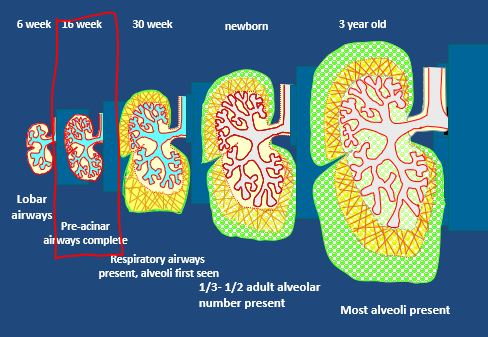
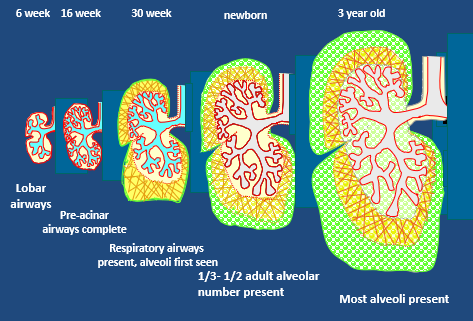
- Embryonic phase: 0/7 weeks – lung buds (left and right) and main bronchi form. Lobar airways have formed at 6 weeks (separate each of the lobes of the lung).
- Pseudo-glandular phase: 5-17 weeks – conducting airways and bronchi/bronchioles form.
- Canalicular phase: 16-27 weeks – respiratory airways and blood gas barrier forms. Infant is now viable.
- Saccular/alveolar phase: 28-40 weeks – alveoli phase – alveogenesis and angiogenesis.
- Postnatal/Adolescence phase: alveoli multiply and enlarge in size with chest cavity.
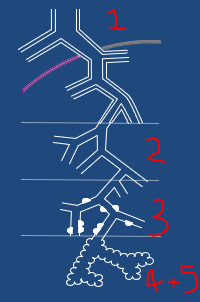
What types of processes predominate at each stage of lung development?
Top row –> bottom row = embryonic, pseudoglandular, canalicular and saccular phase.
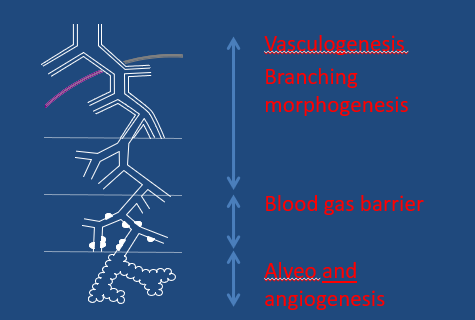
What is vasculogenesis?
Occurs in parallel with lung development, occurs when vessels form around framework provided by budding airways.
What is the embryogenesis of the lung lobes? What phase do they become apparent in lung development?
Asymmetric branching occurs to produce three lobes on the right and 2 on the left. These have formed by week 6 in the embryonic phase.
What tissues develop in the pseudo-glandular phase?
Conducting airways and bronchi/bronchioles form: 5-17 weeks.
Branching morphogenesis of airways develops into mesenchyme (embryonic tissue which develops into connective and skeletal tissue). Pre-acinar (acinar denotes regions of the lung supplied with air from bronchioles) airways are all present by 17 weeks. Development of cartilage, glands and smooth muscles continues into the canalicular phase.
What is the mechanism of branching morphogenesis? How is growth controlled? (x3)
MORPHOGENESIS = the origin and development of morphological characteristics.
Lung buds drive lung development – epithelial cells at the tips of buds are progenitor multipotent cells that differentiate into a range of lung cells based on the physical and chemical environment, stretching to mesenchyme. Growth is controlled by growth factors, inhibitors and by the physical growth itself (there is close communication between epithelial cells of the lung buds and surrounding mesenchyme, such that physical growth stimulates the mesenchyme to produce growth factors or inhibitors to control the amount of growth and branching that’s going on).
What examples are there of inductive growth factors in lung development? (x2)
F(ibroblast)GF – branching morphogenesis. Subtypes found in epithelium and mesenchyme. FORMS THE ECM and COLLAGENS.
E(pidermal)GF – epithelial proliferation and differentiation. FORMS EPITHELIUM (squamous cells alveoli).
What examples are there of inhibitory growth factors in lung development? (x2)
TGF-beta – matrix synthesis, surfactant production, inhibits proliferation of epithelium and blood vessels i.e. inhibits the actual growth and surfactant synthesis.
Retinoic acid – inhibits branching into further generations.
How and where does lung ENDOTHELIAL differentiation occur? Relationship with branching morphogenesis?
Endothelial cells differentiate in mesenchyme due to production of vascular EGF at the tip of the lung bud. Endothelial cells coalesce (come together) to form capillaries in a process called VASCULOGENESIS, with airways acting as a structural template. ***This means that VASCULOGENESIS IS MATCHED BY BRANCHING MORPHOGENESIS!!!
What, specifically, occurs in the canicular phase?
16-27 weeks – respiratory airways and blood gas barrier forms. Infant is now viable.
- Peripheral airspaces enlarge, with thinning of the epithelium (specifically TI epithelial cells, TII tend not to flatten) underlying capillaries to allow gas exchange, forming blood-gas barrier required in post-natal life.
- Epithelium differentiated to type I and type II cells.
- Surfactant cells and surfactant is detectable at 24-25 WEEKS.
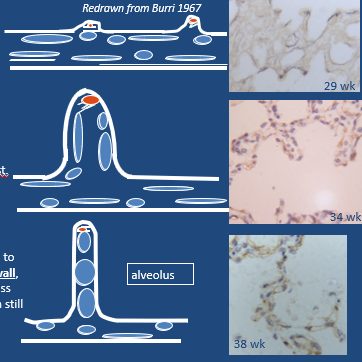
What is the mechanism of the formation of alveolar walls (in saccular phase of lung development)?
- SACCULE WALL: epithelium found on both sides of the saccule wall with double capillary network. Myofibroblasts and elastin are found at intervals along the wall.
- SECONDARY SEPTA (small ridges) develop from the wall. Wall grows into secondary septa by elastin – which is laid down and led by myofibroblasts (indicated in orange). The capillary network is found on both sides of the septa, with matrix in between.
- Capillaries have coalesced (come together) to form one capillary sheet in the alveolar wall (there’s no longer two capillary beds found on both sides of the septa). The alveolar wall is thinner and longer with less matrix.
[PHOTO 3].
When do babies become viable? Why this time?
24 weeks gestation due to canicular phase, and specifically due to the surfactant which prevents airways from collapse i.e. surfactant is the last stage before viability.
What is the nature of the lungs at birth?
Small volume, all airways present and differentiated, with most arteries and veins present, but ONLY 33-50% OF ALVEOLI PRESENT.
What mechanisms are there to increase blood flow in the lungs AFTER BIRTH? (x4)
- FIRST THING: Expansion of alveoli dilates arteries (remember, at birth, first breath dilates all the alveoli for the first time) – direct physical effect.
- Expansion of alveoli stimulates release of vasodilator agents (NO, PGI2 (prostaglandins)).
- Inhibition of vasoconstrictors present during fetal life (ET) – prevents pulmonary hypertension.
- Direct effect of oxygen on smooth muscle cells – oxygen is a smooth muscle relaxant.
What changes to blood vessels in the lungs are there at birth? (x3) Overall effect?
OVERALL EFFECT: Creates a low pressure, low resistance pulmonary vascular system.
- 10-fold increase in pulmonary blood flow.
- Arterial lumen increases, and wall thins.
- Change in cell shape and cytoskeletal organisation to allow thinning (means that arteries grow and maintain thin walls).
What happens to lungs during childhood and adolescence? (x3)
ALVEOLI increase in number until puberty/adulthood (though most are present by 3 years old), with SURFACE AREA increasing until body growth complete after adolescence. ARTERIES, veins and capillaries increase alongside alveoli.
What differences are there in alveolar recovery (e.g. after disease) between children and adults? Why?
Children have very rapid alveolar repair and recovery than adults because alveoli growth continues into adolescence, so if children lose alveoli in disease, they have much greater capacity to recover than adults – who’s alveoli are not growing and increasing in number.
Summary of the landmarks in lung development:
What is primary ciliary dyskinesia?
Autosomal recessive mutation that impacts ciliary function. Dynein arms are absent, causing cilia to become static so mucous is not moved and cleared; will get bronchiestasis and respiratory failure.
What are congenital bronchial cartilage defects? (x2 types)
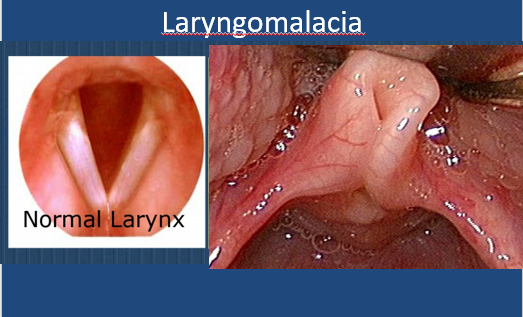
Normally, cartilage are incomplete rings with irregular plates. Abnormally, they can be malacic (floppy). Can be generalised (causing laryngomalacia) or localised (malacic segment of cartilage – may occur due to a developmental issue in another tissue that puts an external compression on the adjacent cartilaginous plate – so that as that plate also develops, it develops abnormally and ends up malacic).
What is a laryngomalacia?
Omega shaped epiglottis with folds that collapse on inspiration causing severe airway obstruction – from immature, soft cartilage.
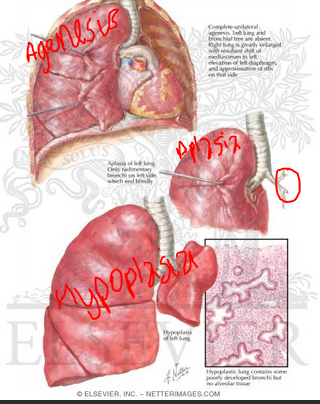
What are the three types of lung growth anomalies?
AGENESIS: complete absence of lung and vessel – rare and associated with other conditions.
APLASIA: blind ending bronchus (circled), no lung or vessel.
HYPOPLASIA: bronchus and rudimentary lung are present, but all elements are reduced in size and number.
What is cystic pulmonary airway malformation (CPAM)?
Previously called CCAM. Diagnosed on antenatal ultrasound.
It is a defect in pulmonary mesenchyma resulting in abnormal differentiation in the 5-7th week of development. Normal blood supply though.
What is congenital lobar emphysema?
Progressive lobar overexpansion, expanding over the midline and squashing other lobes due to weak cartilage or one-way valve effects i.e. one of the lobes is abnormally LARGE, and puts pressure on the other lobes – the other lobes are consequently squashed and small.

-
Respiratory anatomy37
-
Ventilation36
-
Gas transport118
-
Respiratory cell biology62
-
Control of breathing38
-
Respiratory mechanics29
-
Sensory Aspects of Respiration39
-
Lung infection and immunology58
-
Lung cancer42
-
Lung development25
-
Pulmonary circulation24
-
Clinical assessment of respiratory disease52



