What is the pulmonary circulation?
Blood supplied to GAS EXCHANGE SURFACE for oxygenation, it does not SUPPLY the lung tissue.
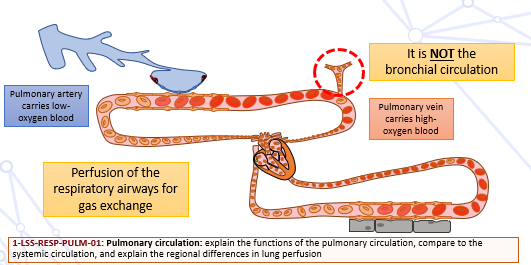
What is the bronchial circulation?
The bronchial arteries come off the thoracic aorta and provide the lung parenchyma (functional tissue of an organ) with oxygen and nutrition and eliminates waste products. Bronchial veins converge – most drains in the vena cava like the rest of the systemic circulation, while SOME bronchial veins converge and drain into the pulmonary veins and into the left atria instead.
What are the differences between the pulmonary and systemic circulations? (x6) TLVLSR
- WALL THICKNESS:LUMEN RATIO: is smaller in pulmonary arteries (thinner muscles) so more compliant as pressure is lower, and stops unnecessary increase in blood pressure (prevents pulmonary hypertension – REMEMBER, PULMONARY ARTERIOLAR WALL THINNING IS IMPORTANT IN BABIES FOR THIS REASON [Lung development]). 2. Lungs close to heart, so LOCALISED, so don’t need HIGH PRESSURE circuit – this explains (1). 3. Right VENTRICLE much thinner wall to generate a reduced force. 4. Systemic circulation: 4.5L; Pulmonary circulation: 0.5L – most of each volume exists in the veins. 5. STATISTICS: pulmonary circulation operates at 10% volume at 15% of the pressure with 10% of the gradient (artery to veins) of the systemic circulation. 6. Much LOWER RESISTANCE to increased flow. TLVLSR (TeL Aviv Loves Sending Rockets).
What are the functions of the pulmonary circulation? (x3)
- GAS EXCHANGE: pulmonary transit time = 0.75s, with CO2 leaving and O2 entering. 2. METABOLISM OF VASOACTIVE SUBSTANCE: endothelial cells express ACE to convert ACTI to ACTII (vasoconstrictor) and ACE breaks down bradykinin (vasodilator) allowing vasoconstriction to reduce pulmonary hypertension. 3. BLOOD FILTRATION: emboli (e.g. air bubbles, ruptured fatty plaques, venous thrombosis) are caught in pulmonary vessels. Therefore, pulmonary circulation filters out emboli before reaching systemic arteries – if small, it can be eliminated and broken down in the pulmonary microcirculation; if large, will be local perfusion obstruction.
What is the difference between an embolus and an embolism?
EMBOLUS: mass in circulation causing obstruction. EMBOLISM: event characterised by major artery obstruction.
What are pulmonary shunts?
Circumstances leading to the bypassing of the respiratory exchange surfaces.
What three examples are there of pulmonary shunts?
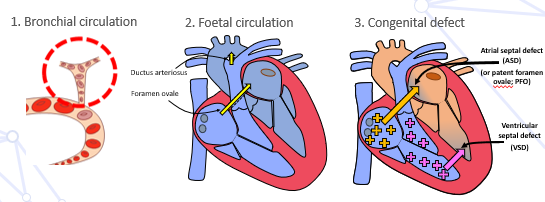
- BRONCHIAL CIRCULATION: blood from left side of the heart supplies the parenchyma but SOME drains back to pulmonary veins to re-enter left side of the heart – skipping the systemic circulation and right side of the heart. 2. FOETAL CIRCULATION: in utero, blood bypasses non-ventilated lungs using the foramen ovale (right atrium to left atrium) and the ductus arteriosus (pulmonary arteries to aortic arch). This is BENEFICIAL because the pulmonary circulation in the foetus is VERY VASOCONSTRICTED, so it would be harmful to force blood through it. 3. CONGENITAL DEFECTS: atrial septal defect (or patent foramen ovale), or ventricular septal defects lead to blood mixing across the septa. They are types of congenital heart diseases and often require corrective surgery. RESULT: Initially, blood is pumped from the higher pressure side on the left and therefore crosses into the lower pressure right side – over time, this results in hypertrophy on the right side of the heart to try and match the pressure of the blood coming over from the left. [PHOTO 3].
How is resistance affected in the pulmonary circulation? (x3)
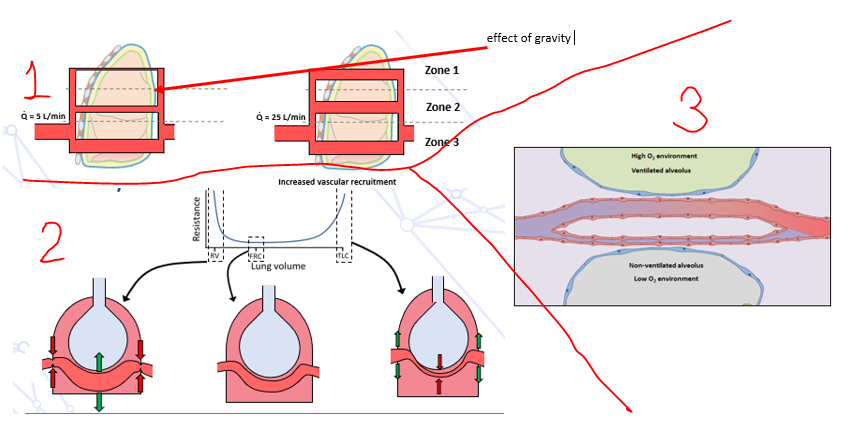
- INCREASING CARDIAC OUTPUT: pulmonary circulation is a LOW RESISTANCE, HIGH CAPACITY CIRCUIT (at resting Q = 5L/min). Increased Q (flow rate) should increase MAP and pulmonary oedema and reduce function BUT arteries distend due to greater compliance and perfusion to hypoperfused beds (towards to apex – look at photo) increases, leading to negligible MAP change and minimal fluid leakage – so no pulmonary oedema and no detriment to pulmonary function. 2. EFFECT OF INCREASING VENTILATION: (i) Inspiration compresses intra-alveolar alveolar blood vessels (alveolar vessels are compressible because they have no cartilage); so, there’s HIGH RESISTANCE IN INTRA-ALVEOLAR VESSELS NEAR TOTAL LUNG CAPACITY. (ii) Expiration compresses extra-alveolar blood vessels (look at photo) because thorax decreases in volume, so pinches outsides; so EXTRA-ALVEOLAR VESSELS EXHIBIT HIGH RESISTANCE NEAR RESIDUAL VOLUME. (NB about photo: FRC is the functional residual capacity i.e. volume in lungs at end of passive expiration.) 3. HYPOXAEMIA: systemically causes vasodilation but in pulmonary circulation causes vasoconstriction (O2 sensitive K+ channels close, decreasing the efflux (flowing out) of ions and increasing membrane potential until depolarisation and VSMC contraction) – stops blood flow through unventilated alveoli to match ventilation and perfusion. [PHOTO 4].
What is the benefit of high compliance of pulmonary vessels? (x3)
Reduced risk of oedema. Reduced stress on the right ventricle. Reduced velocity, which allows for effective gas exchange.
What context is pulmonary vasoconstriction in hypoxaemia beneficial and disadvantageous?
BENEFICIAL: during foetal development to increase resistance in pulmonary circuit, and hence increase flow through shunts (first breath increases alveolar PO2 and dilates pulmonary vessels). COPD: bronchitis and emphysema are associated with reduced alveolar ventilation and air trapping, which means ALL lung vessels constrict leading to pulmonary hypertension, RIGHT VENTRICULAR HYPERTROPHY and hyperplasia and congestive heart failure. The last effects are because a greater effort is required from the RV to pump into this higher-pressure circuit.
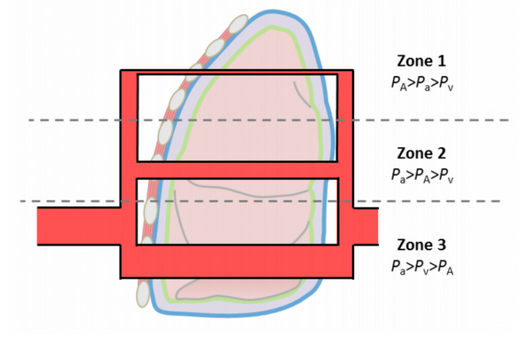
What is the three-zone model in the lungs? Why? What is the relativity of PA, Pa and Pv in each zone?
Pulmonary blood flow to the apex (top) of the lung is lower than the base because the pulmonary circulation is a low-pressure circuit and favours the path of least resistance. The distribution of the three zones is associated with cardiac output – the zones are pushed upwards in exercise. Look at photo for PA, Pa, PV relativities.
What is the property of pulmonary capillaries that gives it fluid-movement dynamics?
Pulmonary capillaries are more porous (leaky) than their systemic counterparts, which means that fluid moves more easily between capillaries, the interstitium and the alveoli.
What are the four key pressures that affect fluid balance in the lungs?
- Capillary/Plasma hydrostatic pressure – the force pushing water out of the vessel. Highest at arterial end and decreases across the venous end. 2. Interstitial hydrostatic pressure – this force tries to push water into the vessel, but barely noticeable. 3. Plasma protein oncotic (colloid osmotic) pressure – this force tries to draw water into the vessel. This is greater than in the interstitium – blood should contain a lot more protein. 4. Interstitial protein oncotic pressure – this force tries to draw water into the interstitium – originates from soluble ECM molecules.
What are the values for the four key pressures that affect liquid balance in the lungs?
Capillary hydrostatic pressure – mean value is 9 mmHg. Interstitial hydrostatic pressure – 0 mmHg. NEGLIGIBLE. Plasma protein oncotic pressure – 25 mmHg. Interstitial protein oncotic pressure – 17 kPa.
What is the net effect of the four key pressures that affect fluid balance in the lungs? What happens to the fluid?
1 mmHg force from the vessels into the interstitium. This steady fluid loss is SMALL and is easily drained by the lymphatic system.
What happens if the lymphatic system in the lungs fail, or fluid accumulates at a rate higher than the lymphatic system?
A pulmonary oedema may develop. This would initially be a pulmonary interstitial oedema, which may develop into a pulmonary alveolar oedema.
What are the causes of pulmonary oedema? (x4 – x2, x4, x2, x1).
- INCREASING THE INTRAVASCULAR HYDROSTATIC PRESSURE: mitral valve stenosis and heart failure. 2. REDUCING THE ONCOTIC PRESSURE: hypoproteinaemia, protein-losing nephropathies (in the kidneys), liver cirrhosis, protein-losing enteropathies (describes a pathology of the intestines e.g. diarrhoea). 3. INCREASING INTERSTITIAL ONCOTIC PRESSURE: pulmonary endothelial damage, infection. 4. BLOCKED LYMPHATIC SYSTEM: cancer (resulting in lymphoedema – when an oedema is caused by a problem with the lymphatic system).
What is a general name for the outward, pushing forces, and the inward, pulling forces in fluid balance?
PUSHING = hydrostatic. PULLING = oncotic.
What are the consequences of pulmonary oedema? (x3)
- Oedematous lungs are much less compliant (increased stiffness). The less compliant lung requires more effort to ventilate, this increased work of breathing can present dyspnoea. 2. Excessive oedema can also cause walls of the bronchioles to become swollen which increases resistance and the work of breathing further. 3. Excessive oedema in the interstitial space can increase the diffusion distance and impede gas exchange (Fick’s law).
Why does mitral valve stenosis increase plasma hydrostatic pressure?
Mitral valve is an atrioventricular valve found between the left atrium and ventricle (left ventricle receives blood from the pulmonary circulation). Stenosis causes hardening of the valve, so pressures back up through pulmonary circulation, increasing pulmonary pressure. This causes net accumulation of fluid that exceeds lymphatic capacity to drain it.
How does liver failure lead to reduced oncotic pressure?
Liver synthesises plasma proteins, so = reduced plasma oncotic force. So reduced sucking force back into blood vessel.
How does cancer result in blocked pulmonary lymphatic system?
Metastatic breast cancer.
Which atrium has the largest amount of venous return? Why?
The left atrium receives slightly more blood due to bronchial drainage shunt.
Which region of the lung has the best ventilation-perfusion (V/Q) ratio?
The middle – hits a 1 somewhere in the middle. Base regions have more perfusion than ventilation.

-
Respiratory anatomy37
-
Ventilation36
-
Gas transport118
-
Respiratory cell biology62
-
Control of breathing38
-
Respiratory mechanics29
-
Sensory Aspects of Respiration39
-
Lung infection and immunology58
-
Lung cancer42
-
Lung development25
-
Pulmonary circulation24
-
Clinical assessment of respiratory disease52



