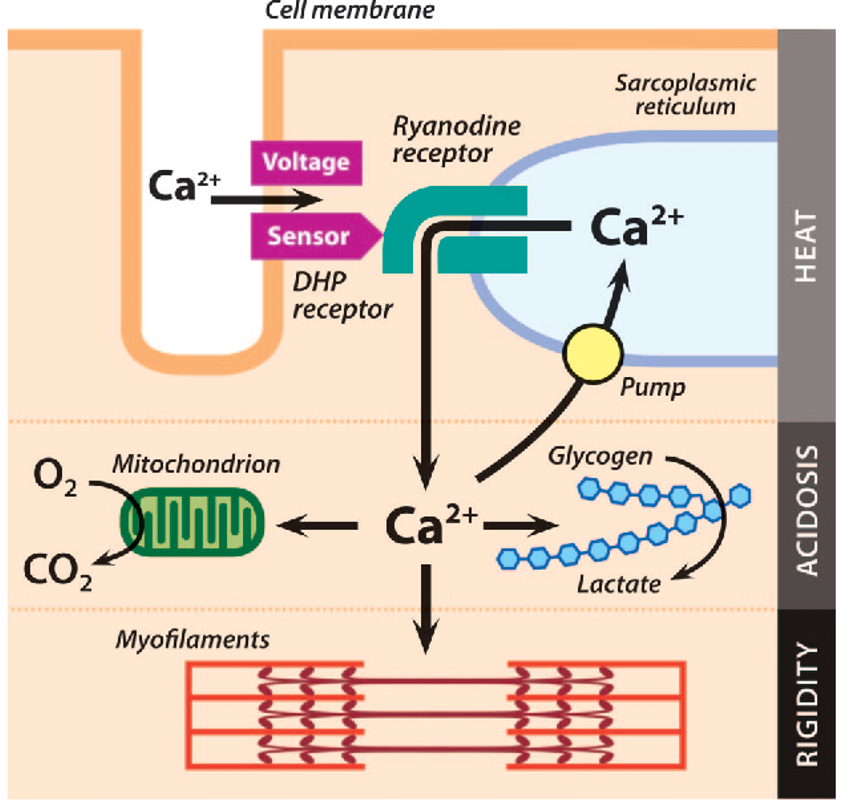
What is malignant hyperthermia?
Inherited disorder of skeletal muscle
What triggers Malignant Hyperthermia?
Triggered in susceptible humans or animals by volatile inhalation agents or succinylcholine
What anesthetics can cause Malignant Hyperthermia?
- Sevoflurane
- desflurane
- isoflurane
- halothane
- enflurane
- ether
What are other triggers for Malignant Hyperthermia?
Vigorous exercise and heat**
What is malignant hyperthermia characterized by?
- Hyper metabolism
- Skeletal muscle damage
- Hyperthermia
- Death
True incidence of Malignant Hyperthermia is ________
Unknown
What is the genetic component of Malignant Hyperthermia?
Autosomal dominant
What is the clinical incidence in adults with Malignant Hyperthermia?
1 in 3,000 – 1 in 50,000 anesthetics
What is the pediatric incidence of Malignant Hyperthermia?
Children under 15 years comprise approx. 52% of all reactions
Which gender is more like to cause Malignant Hyperthermia?
More common in males (2.5-4.5 times)
What is the autosomal dominant traits for Malignant Hyperthermia?
One abnormal gene needed to manifest symptoms
How many mutations are associated with Malignant Hyperthermia?
Associated with 34 genetic mutations
What are the most common genetic mutations for Malignant Hyperthermia?
- RYRI (70%) (ryanodine receptor for Ca++ release at SR)
- CACNA1S (1%) (subunit of dihydropyrdine Ca++ channel on T-tubes)
What is variable penetrance mean in association with Malignant Hyperthermia?
Susceptible patient does not necessarily trigger to every exposure
Review genetic components of Malignant Hyperthermia.
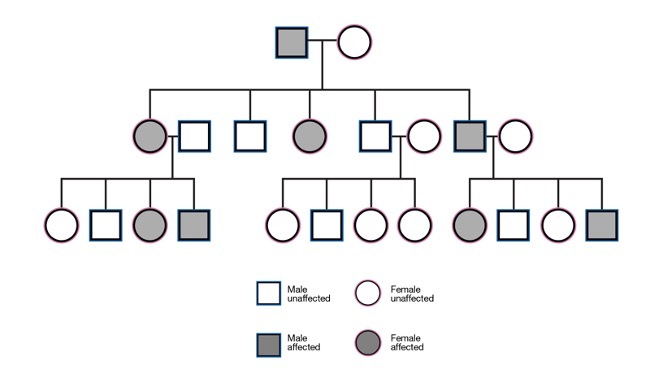
The gene for the RYR 1 receptor is located on _________
chromosome 19
Where are all of the genetic mutations associated with Malignant Hyperthermia located?
chromosome 19
Where is calicum stored?
Invaginations of plasma membrane known as t-tubules which are surrounded by sarcoplasmic reticulum which stores intracellular calcium.
What is the unique feater of the sarcolemma?
- It has holes in it.
- These “holes” lead into tubes called transverse tubules (or t-tubules for short).
- These tubules pass down into the muscle cell and go around the myofibrils.
- However, these tubules do not open into the interior of the muscle cell; they pass completely through and open somewhere else on the sarcolemma (i.e., these tubules are not used to get things into and out of the muscle cell).
What is the function of the T-tubules?
The function of t-tubules is to conduct impulses from the surface of the cell (sarcolemma) down into the cell and, specifically, to another structure in the cell called the sarcoplasmic reticulum.
How is the muscle fiber excited?
- A muscle fiber is excited via a motor nerve that generates an action potential that spreads along the surface membrane (sarcolemma) and the transverse tubular system into the deeper parts of the muscle fiber.
- A receptor protein (DHP) senses the membrane depolarization, alters its conformation, and activates the ryanodine receptor (RyR) that releases Ca2+ from the SR. Ca2+ then bind to troponin and activates the contraction process
Review the normal skeletal muscle.
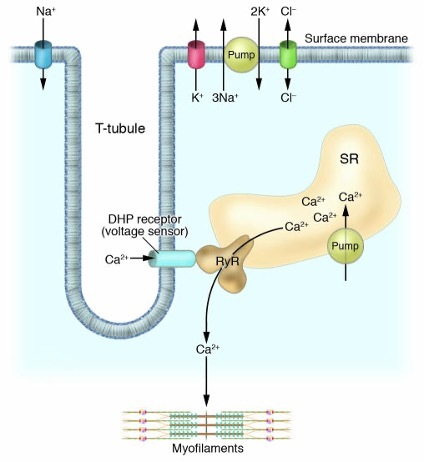
Describe the normal skeletal muscle diagram.
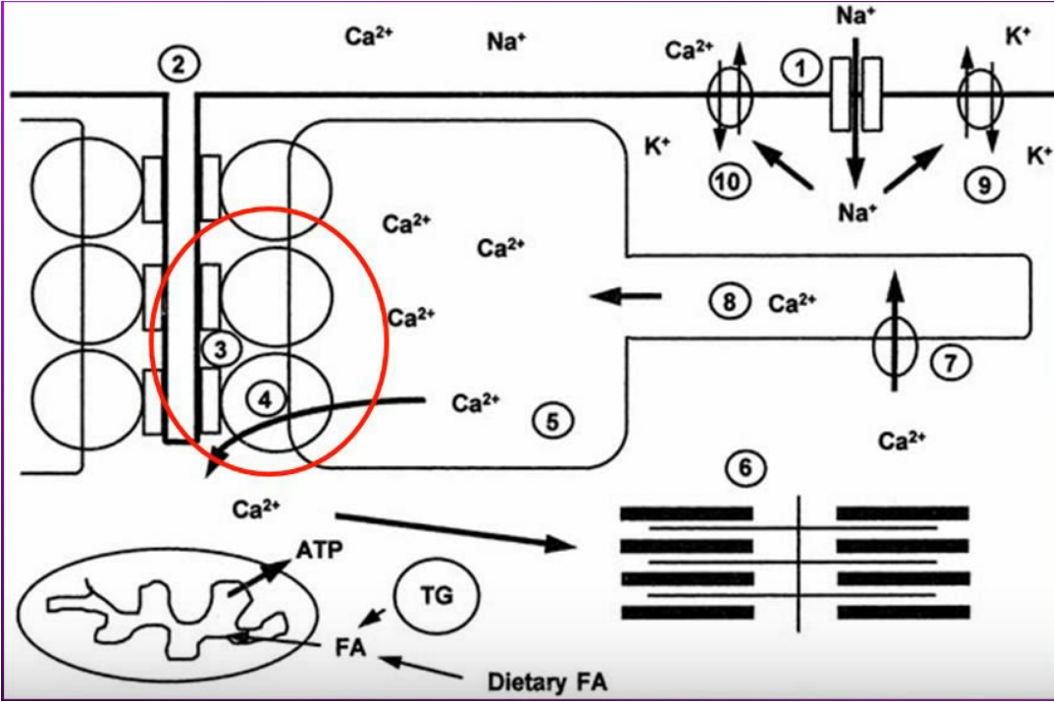
Interior of skeletal muscle cell:
- Plasma membrane
- Invagination of plasma membrane into the cell (t-tubule)
- Protein embedded in the wall of the t-tubule – Dihydropyridine protein
- Large protein in sarcoplasmic reticulum - ryanodine
- Sarcoplasmic reticulum that stores calcium in the cell
- Contractile proteins in the cell
- Reuptake of intracellular calcium after contraction
Bottom left = mitochondria (energy producers)
What does the dihydropyridine receptor sense?
- The dihydropyridine receptor senses the membrane depolarization, alters its conformation, and activates the ryanodine receptor (which releases Ca2 from the sarcoplasmic reticulum, a Ca2 storage area).
- Ca2 binds to troponin and activates the contractile machinery.
- In classic malignant hyperthermia, uncontrolled Ca2 release from the SR leads to an increased pump activity and heat production, mainly by the adenosine triphosphate-dependent Ca2 reuptake into the SR.
- To cope with the increased energy consumption, glycogen stores will be depleted for maximal adenosine triphosphate production