Compare the uterus in nonpregnant and pregnant woman
- General morphology
- Weight
- Capacity
- Nonpregnant
- Pregnant
- General morphology
- Nonpregnant
- Almost-solid structure
- Pregnant
- Thin-walled muscular organ
- Nonpregnant
- Weight
- Nonpregnant
- 70 g
- Pregnant
- 1,100 g
- Nonpregnant
- Capacity
- Nonpregnant
- 10 mL or less
- Pregnant
- 5 to 20 L (500 to 1,000X greater)
- Nonpregnant
Cause of enlargement of uterus
Hypertrophy or hyperplasia
Hypertrophy rather than hyperplasia
Uterine hypertrophy early in pregnancy probably is stimulated by:
- Early in pregnancy – estrogen
- After 12 weeks – pressure exerted by the expanding products of conception
Memory aid:
- _E_strogen
- _E_nlarges the uterus
T/F. Hypertrophy of early pregnancy occurs entirely due to mechanical distention
False; similar uterine changes are observed with ectopic pregnancy
Uterine enlargement is most marked in this portion of the uterus
Fundus
The position of the placenta also influences the extent of uterine hypertrophy. Why?
The portion of the uterus surrounding the placental site enlarges more rapidly than does the rest
Describe the attachment of the tubes and the ovarian + round ligaments to the fundus
- Early month of pregnancy
- Later months of pregnancy
- Early month of pregnancy
- only slightly below the apex of the fundus
- Later months of pregnancy
- slightly above the middle of the uterus
Describe the shape of the uterus as pregnancy progresses
- Pre-pregnancy – pear shape
- First few weeks (8-10 weeks) – pear shape
- 12 weeks – almost spherical
- Subsequent – ovoid
Describe the location of the uterus as pregnancy progresses
- 12 weeks - too large to remain entirely within the pelvis
- As uterus enlarges, it:
- contacts the anterior abdominal wall
- displaces the intestines laterally
- superiorly reaches almost to the liver
With ascent of the uterus from the pelvis, it usually undergoes what? This is caused by what? What is the implication?
- Phenomenon
- Dextrorotation
- Cause
- Rectosigmoid on the left side of the pelvis
- Implication
- The round ligament must be avoided in lower uterine incision
Softening of the uterine isthmus
Hegar sign
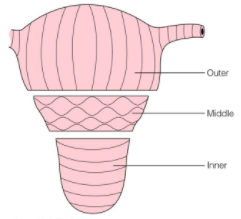
Arrangement of uterine muscle cells and description (indicate the main portion of the uterine wall)
- Outer hoodlike layer
- Arches over the fundus and extends into various ligaments
- Middle layer
- Main portion of uterine wall
- Figure of 8 configuration
- Perforated by blood vessels
- Internal layer
- With sphincter-like fibers around the fallopian tube orifices and internal os of the cervix
Memory aid:
- _M_ain
- _M_iddle
Uteroplacental blood flow increases progressively, with estimates ranging ___ in near term
450 to 650 mL/m
- Summary:*
- More or less half liter
Physiologic reason for increase in uterine blood flow
- Increase in maternal-placental blood flow – vasodilation d/t estrogen action
- Increase fetal-placental blood flow – a continuing growth of placental vessels
Uterine finding on bimanual exam
Uterus feels soft and elastic
Fundal height by weeks 12, 15, 20, 28, 32, 36, 40 weeks
- 12 – barely palpable above pubic symphysis
- 15 – midpoint between pubic symphysis and umbilicus
- 20 – at the umbilicus
- 28 – 6 cm above the umbilicus
- 32 – 6 cm below the xyphoid process
- 36 – 2 cm below xyphoid process
- 40 – 4 cm below xiphoid process
Cervical changes and the physiologic mechanism for such change
- Goodell’s sign
- Due to increased vascularity and edema of cervix
- Cervical mucus beading
- Due to progesterone
- Arias-Stella reaction
- Endocervical gland hyperplasia and hypersecretory appearance
What is Goodell’s sign?
Cervical softening and cyanosis due to increased vascularity and edema of the entire cervix
Cervical mucus beading occurs as a result of ____
Progesterone
What is Arias-Stella reaction?
Endocervical gland hyperplasia and hypersecretory appearance
Cervix palpation on pregnant versus nonpregnant
- Nonpregnant
- feels like the cartilage of the nose
- Pregnant
- feels like the lips of the mouth
Physiologic mechanism for mucus plug formation
↑ in gland activity leads to the formation of a mucous plug
Mucous plug composition and function
Immunoglobulins and cytokines, which act as a barrier to bacteria
Corpus luteum
- Origin
- When does it maximally function
- Produces what hormome
- Origin
- Remains of the ovarian follicle that has released a mature ovum during a previous ovulation
- When does it maximally function
- First 6-7 weeks of pregnancy
- Produces what hormome
- Progesterone
- Memory aid:*
- corProgesterone

-
Maternal Physio - Cardiovascular17
-
Maternal Physio - Hema and Immuno30
-
Maternal Physio - Pulmo10
-
Maternal Physio - Repro34
-
Maternal Physio - Integumentary12
-
Maternal Physio - Breast4
-
Maternal Physio - Metabolic23
-
Maternal Physio - Urinary12
-
Maternal Physio - GIT12
-
Maternal Physio - Endo14
-
Fetal conditions - Fetal circulation6
-
Fetal conditions - Amniotic fluid3
-
Fetal conditions - Teratology38
-
Prenatal care - Hx, PE and Dx31
-
Prenatal care - Diagnosis of pregnancy18
-
Prenatal care - Prenatal nutrition11
-
Parturition - Phases11
-
Parturition - Stages of labor17
-
Labor and delivery - Overview3
-
Labor and delivery - Induction of labor19
-
Labor and delivery - The passenger10
-
Labor and delivery - Functional divisions and phases of cervical dilatation4
-
Labor and delivery - The passageway0
-
Labor and delivery - Cardinal movements0
-
Labor and delivery - Episiotomy10
-
Operative vaginal delivery - Overview0
-
Operative vaginal delivery - Forceps delivery0
-
Operative vaginal delivery - Breech delivery0
-
OB analgesia and anesthesia - Overview0
-
OB analgesia and anesthesia - Overview 20
-
OB analgesia and anesthesia - Overview 30
-
Puerperium0
-
Family planning - Overview0
-
Family planning - Fertility awareness-based0
-
Family planning - Artificial methods0
-
Fetal surveillance - Overview3
-
Fetal surveillance - FHT monitoring19
-
Fetal surveillance - IPM abnormalities16
-
Fetal surveillance - BPP9
-
Fetal surveillance - CST6
-
Hormones - hCG13



