What is potential energy? What are the types of potential energy
Potential energy: the energy that is associated with a given object’s position in space or other intrinsic qualities of the system
- Gravitaional potential energy (U=mgh)
- Elastic potential energy (U= 1/2kx2)
What is forced oscillation?
- If a periodically varying force is applied to a system, the system will be driven at a frequency equal to the frequency of the force
- Note: If the frequency of the applied force is close to the natural frequency of the system, then the amplitude becomes much larger
- Example: If a parent pushes a child on a swing at a frequency nearly equal to the frequency at which the child swings back toward the parent, the arch of the swinging child will become larger and larger
What is total mechanical energy? What is the associated equation?
The sum of an object’s potential and kinetic energy
E= U+ K
U= mgh or 1/2kx2
What is the equation to determine a scalar quantity from two vectors?
- A ⋅ B = |A| |B| cos θ
With regard to total internal reflection, what is the equation that is derived from Snell’s Law, that allows us to calculate the critical angle?
θC = sin-1 (n2/n1)
Think:
n1 sin θ1 = n2 sin θ2
If sin 90= 1, then and you solve for the other angle, you get the above equation
What is noise, scientifically?
- Sounds that we do not find particularly musical, such as tapping a pencil, hitting a chair, or crumpling paper
What is mechanical advantage? What are some tools that can provide this? What is the associated equation?
- A measure of the increase in force accomplished by using a tool
- Simple machines such as wedge, wheel and axel, level, pulley and screw provide mechanical advantage
- Mechanical advantage = Fout/Fin
- This is the ratio of the magnitudes of the force exerted on a object by a simple machine (Fout) to the force actually applied on the simple machine (Fin)
How long are γ- light rays?
< 10-2 nm
What is Conduction? Convection? Radiation?
Conduction: the direction transfer of energy from molecule to molecule through molecular collisions
- There must be direct physical contact between the molecules
Example: heat that conducts to your fingers if you touch a hot stove
Convection: transfer of heat by the physical motion of fluid over a material
- Because convection involves flow, only liquids and gases can transfer energy by this means
Radiation: the transfer of energy by eletromagnetic waves
- Radiation can transfer energy through a vaccuum, which the others cannot
- How sun heats the earth
What is work? What is the associated equation when considering
Work is a process by which energy is transferred from one system to another
- One of two ways in which energy can be transferred (the other is via heat)
What is timbre?
- The quality of the sound; determined by the natural frequency of frequencies of the object
How long are radio waves?
109 to 1m
What is Snell’s Law? What is the associated equation?
- This is the law that describes how the speed of light is altered as it travels through a medium
n = c / v
n: index of refraction of the medium (dimensionless quantity)
c: speed of light in a vacuum
v: speed of light in the medium
n1 sin θ1 = n2 sin θ2
What is the specific heat of an object? What is the specific heat of water?
What is the equation which relates the heat gained or lost by an object and hte change in temperature of that object?
specific heat (c) of a substance is defined as the amount of heat energy required to raise one gram of sustace by one degree Celsius
Specific heat of water: 1cal/g×K
Equation: q=mcΔT
m: mass
c: specific heat
ΔT: change in temperature
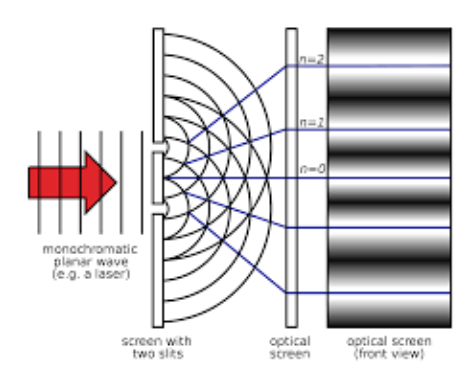
What is the equation which provides the position of dark fringes with Young’s Double-Slit Expierment?
- With regard to experiment, why does this specific type of pattern occur?
d sinθ = (n+1/2 )λ
d: distance between the two slits
θ: the angle between the line drawn from the midpoint between the two slits to the dark fringe and the normal
n: an integer indicating the number of the fringe
λ: the wavelength of the incident light
- This pattern occurs because the diffracted rays emerging from two different slits interefere with one another; where there is constructive interefere, we see bright fringes and where there is destructive interference, we see dark fringes
What is gravitational potential energy? What is the associated equation?
- An objects potential to do work, dependent on an object’s position with respect tto seom level identified as the datum (“ground” or zero potential energy position)
- U=mgh
U: potential energy
m: mass
g: gravity
h: height
- Note the direct 1:1 relationship between U and all three variables
What type of waves are EM waves? Why?
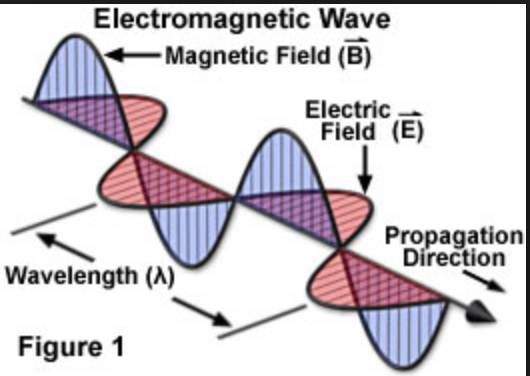
- EM waves are transverse waves because teh oscillating electric and magnetic field vecotrs are perpendicular to the direction of propogation
What regard to closed pipes, where there is a node at the closed end and an antinote at the open end, what is the equation which describes wavelength of the standing wave that can be supported by this pipe?
What is the frequencies of the standing wave supported by this pipe?
λ= 4L/n
n: only odd, positive integers (1, 3, f…)
f= nv/4L
v: wave speed
What is Kirchoff’s Loop Rule?
- Around any closed circuit loop, the sum of voltage sources will always the equal to the sum of voltage (potential) drops
- A consequence of the conservation of energy; all the electrical energy supplied by a source gets fully used up; no excess energy appears and no energy disappears that cannot be accounted for (but can change forms)
V source = V drop
What part of a wave does not change as it enters a new medium?
- The frequency of the wave
What is an electric field? What is the equation which describes the magnitude of the electric field?
Electric field: the surrounding environment created by every electric charge (just like mass creates a gravitational field)
- To determine this, we place a test charge (q) in the presence of a source charge (Q), the charge creating the electric field
E= Fe/q = kQ/r2
E: magnitude of the electric field
Fe: magnitude of the force felt by the test charge, q
k: electrostatic constant
Q: source charge magnitude
r: distance between the charges
How do pulleys work?
- We are able to lift heavy objects to the desired height by using a smaller foce through a greater distance, in order to lift this heavy object to its final height
- Example: There is a crate that must be lifted to a shelf 3 meters above then ground, then both sides of the supporting rope must shorten by 3 meters, an dh the only way to accomplish this is by pulling through 6 meters of rope
What is rotational equilibrium?
- Exists only when the vector sum of all the Torques acting upon an object is zero
- Called the second condition of equlibrium
- Torques that generate clockwise rotation are considered negative; torques that generate counterclockwise rotation are positive
What is pressure? What is the associated equation?
Pressure: the ratio of force per unit area
P=F/A
P: pressure
F: force
A: area
Unit: Pascal (1Pa=1N/m2)






