What is meant by medicines optimisation?
A person-centred approach to safe and effective medication use, to ensure people obtain the best possible outcomes from their medicines. Medicines optimisation applies to all people who may or may not take their medicines effectively.
Define a structured medication review
“A structured, critical examination of a person’s medicines with the objective of reaching an agreement with that person about treatment, optimising the impact of medicines, minimising the number of medication-related problems and reducing waste.” NICE 2015
A SMR must review ALL of the patient’s medications.
Define a medication use review (MUR)
It involves the pharmacist conducting a structured review with patients about their medicines use. The aims of this service are to improve patients knowledge, concordance and use of medicines (i.e. it involves a pharmacist asking a patient about their use of the medicaations). An MUR is not a clinical review. Pharmacist may flag the results of an MUR to a clinician for a full SMR.
Who can complete a SMR?
In order to complete an SMR, professionals must be competent and have:
- A prescribing qualification and advanced assessment & history taking skills
- OR be enrolled in a current training pathway to develop these (e.g. pharmacists must have completed or be enrolled on the PCPEP or similar training that includes independent prescribing)
Example of professionals who can conduct SMR: doctors, advanced nurse practioners, clincial pharmacists.
Examples of professionals who cannot conduct SMR: practice nurses (with no prescribing qualifications), pharmacists that have not completed or are not enrolled on education pathway that includes independent prescribing
State some patient groups which should be prioritised for an SMR
- Care homes
- Severe frailty
- Recent hospital admission and/or fall
- Taking higher risk medicines e.g. Lithium, NSAIDs, digoxin
- Medicines commonly associated with medication errors
- Complex & problematic polypharmacy
- Isolated or housebound
- Where non-compliance is suspected or known
- On addictive pain medication
… and more!
Remind yourself of what the STOPP START toolkit is
“Screening Tool of Older Person’s Prescriptions and Screening Tool to Alert Right Treatment”.
Decision aid for supporting medication review. It consists of a series of rules/suggestions related to high-yield problems in prescribing for older people, both in terms of reducing medication burden (STOPP) and adding in potentially benefical therapy (START)
All primary care clinical systems (including those in community pharmacy medication records) have built in processes to calculate the frailty index; true or false?
False; tool is embedded within main primary care systems but small number of practices don’t have access. The clinical system used by community pharmacists does not have this feature.
What is the electronic frailty index eFI?
The electronic frailty index (eFI) uses the existing information within the electronic primary health care record to identify populations of people aged 65 and over who may be living with varying degrees of frailty. It uses a ‘cumulative deficit’ model to measure frailty on the basis of the accumulation of a range of deficits. These deficits include clinical signs (e.g. tremor), symptoms (e.g. vision problems), diseases, disabilities and abnormal test values. It measures 36 deficitis in total.
State some methods of assessing frailty if you don’t have access to the eFI
NICE reccomends using one of the following in primary care to assess frailty:
- Informal assessment of gait speed (e.g. how long it takes to walk to door)
- Formal assessment of gait speed (taking more than 5 seconds to walk 4m indicates frailty)
- Self-reported health status (ask pt how they would rate their health out of 10. Score of 6 or less indicates frailty)
- PRISMA-7 questionnaire (3 or more positives indicates frailty)
Rockwood clinical frailty score could also be used (although not listed on NICE)
State the 7 questions on the PRISMA-7 questionnaire
- Are you more than 85 years old?
- Are you male?
- In general do you have any health problems that require you to limit your activities?
- Do you need someone to help you on a regular basis?
- In general, do you have any health problems that require you to stay at home?
- If you need help, can you count on someone close to you?
- Do you regularly use a stick, walker or wheelchair to get about?
3 or more POSITIVE answers indicates frailty
What is the anticholinergic burden scale?
ABCS lists the anticholinergic activity of commonly prescirbed drugs to help clinicians quantify the risk of harm due to taking anticholinergic drugs. Anticholinergics are associated with increased risk of cognitive impairment, falls and delerium.
Drugs are put into 3 categories where they score either 1, 2 or 3 points. A score of 3 or more is considered clinically relevant (70% chance of twor or more adverse effects)
What framework can you use to help you structure a medication review?
Describe this framework
NO TEARS toolkit:
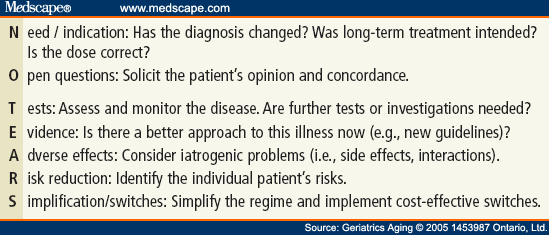
State the 7 steps of a medication review and state whats’ generally included in each step
- Assess patient: PMH? What medications are they on? Frailty? Compliance/adherence?
- Define overall treatment/patient goals: Agree shared desired health outcomes. Agree priority medications to discuss (may need multiple appointments to review all medications)
- Idenfity inappropriate medications: Which conditions are active and hence need treatment? Which condition bothers patient most? Which medications are they not taking? Any OTC medications?
- Asses each medicine for specific risks & benefits in patient context: use tools such as STOPP START. Review pathology results in relation to medications. Cosnider if pt will live long enough to benefit (example of this is statin for secondary prevention of MI)
- Stop or reduce dose: Discuss with prescriber (if not you). Review and agree medications to stop with pt. Withdraw slowly. Follow up with written summary.
- Communicate actions with prescriber: send follow up summary to prescriber (if not you) and pt/carer. Inform other professionals involved in care e.g. pharmacist, community diabetic nurse etc..
- Monitor & adjust as appropriate: Discuss what future monitoring is required with pt and ensure they understand/agree. Review again in future.
When doing a structured medication review you should use both the NO TEARS toolkit and the 7 steps to a medication review together; true or false?
True. You should fit the NO TEARS toolkit/framework into your 7 steps. They fit together quite easily. NOTE: some clinicians may discuss different things in different steps- this is okay as long as all areas are covered by end of review.
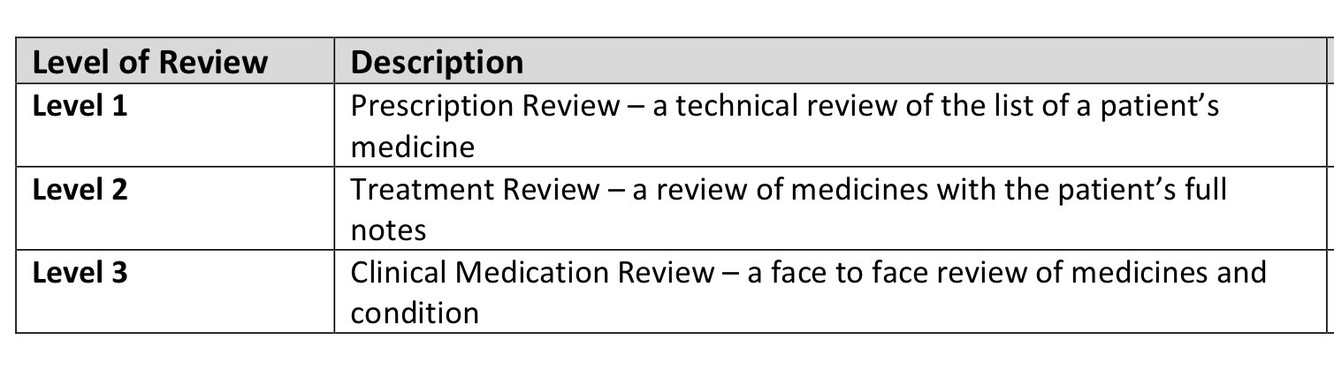
There are three different levels of medication reviews; what are these different levels dependent on?
Compare the three different levels of review
“Levels” of medication review are dependent on the level of detail used for the review:
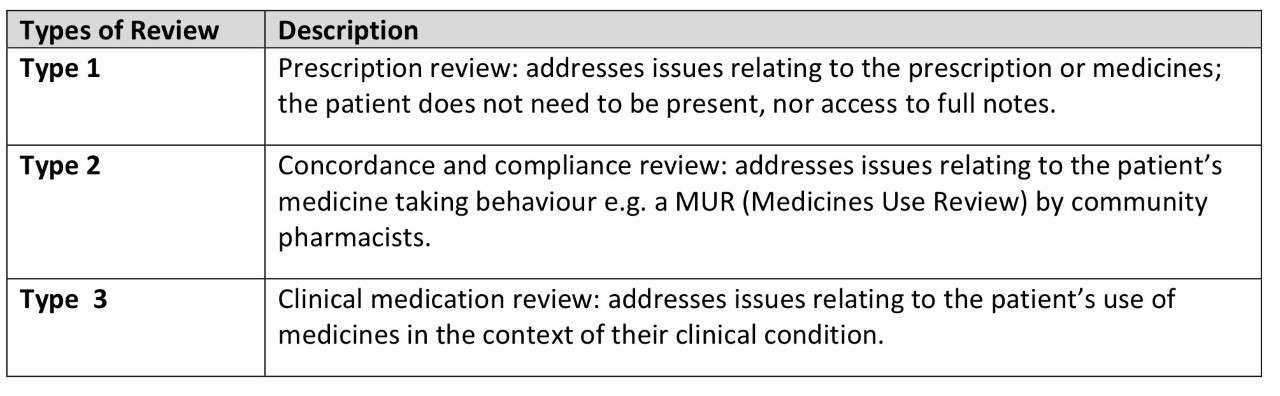
Alongside there also being different levels of reviews, there are different types of review. Describe the 3 types of review

-
Remote Consulting9
-
Acute Emergencies & Pre-hospital Care61
-
Safeguarding26
-
MSK47
-
Paediatrics96
-
Minor Illness36
-
Health Promotion54
-
Men's & Women's Health76
-
Dermatology123
-
ENT79
-
Contraception & Sexual Health93
-
Mental Health81
-
Diabetes61
-
Hypertension, CKD & Hyperlipidaemia76
-
Asthma & COPD76
-
IHD & Heart Failure54
-
Palliative Care25
-
Medicines Optimisation16
-
ENT 261
-
STIs42
-
Scoring Systems & Emergency Drugs52



